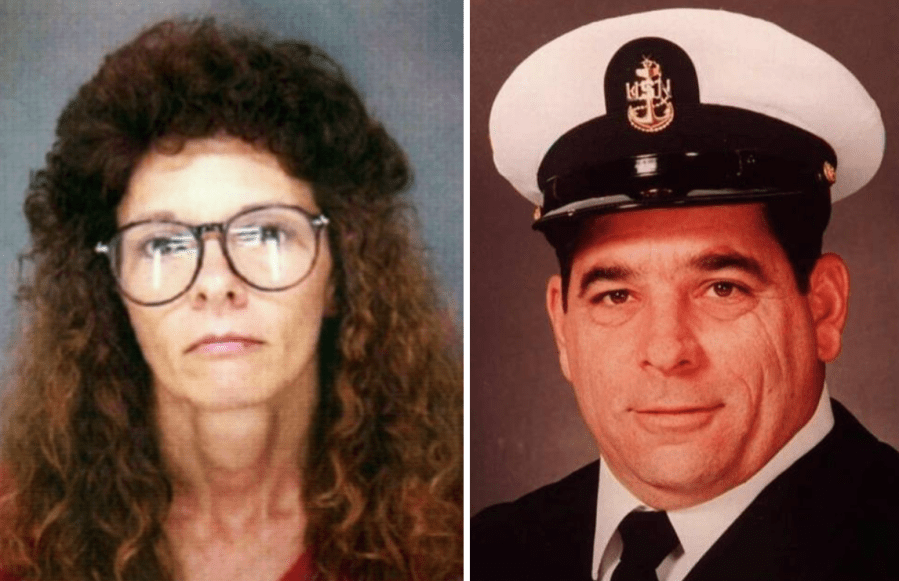
“Over the objections of the victim’s daughters and prosecutors, a two-member panel of the Board of Parole Hearings granted parole to Susan Lee Russo, who masterminded the murder-for-hire of her husband in the 1990s…Russo, 62, was originally sentenced to life in prison without the possibility of parole in the death of David Russo, a senior chief petty officer at Lemoore Naval Air Station…Last year, the sentence was commuted to 25 years to life in prison by Gov. Jerry Brown, making her eligible for parole…Russo was convicted on Jan. 30, 1996, of first-degree murder and conspiracy. The Lemoore Naval Air Station serviceman, 43, was shot in the back of the head on July 14, 1994, while asleep in his Riverdale home. Two of the Russo children were asleep in another room.”
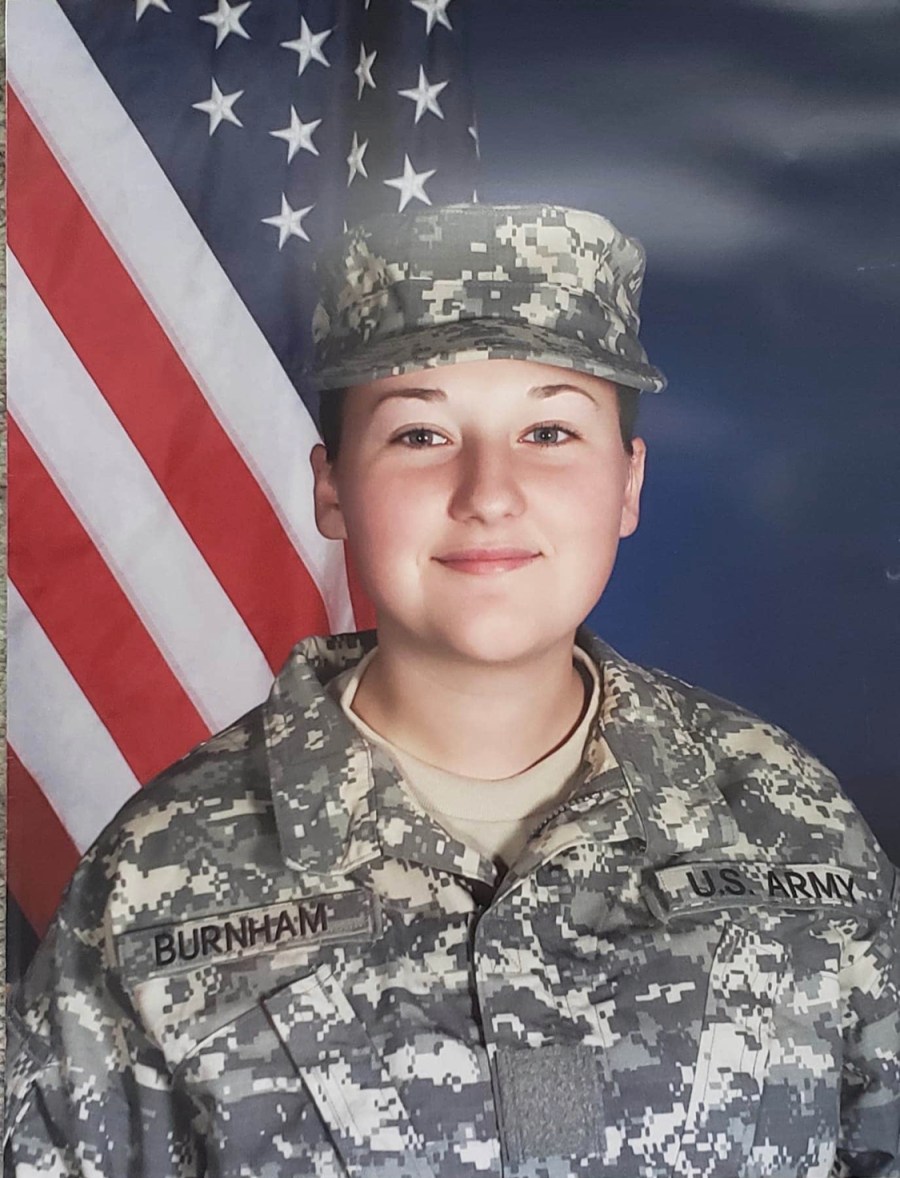
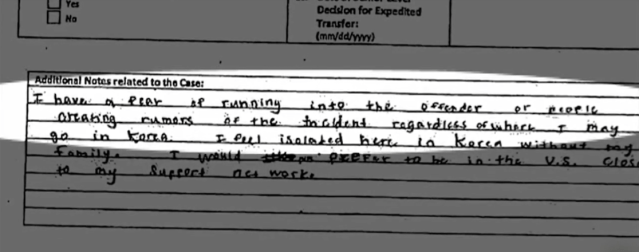
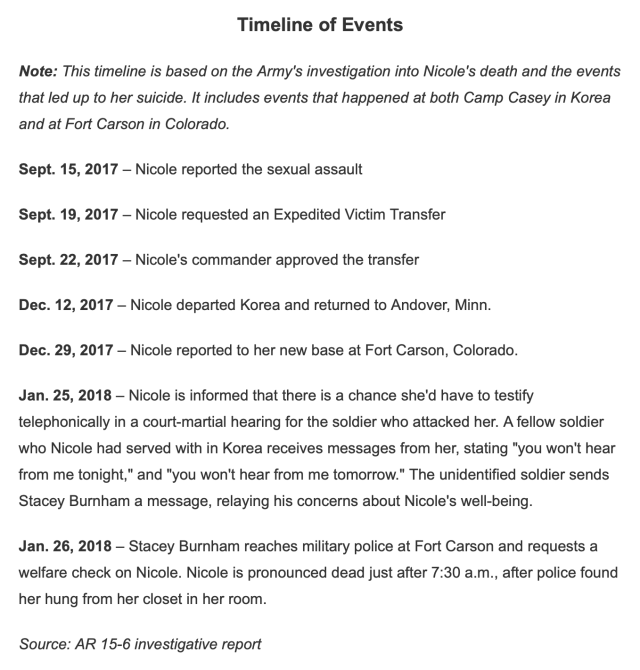
Army Pvt. Nicole Burnham reported a sexual assault at Camp Casey in Korea on September 15, 2017. Four days later, she requested an expedited victim’s transfer (EVT) asking for reassignment back to the United States. Nicole’s Commander approved the request a few days later but it would be 82 days before the transfer occurred. In the meantime, Nicole Burnham shared the same barracks with her attacker. And there was no evidence to suggest the Army even addressed the fact that Nicole shared the same barracks as her attacker until an incident occurred three weeks later when he allegedly jumped out in front of her in an attempt to scare her. It was at this time, the Commander separated the two and put them in different barracks. In the weeks that followed, Nicole suffered verbal harassment and cyberbullying from within the ranks. She received comments from soldiers and their wives over social media calling her a “slut” and “deserving of rape.” Investigators claimed Nicole did not report the harassment to the Chain of Command but in a sworn statement a fellow soldier said most of the leadership was aware of the harassment yet turned a blind eye.
Nicole Burnham Justification for Expedited Transfer (photo: KSTP-TV)
In October 2017, a tearful Nicole told her supervisor she couldn’t “take it” anymore and the supervisor believed she was eluding to suicidal ideation. She was referred to the Officer in Charge (OIC) who then handed her off to the Chaplain for counseling. But according to the A.R. 15-6 investigation, it doesn’t appear leadership in the Chain of Command was aware of what the supervisor believed was suicidal ideation. Nicole reported a sexual assault on September 15, 2017 and experienced three months of retaliation before Army leadership finally transferred her on December 12, 2017. In addition, KSTP reports Army leadership at Camp Casey failed to inform Fort Carson that Nicole was a victim of sexual assault (and harassment, bullying, & cyberbullying). Nicole should have been offered mental health care and compassion. Don Christiansen of Protect Our Defenders said in a statement that the Chain of Command was without a doubt responsible for the failures in Nicole’s case that ultimately lead to her ending her life. Nicole’s death triggered two investigations, one into the allegation of sexual assault that allegedly included Nicole being attacked by multiple men at Camp Casey and the other into the cyberbullying. Of course, the Army declined to comment until the investigation was completed. According to the family, Nicole’s main attacker was courtmartialed and agreed to a plea deal that forced him to leave the Army with a less than honorable discharge. The outcome of the cyberbullying investigation of military personnel and military spouses is unknown.
“It’s inconceivable that they let her languish in Korea. After all these failures, we had this tragic ending to her life.” -Don Christiansen, Protect Our Defenders (January 13, 2020)
Editor’s Note: The military wives who lived on a federal base overseas do not fall under the jurisdiction of the military Chain of Command. Civilians living on base fall under the federal jurisdiction of the FBI who at this point are reluctant to investigate anything but murder. The federal government uses a crisis oriented approach with military personnel and crimes on military bases as opposed to a homicide prevention approach. And in the case of reservations, there has been no justice for missing and murdered Native Americans.
AR 15-6 Timeline of Events for Nicole Burnham (Source: KSTP-TV)
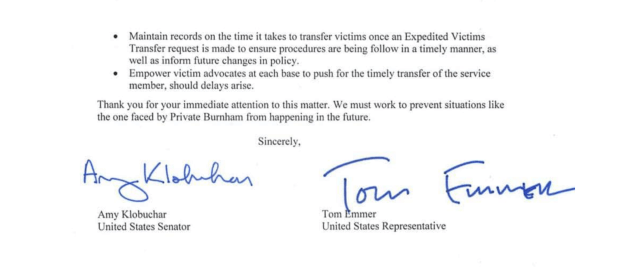
As a result of Nicole’s tragic and untimely death and the KSTP-TV investigation, Senator Amy Klobuchar and Representative Tom Emmer of Minnesota pushed the Army to take action and make changes to the expedited victims transfer policy. The pair asked the Army to track the time it takes to transfer victims of sex assault to another military base, citing the ‘unfortunate delays’ in the transfer of Pvt. Nicole Burnham. In response, the Secretary of the Army directed staff to update policies regarding the treatment of victims of sexual assault who request an off-base transfer. He asked that the Army update policies to mirror the timelines in the Department of Defense (DoD) policy. According to Secretary of Defense Mark Esper, DoD policy states an EVT should occur within 30 days and Esper said the Army’s policies will now reflect that timeline. Nicole’s mother, Stacey Burnham, said 30 days is too long. She also said, “I cannot imagine being a victim, having your EVT approved but knowing you may still be there for another 30 days.” Stacey Burnham has called for more significant changes in the wake of her daughter’s death suggesting the timeline should be condensed even further. She runs a public Facebook page called Pooters Peeps in honor of her daughter.
Letter from Amy Klobuchar & Tom Emmer to the Secretary of the Army (photo: KSTP-TV)
Sources: KSTP-TV, Senator Amy Klobuchar, and Stacey Burnham
In the News:
A 21-year-old Fort Carson soldier who died after being found unresponsive on post last Friday was honored with a dignified transfer. -KOAA 5 (February 2, 2018)
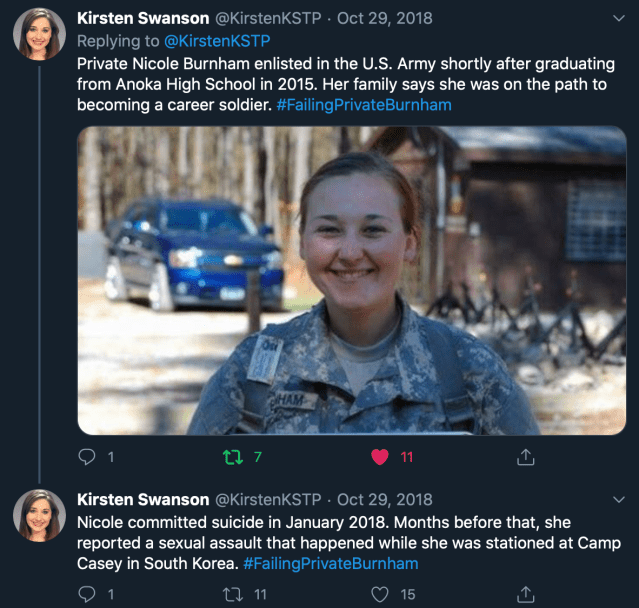
Retweet on Twitter in honor of Pvt. Nicole Burnham.
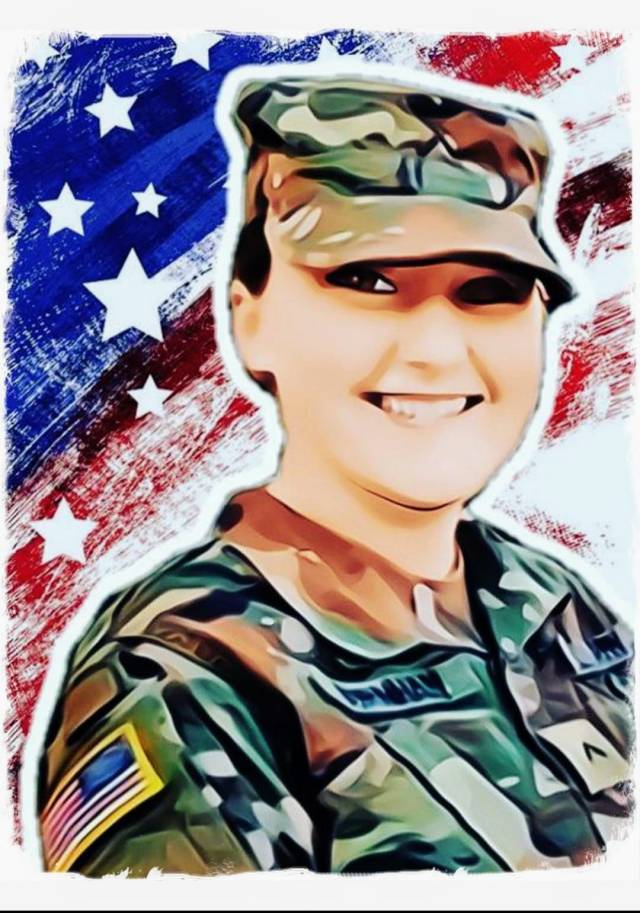
Photos of Nicole Burnham:
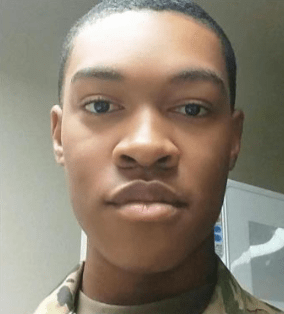
Nicole Burnham (photo: Pooters Peeps)Pvt. Nicole Burnham, U.S. Army (Image: Alex Wentz)
A woman’s body is found in a tent bag in the Kentucky woods. A thousand miles away, a family searches for a missing mother of three. Both cases go unsolved for decades, until a man’s obsession and a family’s determination converge, uncovering the truth. -Who Killed Jane Doe?, Investigation Discovery
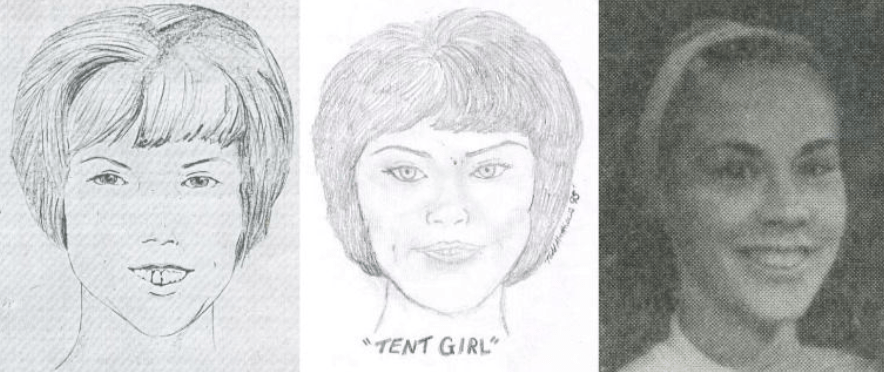
Who Killed Jane Doe? featured the story of ‘The Tent Girl’ on Investigation Discovery in January 2018. On May 17, 1968, a man walking in the woods in Georgetown, Kentucky discovered a body wrapped in a tent. He reported the finding to authorities who determined that the body was that of a female she didn’t have a nam. This Jane Doe was dubbed ‘The Tent Girl’ in the media because the authorities attempted to find out who she was. She had been murdered and they wanted to find her family. The Tent Girl was buried in a local cemetery in an attempt to honor this girl who didn’t have a name. ‘Who Killed Jane Doe?’ began the episode by explaining that in the early sixties, Barbara Ann ‘Bobbie’ Hackmann of Lexington, Kentucky met George ‘Earl’ Taylor when she was a teenager. He was a single father from Florida who claimed his wife left him to be with another man and he needed a babysitter. Bobbie babysat Earl’s daughter Bonnie while he worked for the Carnival.
Although Earl Taylor was five years older than Bobbie Hackmann, the pair fell in love and decided to get married. Because Earl worked for the Carnival, they moved constantly but in 1964 they settled for an apartment in Miami, Florida. Bobbie and Earl had children of their own and Bobbie’s sister moved to Florida to be closer to her. Then one day, Bobbie told her sister she needed to leave town quickly and asked her for some money. Bobbie told her sister the FBI (Federal Bureau of Investigation) was in town and they were looking for Earl because he went Absent without Leave (AWOL) from the military; Earl did not want to go back in. She told her sister they were moving to Texas. Nobody ever heard from Bobbie Taylor again. When Bobbie’s sister finally caught up with Earl, Bobbie wasn’t with him and he told her that she ran off with another man. Once again Earl’s significant other left their children and ran off with another man. Earl would not tell Bobbie’s sister where Bobbie’s kids were. Bobbie’s family filed an official missing person’s report.
Todd Matthews and Bobbie’s family were both obsessed with finding the same person but they didn’t know it. Todd was looking for the identity of a Jane Doe dubbed ‘The Tent Girl’ and Bobbie’s family was obsessed with finding their missing family member Bobbie Taylor. With the invent of the internet, it helped both Bobbie’s family and Todd Matthews get in touch with one another to compare notes. Todd e-mailed Bobbie’s family to tell them about ‘The Tent Girl’ because he believed the Jane Doe in Kentucky was the missing girl Bobbie Hackmann Taylor. Bobbie’s family contacted the police in Kentucky to find out if their Jane Doe was Bobbie. The authorities found enough similarities between the composite drawing and the real photos that they exhumed The Tent Girl’s remains. After DNA testing, The Tent Girl was indeed a match to Barbara Hackmann. The family finally found their missing Bobbie. Bobbie’s children were relieved to know their mother didn’t walk away from them but devastated that she was found and had been murdered.
Earl’s daughter Bonnie described a night on December 6, 1967 where she was awakened by a struggle in Bobbie and Earl’s bedroom. But, she didn’t want to get in trouble so she fell back asleep. When seven year old Bonnie woke up in the morning, Bobbie was gone. The family suspects that Earl murdered Bobbie and then disposed of her body in the woods. He most likely used tents from the Carnivals he worked at to wrap her body. When Bonnie asked Earl where Bobbie was, she never got an answer from him. When Bonnie returned home from school that same day, Earl had packed up the car and informed the children they were moving. When Bonnie asked about Bobbie again, Earl said “she’ll catch up with us later.” Bonnie said this was the last time she saw or heard from Bobbie. When Bobbie was finally identified via DNA in 1998, authorities couldn’t question Earl because he died of cancer 10 years earlier. Bobbie’s family decided to leave Bobbie in the same plot because she had been part of that community for over thirty years. They cared about ‘The Tent Girl’ and the case is still an open investigation.
Editor’s note: With a cable subscription, you can download the free ID Go app and watch all of the Investigation Discovery programming at your convenience. And for those who do not have cable, you can watch “unlocked” episodes on the ID Go app including the latest premieres. Download the ID Go app and binge away. For those who prefer commercial free programming during your binge session, Prime Video has an ID channel: ‘True Crime Files by Investigation Discovery” available for $2.99 a month. It’s a compilation of older seasons but totally worth the cost if you are a true crime addict.
The Tent Girl
Tent Girl | 18 News
The Eerie Case Of Barbara Ann Hackmann Taylor (Jane Doe Identified After 30 Years) -CreepyNews
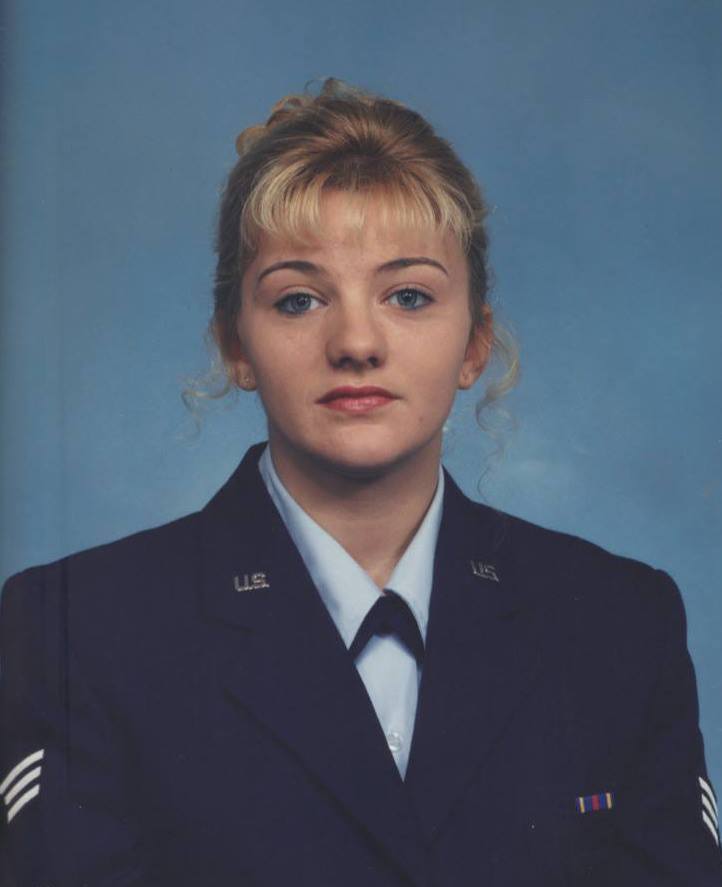
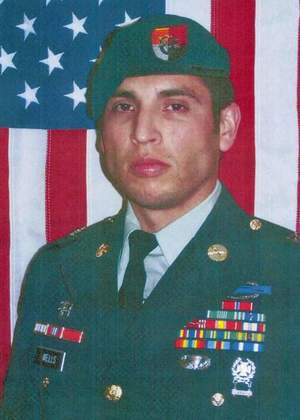
Air Force Staff Sgt. Zachary Townsend was found deceased at his off-base residence near Columbia, South Carolina on January 15, 2018. SSgt. Townsend enlisted in the active duty military on July 15, 2008 and was a crew chief assigned to the 95th Fighter Group (FG). The 495th FG is supported administratively by the 20th Fighter Wing at Shaw Air Force Base in South Carolina. An Air Force press release stated: “While no foul play is suspected, this incident remains under investigation by the Richland County Coroner’s Office.”
We hear a lot about #weinstein and the latest, but Jennifer Norris, who served in the US Air Force, has been talking about sexual assault for years. And in the military, reporting rape means endangering yourself. Watch this brave woman speak here https://t.co/1ipeI3SWP6pic.twitter.com/TAjiVjmdDS
Today U.S. Secretary of Veterans Affairs Dr. David J. Shulkin announced that VA has begun publicly posting information on opioids dispensed from VA pharmacies, along with VA’s strategies to prescribe these pain medications appropriately and safely.
With this announcement, VA becomes the only health-care system in the country to post information on its opioid-prescribing rates.
The disclosure is part of VA’s promise of transparency to Veterans and the American people, and builds on VA’s strong record of transparency disclosures — including on wait times, accountability actions, employee settlements and the Secretary’s travel — under the leadership of President Donald J. Trump over the past year.
“Many Veterans enrolled in the VA health-care system suffer from high rates of chronic pain and the prescribing of opioids may be necessary medically,” Secretary Shulkin said. “And while VA offers other pain-management options to reduce the need for opioids, it is important that we are transparent on how we prescribe opioids, so Veterans and the public can see what we are doing in our facilities and the progress we have made over time.”
Counselor to the president Kellyanne Conway said, “Declaring the opioid crisis a nationwide public health emergency was a call to action by the president. His administration is exploring all tools and authorities within their agencies to address this complex challenge costing lives. Veterans Affairs Secretary Dr. Shulkin is heeding that call; the VA is now the first hospital system in the country to post information on its opioid prescribing rates. This is an innovative way to raise awareness, increase transparency and mitigate the dangers of over-prescribing.”
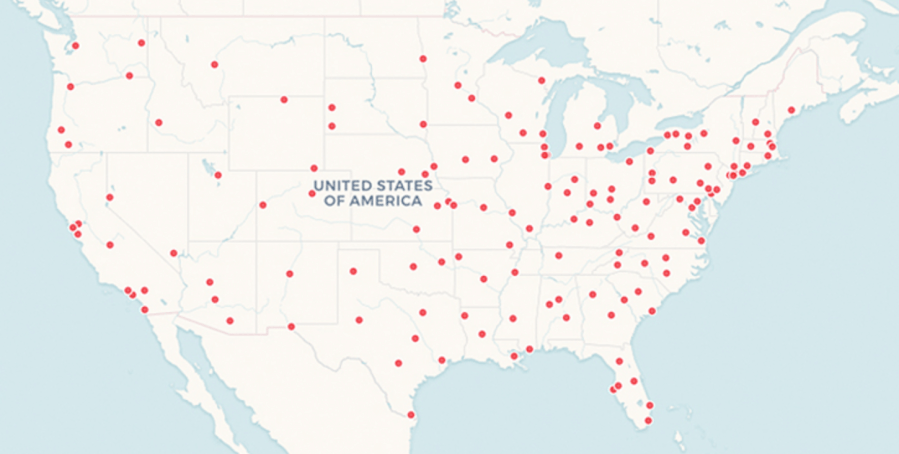
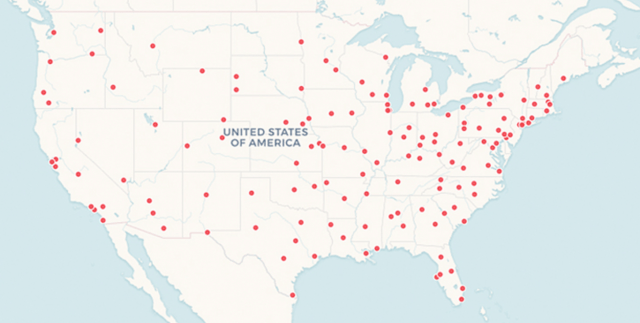
The interactive map shows data over a five-year period (2012-2017) and does not include Veterans’ personal information. The posted information shows opioid-dispensing rates for each facility and how much those rates have changed over time.
It is important to note that because the needs and conditions of Veterans may be different at each facility, rates may also be different for that reason, and cannot be compared directly.
The prescribing rate information will be updated semi-annually, on January 15 and July 15 of each year.
As a learning health system using the current best evidence to learn and improve, VA continually develops and refines best practices for the care of Veterans. Releasing this data will facilitate the sharing of best practices in pain management and opioid prescribing among doctors and medical center directors.
Highlights from the data include:
A 41-percent drop in opioid-prescribing rates across VA between 2012 and 2017
Ninety-nine percent of facilities decreased their prescribing rates.
San Juan, Puerto Rico, and Cleveland, Ohio, top the list of medical centers with the lowest prescribing rates, at 3 percent.
El Paso, Texas, and Fayetteville, North Carolina, are most improved, and decreased prescribing rates by more than 60 percent since 2012. El Paso’s prescribing rate decreased by 66 percent, and Fayetteville’s decreased by 65 percent.
VA currently uses a multifaceted approach to reduce the need for the use of opioids among Veterans. Since 2012, the Opioid Safety Initiative has focused on the safe use and slow and steady decrease in VA opioid dispensing. VA also uses other therapies, including physical therapy and complementary and integrative health alternatives, such as meditation, yoga and cognitive-behavioral therapy.
Information about the VA Opioid Safety Initiative may be found here. A link to the interactive map on VA’s opioid use across the nation may be found here.
“48 Hours” goes behind the scenes with a defense team and cutting edge forensic animators as they strategize to defend a woman accused of murder. CBS News correspondent Tracy Smith investigates in a special two-hour edition of “48 Hours” airing Saturday, Dec. 23 starting at 9 p.m. ET/PT on CBS.
















 MILITARY JUSTICE FOR ALL