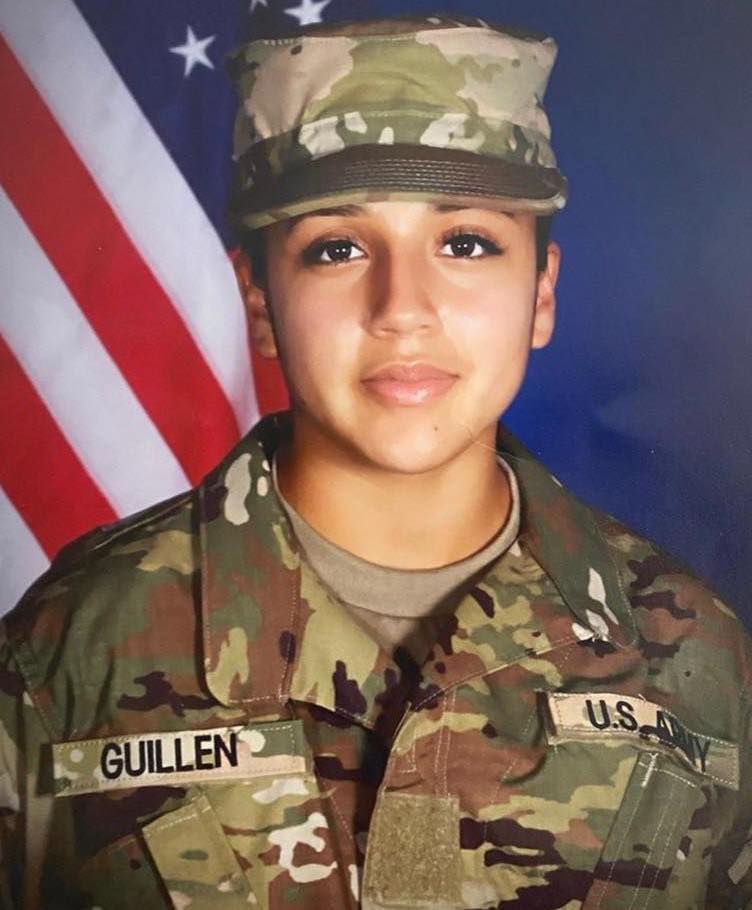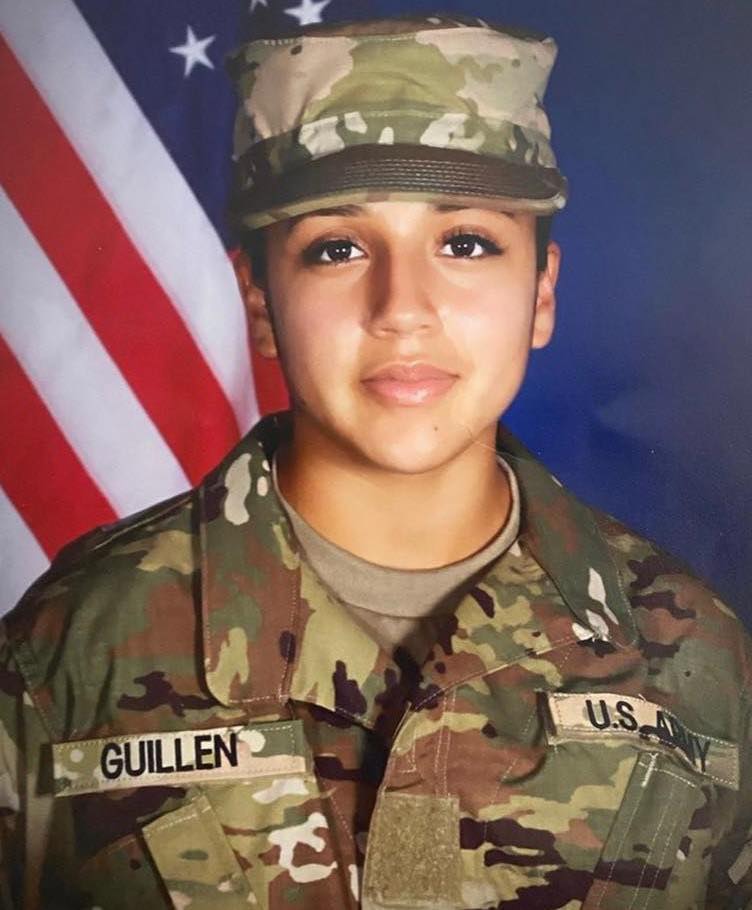
Speier, Mullin Introduce Bipartisan ‘I Am Vanessa Guillén Act’ to Transform the Military’s Response to Sexual Violence & Missing Servicemembers (September 16, 2020)

PLEASE CONTACT YOUR REPRESENTATIVE, SENATORS, AND THE SENATE ARMED SERVICES COMMITTEE & HOUSE ARMED SERVICE COMMITTEE TO EXPRESS YOUR SUPPORT FOR THE I AM VANESSA GUILLEN BILL.

Army Soldiers at Fort Hood in Texas Are Dying at Alarming Rates Stateside (January 1, 2016 to Present)

Washington D.C. Veteran’s Presentation on the Current Status of Forces at Fort Hood in Texas (December 12, 2017)

HASC Congressional Investigation of Fort Hood: Research Reveals Pattern of Suspicious Deaths and Cover-up (September 11, 2020)

***********************************************************

Speier, Mullin Introduce Bipartisan I Am Vanessa Guillén Act to Transform the Military’s Response to Sexual Violence and Missing Servicemembers

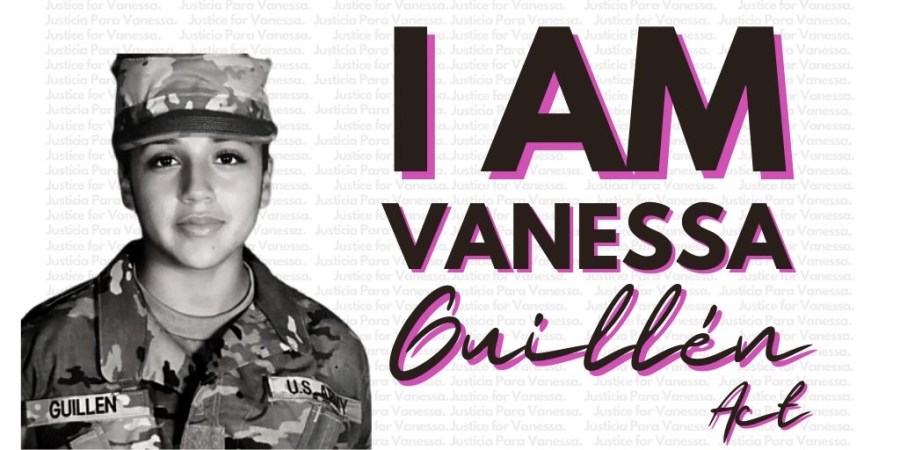
Washington, DC – Today, Congresswoman Jackie Speier (D-CA), Chair of the House Armed Services Military Personnel Subcommittee, and Congressman Markwayne Mullin (R-OK), along with co-leads Reps. Sylvia Garcia (D-TX), John Carter (R-TX), Veronica Escobar (D-TX), Pete Olson (R-TX), Gilbert R. Cisneros, Jr. (D-TX), Troy Balderson (R-OH), Jason Crow (D-CO), and Will Hurd (R-TX), and 94 additional co-sponsors, introduced the I am Vanessa Guillén Act in honor of the late SPC Vanessa Guillén and the many survivors of military sexual violence who have bravely come forward in the wake of her disappearance and brutal murder. The legislation responds to these resounding calls for change by offering provisions that would revolutionize the military’s response to missing servicemembers and reports of sexual harassment and sexual assault by making sexual harassment a crime within the Uniform Code of Military Justice and moving prosecution decisions of sexual assault and sexual harassment cases out of the chain of command. Senator Mazie K. Hirono (D-HI) introduced companion legislation in the U.S. Senate today. This morning, following a meeting with the Guillén family, Speaker Nancy Pelosi announced a commitment to hold a House floor vote on the I am Vanessa Guillén Act. President Trump previously announced his support for the bill during a White House meeting with the Guillén family.

SPC Guillén’s disappearance and brutal murder became the catalyst for long overdue change when her family refused to let her case be neglected by Army leadership at Fort Hood. The Guillén family supports the I Am Vanessa Guillen Act, and Chair Speier is also leading a congressional delegation this weekend to Fort Hood to further investigate matters at the base and speak with servicemembers at all levels about their experiences and how best to accelerate the cultural change that is so urgently needed.

Specifically, the I Am Vanessa Guillén Act would:

-Move prosecution decisions on sexual assault and sexual harassment cases outside of the chain of command to an Office of the Chief Prosecutor within each military service;

-Create a standalone military offense for sexual harassment;

-Establish trained sexual harassment investigators who are outside of the chain of command of the complainant and the accused;

-Create a confidential reporting process for sexual harassment that is integrated with DoD’s Catch a Serial Offender database;

-Require the Government Accountability Office (GAO) to investigate the military’s procedures for finding missing servicemembers and compare with procedures used by civilian law enforcement and best practices;

-Require both DoD and GAO to conduct separate evaluations of the military services’ Sexual Harassment/Assault Response and Prevention (SHARP) programs; and

-Establish a process by which servicemembers can make claims for negligence and seek compensatory damages against DoD in the case of sexual assault or sexual harassment.

“Military leadership has repeatedly failed to reduce sexual harassment, sexual assault, and violent crime at Fort Hood, one of the worst sites for attacks according to Army officials, and throughout the armed forces,” Chair Speier said. “The endless cycle of harassment, assault, and retaliation for those who speak out reveals the deep roots of a toxic culture we must eradicate so that survivors are taken seriously and treated with respect, and assailants are held accountable. The I Am Vanessa Guillén Act would do this by providing survivors independent investigations for both sexual harassment and sexual assault reports and independent charging decisions for courts-martial. It would also make sexual harassment a criminal offense in the military, helping get to the core of an issue that too often leads to violence and destroys careers, and lives. The Guillén family and legions of former and current servicemembers are demanding bold change. Congress must seize this moment and deliver on that demand for change by passing the I Am Vanessa Guillén Act.”

“The issue of sexual assault and sexual harassment in the military isn’t a Democrat or Republican issue – it’s an American issue,” Congressman Mullin said. “We must strengthen the military’s ability to protect its most important resource, which is the people who willingly sign-up to protect all Americans. The I Am Vanessa Guillén Act will also encourage survivors to come forward to report sexual assaults and sexual harassment and to provide justice. This is about protecting our men and women in uniform and I will keep fighting so no family has to go through what the Guillén family has gone through.”

“From the moment I started working with the Guillén family in May, I made it clear I would not stop until we found Vanessa and got justice in her name,” Congresswoman Garcia said. “The I Am Vanessa Guillén Act of 2020 is a transformative and comprehensive bill that will help save lives and give our soldiers an avenue to report sexual assault and harassment without fear – a lasting legacy in honor of Vanessa. I want the Guillén family to know that Congress, the Houston region, and the entire world stands with you and we won’t stop until we get justice for Vanessa.”

“First and foremost, my heart goes out to the Guillén family, no one should ever have to experience the pain they’ve experienced,” Congressman Carter said. “The men and women that selflessly serve our nation deserve to feel safe to report misconduct and feel confident that their issues will be fairly handled. There is absolutely no place for sexual misconduct in the United States military and we must take these steps to ensure that accountability is realized.”

“The unspeakable tragedy of Specialist Vanessa Guillén’s murder has shed new light and revealed to the American public the epidemic of unchecked sexual harassment and assault that too many service members have suffered,” Congresswoman Escobar said. “Specialist Guillén – and all servicemembers – deserve respect and justice, and it’s our obligation to protect those who bravely put their lives on the line for our country. We can’t continue the same approaches that have failed victims. Congress must respond to this moment of reckoning with new solutions to tackle this epidemic and pass the I Am Vanessa Guillén Act.”

“The tragedy that befell PFC Vanessa Guillén was horrific and reflects a growing problem in our Armed Forces. Our military members should never fear harassment or violence while defending our nation,” Congressman Olson said. “As a Navy veteran, I’m proud to support the I am Vanessa Guillen Act, which is an important step towards getting justice for PFC Guillén and other service members like her. It ensures there is a stand-alone military offense for sexual harassment and requires the GAO to review how our military processes missing service members in cases of suspected foul play compared to civilian law enforcement. By working together and demanding accountability, we can prevent the next tragedy. Our military must maintain higher standards and we will not be silent on this issue.”

“Year after year, we see an increase in reports of sexual assault and sexual harassment in our military and the same statements from military leadership about how unacceptable they are. It’s far past time we take bold action to bring accountability to the system and give survivors support,” Congressman Cisneros said. “In the memory of Specialist Vanessa Guillén, Republicans and Democrats are coming together to make legislative fixes to protect our men and women in uniform. I’m proud to join my colleagues in introducing the bipartisan I am Vanessa Guillén Act to provide the necessary support and resources for survivors of sexual assault and sexual harassment in our military. Our servicemembers and military families deserve to have the peace of mind that they’ll be heard and treated with dignity and respect.”

“Ohio is home to thousands of active duty servicemembers who risk their lives for our nation, and in return, it’s our country’s obligation to ensure their safety,” Congressman Balderson said. “In honor of Vanessa Guillén, this legislation will take important steps to ensure survivors of sexual assault and sexual harassment in our military can tell their stories without retribution and seek the justice they deserve.”

“As a soldier, I remember going to basic training to learn everything from marksmanship to the chain of command. The military is supposed to train new recruits on the essential tasks of the job, but we still don’t do nearly enough to address sexual assault in the ranks. We need to make sure we are creating a system and culture of accountability in the military to protect our women and men in uniform. For too long, sexual assault and violence has gone unaddressed,” Congressman Crow said. “The military failed Vanessa Guillén but I refuse to let Congress fail her or her family. It is Congress that decides what kind of military we have and now it is Congress’ responsibility to step up and pass the I AM Vanessa Guillén to protect our women and men in uniform.”

“We must work to ensure what happened to Vanessa Guillén never happens again,” Congressman Hurd said.“The I Am Vanessa Guillén Act of 2020 will protect soldiers like Vanessa by ensuring independent investigations occur in assault and harassment cases. This will better safeguard our soldiers from retaliation and help prevent these atrocious acts from ever happening in the first place.”

“Vanessa Guillén’s story makes painfully clear the need for a better response to sexual harassment and sexual assault in the military,” Senator Hirono said. The I Am Vanessa Guillén Act knocks down barriers to reporting sexual harassment and sexual assault and directly addresses the culture that protects the perpetrators of these crimes. It’s time to make a system that respects and protects survivors.”

The I Am Vanessa Guillén Act will fundamentally reform reporting and investigation of sexual harassment in the military and transform prosecution of sexual harassment and assault by empowering an independent prosecutor, within each military service, to bring charges. The bill will also allow servicemembers who were sexually harassed or sexually assaulted to pursue monetary claims against DoD and will also require a comprehensive GAO review of the military’s sexual harassment and assault prevention and response programs, as well as the military’s procedures for responding to missing servicemembers.

A fact sheet and the text of the bill are attached to this press release.

Introduction of I Am Vanessa Guillen Act:

This is a hearing by the Subcommittee on Military Personnel, looking into sexual harassment allegations and how they’re responded to. It’s also looking into Fort Hood’s sexual assault and response program. This hearing is taking place a day before Vanessa Guillen’s family meets with President Trump and legislation is introduced. -KHOU 11 (July 29, 2020)
Rep. Speier, family of murdered soldier Vanessa Guillen on legislation in her honor -PBS News Hour (September 16, 2020)

Related Files:
Fact Sheet – I am Vanessa Guillen Act Press Fact Sheet.pdf 
2020-09-15 I Am Vanessa Guillen Bill Text.pdf

In the News:

“The IamVanessaGuillen Bill is a BiPartisan Bill. It is NOT a political issue, it’s a human rights issue,” Guillen family attorney Natalie Khawam wrote. -KCEN News (September 16, 2020)
Speaker Pelosi to reportedly bring ‘I am Vanessa Guillen’ Act to U.S. House floor for vote -25 News KXXV (September 16, 2020)
Vanessa Guillén’s family members speak during a news conference about the “I Am Vanessa Guillén Act,” in honor of the late U.S. Army Specialist and survivors of military sexual violence. -KXAN (September 16, 2020)
The ‘I am Vanessa Guillen’ bill was presented to Congress Wednesday, but what does it mean for the future of military service members facing sexual harassment. -KHOU 11 (September 16, 2020)

Related Links:
Hearing: “The Military’s #MeToo Moment”
Rep. Speier, family of murdered soldier Vanessa Guillen on legislation in her honor
Lawmakers introduce the I Am Vanessa Guillen Act
Watch Live | #IAmVanessaGuillen Bill introduced in D.C.
Bill honoring Vanessa Guillen introduced in Washington D.C. Wednesday
Speaker Pelosi to reportedly bring ‘I am Vanessa Guillen’ Act to U.S. House floor for vote
Vanessa Guillén’s family members speak about the “I Am Vanessa Guillén Act”
What is the ‘I am Vanessa Guillen’ bill?

Stars and Stripes: Why is Fort Hood the Army’s Most Crime-Ridden Post? (August 21, 2020)

#IAmVanessaGuillen

by Rose Thayer

Keeping Track

“In the last five years, 165 soldiers assigned to Fort Hood have died, according to the Fort Hood Public Affairs Office, which regularly released information on soldiers’ death until a 2018 decision to stop the practice. The post was an outlier in this level of transparency.

In those years, seven soldiers died by homicide, while six died in a combat zone. The deaths of 70 soldiers were ruled suicides, and on- and off-base accidents resulted in the deaths of 60 soldiers.”

(Army Soldiers at Fort Hood in Texas Are Dying at Alarming Rates Stateside (January 1, 2016 to Present) *we missed close to 25 deaths because Fort Hood stopped issuing press releases for the death of soldiers in early 2018)

Asking for a Solution

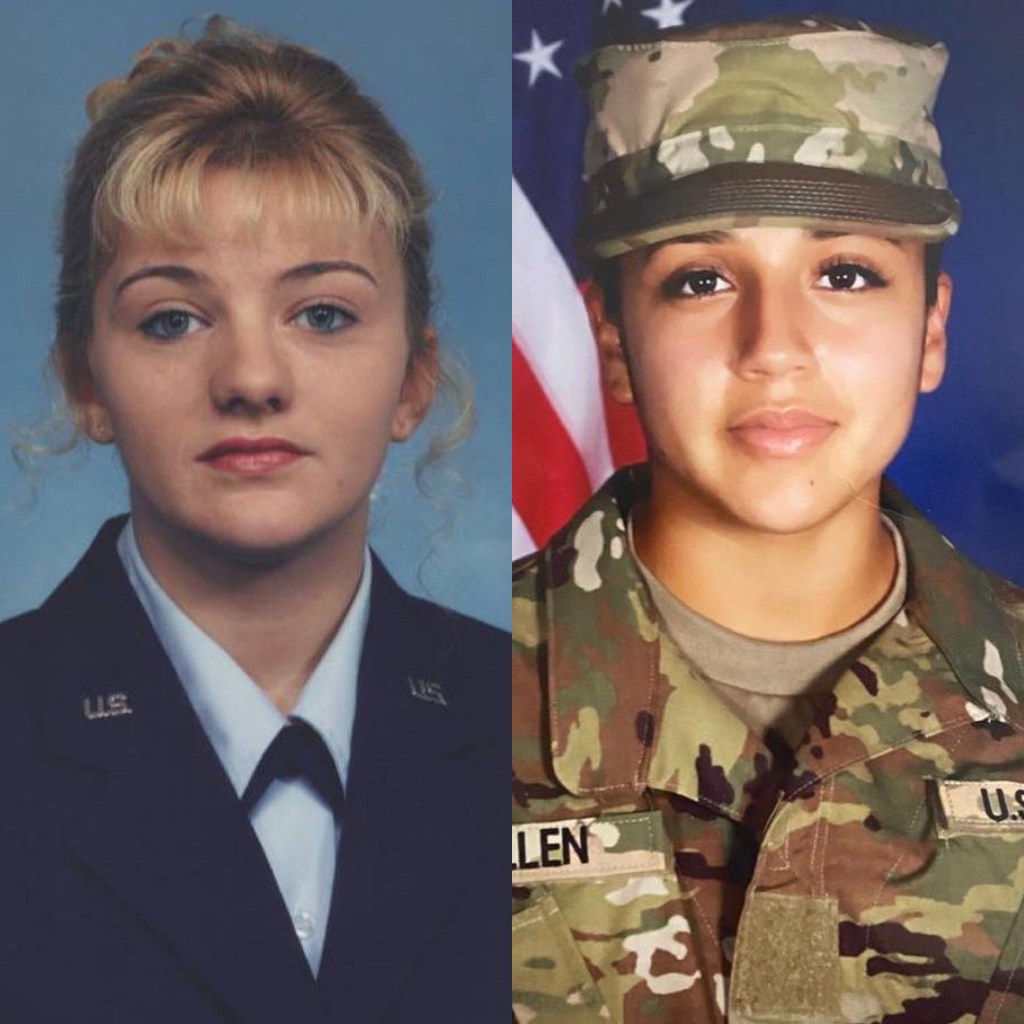
Air Force veteran Jennifer Norris believes Fort Hood’s current situation has been years in the making.

For the past decade, Norris, a trained social worker with a master’s degree in public policy, has been tracking crimes committed by and against service members and advocating for reform. She posts her research on her website, Military Justice for All.

She first focused her research on several large military bases, but after noticing a trend of Fort Hood deaths, Norris narrowed her efforts to the Texas post.

‘I didn’t set up to go after Fort Hood at all. It’s a compilation of systematic issues,’ she said.

At the end of 2017, Norris used her own money to travel from her home in Maine to Washington to meet with lawmakers. By the time she got home, Norris said she thought everyone had moved on without intending to address the problems.

‘The other bases are nothing like Fort Hood is right now,’ she said. ‘I think the anomaly with Fort Hood is that its isolated and that it’s such an economic powerhouse in the community that it’s in everybody’s best interest to protect it so they can protect themselves.’”

(Washington D.C. Veteran’s Presentation on the Current Status of the Armed Forces at Fort Hood in Texas (December 12, 2017))

Read more here: Why is Fort Hood the Army’s most crime-ridden post?

Related Links:
Fort Hood Army Staff Sgt. Paul Norris Fatally Shot Spc. Kamisha Block in Murder-Suicide in Iraq; Family Calls for Congressional Hearings & Independent Investigations (August 16, 2007)
Air Force TSgt. Jennifer Norris Testified Before the House Armed Services Committee in Washington DC (January 23, 2013)
Gillibrand: The Military Justice Improvement Act Would Give Service Members a Justice System That Works (July 1, 2019)
Rep. Seth Moulton Introduces The Brandon Act to Change DoD Mental Health Policy, Pay Tribute to Fallen Navy Sailor Brandon Caserta (June 25, 2020)
Open Letter to House of Representatives in Support of an Independent Investigation of the Murder of Vanessa Guillen at Fort Hood (July 7, 2020)
Austin American-Statesman: Vanessa Guillen’s Death Shines Light on More Tragedies at Fort Hood (July 28, 2020)

Open Letter to House of Representatives in Support of an Independent Investigation of the Murder of Vanessa Guillen at Fort Hood (July 7, 2020)

Vanessa Guillen
http://www.findvanessaguillen.com

Army Soldiers at Fort Hood in Texas Are Dying at Alarming Rates Stateside (January 1, 2016 to Present): https://wp.me/p3XTUi-5oF

Dear Rep. Jared Golden,

I write to you as a victim of crime in the military and as a military crime historian. I have researched the US military’s crime problems for the last 10 years and have documented as much as humanly possible on my Military Justice for All website. I have over 1000 cases of suspicious deaths, homicide and missing cases. Fort Hood has been problematic for years. I visited both Senator Collins and Senator King in DC to warn them about the problems at Fort Hood in December 2017 and to ask them for their help. It fell on deaf ears. Much like Vanessa Guillen, I too was afraid to report sexual harassment and sexual assault for fear of retaliation. I didn’t report until my supervisor in the Chain of Command attempted to force himself on me. Prior to this incident, I experienced daily sexual harassment and he would give me assignments that isolated me so he could do it with no witnesses.

Rep. Sylvia Garcia is asking that the DoD IG do an investigation of the circumstances that led up to the murder of Vanessa Guillen at Fort Hood. I am asking you to support her and all of our service members by adding your name to the list of representatives who support these efforts. Fort Hood leadership has failed time and time again and it’s due time that someone take a look at this problematic base. It’s a sad day when we lose 133 servicemembers stateside to violent crime, suicide, and training accidents compared to 2 combat deaths and 4 insider attacks overseas since 2016.

I also ask that you support legislation such as the Military Justice Improvement Act to give our service members a chance to report unsafe situations to an independent authority outside the Chain of Command. As long as service members are fearful of retaliation (which is very real and the reason I have compounded PTSD), we will continue to see high rates of PTSD, murder and suicide on military bases. According to authorities, Vanessa Guillen was murdered because she was planning on reporting someone she worked with for adultery, and this same individual may also have been sexually harassing her. It is unclear at this time who sexually harassed her but she told her family she was scared and feared reporting the sexual harassment to the Chain of Command because it wasn’t taken seriously and she feared retaliation.

Over the years, I have realized that most don’t realize what it’s like to be enlisted and this still rings true. Imagine how powerless we feel as lower enlisted when someone higher ranking than us can literally get away with crime because they are part of the reporting mechanism or they simply don’t care. While Congress sits on their hands, veterans are flocking to the VA to file PTSD claims and military families are grieving the loss of their loved ones whether it be by murder or suicide. I understand why someone might take their own life when they feel trapped and have no way out.

Please do the right thing and support Rep. Garcia, Rep. Speier and Senator Gillibrand.

Sincerely,

Air Force Veteran

Rep Sylvia Garcia
Find your Representative here.

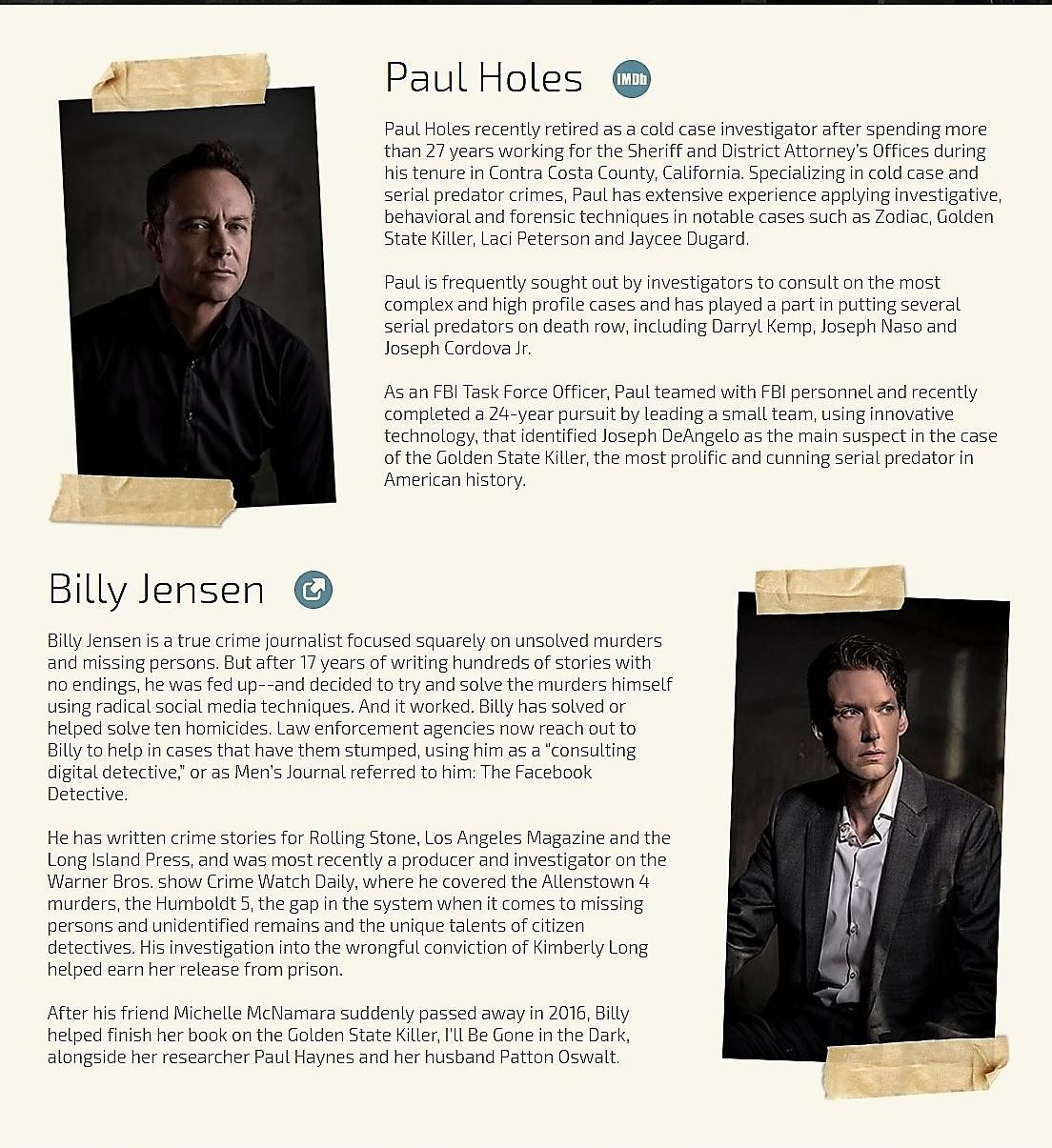
The Murder Squad Podcast: The Murder of Vanessa Guillen and the Unsolved Homicides of Fort Hood (July 6, 2020)

The Murder Squad.jpg
The Murder Squad Podcast

“In this episode, Billy and Paul will delve into the eight cases of unsolved homicides and unknown causes of death of soldiers from the base. And with the help of Murder Squad listeners, they take a closer look at how the US Army investigates sexual assault, sexual harassment and missing persons amidst their ranks—including the cases of Vanessa Guillen and LaVena Johnson.”

Listen to Episode 57: The Murder of Vanessa Guillen and the Unsolved Homicides of Fort Hood from The Murder Squad Podcast here.

Petitions:
Reopen the investigation of LaVena Johnson’s death
HOLD THE US ARMY ACCOUNTABLE: Justice for Vanessa Guillen

Related Links:
The Murder of Vanessa Guillen and the Unsolved Homicides of Fort Hood
Army Soldiers at Fort Hood in Texas Are Dying at Alarming Rates Stateside (January 1, 2016 to Present)
Seven Unsolved Homicide Cases Affiliated with Fort Hood (January 1, 2016 to Present)
Army Pfc. LaVena Johnson Died of Non Combat Related Injuries in Iraq; Death Ruled Suicide But Independent Investigation Revealed Rape & Murder (July 19, 2005)
Federal Criminal Complaint for Cecily Ann Aguilar, U.S. District Court, Western District of Texas (July 2, 2020)

Dear Vanessa Guillen… (June 30, 2020)

Vanessa Guillen
I will never forget you Vanessa Guillen. ❤️

Dear Vanessa,

My heart is heavy with the news we heard today and I still hold out hope that it’s not real. I don’t want to give up the hope that you are still out there and we will find you, as a dedicated, motivated team. So many people care about you. And a lot of people stepped forward and said yes, it happened to me too. The silence was finally broken and now we know for a fact that the same military justice system that failed us failed you too. My heart is broken. The writing was on the wall at Fort Hood. Prior to your disappearance, a team of people fought for you and all the other service members praying none of you would go missing or die whether by your own hand or someone else’s, both failures of leadership. The retaliation is real and we’ve been concerned that if we don’t deal with hazing, bullying, sexual assault and domestic violence appropriately then other more violent behavior would follow and it has.

Ten years of research and the creation of a website dedicated to military crime backs Vanessa up and all the other brave veterans who spoke up and shared their stories of heartbreak and betrayal. Although your safety has been of the utmost priority, we witnessed a shift because of you and because of what’s been going on at Fort Hood. I am so thankful you said something to your mother so everyone would know that sexual harassment is at the beginning of the continuum of harm and if not stopped only escalates. It’s like watching your future attacker plot when to make his move and you know it’s coming but there’s no way to escape. And then it’s too late. I’m not sure how I am going to sleep tonight but please know you are in my thoughts and I pray we can continue searching for you tomorrow and that what we learned is not true.

I was disappointed with the media today and how this was handled. I was especially disappointed with the headlines that purposefully made assumptions. I pray that justice will be served, that Fort Hood cleans up its act, and that your experience changes the entire military justice system. If this had been treated like the missing persons case it was, I may not be so angry knowing this is business as usual for the military. They replace us just as quickly as we disappear. The callousness and lack of regard for our fellow human, including murder victims, is sickening and heart breaking. Vanessa, please know how much you mean to me and so many other thousands of people. You are making a huge impact. Sending so much love and comfort to your family at this time, and anyone else who is struggling with today’s news.

Much love,

A Vet with MST
#IAmVanessaGuillen
Share on Facebook

Gillibrand: The Military Justice Improvement Act Would Give Service Members a Justice System That Works (July 1, 2019)

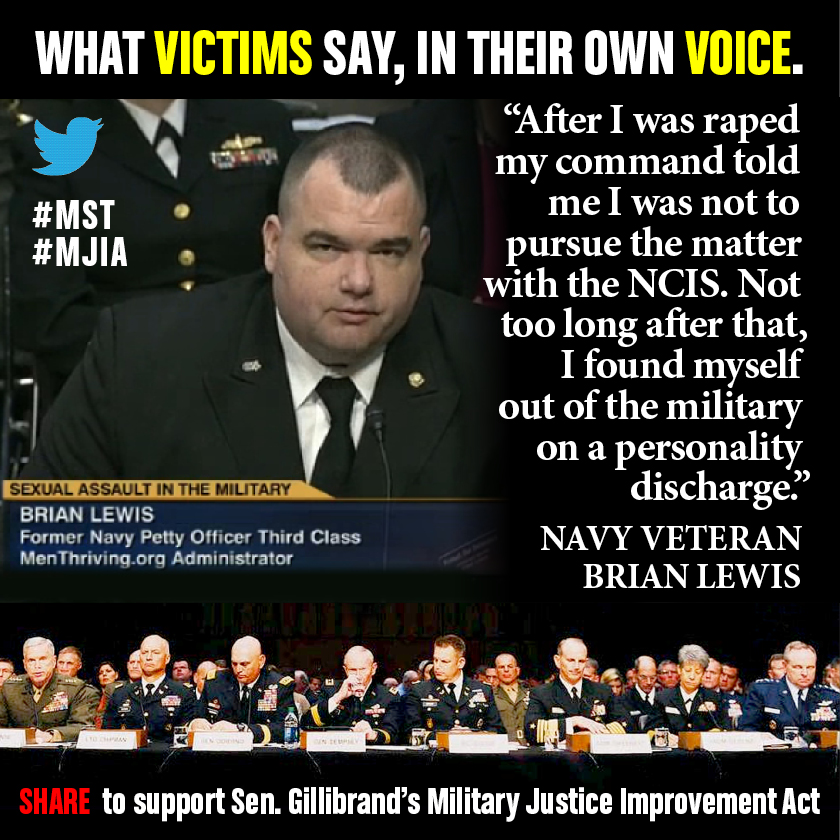
Brian Lewis MJIA.jpg
You can listen to U.S. Navy veteran Brian Lewis’ March 13, 2013 testimony to the Senate Armed Services Subcommittee on Personnel here.

“Nearly 30 years ago, when George H. W. Bush was president and Dick Cheney was the secretary of defense, the Pentagon made a promise to our service members. Dozens of Navy and Marine Corps aviation officers had just been investigated for the infamous Tailhook sexual assault scandal, and America’s military leadership affirmed a “zero tolerance” policy toward sexual assault within their ranks. The military had a sexual assault problem, and pledged to solve it.

It’s painfully clear that the military has now failed at this mission by almost any metric. For years, survivor after survivor has told us the change in the system we needed to make to end this scourge — the same change that a number of our allies around the world have already made: take the adjudication of these crimes outside of the chain of command and allow trained military prosecutors to prosecute them.” Read more opinion at Military Times here.

“The Military Justice Improvement Act would take the prosecution of sexual assault and other serious crimes, such as murder, out of the chain of command. It would keep those crimes in the military justice system, but put the decision to prosecute them into the hands of actual military prosecutors who are trained to deal with complex legal issues.” –Senator Kirsten Gillbrand (Military Times, July 1, 2019)

Gillibrand Leads Bipartisan Coalition to Reform Military Justice System  -Senator Kirsten Gillibrand (May 16, 2013)

Related Links:
Pass the Military Justice Improvement Act @SenGillibrand
S. 1789: Military Justice Improvement Act of 2019
S. 1789: Military Justice Improvement Act of 2019 [Full Text]
Comprehensive Resource Center for the Military Justice Improvement Act
Sens. Cruz, Gillibrand Reintroduce Military Justice Improvement Act
Udall, Heinrich Reintroduce Military Justice Improvement Act To Address Crisis Of Military Sexual Assault
Leahy Joins Gillibrand And Others To Reintroduce Military Justice Improvement Act
Hirono Wants To Change How The Military Prosecutes Sexual Assault
Senator Martha McSally’s Responsibility to Survivors of Military Sexual Assault
McSally defends keeping military commanders involved in sexual assault cases
Gillibrand: “Status Quo” Not Working With Military Sexual Assaults
Veterans for Peace: Sexual Assault on Military Members Press Conference, Seattle, Washington (August 11, 2006)
Jamie Leigh Jones Testified at the House Judiciary Committee Halliburton/KBR Iraq Rape Case Hearing (December 19, 2007)
HOR Oversight Subcommittee on National Security & Foreign Affairs Held a Hearing on Sexual Assault in the Military (July 31, 2008)
Former Representative Bruce Braley (D-IA) Introduced the Holley Lynn James Act (April 12, 2011)
Lauterbach Case Prompts Policy Reforms for Victims of Sexual Assault in the Military (December 25, 2011)
Sexual Misconduct Allegations at Lackland AFB | C-SPAN (January 23, 2013)
Panetta Is Lifting Ban On Women In Combat Roles (NPR, January 23, 2013)
Sexual Assault in the Military, Part 1 | C-SPAN (March 13, 2013)
Sexual Assault in the Military, Part 2 | C-SPAN (March 13, 2013)
Gillibrand Leads Bipartisan Coalition to Reform Military Justice System [Full Video] | Senator Kirsten Gillibrand (May 16, 2013)
Gillibrand Builds Bipartisan Support for Change of Military Justice Code (May 16, 2013)
S. 967: Military Justice Improvement Act of 2013 – U.S. Senate Voting Record (March 6, 2014)
The war in Congress over rape in the military, explained (June 8, 2016)
Sexual Assault in the Military | C-SPAN (March 6, 2019)
S. 1789: Military Justice Improvement Act of 2019 Reintroduced by Republican Senator Ted Cruz of Texas and Democratic Senator Kirsten Gillibrand of New York (June 13, 2019)
Senate Armed Services Committee Members & House Armed Services Committee Members (June 21, 2019)
Gillibrand: The Military Justice Improvement Act Would Give Service Members a Justice System That Works (July 1, 2019)

DOD Releases Annual Report on Sexual Harassment & Violence at the Military Service Academies, Academic Program Year 2017-2018 (January 31, 2019)

Department of Defense“Today, the Department of Defense released the Annual Report on Sexual Harassment and Violence at the Military Service Academies, Academic Program Year 2017-2018…There were 117 reports of sexual assault received across all three academies. This is an increase of five from the prior academic program year, indicating confidence in response measures, however, surveyed measures of unwanted sexual contact and sexual harassment increased compared to rates last measured in 2016. There was also an overall increase in sexual harassment.” Read more here. -Department of Defense (January 31, 2019)

To view the full report, visit SAPR.mil.

Related Links:
DOD Releases Annual Report on Sexual Harassment & Violence at the Military Service Academies, Academic Program Year 2017-2018 (January 31, 2019)
Annual Report on Sexual Harassment and Violence at the Military Service Academies (MSAs) for Academic Program Year (APY) 2017-2018
USA Today publishes fake news story about sexual assault at the military academies | CAAFlog
Department of Defense Retaliation and Response Strategy (July 2017)
Fiscal Year 2017 Annual Report on Sexual Assault in the Military (April 2018)
Department of Defense Instruction 6495.02 | Sexual Assault Prevention and Response (SAPR) Program Procedures

People Magazine Investigates Premiered ‘Terror in Philadelphia’ on ID: University Student Shannon Schieber Found Raped & Murdered (November 12, 2018)

In 1998, a gifted Philadelphia graduate student is found murdered in her bed. The hunt for her killer forces police to reevaluate a series of unsolved crimes, turning the city upside down. Will her killer be caught or will he strike again? -Terror in Philadelphia, People Magazine Investigates (S3, E2)

Editor’s note: With a cable subscription, you can download the free ID Go app and watch Investigation Discovery programming at your convenience. And for those who do not have cable, you can watch “unlocked” episodes on the ID Go app including the latest premieres. For those who prefer commercial free programming during your binge session, Prime Video has an ID channel: ‘True Crime Files by Investigation Discovery” available for $3.99 a month. It’s a compilation of older seasons but totally worth the cost if you are a true crime addict. Download the ID Go app or purchase ID True Crime Files & binge away.

Related Links:
Death’s Door | People Magazine Investigates
How a Business Student’s Dying Cries of ‘Help Me’ Eventually Led to a Serial Rapist
Mom of Wharton Student Found Raped, Murdered in 1998 Still Wonders: ‘How Could Somebody Do That?’
University of Penn. Student Shannon Schieber Found Raped & Murdered in Home; Air Force SrA Troy Graves Sentenced to Life in Prison (May 7, 1998)
Terror in Philadelphia | People Magazine Investigates | Investigation Discovery (S3, E2)
Terror in Philadelphia | People Magazine Investigates | Investigation Discovery (website)
Terror in Philadelphia | People Magazine Investigates | Investigation Discovery (Prime Video)

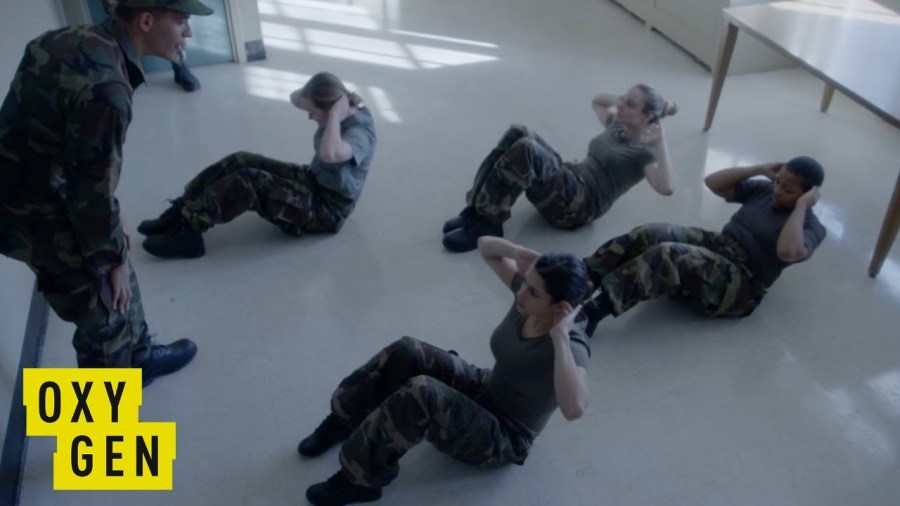
Deadly Power Premiered ‘Lackland Military Scandal’ on Oxygen: Virginia Messick Recounts Experience in Air Force Basic Training (July 23, 2018)

When 19-year-old Virginia joined the U.S. Air Force, a superior officer’s sexual abuse turned her lifelong dream into a daily nightmare. -Lackland Military Scandal, Oxygen (S1, E1)

When Sergeant Walker began harassing Virginia, his powerful military rank kept her from speaking out against his appalling behavior. -Lackland Military Scandal, Oxygen (S1, E1)

Sergeant Walker isolated Virginia and assaulted her in an Air Force dorm room. -Lackland Military Scandal, Oxygen (S1, E1)

Virginia fought for justice not just for herself, but also for nine other victims who suffered Walker’s abuse. -Lackland Military Scandal, Oxygen (S1, E1)

Virginia experienced PTSD from the sexual abuse she suffered at Lackland Air Force Base. -Lackland Military Scandal, Oxygen (S1, E1)

Virginia explains the extreme intensity of Air Force basic training. -Lackland Military Scandal, Oxygen (S1, E1)

Colonel Don Christensen left the Air Force after 23 years to dedicate his career to eradicating sexual assault in the military. -Lackland Military Scandal, Oxygen (S1, E1)

Related Links:
Deadly Power: Preview – An Air Force Academy Nightmare (Season 1, Episode 1) | Oxygen
Deadly Power: Preview – The Abuse Escalates (Season 1, Episode 1) | Oxygen
Deadly Power: Preview – Trapped By A Predator (Season 1, Episode 1) | Oxygen
Deadly Power: Preview – Virginia’s Day In Court (Season 1, Episode 1) | Oxygen
Deadly Power: Bonus Clip – Virginia’s Lasting Trauma (Season 1, Episode 1) | Oxygen
Deadly Power: Bonus Clip – Surviving Basic Training (Season 1, Episode 1) | Oxygen
Deadly Power: Bonus Clip – Fighting For Change (Season 1, Episode 1) | Oxygen

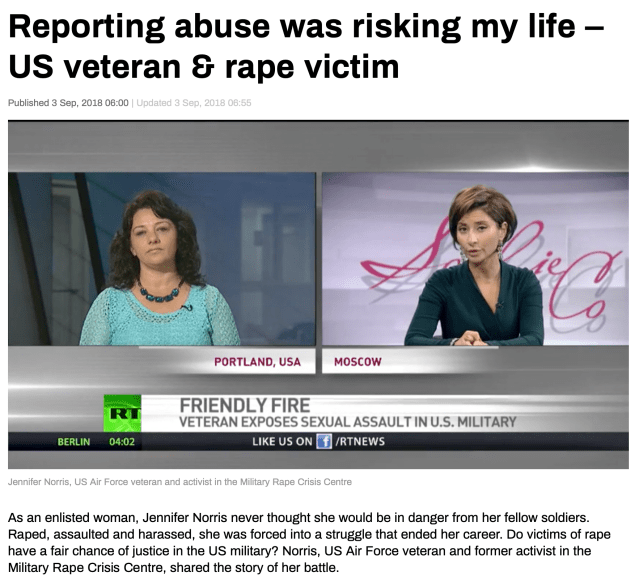
Reporting abuse was risking my life – US veteran & rape victim | Sophie and Co | RT (January 12, 2018)

Reporting abuse was risking my life – US veteran & rape victim

Correction: Jennifer Norris is not an advocate for MRCC. She left the organization in March 2014.

We hear a lot about #weinstein and the latest, but Jennifer Norris, who served in the US Air Force, has been talking about sexual assault for years. And in the military, reporting rape means endangering yourself. Watch this brave woman speak here https://t.co/1ipeI3SWP6 pic.twitter.com/TAjiVjmdDS — SophieCo (@SophieCo_RT) January 12, 2018

As an enlisted woman, Jennifer Norris never thought she would be in danger from her fellow soldiers. Raped, assaulted and harassed, she was forced into a struggle that ended her career. Do victims of rape have a fair chance of justice in the US military? Norris, US Air Force veteran and former activist in the Military Rape Crisis Centre, shared the story of her battle.

Sophie Shevardnadze: Jennifer Norris, retired U.S. Air Force veteran, former activist in the Military Rape Crisis Centre, who herself had firsthand experience of sexual assault in the military, thank you for joining us on this programme. I want to start right away, the first time this happened, you were drugged by your recruiter – did he trick you into having sex with him? Do you have any recollections of how the incident happened?

Jennifer Norris: When I look back on this incident I realise that I was actually tricked by this man into going to the party to begin with. He had told me that there was a new recruit party for other recruits. I was excited to go and meet them because they would understand exactly how I felt. So he had ill intentions from the gitgo. When I got there there were no new recruits, I was the only one.

SS: How many times were you subjected to sexual assault or abuse? Was it just one case?

JN: It started with that one case and I thought that maybe it would be over after that, that I was just unlucky at the wrong place at the wrong time, so I pushed forward. But, unfortunately, as I entered the military service it happened again and again, and again within the first two years of service. 

SS: Tell me this – why didn’t you report it straight away, after that first time?

JN: I didn’t report the first time because I hadn’t even gone to basic training yet and I didn’t really know what to say. I didn’t even know where to go: if I was supposed to go to a commander in the military, if I was supposed to go to the police department. I was completely clueless as to what sexual assault, rape and harassment were at that time. So I just tried to soldier on, move on with the career that I was looking for doing for at least twenty years.     

SS: So what happened after you were assaulted? What did you feel? Was it guilt? Was it shame, uncertainty? 

JN: It used to be shame because I used to feel like an idiot for going to this person’s party. But after years of counseling and working with rape victims’ advocates I learnt that predators operate in much the same way: they are very manipulative and they will set you up for an attack or they will take advantage of an opportunity. So now I realise it was a calculated crime but it took me years to realise that.  

SS: So for those who haven’t faced this kind of ordeal, but danger is always there, tell us how these manipulators actually trick their victims into it? How do they lure you in?  

JN: I think, they do what you would call ‘grooming’, they make you believe that they are trustworthy and that they are going to take care of you, and it almost seems that it is too good to be true. When you are naive, you don’t necessarily realise that not everybody is speaking at face value. So as an 18-year-old or even a 24-year-old it’s easy to fall prey to the niceties because you don’t know that there’s evil lurking behind it. And I think that’s the real danger of this kind of people and how they operate is that they are able to get to us based on the trust that’s been established. In the military we are depending on each other in every way, especially in trust.   

SS: So how old were you when that happened? Like, eighteen?

JN: No, I was actually 24. I had already graduated from college, as a social worker I worked in the field for a couple of years. As a case manager I worked on a suicide crisis hotline, then I decided I wanted to go and get my master’s degree and the military offered the GI Bill that could help me accomplish those goals. So that’s the No.1 reason why I joined aside from being patriotic and wanting to give back and being involved in something that was bigger than myself. I was completely clueless as to what was in store.    

SS: Ok. One woman who went through a similar ordeal – Air Force Sergeant Marti Ribeiro said, “The military has a way of making females believe they brought this upon themselves.” Did you feel that as well? 

JN: Yes.

SS: Did you blame yourself for what happened?

JN: I did for the longest time especially with the recruiters incident. If I knew as soon as I walked through that door that there was danger but it was too late to turn back… That particular incident taught me a lot of how to take care of myself in the future. Unfortunately, if you are working for someone who’s assaulting you you can’t escape them. So now I don’t have shame or blame or any of that stuff any more as far as what I did. All I did is go to work in uniform and these people took advantage of their power and opportunity. That’s what we’re trying to change, it’s taking more seriously if someone does in fact abuse their power in that kind of setting.

SS: I’m trying to figure out the psychological aspect of it – how did the military structure make you feel guilty about what had happened and not the other way round? 

JN: I understand. So, given the way that you report currently in the military is not that you go to a police office to report a crime. You are supposed to report it to your commander. In my particular case and in a lot of soldiers’ cases the commander also has a relationship with the perpetrator and he may have known the perpetrator way longer than he knows you. So what it does it creates an atmosphere of intimidation that when you see your commander hanging out with the guy who assaulted you, then you feel like “Oh, wow, he’s not going to take me seriously, it looks like they both are really good friends”. And then when you do go ahead and do a report the first thing the defense attorney start looking into is whether or not you did this, you did that, how did you conduct yourself. They immediately go into that you shouldn’t have been in this place, if you hadn’t that wouldn’t have happened. They could have done that to me too. But it’s not our fault that we thought we were attending what we were supposed to be.        

SS: Jennifer, I’m thinking, there are also other women in the military, they are compassionate  creatures, you could have shared your story with them, they certainly would have understand what you went through, especially if this happens all the time. Maybe there were other women alongside you who were actually subjected to sexual assaults – did you share your story with any of your female peers?

JN: What I’ve learnt is that, first of all, I was one of very few women in my squadron. There may have been, if we were lucky, three of them and one of them is administration personnel, and maybe there was another one in another shop. But I was the only female working for satellite communications in combat communications. So, no, I didn’t have other females that I could turn to and say “hey, this has happened to me”. As the matter of fact, I didn’t want anyone to know that this had happened to me because I didn’t want to be judged. Unfortunately, it appears that once people learn that you’ve reported a sexual assault or may have been involved in an incident they become scared of you instead of being scared of the perpetrator. They think that you are going to be hypersensitive too if they swear or if they say something, you know, offensive when in fact it’s not going to be that way at all. So there’s a culture of fear built up in the military. And I think that’s why they want to automatically blame it on a woman because if she goes away the problem goes away and they can get back to work as normal. 

SS: Human Rights Watch reports a very dire picture of what happens to the victims of sexual assault. They say that these people are being “spat on, deprived of food, assailed with obscenities, threatened with ‘friendly fire’ during deployment…discharged for misconduct”. Is it true? Is it really that dangerous to come forward?

JN: It is. In some cases it just depends on your situation. If you are isolated you are in a way more danger than, say, other people would be on some big base that has security forces in a JAG office. But if you are in some place like the Azores or some other random location across the world all you have is the people that are with you. Then yes, you could be in grave danger if in fact someone harms you and threatens you and says that if you say anything they will kill you. It happens, I’ve researched this. We have had non-combats deaths occur overseas that include homicide and unsolved cases that nobody is talking about. That’s what we are trying to tell people is…

SS: Did you get any threats? Were you threatened?

JN: Yes, not only was I threatened, but I was physically beaten after I reported by one of the perpetrators’ friends. The entire squadron turned on me. I was automatically the liar. Even though they didn’t know the circumstances and even though we did have proof and we were able to move forward with two of the four cases the other people in the squadron didn’t know what happened and they believed the perpetrator who was able to tell them the story while I was at some other squadron waiting for the case to go through.

Reporting abuse was risking my life – US veteran & rape victim

SS: But see, for me it’s just mind-bogglingthat you were standing there harassed, assaulted in the open with other people standing by and not interfering. How come no one interfered? Why didn’t troops come forward for a fellow soldier? 

JN: Well, I did have a couple of people that had my back along the way. But it felt more like it was a culture of fear, like, nobody dared to stand up to those who were higher-ranking if they were the ones that were doing the harm because they were afraid it would have backlash on their career. Now I don’t have respect for those people who didn’t stand by and take a stand and support the ones who were actually being harmed. But along the way there were some silent people that came up to me and said that this person had done this to them, that that person had done that to them etc. So people would open up along the way but they wouldn’t take it as far as I did and actually report. Although I must say it was because of the senior master sergeant that I finally confided in. He’s the one that finally convinced me to report the four individuals to the commander. 

SS: Iraq veteran Chantelle Henneberry says she was less scared of enemy fire than the men she served with. She recalls she would drink less water to avoid going to the bathroom in the night, she was so terrified of being harassed – why do women even join the army despite hearing all these horrific stories?

JN: I think that it boils down to that people don’t think it would happen to them. And that’s just typical of society, you don’t think that bad things are going to happen to you. I had the same mentality before I joined too. So they want to follow their dreams and they want to do what they want to do and some of us dream of being in the military, retire, do great things and move women forward. So I think that’s normal, that’s ok.

SS: The United Nations is speaking out about the problem of sexual assault in the U.S military, saying it needs to ‘ensure effective prosecution of offenders’. Is this going to make any difference?

JN: Absolutely. Right now, the prosecution rate for sexual assault is less than 10% compared to the civilian world which is at least 40%. That’s what we are trying to say – if people are raped or assaulted and then report we would like these cases to be taken seriously. Right now, like I spoke to you earlier, you have to report the crime to your commander. They are not legal professionals, they are no Special Victims Unit. They do not understand how these things work. And what we want is to be able to report to a police department or a law enforcement professional, someone who understands how these people are working and cannot be manipulated by them. 

SS: For years, activists and lawmakers in the United States have tried to change this protocol – but leaders in the military are against bringing civilians into bases to investigate alleged assaults – why are they against it? And why are they winning this debate?

JN: Because they are able to protect their institutions if they are able to keep everything in house, and that’s exactly what they do. They want to stamp it out before it gets out to the public whereas we want this out in the public so that people know who these offenders are and can be on alert. They don’t just offend people in the military, they offend people in our communities as well – their wives, their children… So it’s not just a military issue, it’s a societal issue and I think, it would be way more effective if everyone reported to a police department where all the crime data was kept in one place.

SS: Do you think completely removing sexual assault cases from the military chain of command would actually solve the problem?

JN: I think standardizing the justice process in general to have it synced with the civilian society, meaning data basis connected, whether it’s the civilians that try the perpetrator or it’s the military that tries the perpetrator… Everyone should be talking so that we can connect the dots on who’s doing what where because it makes it a little bit more complicated with the military personnel who can transfer all over the country and to different parts of the world. We need all the data collection to be put into a system so we can actually track what these people have done through the course of time and be able to move forward with cases that may win as opposed to he-said, she-said incident. 

SS: So, Jennifer, I’m thinking, maybe there should be more women in the U.S. military? If there were more women in high-ranking positions being able to kick butt especially to the men who are potential assaulters? What do you think? Should there be more women in the U.S. military?

JN: That would be ideal. Although we have to take into account that over a half of victims in the military, actually 53% of them are males. So this is not a female issue necessarily. We are at higher risk because we’re seen as a weaker sex. But predators do not discriminate: they are harming both men and women in the military. A lot of media have been trying to cover the issue but we have just not been able to get the footing with it, but people need to know that over half of the victims are men in the military. 

SS: There are crazy numbers: according to HRW, only 5 percent of sexual assault cases in the U.S. military lead to convictions of the perpetrators. What happened to the man who assaulted you? Was he punished?

JN: Yes. The recruiter skipped town after I threatened to report him to the commander, unfortunately. So we couldn’t do anything with that case. The technical instructor that assaulted me in Keesler, Mississippi – we had no jurisdiction over because he was active-duty and I was considered National Guard. And the other two were both National Guard members who worked with me, and we were able to move forward with cases. But by the time it went up the chain of command it got minimized from sexual assault to sexual harassment they both retired with full benefits after 20 years of service. 

SS: The Pentagon keeps saying that programs are implemented, changes are being made, and the problem is being solved – is it all a lie?

JN: I don’t think it’s all a lie, but I definitely think they sway the media to see things in a certain way. For example, although the numbers may have gone down from 26 thousand to roughly 19 thousand in the last couple of years and they’re bragging about a 30% increase in the reporting it means nothing. And what the civilian world doesn’t understand is that in the military you can report a crime under two different guises: either restricted or unrestricted. If it’s restricted that means that nobody is supposed to know about it including your commander so you can go forward and get some help. If it’s unrestricted then it turns into a full-blown investigation if, in fact, your commander agrees to move forward with the case which is another sticking point. So people need to realise that although the reporting has gone up it’s been restricted reporting which is not helping us catch these criminals. They are still not being reported. You might get some help but they are still moving along in their careers assaulting other people while the latest victim is just getting help. 

SS: You now work with those who went through the same as you did – are you seeing more cases of women speaking out, has the situation gotten better?

JN: I think awareness has definitely gotten better around the issue. There’s way more talk within the military and outside in the veteran community to address getting help after someone has been traumatized by an incident like this. So that has definitely improved. I actually benefited greatly from programmes that have come up as a result of our advocacy with military sexual assaults. So for that I’m thankful. As far as the military justice system and policy goes it’s the same thing it has always been – nothing has changed whatsoever. As far as the court issue we’ve been trying to address which is taking the commander out of the decision-making process as far as you can move forward with the case. We just want law enforcement professionals, detectives and investigators to deal with these cases, not a commander who’s great at war but has absolutely no idea how the legal process works and what sexual assault is. I shouldn’t have reported it to my boss.

SS: What do you do for the victims, how are you helping them?

JN: What I do is I empower them. When I did worked as an advocate I actually would help them deal with their cases as they were moving along in the process and I noticed the same patterns over and over. What I do now (and it was actually hard to do it before we could change things) is focus on helping them to heal despite not being able to get justice, trying to find a place of faith and comfort in yourself to know that you didn’t do anything wrong. It’s just the system that isn’t working well and it needs to be changed, and there’s nothing we can do about it right now except to take care of ourselves and hope for the best in the future. 

SS: You mentioned earlier that it’s not just men-women problem and that 51% percent of those assaulted being men. I’ve read a recent survey by the American Psychological Association that says the number of men facing sexual assault in the military is 15 times higher than reported by the Pentagon. That would mean up to 210 thousand men are assaulted in one year. Is that number correct? Is it a right calculation? And do you help men as well? 

JN: Yes, whoever needs help and comes to me – I will assist them as best as I can. That actual study from the American Psychological Association was retracted. They used not a very good way to determine those numbers. It wasn’t correct so it was retracted. It’s not actually that high. But it doesn’t really matter. It’s still high enough that it should be a concern. The actual number that I shared with you is that roughly 53% of victims of military sexual assault are males. It’s not a female soldier issue, it’s a predator issue and that’s what we’re trying to tell people. 

SS: Jennifer, thank you so much for sharing this story with us. Thank you so much for empowering women who want to do the same thing that you did. Thank you so much for being so brave and outspoken. And I hope that you’ll win over Pentagon. 

JN: Thank you.

Related Links: