“Today, the Department of Defense released the Annual Report on Sexual Harassment and Violence at the Military Service Academies, Academic Program Year 2017-2018…There were 117 reports of sexual assault received across all three academies. This is an increase of five from the prior academic program year, indicating confidence in response measures, however, surveyed measures of unwanted sexual contact and sexual harassment increased compared to rates last measured in 2016. There was also an overall increase in sexual harassment.” Read more here. -Department of Defense (January 31, 2019)
A vacationing couple’s disappearance exposes the horrific crimes of a murderous husband and wife. -Erika and BJ Sifrit, Killer Couples (S11,E2)
A young woman’s scrapbook offers insight into a shocking crime. -Erika Sifrit, Snapped (S8,E11)
Oxygen (Previews & Bonus Clips):
Erica Sifrit was your typical girl next door during high school, but experienced issues with anxiety and OCD at Mary Washington College. -Erika & BJ Sifrit, Killer Couples (January 29, 2019)
Erika and Benjamin Sifrit’s marriage ended in thrill killings, pain, and anguish. -Erika & BJ Sifrit, Killer Couples (January 29, 2019)
Scott Bernal, Ocean City Lead Detective discusses the murder trials of Erika and Benjamin Sifrit’s for the death two tourists. -Erika & BJ Sifrit, Killer Couples (January 30, 2019)
Ocean City Detectives Brett Case and Scott Bernal reflect on the murder of Joshua Edward Ford and the acquittal of Benjamin Sifrit, and his potential release. -Erika & BJ Sifrit, Killer Couples (January 30, 2019)
Kristen Heinbaugh, a high school friend of Erika Sifrit, reflects on the character of the person she used to know before the murders of Joshua Edward Ford and Martha Margene Crutchley. -Erika & BJ Sifrit, Killer Couples (January 30, 2019)
Forensic Files:
Full Episode: The couple spent Memorial Day weekend at the beach, and then they simply vanished. Their clothes and personal items were still in the rented condo, their car was parked outside, and there were no signs of forced entry or foul play. A week later, police would get an unexpected lead from a robbery in progress, and the evidence they found helped them to solve a crime of unparalleled violence and brutality. -Dirty Little Seacret, Forensic Files (S13, E46)
Kansas Army National Guard veteran Zachary Schaffer, 21, was found unresponsive in his Kansas City, Kansas home on January 23, 2019. According to theDodge City Daily Globe, Zachary fatally overdosed only a few days after he was punished and discharged from the Kansas Army National Guard. According to his mother, Wendy Mottas, Zachary, or Zach, as he was known to most, was accused of failing to show up for multiple weekend drills and discharged with an “other than honorable.” In the midst of losing his military career and eventually his security clearance, Zach was flagged by his command for the prescribed use of Adderall to treat ADHD, even after he was reassured it was okay for him to take the prescription. Wendy doesn’t know if her son’s death was intentional, but stated Zach began suffering with depression and substance abuse during his time in service with the Kansas Army National Guard. Zach went from being a stellar soldier at the age of 19 to being hired as a full time military technician to losing that same position less than one year later for reasons undisclosed. Six months after being fired by the Kansas Army National Guard, he was also passed over for deployment to Afghanistan, having been told he was ‘red flagged’ for the use of Adderall. Six months later, Zach would also experience sadness and grief after losing his friend, 24 year-old Kansas Army National GuardsmanKhamis Naser, who died by suicide on July 31, 2018.
Zach grew up in the Hutchinson, Kansas area and joined the Kansas Army National Guard in May 2014. Zach’s mother, also an Army veteran, said he was born in Germany when she was in the military. Zach came from a military family and it was a natural fit for him too. Wendy shared Zach was always intelligent and she knew he would be successful because he was very skilled in anything related to computers and coding. After Zach completed Army basic training and specialty training, he progressed quickly as a soldier and eventually got a full-time job with the Kansas Army National Guard at age 19. Zach was a federal military technician (Personnel Security Technician: GS-7) during the week and on Guard weekends, he was an Intelligence Analyst (E-4). Zach’s downward spiral began when he lost his full-time job as a federal technician and was made to feel incompetent by those who also originally built him up to be a great soldier with a bright future in the military. Zach’s mother does not know why Zach was fired during the probationary period, but she does suspect that Zach had information about other National Guard members whose misconduct were overlooked during routine background checks so they could maintain their security clearances.
Once Zach lost his full-time position, he went from being a professional soldier to not caring about anything anymore. He moved from his home in Topeka, Kansas to Lawrence, Kansas and became somewhat estranged from the family. Zach became secretive, fell in with the wrong crowd, stopped going to therapy and became reliant on self-medicating to take care of the pain of depression he was feeling. Realizing this lifestyle was not healthy, Zach moved back home to Junction City and tried to get his life together in early January 2018. After about three months of living at home, he discovered the Kansas Army National Guard unit in Junction City, Kansas was tasked with a deployment to Afghanistan, to which he inquired and expressed interest to the unit’s leadership. The leadership put him through mobilization procedures for nearly a month and then his deployment orders to Afghanistan were cancelled citing he had been flagged during the pre-deployment process for Adderall use. Zach was prescribed Adderall for the diagnosis ADHD and his mother states he was prescribed the drug due to a struggle with concentration and focus. Once Zach was flagged, someone made the decision to prevent him from deploying to Afghanistan and his mother does not know if his National Guard unit influenced the decision at that time or not.
Zach was looking forward to the deployment. Instead his orders to Afghanistan were cancelled and it was then Zach started meeting regularly with mental health personnel for depression. It is unknown what Zach may have shared with health care professionals, but his family realized something changed in Zach’s life. Shortly after, Zach moved from Junction City to Kansas City with a friend with which his family was not familiar. He remained distant from his family and friends. Worse yet, the same military officer (O-4) who made the decision to fire Zachary from his full-time military technician position also influenced National Guard unit leadership to end Zach’s military career in its entirety. Leadership observed the changes in Zach’s attendance and behavior. Instead of helping him, they used it to revoke his security clearance knowing he needed a security clearance for his job as an intelligence specialist in the National Guard and his full-time job with the Marine Corps. During this time, the only thing done to assist Zach or try to get to the root of the issues he was having was to refer him to the unit’s social work office. At some point, this social worker was told to ‘stand down’ and allow the unit’s part-time civilian social worker to take care of his issues. To his mother’s knowledge, this individual never contacted Zach to offer support and he was never offered any type of assistance including participation in the Army Substance Abuse Program.
In early July 2018, Zach contacted his mom and stated he wanted to go to an inpatient rehabilitation program. He self-admitted to the substance abuse program to help him stop his drug dependency and get his life back on track. The day after Zach left the rehabilitation program and returned to Kansas City, he learned his best friend and fellow National Guardsman, Khamis Naser, had died by suicide. Zach told his mother he had talked to Khamis only five hours before he was found dead in his apartment. Zach attended the August 2018 drill weekend and his mother said he told her he was met with disdain from his leadership. Zach’s mother states she has text messages from her son indicating the NCOs in his unit were bullying him. Zach told her they said his best friend would still be alive if he ‘wouldn’t have been high’ and ‘would’ve been there for him’ (Khamis). After Zach was blamed for the death of his friend, he got in a physical confrontation with one of his NCOs. During another drill weekend, word got around the unit that leadership wanted to ‘get rid of that “shitbag”’ (referring to Zach) because he made the unit ‘look bad.’ Despite the ill treatment by the Kansas Army National Guard, Zach picked himself up and got a new job as a civilian contractor for the Marine Corps in Kansas City at age 21. Unfortunately, a short time after he got the job, he was terminated when he learned the National Guard had suspended his security clearance. At this point, Zach had no income, including from his drill weekends, due to a status discrepancy. Zach was still considered in ‘active duty’ status because of the deployment orders to Afghanistan and no one in his military leadership would assist him to get transferred back to his original unit. His mother states he discussed this with someone at his unit who agreed with him — why bother going to weekend drill if he was getting bullied and not receiving any pay? He stopped attending drill after September of 2018 and once again became estranged from his family. He would never return to the National Guard.
According to the Kansas Adjutant General’s Department, the Kansas Army National Guardsuicide prevention programis “based on the premise that suicide prevention will be accomplished through the positive action of unit leaders and implementation of command policy. The key to the prevention of suicide is positive leadership and honest concern by supervisors for military personnel who are at risk of suicide and appropriate intervention for all such personnel.” Khamis Naser died by suicide in July 2018 and six months later in January 2019, Zach Schaffer died of a fatal drug overdose. How did the Kansas Army National Guard’s suicide prevention program help Khamis and Zach? Although we don’t know why Khamis Naser chose to die by suicide, we do know he was a current member of the Kansas Army National Guard. One would think losing a fellow comrade would initiate a more proactive suicide prevention approach yet instead we learn the very people tasked with a “positive and honest concern by supervisors” for military personnel at risk of suicide and appropriate intervention was not implemented in the last couple of years. Zach was a soldier dealing with the loss of his full-time job, grief from the loss of his friend, the loss of his military career, and the loss of his security clearance. Military leadership knew Zach was not well and they knew he was a risk to himself.
Thetop 10 most stressfullife events include death of a loved one, separation, starting a new job, workplace stressors, financial problems, and chronic illness/injury. Zach’s mom shares he was dealing with six out of ten of those stressful life events at the age of 21. Wendy wonders why the military wouldn’t be especially cognizant of the fact they are molding young kids into warriors at a very impressionable time in life. At a time when young adults need guidance most, instead in the military environment, they are forced to deal with additional stressors, caused by military leadership in Zach’s case. Why would the same organization at the root of the cause of the downward spiral of young lives be interested in also pretending to care about suicide prevention of those same personnel? The moment Zach was let go from his full-time job was the moment he started to struggle. Why did he get let go? Why did it contribute to a need to use drugs to self-medicate? And one can only imagine the kind of grief Zach experienced after losing a close friend in such a tragic way. Did anyone refer Khamis or Zachary to mental health programs or theDepartment of Veterans Affairs?
It appears Zach’s source of pain or original stressor began when he lost his full-time federal military technician position as a Personnel Security Technician. After Zach lost Khamis, another high-paying job and his military career, his downward spiraled accelerated. Zach was dead less than six months after his friend passed. How can the National Guard implement a suicide prevention program when they are the suspected cause of the unit members’ downward spiral? Why did the National Guard choose to characterize ADHD treatment as a ‘mental health risk’? The prescription was used to assist with concentration and focus. Why would Adderall negatively impact a deployment when it is a fact the active duty deploy personnel on all kinds of prescribed medications? Why not help Zach transfer from Active Duty status back to his National Guard unit so he would be paid for drill weekends? How did Zach go from successfully holding great positions of responsibility within the unit to losing his entire military career? Why did they give Zach an ‘other than honorable’ discharge knowing it will negatively impact the rest of one’s working life, never mind the impact losing a security clearance has on anyone’s future financial security. Why did Zach have to lose everything? How does that help his mental health?
Wendy Mottas told theDodge City Daily Globethat there is a stigma to be tough in the military. And this was confirmed the day the National Guard decided Zach was a “mental health risk” because he had a prescription for ADHD he wasn’t even currently taking. Each Commander has the ultimate say on whether or not an individual can still perform despite taking medication. The prescription was for concentration and focus and not something that had to be a military career ender. Wendy said her son could have used extra support following Khamis’s death and that she would like to see mental health be taken more seriously by the Kansas Army National Guard. While she realizes there were many factor’s influencing Zach’s death, she doesn’t understand why the National Guard wouldn’t offer to help him like so many soldiers with substance abuse are assisted. In Zachary’s case it appears leadership actively contributed to the decline of Zach’s mental health. Who at the Kansas Army National Guard would offer help to Zach after the chain of command (supervisors and leadership) decides a soldier is a “shitbag”? How does the Kansas Army National Guard implement a command driven suicide prevention program when they are the same leadership contributing to a downward spiral? How can the same people tasked with punishing their personnel with a heavy hand simultaneously help prevent a suicide or untimely death of young soldiers? At the very least, in this situation, the National Guard needs to upgrade this soldier’s other than honorable discharge to honorable to make this right for Zach and his family. It’s one thing to let someone go, it’s an entirely different thing when a person’s life and future is destroyed.
“The military still has to take some responsibility for this, I think, and I think more could have been done to be preventative and be proactive instead of reactive. They have a responsibility to these young men and women. It’s not to live their lives for them or to be mommy or daddy or anything like that, but the soldiers still have to live by the army creed, and in order to do that, they have a role in that.” -Wendy Mottas (quote in Dodge City Daily Globe)
“Until my son is found, there is no limit to the resources that should be brought. And if that means you have to go over the same area three times, go over the area three times.” -Jennifer Florin (Scott Weinhold’s mother)
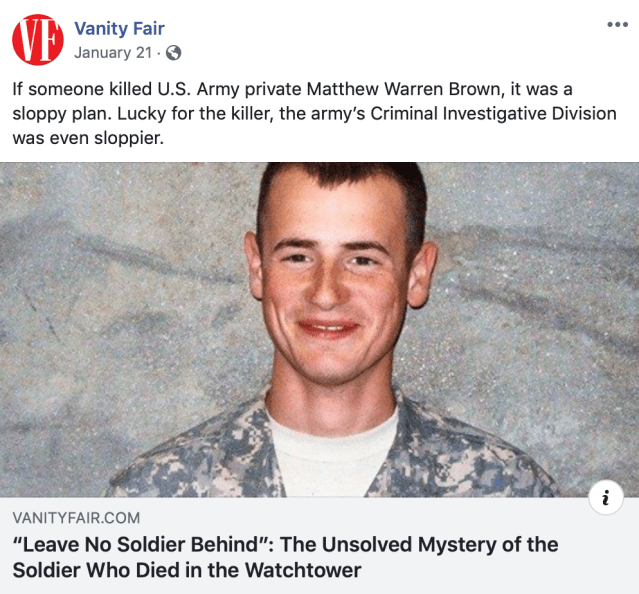
Is the Army botching its investigations into noncombatant deaths?
I. The Gun Tower
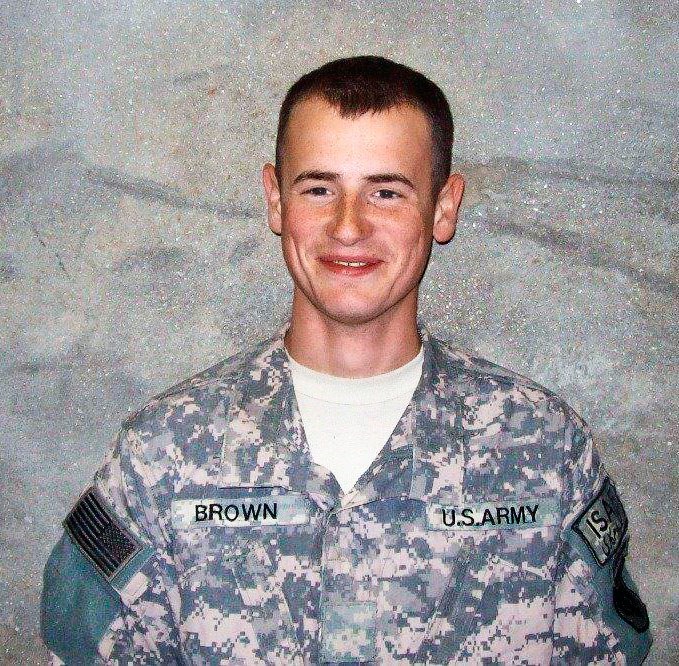
“On the morning of May 11, 2008, a U.S. Army private second class named Matthew Warren Brown died of a single gunshot wound to the head while manning a watchtower at a forward operating base in Afghanistan. Brown was 20 years old. He was a skinny, all-American kid, a bit aimless but affable and unassuming. He was a good guy. You could see it in his face. At his funeral back home in Pennsylvania, some 200 people showed up. In the aftermath of Brown’s death, army investigators created files about the circumstances. The bullet that killed him was fired from his own weapon, an M4 carbine. He was working the six A.M. shift, alone in the watchtower by the fortified main gate to the base. The tower was known as the Gun Tower. It was made of concrete, and looked medieval when viewed from the outside. It was three stories tall. On the second and third floors it had openings covered with two-piece Plexiglas windows, some of which had broken off and been left lying in shards on the floors.” Read more from Vanity Fairhere.
ID Go: When Joshua Hudnall went off to war, he felt more at home in combat than he ever did around his mother. But just when Joshua thought he had escaped her torment, she set her sights on someone else, and destroyed their family from within. -Let Her Rot, Evil Lives Here (S5,E1)
Evil Lives Here is by far one of the best shows on Investigation Discovery. “Evil Lives Here tells the true stories of people who lived with a killer. How well do you really know your family? Would you recognize the warning signs?” The season 5 episode Joshua Hudnall was featured in ‘Let Her Rot’ was by far one of the most powerful episodes to date. Today we not only share this particular episode with you because it’s educational but we pause to honor Army veteran Joshua Hudnall because we learned from Investigation Discovery that he passed. We learned shortly after this episode premiered in January 2019 that Joshua Hudnall had passed away in 2018 and never saw the Evil Lives Here episode he was featured in. After the episode premiered, I wanted to reach out to him to let him know how much I appreciated that he shared his very personal story with us.
Joshua experienced violence in the home and suffered in silence because he didn’t know how to escape it. His father’s love was his beacon of hope. He believes strongly his deployment overseas contributed to his Post Traumatic Stress, BUT it started with his mother’s abuse. He said on the outside she appeared to be the world’s best mom but really she was manipulative, greedy, and violent. One of Joshua’s most profound thoughts was when he admitted a deployment to Iraq was easier than what he grew up with because at least he could defend himself. It was while Joshua was in Iraq that he learned his mother Stephanie Hudnall and his sister Guenevere Lynn murdered his father William Hudnall with a pick axe, one of the most violent tools one could use. Joshua went through a lot in his short life including serving our country in Operation Iraqi Freedom. But he left us with his story, a story we can use to help other abused children. Rest easy Joshua.
Joshua Hudnall, U.S. Army Veteran (featured on Evil Lives Here)
“I loved being in the Army, I really did. In Iraq, and I know everybody watching this is gonna say some crap about what I’m about to say, but Iraq was the EASIEST and best time of my life. Swear to God. My base was the hardest hit. We were the ones who were attacked the most out of all of our bases in the Middle East. You got bombs going off everywhere. There’s always someone trying to kill you. And even with all of that, all of that craziness, all that confusion, still a thousand times better than what I grew up with. If someone shot at me, I could shoot back. Growing up, I couldn’t grab a knife and chase her with it. No matter how bad Iraq got, I knew I had someone watching my back.” -Joshua Hudnall, U.S. Army Veteran (Evil Lives Here)
Editor’s note: With a cable subscription, you can download the free ID Go app and watch all of the Investigation Discovery programming at your convenience. And for those who do not have cable, you can watch “unlocked” episodes on the ID Go app including the latest premieres. Download the ID Go app and binge away. For those who prefer commercial free programming during your binge session, Prime Video has an ID channel: ‘True Crime Files by Investigation Discovery” available for $2.99 a month. It’s a compilation of older seasons but totally worth the cost if you are a true crime addict.
We were sad to learn that Joshua Hudnall, who told his emotional, heartfelt story on last Sunday’s #EvilLivesHere, passed away in 2018. Our thoughts are with Joshua’s loved ones. pic.twitter.com/o9O0ctSqnd
“48 Hours: NCIS” takes you inside the real-life investigation of a marine, Justin Huff, who mysteriously disappeared. “48 Hours” Senior Executive Producer Susan Zirinsky joined CBSN to discuss the episode. -CBS News
Preview: Did a duplicitous online love affair between two people who never met lead to an innocent Marine being murdered? -Deadly Lies, 48 Hours
Marine Corporal Justin Lee Huff, 23, of Camp Pendleton, California passed away January 2, 2006 in Currituck County, North Carolina. Justin was attending the Navy and Marine Corps Intelligence Training Center in Virginia Beach, Virginia. Initially, fellow Marines at Dam Neck Annex of Oceana Naval Air Station and his family considered his absence a disappearance because this wasn’t like Justin. But the US Marine Corps considered it an unauthorized absence and NCIS was tasked with investigating the suspicious circumstances. And during the course of their investigation, they would learn that Navy sailor Cooper Jackson was involved and that this wasn’t a disappearance, it was a murder. Jackson was also attending the Intelligence Training Center and he admitted to impersonating a NCIS officer in an attempt to lure Justin Huff and ultimately kill him. The reason: Jackson’s internet girlfriend (who he had never met in person) told him she had sex with a Marine and Jackson insisted it was rape because she was too intoxicated to consent. Jackson wanted revenge for a rape that turned out to be a rape hoax. As it turns out, Cooper Jackson’s girlfriend “Samantha” went along with the fake rape simply to agree with him, not realizing he had sinister plans.
Cooper Jackson admitted he impersonated a NCIS officer so he could handcuff Justin and trick him into going for a ride with him. Jackson told NCIS agents he confronted Justin about the rape and after Justin denied it, he slit his throat. Jackson basically picked a Marine, any Marine, to exact his vengeance. He told NCIS agents where Justin’s body was and where he disposed of the murder weapon and handcuffs used to subdue Justin. NCIS found Justin and recovered the instruments of murder from the river where Cooper said he tossed them. Jackson was charged with kidnapping and murder in a death penalty trial. Jackson froze when he finally laid eyes on “Samantha” in the courtroom. Cooper Jackson couldn’t even look at her and apologized to the court for his actions. Jackson was found guilty and he was sentenced to life in prison without parole. Samantha on the other hand wouldn’t spend a single day in jail. The investigators discovered she did not ask Cooper Jackson to kill Justin Huff but Justin’s fellow Marines feel differently. They say she may not have done anything criminally wrong but her actions lead to Justin’s death. Huff’s Marine brothers, who served two tours overseas with him, said if everybody was like Huff, this world would be a better place.
Editor’s Note: If you would like to watch the full episode of ‘Deadly Lies,’ please visit the CBS All Access website, visit the 48 Hours website, or download the 48 Hours app for iPad. The most recent episodes are unlocked on the 48 Hours website and app. If you would like to watch past episodes on the 48 Hours app, it cost’s $4.99 a year. There’s programming dating back to 2005 on the 48 Hours app, including some classics, to feed your true crime addiction.
Keith Morrison follows a cold case for nearly 10 years, as a father in Hawaii fights to bring his daughter’s killer to justice despite one setback after another. -Dateline NBC
Sandra Galas
On June 15, 2018, Dateline premiered ‘The Other Side of Paradise’ on NBC. It’s the true crime story of Sandra Galas and her father’s quest for cold case justice. Air Force retiree Larry Mendonca’s daughter Sandra was found strangled to death in her car in the garage of her home on January 25, 2006 in ‘Ele’ele, Hawaii. The case went unsolved for years and if not for the efforts of her father Larry, the case may never have been solved. For years, Sandra’s estranged husband Darren Galas was the prime suspect. Darren had a history of domestic violence and it was rumored that he was angry Sandra was dating someone new. It wasn’t until 2012, investigators were able to pin Darren to the crime with the use of new forensic techniques, specifically touch DNA from evidence at the scene of the crime was a match to Darren Galas. In January 2018, twelve years after the murder, Darren Galas entered a no contest plea in court for a charge of first degree assault, a class B felony. The judge accepted his plea and he was found guilty. In March 2018, Galas was sentenced to a ten year open prison term for his connection to the crime, the maximum that could be imposed. Unfortunately, due to parental alienation, Sandra’s father Larry has no relationship with her two children. He claims Darren has brainwashed them to hate both their mother and her family.
Editor’s Note: You can watch the full episode of Dateline for a limited time on the NBC app. Download the app and binge on the last couple years of programming.
Darren Galas, 40 of Kalaheo was arrested for the 2006 murder of his estranged wife, Sandra Galas. -KHON2 News (2012)
A 2006 Kauai case has new witnesses and interviews. -KITV (2012)
The body of Sandra Galas was found in her garage in Eleele on Jan. 25, 2006. -KHON2 News (2018)
Kauai man Darren Galas has been sentenced in connection with his wife’s 2006 murder. -KHON2 News (2018)
Apple Valley in California’s Mojave Desert is the perfect place to hide a secret. When the body of an unidentified Jane Doe is discovered there in 1994, it takes almost two decades to bring a twisted tale of love, jealousy, and a horrible crime to light. -Who Killed Jane Doe, Investigation Discovery
Editor’s note: With a cable subscription, you can download the free ID Go app and watch all of the Investigation Discovery programming at your convenience. And for those who do not have cable, you can watch “unlocked” episodes on the ID Go app including the latest premieres. Download the ID Go app and binge away. For those who prefer commercial free programming during your binge session, Prime Video has an ID channel: ‘True Crime Files by Investigation Discovery” available for $2.99 a month. It’s a compilation of older seasons but totally worth the cost if you are a true crime addict.
A startling development in the case of Jovita Collazo, the Southern California Filipina who went missing in 1992. -TFCBalitangAmerica


 “Today, the Department of Defense released the Annual Report on Sexual Harassment and Violence at the Military Service Academies, Academic Program Year 2017-2018…There were 117 reports of sexual assault received across all three academies. This is an increase of five from the prior academic program year, indicating confidence in response measures, however, surveyed measures of unwanted sexual contact and sexual harassment increased compared to rates last measured in 2016. There was also an overall increase in sexual harassment.” Read more here. -Department of Defense (January 31, 2019)










 MILITARY JUSTICE FOR ALL