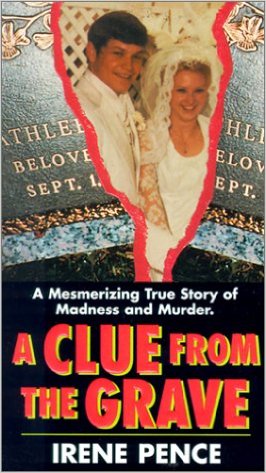
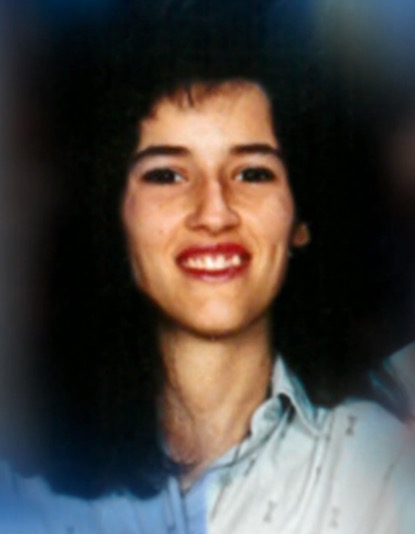
‘A Clue from the Grave’ by Irene Pence is a fascinating look into the investigation of US Air Force wife Kathleen Lipscomb’s murder in San Antonio, Texas in 1986. Her husband MSgt William Lipscomb, who was stationed at Lackland Air Force Base as a Military Training Instructor, would eventually be accused of her murder and stand trial at Langley Air Force Base in Virginia in 1989. This book shows the difficulties the detectives face when it comes to investigating crimes perpetrated by a transient military member.
If not for the persistence of Kathleen’s mom Nadine and her sister Darlene, Bill Lipscomb almost got away with murder. Kathleen’s family did not want to believe that Kathleen’s estranged husband committed this crime but nonetheless wanted to find out who killed Kathleen. Kathleen was found battered and nude on the side of the road outside the city limits of San Antonio. It appeared that she had been raped and murdered elsewhere and her body was dumped at this location. As a result, the Bexar County Sheriff’s Department had jurisdiction of the investigation of Kathleen’s murder. The book revealed that Air Force leadership was not aware that Bill Lipscomb was even considered a suspect by the local Sheriff’s Department. In the meantime, Bill Lipscomb requested a humanitarian transfer to Langley Air Force Base, Virginia so that he would be near his parents who would help him care for Kathleen and Bill’s two children.
After the investigation stalled at the Sheriff’s Department and it looked like no one would be held accountable for Kathleen’s death, Nadine and Darlene decided to hire two private investigators to find out who killed Kathleen. The private investigators carefully went through the list of suspects to rule people out but they could not rule out Bill Lipscomb after what they discovered. These investigators learned that Bill had plenty of motive to kill Kathleen including the fact that Kathleen threatened to turn Bill and his Air Force colleagues in to Air Force leadership for their role in a WAPS test promotion cheating scandal. Bill also wanted custody of the two children so Kathleen used her knowledge of this cheating scandal as leverage in the divorce proceedings so she could keep custody of the two children. In addition, Bill Lipscomb had over $300,000 worth of life insurance on Kathleen, one policy was purchased after Kathleen decided to divorce him. Coincidentally, Kathleen was murdered just days before the final divorce proceedings. Nadine and Darlene began suspecting Bill more and more as time went on because of statements made by Bill and Kathleen’s children and the controlling behavior he exhibited after Kathleen died.
It would be the private investigators that Kathleen’s family hired who convinced the Air Force Office of Special Investigations (AFOSI) to get involved. Bill was no longer in the San Antonio area so no one but the AFOSI had jurisdiction over him. The crime was committed in Texas yet Bill had been conveniently transferred to Virginia. Thanks to the thorough work by the two private investigators, the AFOSI had probable cause to investigate Bill Lipscomb. The AFOSI used both their knowledge of the WAPS test cheating scandal and what they learned from the private investigators to begin their own investigations. They would learn from others involved in the cheating scandal that Bill did in fact cheat on his promotion testing which is how he was able to achieve the rank of MSgt so soon. They would also learn from Kathleen’s date book that she was fully aware of the cheating scandal and knew that Bill was having an affair with another Air Force member he worked with. It would be this date book that gave the investigators involved in the case a reason to suspect Bill Lipscomb of her murder. In the end this information would become ‘A Clue from the Grave’ that helped Kathleen solve her own murder.
Fort Bragg, North Carolina, had seen it all before – when Dr. Jeffrey MacDonald was convicted of savagely slaying his wife and children. Now another officer’s wife had been raped and murdered, another pari of children viciously butchered. And another member of the military was brought to trial. This time the state had no trouble winning a conviction. Tim Hennis was found guilty and sentenced to death. Only Hennis’ parents, wife, and dedicated defense team refused to give up. Piece by piece they ripped the state’s case to shreds, revealing a stunning story of perversion of justice, false witnesses, hidden evidence, and, incredibly, a baby-sitter who had a fascination with Dr. Jeffrey MacDonald. With the brutal truth and chilling suspense of Fatal Vision, this riveting account recreates a vicious crime, the behind-the-scenes story of its investigation, the compelling drama of one of the very few men ever released from Death Row, and an unsolved mystery that still casts a spell of terror. (Innocent Victims by Scott Whisnant)
Book Review:
I read the Innocent Victims book while I was camping and honestly I could not put it down. I was reminded of it while listening to the Military Murder Podcast and inspired to read it because of the level of detail available in the book. It was a great read because there were so many twists and turns in the case. If I didn’t know about the fact that a DNA match to Timothy Hennis helped prove his guilt in a 2010 military trial, I would have been convinced Timothy Hennis was wrongfully convicted. Timothy Hennis was luckier than most because he had the staunch support of his adopted family and wife Angela, who all believed wholeheartedly in his innocence. This case is one for the history books because it’s not every day someone is found guilty in a civilian trial, then found not guilty in a civilian trial on appeal, and then tried again by the military in a third trial and found guilty. Timothy Hennis was sentenced to death and is one of four service members languishing on military death row. The military hasn’t executed anyone since they hanged Army Pvt. John Bennett on April 13, 1961.
Journalists and scholars have questioned the military’s ability to try someone found not guilty in a civilian court because of the double jeopardy concerns. Due to the fact that Timothy Hennis was found not guilty in a second civilian trial, he was allowed to resume his career in the U.S. Army and retired as a MSG in 2004. As far as we know, Timothy Hennis committed no other crimes and was well respected by those he served with. It would be because of his retirement from the military, the Army was able to bring him back on active duty status and try him in a third trial for the murders of the Eastburn family. This practice is also controversial. On appeal Timothy Hennis challenged the military’s jurisdiction to recall him to active duty status to prosecute him and questioned the double jeopardy concerns. In January 2020, an Appeals Court decided military retirees can be recalled to active duty status and court-martialed. In February 2020, the U.S. Court of Military Appeals rejected Hennis’ constitutional rights challenges to the military court’s jurisdiction to try him.
September 28, 1992: Jennifer Asbenson, 19 (at the time of crime), survived a rape and abduction by former Camp Pendleton Marine Andrew Urdiales in California. She was able to escape from his trunk and run into the arms of two other Marines driving in the area. She did not know who her attacker was at the time of the crime but eventually was able to identify Andrew Urdiales in a police photo line-up. She testified on behalf of three women murdered by Urdiales in Illinois and continues to await his trial in California for five more homicides and her case.
Camp Pendleton Marine veteran Andrew Urdiales is accused of murdering eight women from 1986 to 1996, five in California and three in Illinois, and raping and abducting a 19 year old, Jennifer Asbenson, who escaped and survived. Urdiales was indicted for three murders in Illinois and was sentenced to death but the death sentence was commuted after Governor Pat Quinn of Illinois abolished capital punishment in 2011. Instead he received three life sentences for the murders of Laura Uylaki, Cassandra Corum, and Lynn Huber. A gun confiscated in a separate incident linked the three murders in Illinois together and during an interrogation, Urdiales admitted in detail to five cold case murders in California too. After years of legal wrangling, Urdiales was eventually extradited to California and indicted in 2009 on five counts of first degree murder. He was accused of killing Robbin Brandley, Julie McGhee, Mary Ann Wells, Tammie Erwin, and Denise Maney. Initially California was seeking the death penalty but Proposition 62 was repealed in November 2016. Urdiales continues to await trial in California.
A woman’s story of survival is truly inspiring after she was abducted and tortured by a notorious serial killer. Jennifer Asbenson was 19 when she was abducted by Andrew Urdiales. 24 years later, she returned to California’s Desert Hot Springs to record a video explaining her daring escape to encourage others never to give up. Asbenson was walking to a bus stop near Palm Springs, California, in September 1992 when she was offered a ride by Urdiales, who is believed to have killed eight women. –Inside Edition
Military sexual assault is not a new phenomenon. A second look at the Tailhook scandal in 1991 reveals what happened then. And what it all means now. -NY Times
Earl Richmond, Jr., Army veteran, was executed in 2005.
Sgt. Earl Richmond, Jr was stationed at Fort Dix from 1988 until he was discharged for misconduct in the fall of 1990 for taking money from trainees.
On April 15, 1989, a female Air Force officer stationed at Fort Dix and her male companion were held at gunpoint and robbed at a bus stop. The Air Force officer was sexually assaulted as well. Richard Stevens was a civilian who worked at the base. He was charged, convicted of the crimes, and sentenced to fourteen years by a federal court. Eventually it was determined that he was wrongfully convicted of these crimes. He served more then three and a half years in jail before he was exonerated. Stevens resembled Earl Richmond Jr. who was identified as a suspect in this case yet never officially charged. While Stevens was getting out of jail in 1992, Richmond was awaiting trial on state charges for the rape of a 17-year-old girl at a motel near Fort Dix in April 1989. The burglary and rape case involving the Air Force officer at Fort Dix is considered unsolved.
Shortly after the rape accusations surfaced, Earl Richmond, Jr. was charged with four murders. In 1991, Richmond raped and murdered both Army Spc Lisa Nadeau in Fort Dix, New Jersey and Helisa Hayes in Fayetteville, North Carolina. He murdered Helisa Haye’s two children who were witnesses to the crime as well. DNA evidence helped solve these four cases and tied him to the 1989 rape of the 17-year-old girl at the motel near Fort Dix.
Spc. Lisa Nadeau, 24, raped & strangled on April 4, 1991 in base housing.
Helisa Hayes, 27, raped and strangled in her home in November 1991.
Phillip Hayes, 8, stabbed 60 times with a pair of scissors.
Darien Hayes, 7, strangled with an electric cord.
Earl Richmond, Jr. was sentenced to death for the four murders and executed by lethal injection in North Carolina on May 6, 2005.
Navy spouse Dina Kichler was beat, raped and murdered by civilian John Brewer in Mayport, Florida on December 3, 1990. Brewer targeted Dina Kichler months before by befriending her and offering to help her out while her husband was away. The night after her husband Pat Kichler shipped out for six months with the US Navy on the USS Forestall, John Brewer made his move. He stopped by Dina’s residence uninvited and because she knew him she opened the door. John immediately hit her in the face and dragged her upstairs to her bedroom where he beat, raped, and strangled her to death. Her co-workers called the police because they were concerned when Dina didn’t show up for work and they couldn’t get ahold of her. It would be a few years and significant advancements in forensic technology before authorities could prove that John Brewer committed the rape and murder of Dina Kichler. John Brewer was considered a suspect in the murder of Dina Kichler but the prosecutor lacked evidence beyond a reasonable doubt to prove that Brewer committed the crime.
In the meantime, detectives attended a national conference where they discussed unsolved cases with other investigators. After the Florida detectives discussed the Dina Kichler case, New Hampshire detectives recognized the modus operandi of the killer. The methodology of the death was identical to that of Michelle Lafond who was raped and murdered in 1987. Florida police combed through the New Hampshire case file and discovered that John Brewer applied for a job with Michelle’s husband. Meanwhile, the DNA evidence collected from the bodies of both Dina and Michelle were compared to the DNA of known suspects. As a result, John Brewer’s DNA sample was a match to Dina Kichler in Florida and Michelle Lafond in New Hampshire. At this time, Florida prosecutors were able to prove their case beyond a reasonable doubt and John Brewer plead guilty to the rape and first degree murder of Dina Kichler in June 1999 to avoid the death penalty. He also plead guilty to the rape and murder of Michelle Lafond in New Hampshire. John Brewer was given two life sentences.
Investigation Discovery:
In December of 1990, young Navy wife and mother Dina Kichler is found brutalized and strangled in her Mayport, Florida apartment. Investigators work through a list of the victim’s admirers before closing in on the killer. -An Eye for Murder, Unusual Suspects (S7,E7)
Editor’s note: With a cable subscription, you can download the free ID Go app and watch Investigation Discovery programming at your convenience. And for those who do not have cable, you can watch “unlocked” episodes on the ID Go app including the latest premieres. For those who prefer commercial free programming during your binge session, Prime Video has an ID channel: ‘True Crime Files by Investigation Discovery” available for $3.99 a month. It’s a compilation of older seasons but totally worth the cost if you are a true crime addict. Download the ID Go app or purchase ID True Crime Files & binge away.
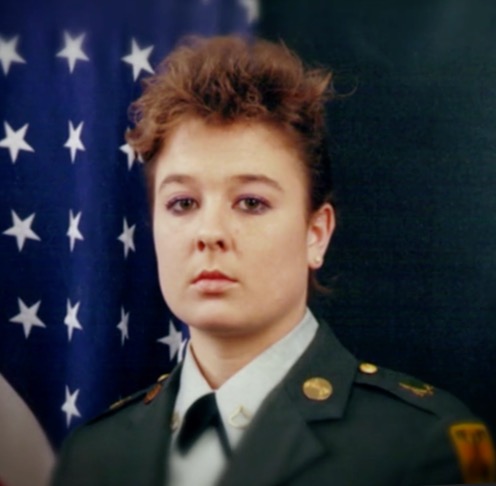
Army Soldier Erin Tynan, 21, was found dead on November 15, 1990 in her off base apartment in Barstow, California. Erin Tynan was an active duty military police officer stationed at the Fort Irwin National Training Center. She had already spent a couple years in Germany and after her enlistment was up, she was going to use her GI Bill to go back to school and get a degree in forensic social work. After she didn’t show up to work, the Army asked the Barstow Police Department to check in on her because they were concerned about a respiratory medical condition she had been diagnosed with in Germany. The Barstow Police Department went to Erin’s home and found her dead at the scene.
Barstow PD detectives determined that Erin had been the victim of a surprise sexual attack and murder. They deduced that whoever killed Erin was someone that she knew and the person was able to gain access inside her apartment and overpower her. The autopsy confirmed that Erin was assaulted, forcibly raped, strangled, and stabbed in the neck post mortem. Investigators believed that the precision stab wound in the back of the neck was the work of someone who served in the military and wanted to make sure she was dead. They first turned to Erin’s last known boyfriend William Jones. He had recently been discharged from the Army and left the day before but there was tension because the six month relationship ended. Jones informed investigators that he had left Erin with a 22 pistol for protection but she was planning on selling the gun to another Army soldier because it jammed. They did not locate the gun in Erin’s apartment and believed the killer stole the gun. Jones was eventually ruled out because his DNA did not match the DNA found at the crime scene and he was in fact physically placed in Illinois at the time of the murder. The next person they turned to was a lead they got from the Army Criminal Investigation Division (CID). CID learned that another soldier by the name of Eugene Knox was in possession of a 22 pistol and had been acting erratically. The Barstow PD spoke with Knox and learned that he had been dating Erin. No one knew the two were seeing one another. Investigators determined that Knox could not have been the killer because he was out in the field on the night of the murder.
A couple years later, evidence from an attempted murder of a young mother in Louisiana was linked to evidence in a murder case in California. The young mother had been shot in the face once with a 22 pistol but her life was spared when the gun jammed the second time the killer pulled the trigger. The murder victim, Curtis Dean, had also been stabbed in the neck in the same precise way that Erin Tynan was stabbed in the neck. The suspect in the murder of Curtis Dean was an Army soldier at Fort Irwin, Christopher Geier. Army CID immediately recognized the similarity in the knife wounds found on both Curtis Dean and Erin Tynan. They contacted the Barstow PD to inform them of what they had learned. Geier admitted to investigators that he was hired to murder Curtis Dean but did not admit to the rape and murder of Erin Tynan when confronted. But it didn’t matter because in the meantime forensic testing revealed the gun used to shoot the young mother in Louisiana who survived matched the 22 pistol missing from Erin’s apartment. And the British Commando knife Geier admitted using on Curtis Dean was consistent with the knife used on Erin Tynan. Hair samples and DNA evidence collected from the rape also matched Geier. The prosecutor determine based on evidence collected at the scene that Geier knew that Erin Tynan would be alone and vulnerable that night. He also knew that her boyfriend Billy Jones was gone. He used the ruse to buy the pistol to gain access into her apartment with one thing in mind: he wanted a sexual encounter with her. After she resisted and rejected him, he raped and strangled her.
On July 21, 1995, Christopher Adam Geier was sentenced to death for the first degree murder of Erin Tyner and Curtis Dean, and the attempted murder of the young mother in Louisiana. Investigators eventually learned that Geier’s Fort Irwin Tank Commander in the Army, Jeffrey Hunter, hired him to kill Curtis Dean. Army soldier Jeffrey Hunter was sentenced to life in prison.
Update: On August 31, 2017, Christopher Geier, 49, collapsed and died in the prison’s recreational yard. The cause of death is unknown, pending the results of an autopsy.
Investigation Discovery:
The discovery of a beautiful military police officer murdered in her own home sends police on a twisted journey for answers. -Blood and Betrayal, On the Case with Paula Zahn (S14,E5)
Editor’s note: With a cable subscription, you can download the free ID Go app and watch Investigation Discovery programming at your convenience. And for those who do not have cable, you can watch “unlocked” episodes on the ID Go app including the latest premieres. For those who prefer commercial free programming during your binge session, Prime Video has an ID channel: ‘True Crime Files by Investigation Discovery” available for $3.99 a month. It’s a compilation of older seasons but totally worth the cost if you are a true crime addict. Download the ID Go app or purchase ID True Crime Files & binge away.
On August 2, 1988, nine year old Dolana Clark vanished from Great Falls, Montana without a trace. A year later, a hunter found Dolana’s remains in the Little Belt Mountains southeast of Great Falls. She died of a gunshot wound to the back of the head. Retired Air Force Sergeant Wilfred “Bill” Morrisey lived a couple of blocks from the Clark residence and had a close relationship with the family during the years preceding Dolana’s disappearance. Police considered Morrisey a person of interest but he repeatedly denied any involvement. A few months later, Morrisey left Great Falls and eventually settled in Colorado. Dolana Clark’s disappearance and homicide case went cold.
Four years later in 2002, the Great Falls Police Department renewed the investigation into Dolana’s death. Detectives reviewed the case file including statements Morrisey had given back in 1988 and found inconsistencies. This peaked a renewed interest in Wilfred Morrisey. After an investigation, detectives developed the theory that Dolana went to Morrisey’s house the evening of August 2, 1988 after her father refused to give her money to purchase a Siamese cat on layaway at a local pet store. Investigators deduced that Dolana went to Bill and asked for money to purchase the cat. They believe Morrisey took advantage of this opportunity. Police suspected that Morrisey most likely sexually abused Dolana in exchange for the money, hit her, and realized he went too far.
Wilfred Morrisey most likely killed young Dolana Clark in an effort to hide his crimes. Police believe he placed Dolana’s body in the trunk of his vehicle and then joined family members in searching for Dolana but refused to use either of his vehicles in the search. After the search, he drove up to the mountains where he dumped her body in a remote location. Detectives learned from a friend of Bill’s that he did in fact own a gun of the same caliber used in the death of Dolana. They also learned that Bill went to the pet store and purchased the Siamese cat that Dolana wanted and kept the cat as his own. The State of Montana charged Wilfred Morrisey on September 4, 2002 with deliberate homicide. In 2005, a jury found Morrisey guilty and sentenced him to life in prison with no eligibility for parole.
Investigation Discovery:
Preview: In 1988, a nine year-old girl goes missing in Great Falls, Montana. Years after the case goes cold, a chance bus stop encounter breathes new life into the investigation, leading detectives to the horrifying truth behind the girl’s disappearance. -Little Girl Gone, Unusual Suspects (S7,E12)
Editor’s note: With a cable subscription, you can download the free ID Go app and watch Investigation Discovery programming at your convenience. And for those who do not have cable, you can watch “unlocked” episodes on the ID Go app including the latest premieres. For those who prefer commercial free programming during your binge session, Prime Video has an ID channel: ‘True Crime Files by Investigation Discovery” available for $3.99 a month. It’s a compilation of older seasons but totally worth the cost if you are a true crime addict. Download the ID Go app or purchase ID True Crime Files & binge away.