Research Reveals Pattern of Violence, Suspicious Deaths, Problematic Death Investigations, and Cover-up at Fort Hood in Texas (September 11, 2020)

(photo: Hedge Hedge Baker)

*Submitted to the House Armed Services Committee on September 11, 2020 and received no response

Dear House Armed Services Committee:

I accidentally stumbled upon Fort Hood while conducting research on the non combat deaths of female service members overseas. Fort Hood, along with a few other big Army bases in the U.S., was the common denominator in non combat death overseas. I also learned there are countless numbers of non combat deaths of male service members as well. They shouldn’t have to face death as a way to escape their situation (whether they are a victim of crime and/or it’s a mental health emergency). This issue in and of itself is its own animal and the reason we need policy enacted immediately to create a “bug out” plan for those in danger (or mental health emergencies) in overseas locations, especially if the chain of command fails them. There is no 911 overseas. Why is it the military is not accountable to the American public with the outcome of the investigations of a U.S. service member’s death? They conveniently get to hide behind the non combat death label and because they don’t disclose why or how the service member died in most cases, we are not able to make informed consent as to whether we want to join an organization that appears to hide their misdeeds in an effort to protect the reputation of the institution. I was inspired to look into the other non combat deaths of women overseas after learning the military labeled the obvious rape and murder of LaVena Johnson as a suicide. My research found this isn’t an anomaly, this is a pattern.

Non Combat Deaths of Female Soldiers in the US Military (Iraq)
Non Combat Deaths of Female Service Members in the U.S. Military (Afghanistan)
Non Combat Deaths of Female Service Members in the U.S. Military (Other Areas)
Department of Defense Press Releases (2001 to 2013) *deleted in fall of 2020
Department of Defense Press Releases (2014 to present)
Military Policy and Legislation Considerations for the Investigations of Non Combat Death, Homicide, and Suicide of U.S. Service Members
Fort Campbell Army Pfc. LaVena Johnson Died of Non Combat Related Injuries in Iraq; Death Ruled Suicide But Independent Investigation Revealed Rape & Murder (July 19, 2005)

After noticing the pattern of the same bases tied to the non combat deaths overseas, I decided to start researching crime in and around the bases in question. Crime knows no boundaries. I took a look at JBLM, Fort Bragg, Fort Hood, Fort Carson, Fort Campbell, JBER, Fort Wainwright, Camp Pendleton, etc. I not only discovered violent crime in and around the bases but I discovered suicide and homicide in garrison were significant issues as well. In late 2016, I noticed a large cluster of deaths at Fort Hood on the heels of learning about all the other violent crime, non combat death and suicide at Fort Hood since 9/11/2001. I was especially upset with the way Fort Hood handled the missing person case of Dakota Stump and how they treated his family. As a result of me taking an interest in the issues at Fort Hood, families of the fallen started contacting me. What I learned collectively was startling. Please keep in mind, each family didn’t know about my conversations with the other families as all this information is considered confidential unless they want to tell their loved ones story on my website: www.militaryjusticeforall.com

Violent Crime, Non Combat Death & Suicide at U.S. Military Bases
Fort Hood Army Pvt. Dakota Stump Found Dead on Post Three Weeks After Vehicle Accident; Family Wants Missing ‘Warrior Alert Law’ (November 3, 2016)
Violent Crime, Suicide, and Non Combat Death at Fort Hood, Texas

As a result of the intel I was getting from families of the fallen at Fort Hood, I decided I was going to start paying closer attention to what was going on at this base. It was by far the most problematic compared to any other base. But please understand Fort Hood is symbolic of the other bases; they all have these same problems. The Army is by far the worst offender concerning death and violent crime in the military. The patterns that emerged from the Fort Hood families included lack of interest in missing persons cases, mislabeling deaths, shoddy death investigations, reports and information from Army leadership that didn’t add up or make sense, evidence goes missing, computer devices and phones are erased, secretiveness, dismissiveness, misleading, and cover-up. When it comes to an untimely or dubious death, it’s hard to find a family who won’t stop fighting for their loved one until justice is served. No justice, no peace. We currently have a group of families at Fort Hood and elsewhere who want to file a class action lawsuit to get the suspicious deaths of their loved ones reopened so they can be investigated properly by independent investigators. The Army did not investigate each death as a homicide until ruled out, therefore the scene was not preserved for evidence collection; they quickly ruled the death a suicide and moved on. According to Stars and Stripes, in the last five years, we’ve lost 165 soldiers at Fort Hood and 70 of those deaths were deaths ruled suicide. I have not included all cases because a lot of families have not come forward to share their story publicly because they are heartbroken, traumatized, confused, and overwhelmed. This experience leaves the families feeling helpless. Even if the death was in fact a suicide, these families want answers, they want the truth, and they want an avenue to find the truth. I was so concerned with the number of deaths stateside at Fort Hood, I went to Washington D.C. in December 2017 to ask for help and it fell on deaf ears including the office of the chair of the House Armed Services Committee, Mac Thornberry.

Fort Hood Research for Last 5 Years:
Army Soldiers at Fort Hood in Texas Are Dying at Alarming Rates Stateside (January 1, 2016 to Present)
Washington D.C. Veteran’s Presentation on the Current Status of Forces at Fort Hood in Texas (December 12, 2017)
Austin American-Statesman: Vanessa Guillen’s Death Shines Light on More Tragedies at Fort Hood (July 28, 2020)
Stars and Stripes: Why Is Fort Hood the Army’s Most Crime-Ridden Post? (August 21, 2020)

Homicide Cases in Last 5 Years:
Unsolved Homicide: Fort Hood Army Pvt. Justin Lewis Shot & Killed Near Vacant Lot in Killeen, Texas Neighborhood (April 17, 2017)
Unsolved Homicide: Fort Hood Army Pvt. Gregory Wedel-Morales Reported AWOL; Based on Anonymous Tip, Remains Found in Shallow Grave in Killeen 10 Months Later (August 19, 2019)
Unsolved Homicide: Fort Hood Army Spc. Shelby Jones Died of Gunshot Wound at Mickey’s Convenience Store in Killeen, Texas; Shot at Nearby Night Club (March 1, 2020)
Asia Cline, Army Veteran Shaquan Allred, & Fort Hood Spc. Freddy Delacruz, Jr. Found Shot Dead at Killeen, Texas Apartment; Suspect Arrested (March 14, 2020)
Fort Hood Army Pfc. Brandon Rosecrans Found Fatally Shot Four Miles From Burning Jeep in Harker Heights, Texas; Two Arrested & Charged (May 18, 2020)
An Open Letter to the House of Representatives in Support of an Independent Investigation of the Murder of Vanessa Guillen at Fort Hood (July 7, 2020)

Cases of Significance (homicide has no statute of limitations):
Fort Hood Army Pfc. Melissa Hobart Collapsed and Died From Undetermined Cause While on Guard Duty in Baghdad, Iraq (June 6, 2004)
Fort Hood Army Sgt. William Edwards Killed Estranged Wife Erin Edwards at Killeen, Texas Home; Killed Self in Parking Lot Across Street (July 22, 2004)
Fort Hood Army Pfc. Tina Priest Died From a Non-Combat Related Incident in Iraq; Death Ruled Suicide But Family Suspects Rape and Murder (March 1, 2006)
Fort Hood Army SSG Jeannette Dunn Died of a Non Combat Related Injury in Taji, Iraq (November 26, 2006)
Fort Hood Army Cpl. Christopher Ferguson Died of Undetermined Causes; CID Claimed Death Was Accident; CBS News Reported Suicide (March 25, 2007)
Army Staff Sgt. Paul Norris Fatally Shot Spc. Kamisha Block in Murder-Suicide in Iraq; Family Requests Congressional Hearings & Investigation of Military Leadership (August 16, 2007)
Fort Hood Army Spc. Christine Ndururi Died of Non Combat Illness at Camp Arifjan in Kuwait; Family Claims She Has Not Been Sick (November 6, 2007)
Fort Hood Army Spc. Keisha Morgan Died of Non Combat Related Cause in Baghdad, Iraq; CID Ruled Suicide But Family Suspects Rape and Murder (February 22, 2008)
Fort Hood Army Spc. Seteria Brown Died of a Non-Combat Related Incident in Afghanistan; Army Said Found in Barracks With Gunshot Wound From M-16 (July 25, 2008)
Army SSG Devin Schuette Found Dead in Vehicle at Recreation Area Near Fort Hood; CID Ruled Suicide, Spouse Requests Independent Investigation (January 3, 2016)
Army Sgt. Marcus Nelson Sr. Died While in Custody at Bell County Jail in Belton, Texas; Nelson Held on Charges Stemming from 1st Cavalry Division (May 23, 2016)
On This Day, Eight Army Soldiers & One West Point Cadet Died in a Flash Flood Training Accident at Fort Hood in Texas (June 2, 2016)
Army Pvt. Paige Fontenot Briles Found Unresponsive in Vehicle at Ft Hood Housing in Texas; Despite Suicide Ruling, Family Requests Homicide Investigation (Dec. 24, 2016)
Fort Hood Army CID Special Agent Steven Hines Found Dead Behind Office Building of Apparent Self-Inflicted Gunshot Wound, Death Ruled Suicide (February 5, 2017)
Fort Hood Army Spc. Justen Ogden Found Unresponsive at On-Post Home; Family Questions Cause of Death Ruling Claiming “None of It Ever Added Up” (July 11, 2017)
Fort Hood Army Spc. Zachary Moore Died by Suicide While on Deployment to Camp Hovey, South Korea; Delay in Medical Care Contributed to Death (August 2, 2017)
Fort Hood Army MSG Alva ‘Joe’ Gwinn Led Police on High Speed Car Chase After Welfare Check Initiated; Died by Suicide During the Incident (October 12, 2017)
Timeline: Army Sgt. Kelton Sphaler & Army Vet Scott Weinhold Reported Missing at Belton Lake on Ft Hood; After Search Launched, Recovered in Water (January 21, 2019)
Fort Hood Army Spc. Mason Webber Died of Injuries Sustained Conducting Maintenance on a Bradley Fighting Vehicle at Texas Base (September 5, 2019)

Active Duty Military Legislation Recommendations:
Rep. Seth Moulton Introduces The Brandon Act to Change DoD Mental Health Policy, Pay Tribute to Fallen Navy Sailor Brandon Caserta (June 25, 2020)
Senators Cruz, Gillibrand, Grassley Offer Bipartisan Military Justice Improvement Act as Amendment to Defense Bill (July 2, 2020)
Chair Jackie Speier NDAA Provisions Address Military Sexual Assault, Intimate Partner Violence, Racial Justice, Ethics, Military Families, and DoD Oversight and Modernization (July 2, 2020)
Speier, Mullin Introduce Bipartisan ‘I Am Vanessa Guillén Act’ to Transform the Military’s Response to Sexual Violence and Missing Servicemembers (September 16, 2020)
Military Policy and Legislation Considerations for the Investigations of Non Combat Death, Homicide, and Suicide of US Service Members
Report of the Fort Hood Independent Review Committee (November 6, 2020)
Featured

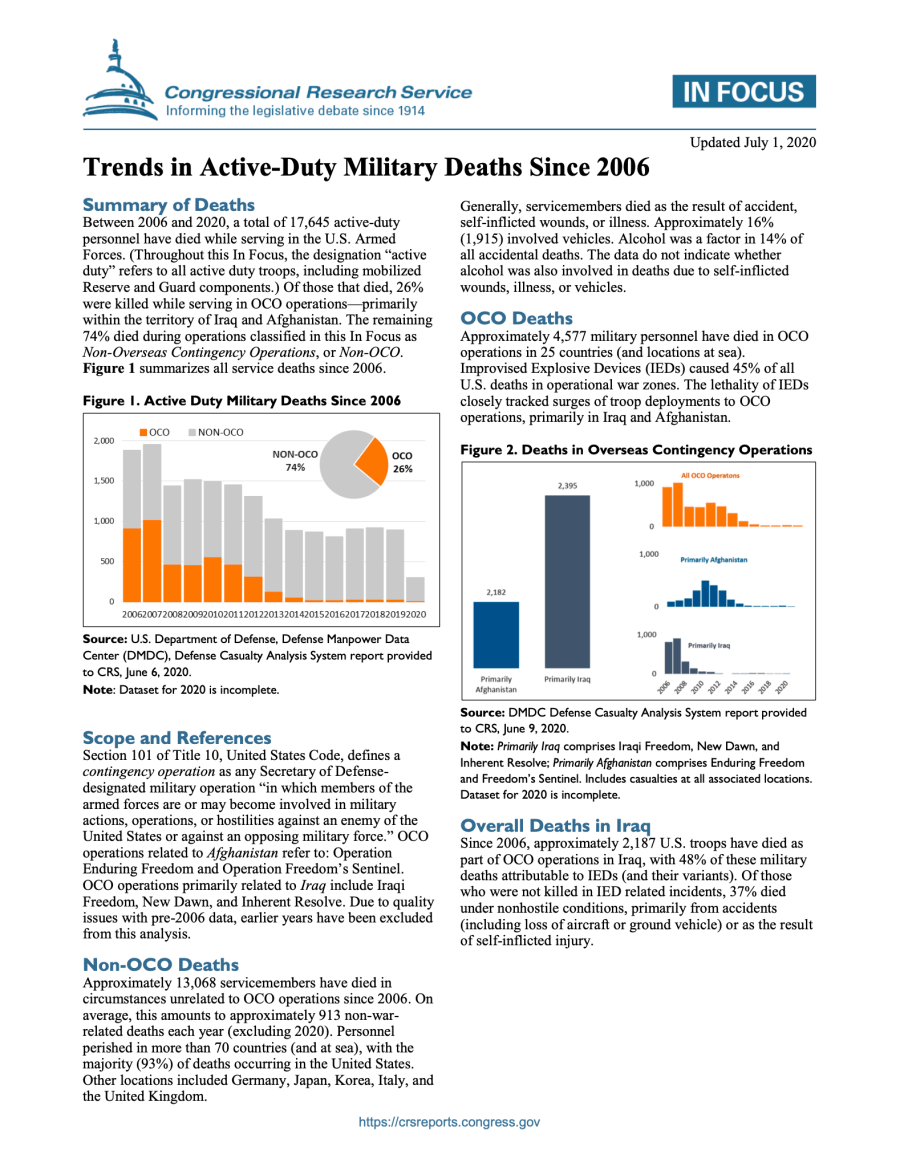
Trends in Active-Duty Military Deaths Since 2006 | Congressional Research Service (July 1, 2020)

Trends in Active-Duty Military Deaths Since 2006

Related Links:
Trends in Active-Duty Military Deaths Since 2006 (July 1, 2020)
Source: Trends in Active-Duty Military Deaths Since 2006 (July 1, 2020)
Non Combat Deaths of Female Service Members in the U.S. Military (Iraq)
Non Combat Deaths of Female Service Members in the U.S. Military (Afghanistan)
Non Combat Deaths of Female Service Members in the U.S. Military (Other Areas)
August: U.S. Department of Defense Casualties Report from Sep. 11, 2001 to 2017
September: U.S. Department of Defense Casualties Report from Sep. 11, 2001 to 2017
Military Policy and Legislation Considerations for the Investigations of Non Combat Death, Homicide, and Suicide of US Service Members

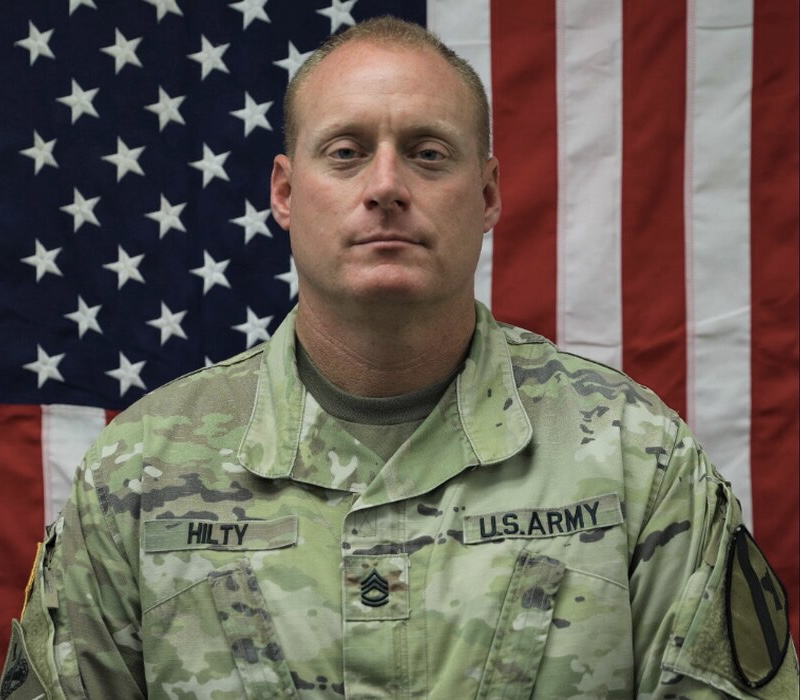
Fort Hood Army Sgt. 1st Class John David Randolph Hilty Died of a Non-Combat Related Incident in Erbil, Iraq (March 30, 2020)

Sgt. 1st Class John David Randolph Hilty, U.S. Army

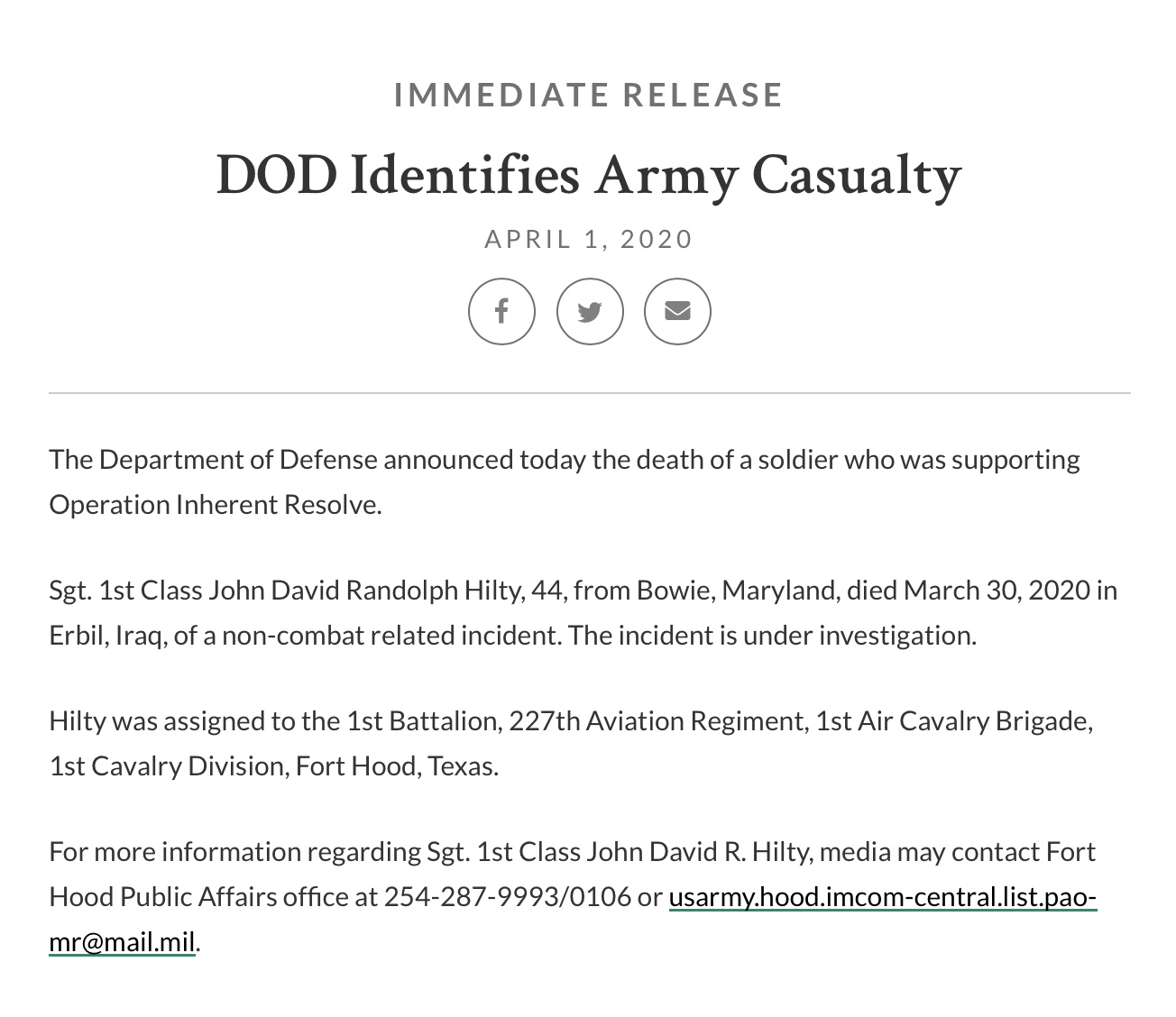
The Department of Defense announced today the death of a soldier who was supporting Operation Inherent Resolve. Sgt. 1st Class John David Randolph Hilty, 44, from Bowie, Maryland, died March 30, 2020 in Erbil, Iraq, of a non-combat related incident. The incident is under investigation. Hilty was assigned to the 1st Battalion, 227th Aviation Regiment, 1st Air Cavalry Brigade, 1st Cavalry Division, Fort Hood, Texas.

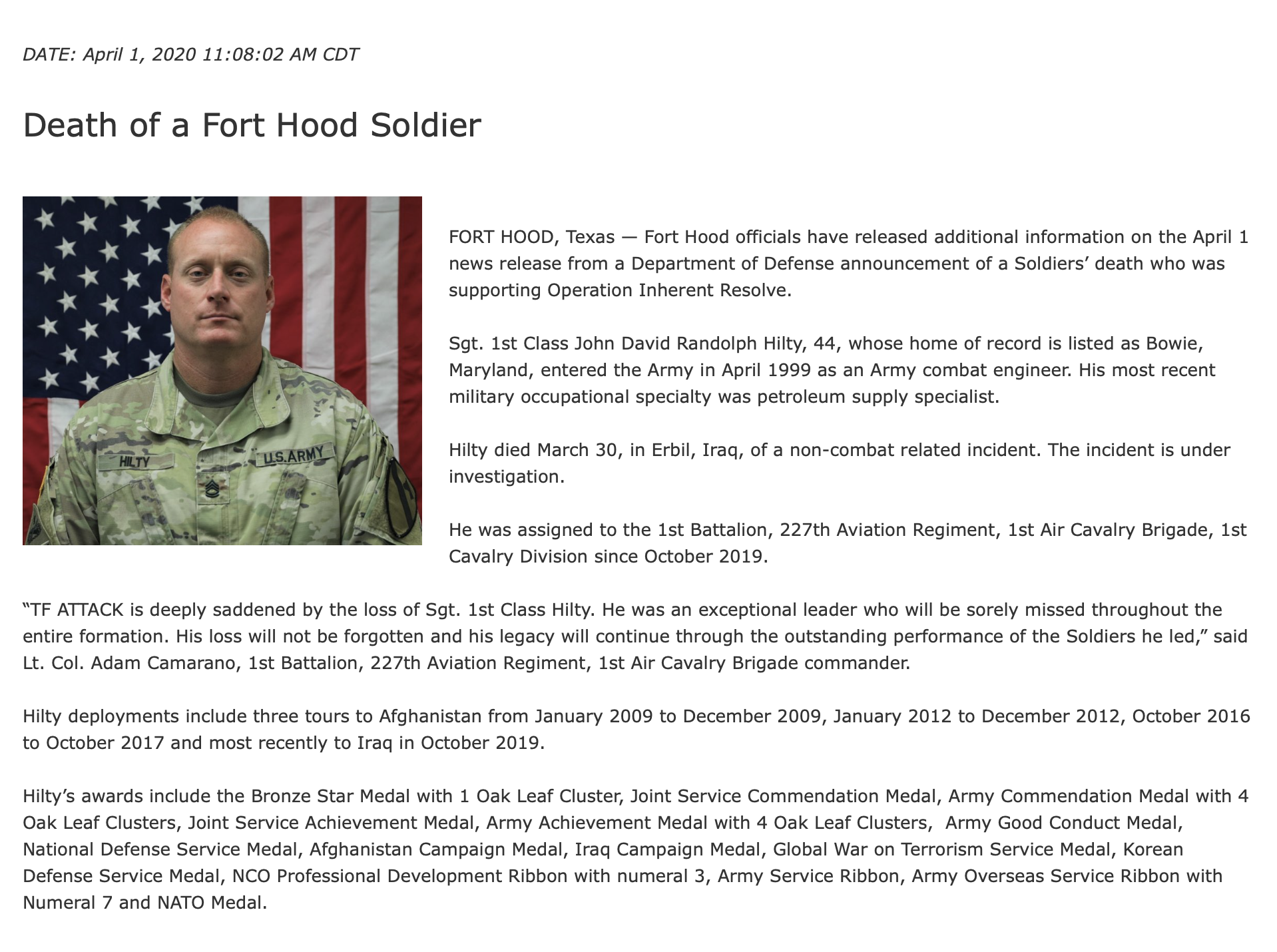
Sgt. 1st Class John David Randolph Hilty entered the Army in April 1999 as an Army combat engineer. His most recent military occupational specialty was petroleum supply specialist. Hilty’s deployments include three tours to Afghanistan from January 2009 to December 2009, January 2012 to December 2012, October 2016 to October 2017 and most recently to Iraq in October 2019.

John Hilty (Facebook)

Related Links:
DOD Identifies Army Casualty (April 1, 2020)
Death of a Fort Hood Soldier | John Hilty
Fort Hood: Soldier dies in Iraq
Fort Hood soldier dies in Iraq
Soldier from Bowie dies in Iraq
Fort Hood: Soldier dies in Iraq
Fort Hood soldier killed Monday is identified
Bowie Man Dies Serving With US Army In Iraq
Non-Combat, Non-CoVid Death of Soldier in Erbil, Iraq
Army soldier dies in Iraq, identified as Maryland native
Pentagon IDs Soldier Who Died During Iraq Deployment
DoD identifies soldier killed in non-combat incident in Iraq
Pentagon IDs Soldier Who Died During Iraq Deployment
Army sgt. 1st class who died in non-combat incident identified
Fort Hood soldier dies in non-combat related incident in Iraq
‘He was an exceptional leader’ | Soldier from Bowie, Md. dies in Iraq
Fort Hood-based soldier’s death is seventh for coalition in Iraq this year
Bowie resident dies in Iraq supporting Operation Inherent Resolve, incident was not combat-related
Gold Star Father Talks Of Isolation On Memorial Day During Pandemic
Army Soldiers at Fort Hood in Texas Are Dying at Alarming Rates Stateside (January 1, 2016 to Present)

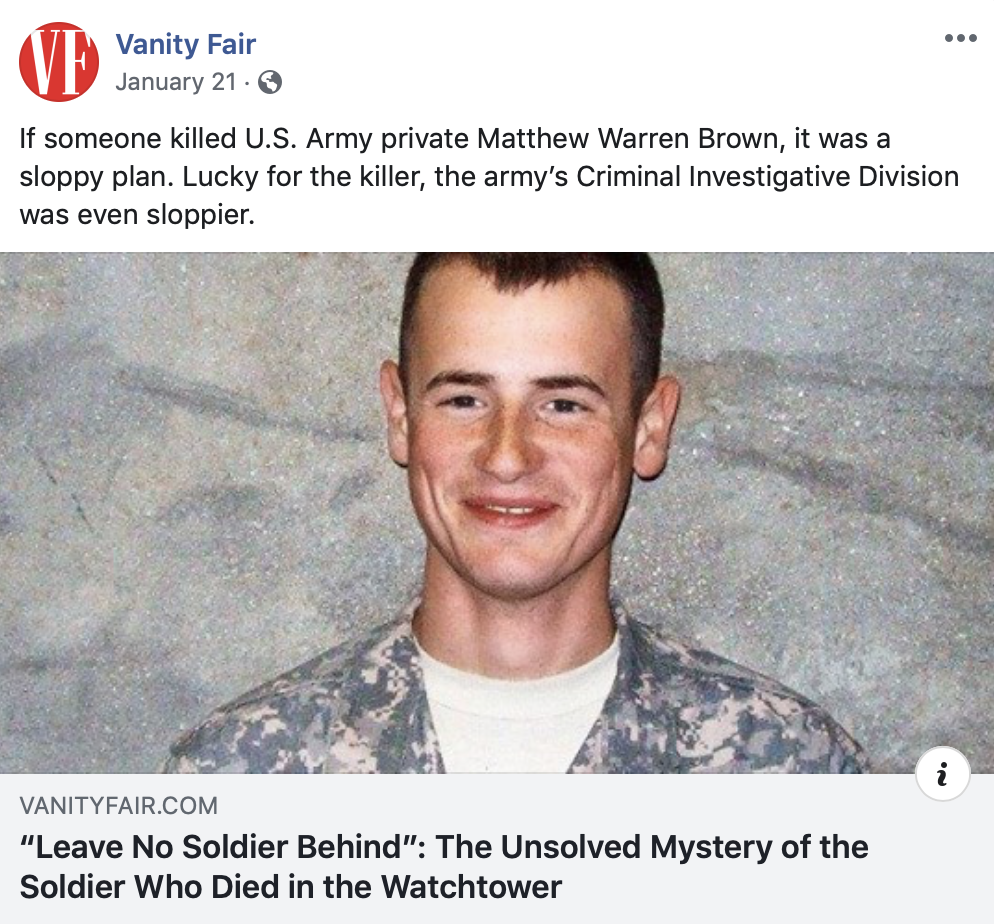
“Leave No Soldier Behind”: The Unsolved Mystery of the Soldier Who Died in the Watchtower | Vanity Fair (January 8, 2019)

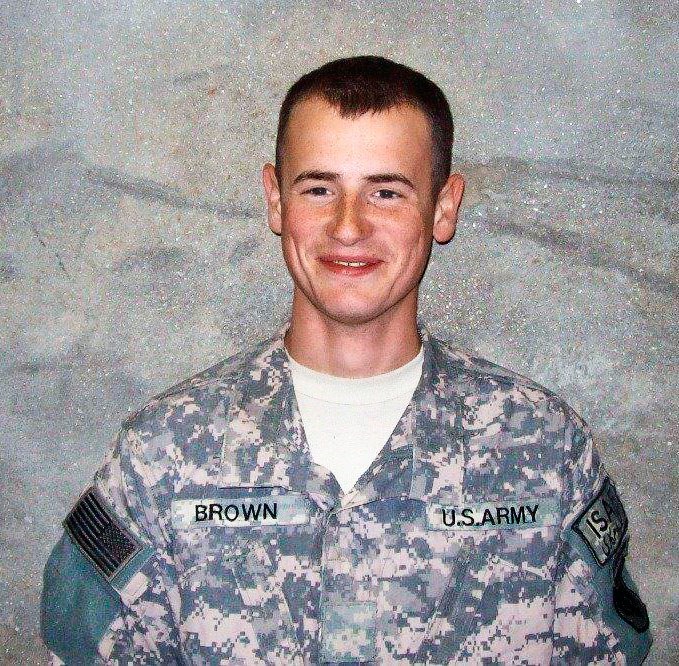
Matthew Brown Army.png
Matthew Warren Brown, U.S. Army (via Vanity Fair Facebook)

Is the Army botching its investigations into noncombatant deaths?

I. The Gun Tower

“On the morning of May 11, 2008, a U.S. Army private second class named Matthew Warren Brown died of a single gunshot wound to the head while manning a watchtower at a forward operating base in Afghanistan. Brown was 20 years old. He was a skinny, all-American kid, a bit aimless but affable and unassuming. He was a good guy. You could see it in his face. At his funeral back home in Pennsylvania, some 200 people showed up. In the aftermath of Brown’s death, army investigators created files about the circumstances. The bullet that killed him was fired from his own weapon, an M4 carbine. He was working the six A.M. shift, alone in the watchtower by the fortified main gate to the base. The tower was known as the Gun Tower. It was made of concrete, and looked medieval when viewed from the outside. It was three stories tall. On the second and third floors it had openings covered with two-piece Plexiglas windows, some of which had broken off and been left lying in shards on the floors.” Read more from Vanity Fair here.

Related Links:
Pvt Matthew Warren Brown | Find A Grave
DoD Identifies Army Casualty: Pvt. Matthew W. Brown
Army Pvt. Matthew W. Brown | Honor the Fallen
Fort Bragg Soldier dies in Afghanistan
Soldier from Fort Bragg dies in Afghanistan
Fort Bragg soldier dies from injuries in Afghanistan
Zelienople soldier killed in Afghanistan, father says
Soldier from Zelienople killed in Afghanistan
Zelienople soldier who died in Afghanistan buried today
“Leave No Soldier Behind”: The Unsolved Mystery of the Soldier Who Died in the Watchtower | Vanity Fair
Family of soldier found dead in Afghanistan in 2008 says he did not commit suicide as claimed
Family of soldier who was found dead in Afghanistan watchtower in 2008 says he did not commit suicide, as the military claims, and had told them he feared he would be killed over his role in a drug ring that was being run on-base by a ‘thug’ sergeant
Army Pvt. Matthew Brown Died As a Result of a Non-Combat Related Incident in Afghanistan; Death Ruled Suicide But Family Alleges Murder in Vanity Fair Publication (May 11, 2008)

Crime Junkie Podcast Featured the Suspicious Deaths of LaVena Johnson & Tina Priest in ‘Conspiracy: Women in the US Military’ (October 22, 2018)

Crime Junkie Podcast

“In 2010, statistics came out that 120 female U.S. soldiers stationed in Iraq had died. Half of those deaths were reported to be non-combat related. 30 those non-combat related deaths were ruled suicides, but there is evidence to suggest many of them may have actually been murders. In this episode, we dive into the case of LaVena Johnson and other women of the U.S. military who died very suspicious deaths during Operation Iraqi Freedom.” –Conspiracy: Women in the US Military, Crime Junkie Podcast (10/22/18)

Related Links:
10 Unsolved Military Cases
Crime Junkie Podcast (website)
Crime Junkie Podcast (Facebook)
Crime Junkie Podcast (Twitter)
Conspiracy: Women in the US Military | Crime Junkie Podcast (website)
Conspiracy: Women in the US Military | Crime Junkie Podcast (stitcher)
Conspiracy: Women in the US Military | Crime Junkie Podcast (Bullhorn)
Conspiracy: Women in the US Military | Crime Junkie Podcast (Podbay)
Conspiracy: Women in the US Military | Crime Junkie Podcast (Player FM)
Conspiracy: Women in the US Military | Crime Junkie Podcast (Poddmap)
Conspiracy: Women in the US Military | Crime Junkie Podcast (RadioPublic)
Non Combat Deaths of Female Service Members in the U.S. Military (Iraq)
Army Soldiers at Fort Hood in Texas Are Dying at Alarming Rates Stateside
Army Pfc. LaVena Johnson Died of Non Combat Related Injuries in Iraq; Death Ruled Suicide But Independent Autopsy Revealed Rape & Murder (July 19, 2005)
Army Pfc. Tina Priest Died From a Non-Combat Related Incident in Iraq; Death Ruled Suicide But Family Suspects Rape & Murder (March 1, 2006)
‘The Silent Truth’ Documentary: The Rape, Murder & Military Cover-Up of Army Pfc. LaVena Johnson in Iraq (July 1, 2014)
The Strange & Unexplained: ‘The Biggest Suspicious Unsolved Military Mysteries’
15 Active Duty Cases That Beg for Prevention Efforts, Military Justice Reform, and the End of the Feres Doctrine
15 Movies & Documentaries That Expose the Broken Military Justice System
Military Policy and Legislation Considerations for the Investigations of Non Combat Death, Homicide, and Suicide of US Service Members

Army Reservist Sgt. Christina Shoenecker Died of a Non-Combat Related Incident in Baghdad, Iraq (February 19, 2018)

Christina Schoenecker
Sgt. Christina Schoenecker, U.S. Army Reserve

Army Reservist Sgt. Christina Schoenecker, 26, died of a non-combat related incident on February 19, 2018 in Baghdad, Iraq. Sgt. Schoenecker was supporting Operation Inherent Resolve on behalf of the 89th Sustainment Brigade, 451st Expeditionary Sustainment Command in Wichita, Kansas. Sgt. Schoenecker’s home of record is listed as Arlington, Kansas. According to Honor the Fallen at Military Times, Sgt. Schoenecker enlisted in the military in May 2009 and served as a human resources specialist. At the time of the press release, the incident was under investigation which is typical with any non combat death but an official cause of death has not been determined or publicized by authorities. The site Popular Military shared that a source close to them in Iraq in an unofficial report believed it was a suicide. This could not be confirmed in other media reports.

In the News:

The body of U.S. Army Sergeant Christina Marie Schoenecker is escorted from the Hutchinson Airport to Elliot Mortuary by the Patriot Guard, Hutchinson Police and the Hutchinson Fire Departments. SGT Schoenecker died February 19, 2018, from a non-combat related incident, in Baghdad, Iraq at the age of 26. She will be buried in her hometown of Arlington, Kansas, Monday, March 5, 2018. -The Hutchinson News (March 2, 2018)

U.S. Army Sergeant Christina Marie Schoenecker was buried at Arlington Cemetery, Arlington, Kansas on Monday, March 5, 2018. SGT Schoenecker died February 19, 2018, from a non-combat related incident, in Baghdad, Iraq at the age of 26. -The Hutchinson News (March 5, 2018)

Related Links:
DoD Identifies Army Casualty
Honor the Fallen: Sgt. Christina M. Schoenecker, U.S. Army Reserve
Christina Marie “Tina” Schoenecker | 1992 – 2018 | Obituary
Kansas soldier dies in Iraq
Kansas soldier dies in non-combat incident in Iraq
Female soldier dies in accident in Iraq
US soldier dies in non-combat incident in Baghdad
SGT Schoenecker’s body returns home
Army Sgt. Christina M. Schoenecker honored in dignified transfer Feb. 22
Army identifies soldier killed in noncombat incident in Baghdad
Army Identifies Sergeant Who Died While Deployed Supporting ISIS Fight
Kansas soldier dies in non-combat incident while supporting ISIS fight in Iraq
U.S. Army sergeant dies in Iraq, unofficial report suggests it was suicide
Mystery surrounds ‘non combat’ death of female soldier battling ISIS in Iraq as her body is returned home and Department of Defence announce an investigation
IGTNT: “She will be sorely missed” | Daily Kos
Funeral held for KS soldier who died last month in Iraq
Family and friends celebrate the life of Christina Schoenecker
Family, friends gather to honor fallen Arlington soldier
SGT Christina Marie Schoenecker’s burial service
Latest U.S. military deaths in Afghanistan, Iraq
On Memorial Day: Three stories to remember the soldiers we have lost
CJTF-OIR reflects on significant military gains, fighting ISIS in 2018
Non Combat Deaths of Female Service Members in the U.S. Military (Iraq)
Military Policy and Legislation Considerations for the Investigations of Non Combat Death, Homicide, and Suicide of US Service Members

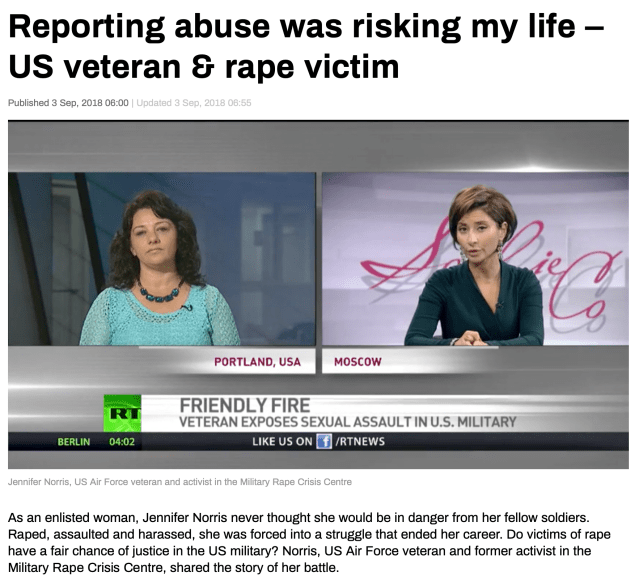
Reporting abuse was risking my life – US veteran & rape victim | Sophie and Co | RT (January 12, 2018)

Reporting abuse was risking my life – US veteran & rape victim

Correction: Jennifer Norris is not an advocate for MRCC. She left the organization in March 2014.

We hear a lot about #weinstein and the latest, but Jennifer Norris, who served in the US Air Force, has been talking about sexual assault for years. And in the military, reporting rape means endangering yourself. Watch this brave woman speak here https://t.co/1ipeI3SWP6 pic.twitter.com/TAjiVjmdDS — SophieCo (@SophieCo_RT) January 12, 2018

As an enlisted woman, Jennifer Norris never thought she would be in danger from her fellow soldiers. Raped, assaulted and harassed, she was forced into a struggle that ended her career. Do victims of rape have a fair chance of justice in the US military? Norris, US Air Force veteran and former activist in the Military Rape Crisis Centre, shared the story of her battle.

Sophie Shevardnadze: Jennifer Norris, retired U.S. Air Force veteran, former activist in the Military Rape Crisis Centre, who herself had firsthand experience of sexual assault in the military, thank you for joining us on this programme. I want to start right away, the first time this happened, you were drugged by your recruiter – did he trick you into having sex with him? Do you have any recollections of how the incident happened?

Jennifer Norris: When I look back on this incident I realise that I was actually tricked by this man into going to the party to begin with. He had told me that there was a new recruit party for other recruits. I was excited to go and meet them because they would understand exactly how I felt. So he had ill intentions from the gitgo. When I got there there were no new recruits, I was the only one.

SS: How many times were you subjected to sexual assault or abuse? Was it just one case?

JN: It started with that one case and I thought that maybe it would be over after that, that I was just unlucky at the wrong place at the wrong time, so I pushed forward. But, unfortunately, as I entered the military service it happened again and again, and again within the first two years of service. 

SS: Tell me this – why didn’t you report it straight away, after that first time?

JN: I didn’t report the first time because I hadn’t even gone to basic training yet and I didn’t really know what to say. I didn’t even know where to go: if I was supposed to go to a commander in the military, if I was supposed to go to the police department. I was completely clueless as to what sexual assault, rape and harassment were at that time. So I just tried to soldier on, move on with the career that I was looking for doing for at least twenty years.     

SS: So what happened after you were assaulted? What did you feel? Was it guilt? Was it shame, uncertainty? 

JN: It used to be shame because I used to feel like an idiot for going to this person’s party. But after years of counseling and working with rape victims’ advocates I learnt that predators operate in much the same way: they are very manipulative and they will set you up for an attack or they will take advantage of an opportunity. So now I realise it was a calculated crime but it took me years to realise that.  

SS: So for those who haven’t faced this kind of ordeal, but danger is always there, tell us how these manipulators actually trick their victims into it? How do they lure you in?  

JN: I think, they do what you would call ‘grooming’, they make you believe that they are trustworthy and that they are going to take care of you, and it almost seems that it is too good to be true. When you are naive, you don’t necessarily realise that not everybody is speaking at face value. So as an 18-year-old or even a 24-year-old it’s easy to fall prey to the niceties because you don’t know that there’s evil lurking behind it. And I think that’s the real danger of this kind of people and how they operate is that they are able to get to us based on the trust that’s been established. In the military we are depending on each other in every way, especially in trust.   

SS: So how old were you when that happened? Like, eighteen?

JN: No, I was actually 24. I had already graduated from college, as a social worker I worked in the field for a couple of years. As a case manager I worked on a suicide crisis hotline, then I decided I wanted to go and get my master’s degree and the military offered the GI Bill that could help me accomplish those goals. So that’s the No.1 reason why I joined aside from being patriotic and wanting to give back and being involved in something that was bigger than myself. I was completely clueless as to what was in store.    

SS: Ok. One woman who went through a similar ordeal – Air Force Sergeant Marti Ribeiro said, “The military has a way of making females believe they brought this upon themselves.” Did you feel that as well? 

JN: Yes.

SS: Did you blame yourself for what happened?

JN: I did for the longest time especially with the recruiters incident. If I knew as soon as I walked through that door that there was danger but it was too late to turn back… That particular incident taught me a lot of how to take care of myself in the future. Unfortunately, if you are working for someone who’s assaulting you you can’t escape them. So now I don’t have shame or blame or any of that stuff any more as far as what I did. All I did is go to work in uniform and these people took advantage of their power and opportunity. That’s what we’re trying to change, it’s taking more seriously if someone does in fact abuse their power in that kind of setting.

SS: I’m trying to figure out the psychological aspect of it – how did the military structure make you feel guilty about what had happened and not the other way round? 

JN: I understand. So, given the way that you report currently in the military is not that you go to a police office to report a crime. You are supposed to report it to your commander. In my particular case and in a lot of soldiers’ cases the commander also has a relationship with the perpetrator and he may have known the perpetrator way longer than he knows you. So what it does it creates an atmosphere of intimidation that when you see your commander hanging out with the guy who assaulted you, then you feel like “Oh, wow, he’s not going to take me seriously, it looks like they both are really good friends”. And then when you do go ahead and do a report the first thing the defense attorney start looking into is whether or not you did this, you did that, how did you conduct yourself. They immediately go into that you shouldn’t have been in this place, if you hadn’t that wouldn’t have happened. They could have done that to me too. But it’s not our fault that we thought we were attending what we were supposed to be.        

SS: Jennifer, I’m thinking, there are also other women in the military, they are compassionate  creatures, you could have shared your story with them, they certainly would have understand what you went through, especially if this happens all the time. Maybe there were other women alongside you who were actually subjected to sexual assaults – did you share your story with any of your female peers?

JN: What I’ve learnt is that, first of all, I was one of very few women in my squadron. There may have been, if we were lucky, three of them and one of them is administration personnel, and maybe there was another one in another shop. But I was the only female working for satellite communications in combat communications. So, no, I didn’t have other females that I could turn to and say “hey, this has happened to me”. As the matter of fact, I didn’t want anyone to know that this had happened to me because I didn’t want to be judged. Unfortunately, it appears that once people learn that you’ve reported a sexual assault or may have been involved in an incident they become scared of you instead of being scared of the perpetrator. They think that you are going to be hypersensitive too if they swear or if they say something, you know, offensive when in fact it’s not going to be that way at all. So there’s a culture of fear built up in the military. And I think that’s why they want to automatically blame it on a woman because if she goes away the problem goes away and they can get back to work as normal. 

SS: Human Rights Watch reports a very dire picture of what happens to the victims of sexual assault. They say that these people are being “spat on, deprived of food, assailed with obscenities, threatened with ‘friendly fire’ during deployment…discharged for misconduct”. Is it true? Is it really that dangerous to come forward?

JN: It is. In some cases it just depends on your situation. If you are isolated you are in a way more danger than, say, other people would be on some big base that has security forces in a JAG office. But if you are in some place like the Azores or some other random location across the world all you have is the people that are with you. Then yes, you could be in grave danger if in fact someone harms you and threatens you and says that if you say anything they will kill you. It happens, I’ve researched this. We have had non-combats deaths occur overseas that include homicide and unsolved cases that nobody is talking about. That’s what we are trying to tell people is…

SS: Did you get any threats? Were you threatened?

JN: Yes, not only was I threatened, but I was physically beaten after I reported by one of the perpetrators’ friends. The entire squadron turned on me. I was automatically the liar. Even though they didn’t know the circumstances and even though we did have proof and we were able to move forward with two of the four cases the other people in the squadron didn’t know what happened and they believed the perpetrator who was able to tell them the story while I was at some other squadron waiting for the case to go through.

Reporting abuse was risking my life – US veteran & rape victim

SS: But see, for me it’s just mind-bogglingthat you were standing there harassed, assaulted in the open with other people standing by and not interfering. How come no one interfered? Why didn’t troops come forward for a fellow soldier? 

JN: Well, I did have a couple of people that had my back along the way. But it felt more like it was a culture of fear, like, nobody dared to stand up to those who were higher-ranking if they were the ones that were doing the harm because they were afraid it would have backlash on their career. Now I don’t have respect for those people who didn’t stand by and take a stand and support the ones who were actually being harmed. But along the way there were some silent people that came up to me and said that this person had done this to them, that that person had done that to them etc. So people would open up along the way but they wouldn’t take it as far as I did and actually report. Although I must say it was because of the senior master sergeant that I finally confided in. He’s the one that finally convinced me to report the four individuals to the commander. 

SS: Iraq veteran Chantelle Henneberry says she was less scared of enemy fire than the men she served with. She recalls she would drink less water to avoid going to the bathroom in the night, she was so terrified of being harassed – why do women even join the army despite hearing all these horrific stories?

JN: I think that it boils down to that people don’t think it would happen to them. And that’s just typical of society, you don’t think that bad things are going to happen to you. I had the same mentality before I joined too. So they want to follow their dreams and they want to do what they want to do and some of us dream of being in the military, retire, do great things and move women forward. So I think that’s normal, that’s ok.

SS: The United Nations is speaking out about the problem of sexual assault in the U.S military, saying it needs to ‘ensure effective prosecution of offenders’. Is this going to make any difference?

JN: Absolutely. Right now, the prosecution rate for sexual assault is less than 10% compared to the civilian world which is at least 40%. That’s what we are trying to say – if people are raped or assaulted and then report we would like these cases to be taken seriously. Right now, like I spoke to you earlier, you have to report the crime to your commander. They are not legal professionals, they are no Special Victims Unit. They do not understand how these things work. And what we want is to be able to report to a police department or a law enforcement professional, someone who understands how these people are working and cannot be manipulated by them. 

SS: For years, activists and lawmakers in the United States have tried to change this protocol – but leaders in the military are against bringing civilians into bases to investigate alleged assaults – why are they against it? And why are they winning this debate?

JN: Because they are able to protect their institutions if they are able to keep everything in house, and that’s exactly what they do. They want to stamp it out before it gets out to the public whereas we want this out in the public so that people know who these offenders are and can be on alert. They don’t just offend people in the military, they offend people in our communities as well – their wives, their children… So it’s not just a military issue, it’s a societal issue and I think, it would be way more effective if everyone reported to a police department where all the crime data was kept in one place.

SS: Do you think completely removing sexual assault cases from the military chain of command would actually solve the problem?

JN: I think standardizing the justice process in general to have it synced with the civilian society, meaning data basis connected, whether it’s the civilians that try the perpetrator or it’s the military that tries the perpetrator… Everyone should be talking so that we can connect the dots on who’s doing what where because it makes it a little bit more complicated with the military personnel who can transfer all over the country and to different parts of the world. We need all the data collection to be put into a system so we can actually track what these people have done through the course of time and be able to move forward with cases that may win as opposed to he-said, she-said incident. 

SS: So, Jennifer, I’m thinking, maybe there should be more women in the U.S. military? If there were more women in high-ranking positions being able to kick butt especially to the men who are potential assaulters? What do you think? Should there be more women in the U.S. military?

JN: That would be ideal. Although we have to take into account that over a half of victims in the military, actually 53% of them are males. So this is not a female issue necessarily. We are at higher risk because we’re seen as a weaker sex. But predators do not discriminate: they are harming both men and women in the military. A lot of media have been trying to cover the issue but we have just not been able to get the footing with it, but people need to know that over half of the victims are men in the military. 

SS: There are crazy numbers: according to HRW, only 5 percent of sexual assault cases in the U.S. military lead to convictions of the perpetrators. What happened to the man who assaulted you? Was he punished?

JN: Yes. The recruiter skipped town after I threatened to report him to the commander, unfortunately. So we couldn’t do anything with that case. The technical instructor that assaulted me in Keesler, Mississippi – we had no jurisdiction over because he was active-duty and I was considered National Guard. And the other two were both National Guard members who worked with me, and we were able to move forward with cases. But by the time it went up the chain of command it got minimized from sexual assault to sexual harassment they both retired with full benefits after 20 years of service. 

SS: The Pentagon keeps saying that programs are implemented, changes are being made, and the problem is being solved – is it all a lie?

JN: I don’t think it’s all a lie, but I definitely think they sway the media to see things in a certain way. For example, although the numbers may have gone down from 26 thousand to roughly 19 thousand in the last couple of years and they’re bragging about a 30% increase in the reporting it means nothing. And what the civilian world doesn’t understand is that in the military you can report a crime under two different guises: either restricted or unrestricted. If it’s restricted that means that nobody is supposed to know about it including your commander so you can go forward and get some help. If it’s unrestricted then it turns into a full-blown investigation if, in fact, your commander agrees to move forward with the case which is another sticking point. So people need to realise that although the reporting has gone up it’s been restricted reporting which is not helping us catch these criminals. They are still not being reported. You might get some help but they are still moving along in their careers assaulting other people while the latest victim is just getting help. 

SS: You now work with those who went through the same as you did – are you seeing more cases of women speaking out, has the situation gotten better?

JN: I think awareness has definitely gotten better around the issue. There’s way more talk within the military and outside in the veteran community to address getting help after someone has been traumatized by an incident like this. So that has definitely improved. I actually benefited greatly from programmes that have come up as a result of our advocacy with military sexual assaults. So for that I’m thankful. As far as the military justice system and policy goes it’s the same thing it has always been – nothing has changed whatsoever. As far as the court issue we’ve been trying to address which is taking the commander out of the decision-making process as far as you can move forward with the case. We just want law enforcement professionals, detectives and investigators to deal with these cases, not a commander who’s great at war but has absolutely no idea how the legal process works and what sexual assault is. I shouldn’t have reported it to my boss.

SS: What do you do for the victims, how are you helping them?

JN: What I do is I empower them. When I did worked as an advocate I actually would help them deal with their cases as they were moving along in the process and I noticed the same patterns over and over. What I do now (and it was actually hard to do it before we could change things) is focus on helping them to heal despite not being able to get justice, trying to find a place of faith and comfort in yourself to know that you didn’t do anything wrong. It’s just the system that isn’t working well and it needs to be changed, and there’s nothing we can do about it right now except to take care of ourselves and hope for the best in the future. 

SS: You mentioned earlier that it’s not just men-women problem and that 51% percent of those assaulted being men. I’ve read a recent survey by the American Psychological Association that says the number of men facing sexual assault in the military is 15 times higher than reported by the Pentagon. That would mean up to 210 thousand men are assaulted in one year. Is that number correct? Is it a right calculation? And do you help men as well? 

JN: Yes, whoever needs help and comes to me – I will assist them as best as I can. That actual study from the American Psychological Association was retracted. They used not a very good way to determine those numbers. It wasn’t correct so it was retracted. It’s not actually that high. But it doesn’t really matter. It’s still high enough that it should be a concern. The actual number that I shared with you is that roughly 53% of victims of military sexual assault are males. It’s not a female soldier issue, it’s a predator issue and that’s what we’re trying to tell people. 

SS: Jennifer, thank you so much for sharing this story with us. Thank you so much for empowering women who want to do the same thing that you did. Thank you so much for being so brave and outspoken. And I hope that you’ll win over Pentagon. 

JN: Thank you.

Related Links:

West Virginia Air National Guardsman TSgt. David Board Died of a Non-Combat Related Incident in Kuwait (August 2, 2017)

Screen Shot 2017-08-05 at 7.19.34 PM
TSgt. David Board, West Virginia Air National Guard

Air Force TSgt. David Board, 49, died in a non combat related incident on August 2, 2017 in Kuwait. TSgt. Board was supporting Operation Inherent Resolve on behalf of the 130th Airlift Wing at McLaughlin Air National Guard Base in West Virginia.

Related Links:
DoD Identifies Air Force Casualty
Pentagon identifies Air Guardsman who died in Kuwait
Airman Who Died in Kuwait in Non-Combat Incident Identified
WV Guard airman from Barboursville dies in Kuwait
West Virginia Air National Guard Airman Dies in Kuwait
Airman killed in Kuwait incident identified
US airman casualty in Kuwait identified as Tech. Sgt. David Board
National Guardsman from Barboursville who died in Middle East remembered fondly

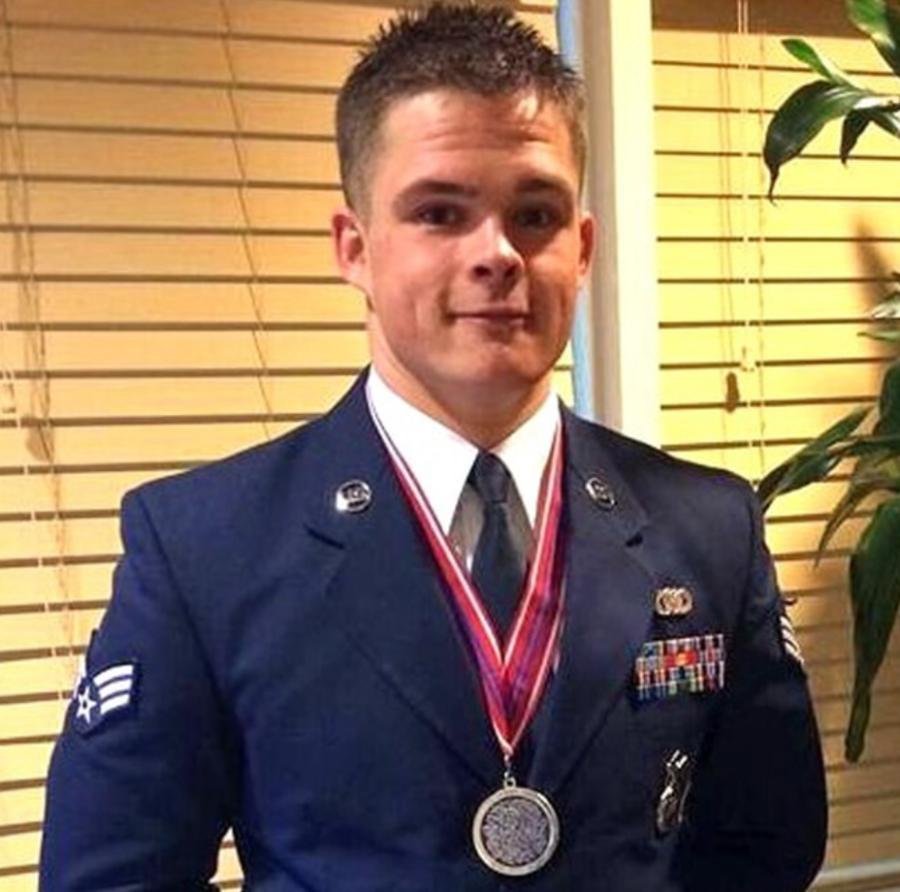
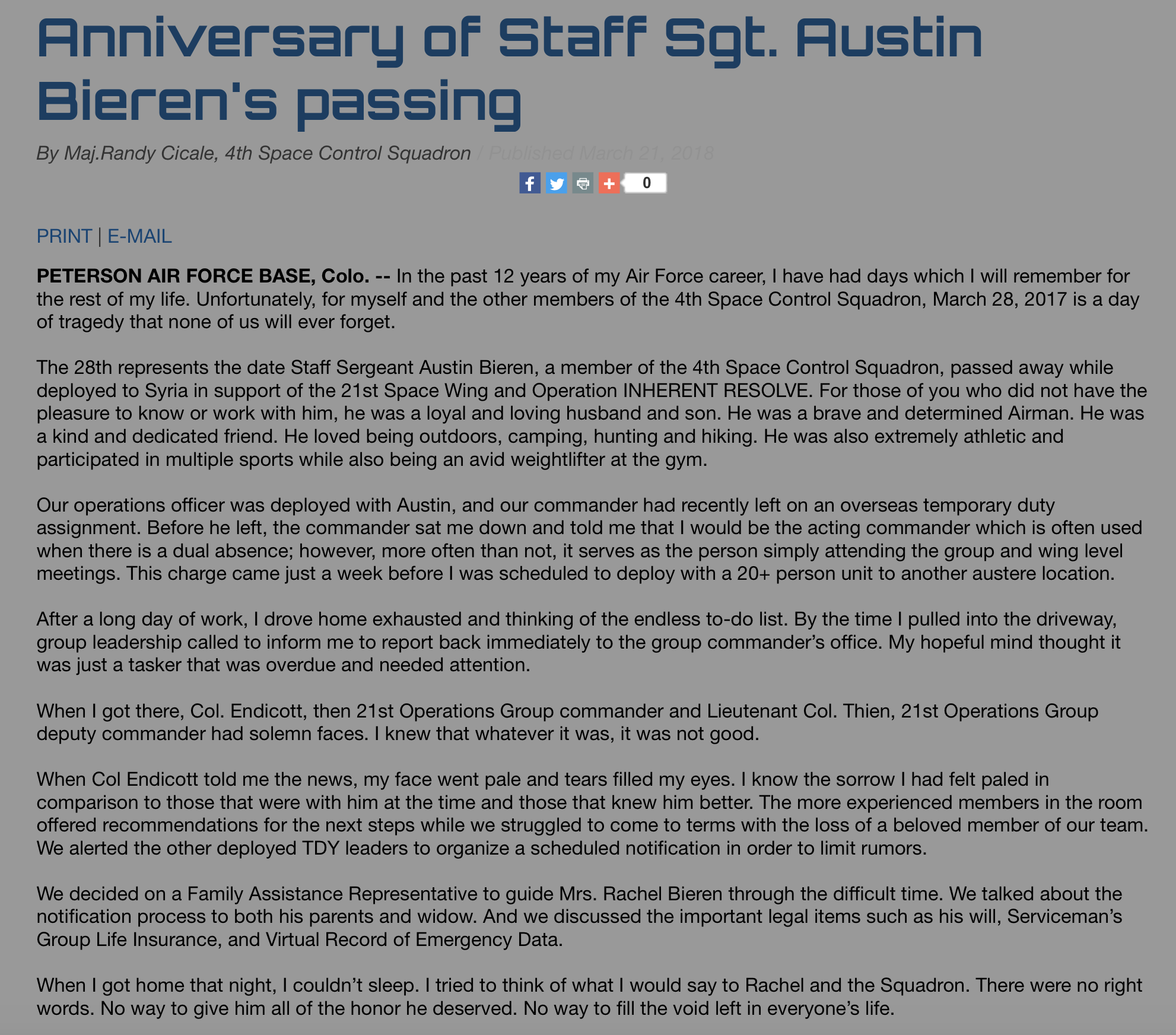
Peterson Air Force Base Staff Sgt. Austin Bieren Died of a Non Combat Death in Syria; Suspected Natural Causes, USAF Would Not Elaborate (March 28, 2017)

The Department of Defense announced today the death of a security forces airman who was supporting Operation Inherent Resolve. Staff Sgt. Austin Bieren, 25, of Umatilla, Oregon, died March 28 in northern Syria in a non-combat-related incident while deployed in support of combat operations. He was assigned to the 21st Space Wing at Peterson Air Force Base, Colorado. AP said in a statement from the base, Bieren died from “suspected natural causes.” Wing commander Col. Douglas Schiess says Bieren was “a beloved member of the team and will be sorely missed.” Bieren graduated from Umatilla High School in 2010 and entered the Air Force that November. He had been stationed at Peterson since June 2014.

According to the Burns Mortuary of Hermiston obituary, Austin Leo Bieren, 25, “was born on January 7, 1992 in Pendleton, Oregon to John Timothy Bieren and Tracy Ann (Gibson) Finck. Austin loved to hunt, fish, and hunt some more. He enjoyed anything and everything outdoors, the true definition of a mountain man. He avidly worked out and did everything to stay healthy and active. After basic training, he married his wife, Rachel (Kennedy) Bieren, and they both moved to Minot, North Dakota and were there for three years, and then moved to Colorado Springs where Austin worked at Peterson AFB. He was deployed three times.”

Notable Quotes:

“The Air Force did not elaborate on Bieren’s cause of death.”Denver Post (March 30, 2017)

“It’s tragic that we lost that young man in kind of a strange way for a 25-year-old, but nonetheless space is embedded in everything we do. So anywhere you have American military people, you’re going to have space.” (Air Force Gen. John Hyten)Fox News (March 31, 2017)

Col. Doug Schiess, 21st Space Wing commander mentioned Staff Sgt. Austin Bieren, a member of the 21st SW who died while serving in Syria. “We brought him home to his family, took care of his family and still are.”21st Space Wing, USAF (June 21, 2017)

Related Links:
Obituary: Staff Sgt. Austin Bieren
DoD Identifies Air Force Casualty
Staff Sgt. Austin Bieren | Military Times
Umatilla airman dies in Syria
DOD Identifies Airman Who Died in Syria
DoD identifies airman who died in non-combat incident in Syria
Airman from Oregon Dies in Non-Combat Incident in Syria
Airman from Oregon dies in non-combat incident in Syria
U.S. Air Force staff sergeant from Oregon dies in Syria
Airman’s Death in Syria Highlights Role of Space Command Downrange
Peterson Air Force Base airman died of “suspected natural causes” while deployed in northern Syria
Peterson Airman dies of suspected natural causes while deployed in Syria
Peterson airman, 25, dies of natural causes while serving in Syria
U.S. Air Force staff sergeant dies of ‘natural causes’ in Syria
Staff Sgt. Austin Bieren dignified transfer
Memories of fallen airman Bieren shared at service
Gov. Brown orders flags flown at half-staff to honor Oregon native killed in Syria
Flags at half-staff for Syria casualty from Oregon
Honoring Staff Sgt. Bieren’s memory
One last time: Col. Schiess presents final Commander’s Call
Anniversary of Staff Sgt. Austin Bieren’s passing
Inside America’s Secret War with ISIS
The Incident is Under Investigation
The state of US military involvement in Syria as Trump orders withdrawal
What you need to know about US military involvement in Syria as Trump orders withdrawal
Trump offers condolences to families of American service members killed in Syria blast
A look at deaths of US troops in Syria
CJTF-OIR reflects on significant military gains, fighting ISIS in 2018
Department of Defense Casualty Status (March 22, 2021)
DoD Instruction: Criminal Investigations of Noncombat Deaths
State of Oregon: Oregon’s Most Honorable

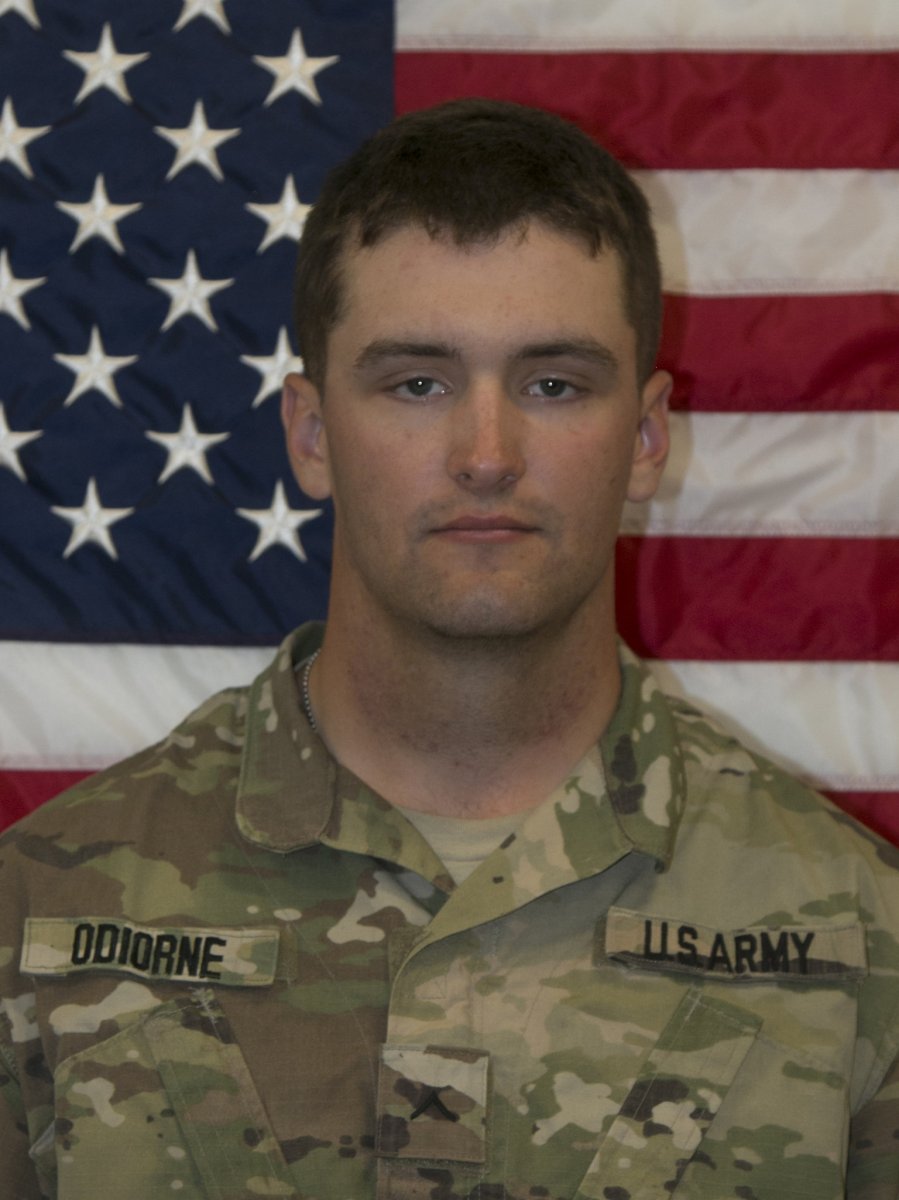
Fort Hood Army Pfc. Brian Odiorne Died from a Non-Combat Related Incident in Al Anbar Province, Iraq; CID Ruled Death Suicide (February 20, 2017)

odiornejpg-accc6757c7e80211
Pfc. Brian Odiorne, US Army

Army Pfc. Brian Odiorne, 21, died from a non-combat related incident in Al Anbar Province, Iraq on February 20, 2017. Pfc. Odiorne’s home of record is listed as Ware, Massachusetts and he joined the Army in October 2015. Pfc. Odiorne was a cannon crewmember supporting Operation Inherent Resolve and was assigned to the 2nd Battalion, 82nd Field Artillery Regiment, 3rd Brigade Combat Team, 1st Cavalry Division at Fort Hood, Texas. After an investigation was concluded, the Army Criminal Investigation Division (CID) ruled the death a suicide.

Related Links:
Pfc. Brian P. Odiorne
DoD Identifies Army Casualty
Death of a Fort Hood Soldier
Obituary: Pfc. Brian P. Odiorne
Fort Hood soldier dies in Iraq
Fort Hood Soldier from Massachusetts Dies in Iraq
Fort Hood soldier from Massachusetts dies in Iraq
Soldier who died in noncombat incident in Iraq identified
Pfc. Brian Odiorne, a Ware native, dies in Iraq
Brian Odiorne, soldier from Ware, dies in Iraq
Ware, Mass. Soldier Dies In Iraq In ‘Non-Combat’ Incident
Baker to family of Ware soldier: “I’m calling you as a dad”
Family, friends mourn death in Iraq of Army Pfc. Brian Odiorne of Ware
Ware selectmen request moment of silence to honor Army Pfc. Brian Odiorne, who died in Iraq
Body of PFC Brian Odiorne returned to western Massachusetts
Bishop Rozanski delivers homily at funeral of Brian Odiorne
US Army Pfc. Brian Patrick Odiorne laid to rest in Ware
Army Investigating After Soldier From Ware Dies In Iraq
Death of Mass. soldier in Iraq under investigation
Why are flags lowered today? March 4, 2017
Fort Hood soldier’s death in Iraq ruled a suicide
Why Have So Many Fort Hood Army Soldiers Died Stateside in the Last Year?
Violent Crime, Suicide, and Non Combat Death at Fort Hood, Texas