On August 29, 1989, Navy veteran Richard Uffelman and his two sons opened fire from their living room window and shot and killed their neighbors Michael and Florence Phillips in Machiasport, Maine. The Phillips family moved back to Maine so they could be closer to their family and the ocean, and they wanted to escape crime in Indiana. Shortly before they moved to Maine, a murder occurred outside their home and this was it for them; they wanted to raise their son Michael in a safe environment. Richard and Anita Uffelman and their two sons were the new neighbors of the Phillips in Maine. Richard was described as an authoritarian and a believer in good order and discipline. He worked at the local post office and taught his two children to shoot guns. Initially the neighbors were good friends and their boys played together. At some point, family came to visit the Phillips for a week. The happy family reunited outside on the front lawn while they barbecued, drank some beers, and enjoyed one another’s company. Apparently Richard found a broken bottle on his lawn during the event and automatically assumed the Phillips threw the bottle on his lawn. Richard called the police to complain about the incident but there was no proof since the Phillips denied doing it. This was it for Richard; the Phillips home interfered with his view of the ocean and he was going to exact his revenge. Read here.
On April 10, 2008, Navy sailor Chris Shortt discovered his step-daughter Meghan Landowski stabbed to death in their Portsmouth, Virginia home. Meghan was 16 years old and from the looks of the crime scene, there was a struggle; Meghan fought back. Investigators learned the killer used a knife from the family’s kitchen. They found it in a gutter down the street. The police didn’t know who committed the murder but they believed it was personal and Meghan knew her attacker. Chris and Angie Shortt believed Robert Hickey killed Meghan and they called NCIS at Naval Station Norfolk to let them know what happened. NCIS questioned Hickey. Robert Hickey was a military officer who was on his way to the rank of Captain when he was accused of sexual assault by Meghan. Robert was a close friend of the family and NCIS believe he groomed Meghan for a sexual relationship. Meghan said Rob began touching her when she was 14 and by age 15, Meghan was having a sexual relationship with a 30-year-old man. The family supported Meghan as she pressed charges against Robert but they learned from civilian investigators that Hickey’s crimes amounted to a misdemeanor in Virginia; he would spend 12 months maximum in prison. But Robert Hickey was a Navy sailor and subject to the Uniform Code of Military Justice. The Navy was investigating and planning to prosecute the case. Read here.
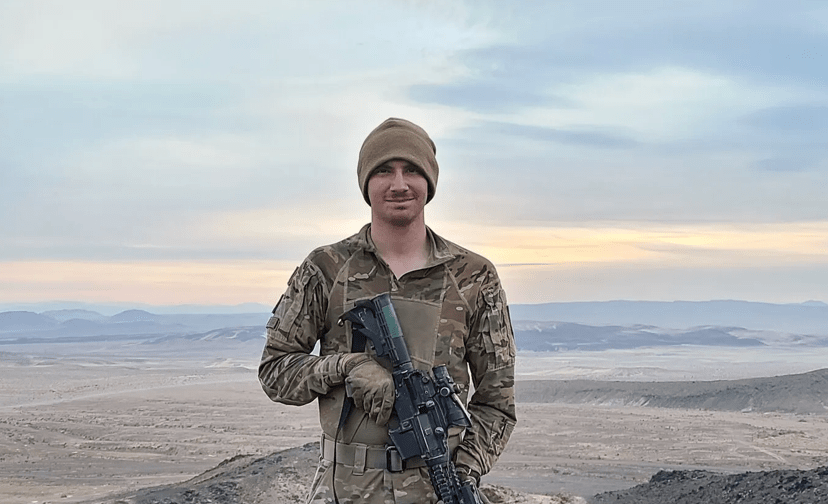
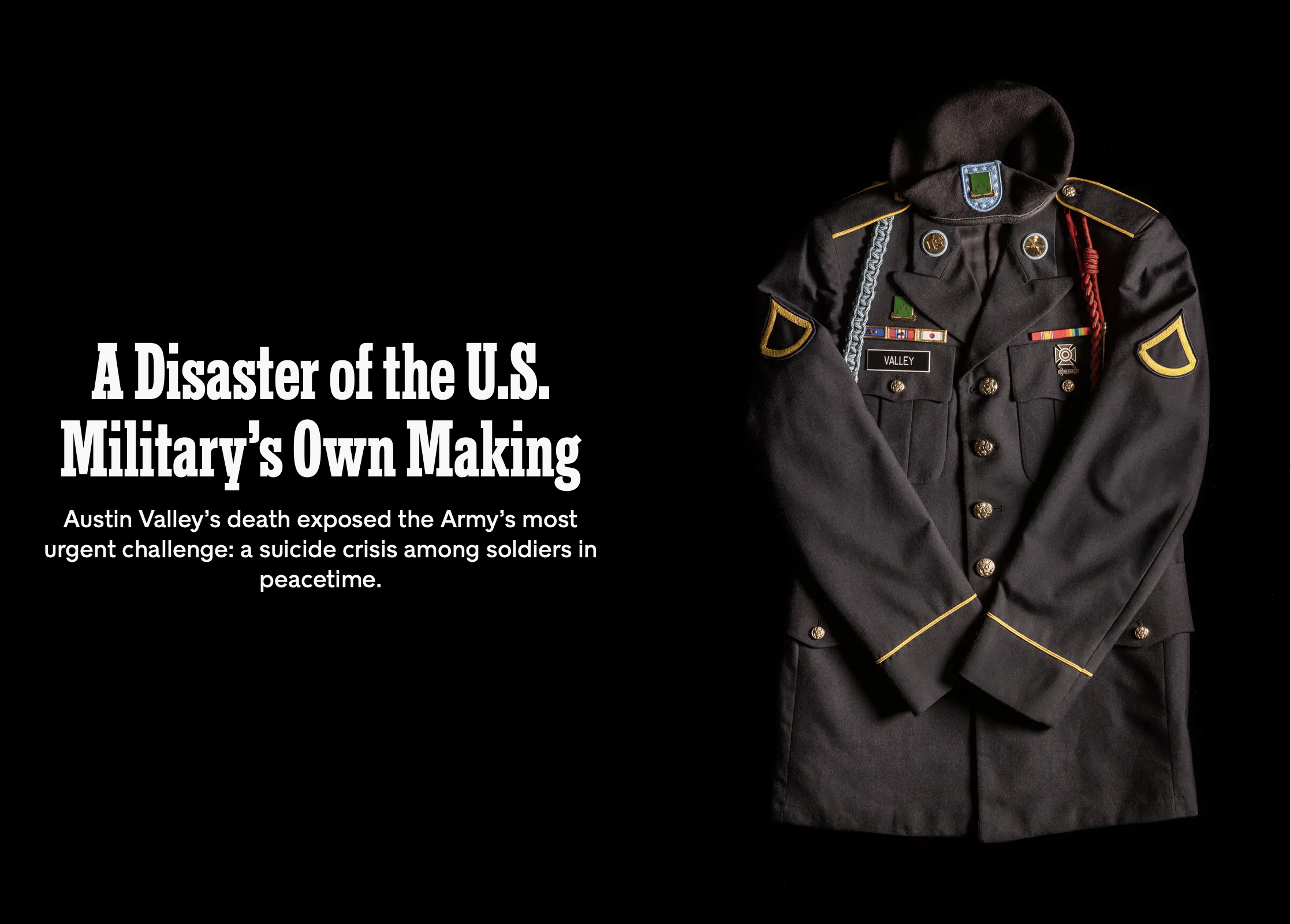
“Austin Valley had just arrived at his Army base in Poland, last March, when he knocked on his buddy Adrian Sly’s door to borrow a knife. The base plate of his helmet was loose and needed fixing, he told Sly. The soldiers had spent most of their day on a bus, traveling from their former base to this new outpost in Nowa Deba, near the border with Ukraine. It had been a monotonous 12-hour journey with no stops and nothing to eat but military rations. Sly thought his friend looked exhausted, but then so did everyone else. He handed Valley an old hunting knife, and Valley offered an earnest smile. “Really appreciate it, man,” he said. Then he disappeared.”
“Word of a soldier’s disappearance spread quickly across the Polish base. Sly recalled sergeants pounding on doors and shining their flashlights. “Where’s Valley?” one asked him. Sly and several others from Valley’s unit took off into the woods. Seeing fresh tracks in the snow, one soldier followed them until he heard a faint gurgling sound. Drawing closer, he saw Valley, hanging from a tree. He was alive, but barely conscious. The soldier cut Valley down, while another called for the medics, who sped off with him into the night. His friends would never see him again. The following morning, Valley was taken to the U.S. Army hospital in Landstuhl, Germany, and then returned to Fort Riley. Four weeks later, he was dead.”
“Soldiers are more likely than their civilian peers to die by suicide. Many people wrongly believe this is because of combat trauma, but in fact the most vulnerable group are soldiers who have never deployed. The Army’s suicide rate has risen steadily even in peacetime, and the numbers now exceed total combat deaths in the Iraq and Afghanistan wars. A Times investigation into the death of Specialist Austin Valley, stationed at Fort Riley in Kansas, found that mental-health care providers in the Army are beholden to brigade leadership and often fail to act in the best interest of soldiers.”
John Blauvelt and Catherine Blauvelt (photo: PEOPLE)
Press Release from U.S. Marshal’s Service (July 21, 2022):
Washington, D.C. – U.S. Marshals in Oregon have arrested a South Carolina murder suspect, putting an end to the man’s six-year run from the law.
Major Case Fugitive John Tufton Blauvelt, 33, was taken into custody in Medford, Oregon, July 20 by U.S. Marshals and Medford police following a lead provided by a dedicated cold case team of investigators at the agency’s headquarters.
Blauvelt is wanted for the killing of his estranged wife, Catherine “Cati” Blauvelt, who was found stabbed to death in an abandoned home in Simpsonville on Oct. 24, 2016. She was 22. Cati had been reported missing by her family the previous day after failing to meet with her friends after work. She was last seen leaving her place of work, a Greenville pet store, at approximately 2:15 p.m. on Oct. 23, 2016.
On Nov. 18, 2016, Simpsonville Police obtained warrants for Blauvelt’s arrest for murder and possession of a weapon during a violent crime.
Blauvelt, who worked as a U.S. Army recruiter in Greenville County at the time of the murder, but was classified by the Army as a deserter shortly thereafter, fled the area just after the murder with his 17-year-old girlfriend Hannah Thompson, of Fountain Inn. Blauvelt had last been seen in Las Cruces, New Mexico, Nov. 15, 2016, traveling with a female passenger police said they believe was Thompson.
Thompson’s parents reported the teen missing to the Fountain Inn Police Department on Nov. 21, 2016.
After the U.S. Marshals joined the search to find Blauvelt, they learned he and Thompson had traveled through Alabama, Texas and California.
Thompson was found safe in Oregon on Dec. 12, 2016, having been abandoned by Blauvelt. She went to a family friend’s home in Eugene and called her parents, saying she wanted to come home. She and Blauvelt had been homeless while in Oregon.
The case was aired on In Pursuit with John Walsh in 2019.
In early 2022, a U.S. Marshals dedicated cold and complex case investigative team, composed of various USMS components, joined the investigation for Blauvelt. Working closely with investigators from the District of South Carolina, the Carolinas Regional Fugitive Task Force, as well as Simpsonville detectives, the South Carolina Highway Patrol and the U.S. Army Criminal Investigation Division, the team was able to put Blauvelt in Medford, Oregon, and sent a collateral lead to the District of Oregon. The U.S. Marshals Pacific Northwest Violent Offender Task Force in Oregon committed numerous personnel and hours to the investigation. Ultimately, investigators there, working with the Medford Police Department and the Jackson County Sheriff’s Office, located Blauvelt, who had assumed the alias “Ben Klein,” and took him into custody without incident.
Blauvelt is being held in Jackson County Jail pending extradition to South Carolina to face the charges against him.
“This arrest represents a tremendous amount of cooperation among numerous agencies dedicated to seeking justice for a victim of a heinous crime six years ago,” said Heather Walker-Wright, Assistant Director of the USMS Investigative Operations Division. “I want to commend the investigators and Deputy U.S. Marshals in South Carolina, Oregon and here at headquarters, as well as our partner agencies, who worked so tirelessly to get John Blauvelt into custody.”
Acting U.S. Marshal for the District of South Carolina Karen Thomas said, “The U.S. Marshals Service dedication to duty, pursuit of justice, and relentless team effort across the nation led to the capture of a violent fugitive.”
“I hope that the arrest of John Blauvelt brings Cati’s family some relief from the situation that they have had to endure the past few years,” said Simpsonville Police Chief Mike Henshaw. “I want to thank the U.S. Marshals Service and all the various agencies that assisted in making this arrest possible. The team effort by law enforcement is to be commended.”
Established in 1985, the U.S. Marshals Major Case Fugitive Program prioritizes the investigation and apprehension of high-profile offenders considered to be some of the country’s most dangerous. These individuals tend to be career criminals with histories of violence or whose instant offense(s) poses a significant threat to public safety.
Shattered Families, Shattered Service: Taking Military Domestic Violence Out of the Shadows -US House Armed Services Committee (September 18, 2019)
“We are here today because domestic violence has become a forgotten crisis in our military. It has been 15 years since a DOD task force analyzed domestic violence within the military, yet we have seen unsettling warning signs since. Within the last few months, DOD reports have highlighted concerning failures in our services’ domestic violence systems. The DOD has not responded urgently. Today, we will hear from three survivors of domestic violence in the military who are bravely coming forward to share their experiences in the hope that others may be helped. Because we lack data that is recent, plentiful, or granular, we must rely on survivors, advocates and experts to help us understand the unique challenges of dealing with this crisis within the military.” Read more from House Armed Services Committee Chairwoman Jackie Speier here.
Military Policy Recommendations (MJFA) (went to DC and visited congressional members, expansion of expedited transfer policy, independent investigations)
Sgt. Ryan A. Curtis, U.S. Marine Corps (September 2, 1990 – October 19, 2017)
Sergeant Ryan A. Curtis, U.S. Marine Corps, age 27, of Jacksonville, North Carolina, formally of Hastings, passed away suddenly on October 19, 2017. Ryan was born in Hastings on September 2, 1990 to Richard A. and Linda A. (Ransome) Curtis.
Ryan was a very private, loving and caring person who would do anything for anyone; mentoring several close friends. He attended Thornapple Valley Church since the age of 4. He graduated from Hastings High School in 2009 and was in the Boy Scouts for a while.
He entered the Marine Corps in 2009 and graduated from Marine Corps Recruit Depot, San Diego in September of 2009. He was deployed to Afghanistan for 2 tours in 2010 and 2012. He served his country for the past 8 years.
Ryan is survived by his wife of 5 years, Samantha; parents, Richard Dick & Linda Curtis; sister, Kelly; and his fur babies, Bear & Nigel.
Amy discovers that her boyfriend’s war game unfolds very differently when the player chooses a female character. -Inside Amy Schumer, Comedy Central (August 26, 2014)
The sketch says it all… there’s a reason the majority of service members don’t report crime. Character assassination and retaliation is real for both male and female victims of crime in the military. Their lives, reputations, careers, and futures are dependent on the actions of the convening authority who has the power to do nothing. In the civilian world, after reporting a crime to the local police department and evidence is gathered, a prosecutor determines whether or not a case moves forward in the judicial system. The Military Justice Improvement Act (MJIA) attempts to mirror this process and was reintroduced in June 2019, yet again was not allowed on the Senate floor for a vote. The last cloture vote on the way the military should handle felony crimes was on March 6, 2014. Invoking cloture means 60 Senators or two-thirds is required for passage of a bill as opposed to the majority of Senators. The biggest opponents of the MJIA were former Senator Claire McCaskill (D-MO) and former Senator Kelly Ayotte (R-NH), both since voted out of the Senate and replaced by Senator Joni Ernst (R-IA) and Senator Martha McSally (R-AZ). This pair of military officers are proponents of keeping the Chain of Command involved in the decision making process of adjudicating felony crime despite what the majority of military sexual assault survivors have asked for because the fear and retaliation continues. Meanwhile, the fight for military justice reform rages on. #PassMJIA
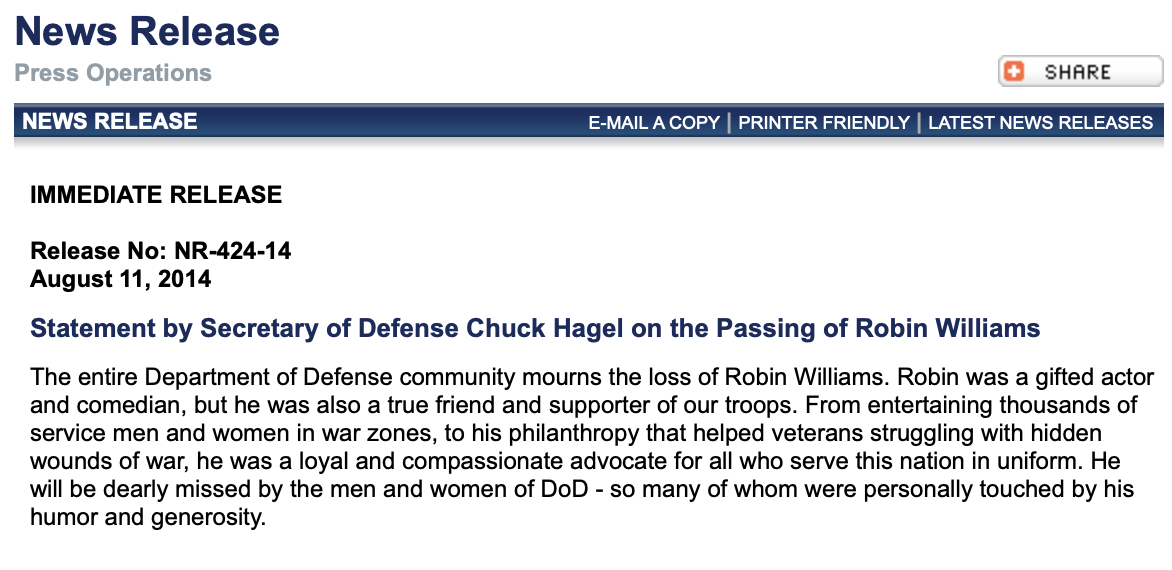
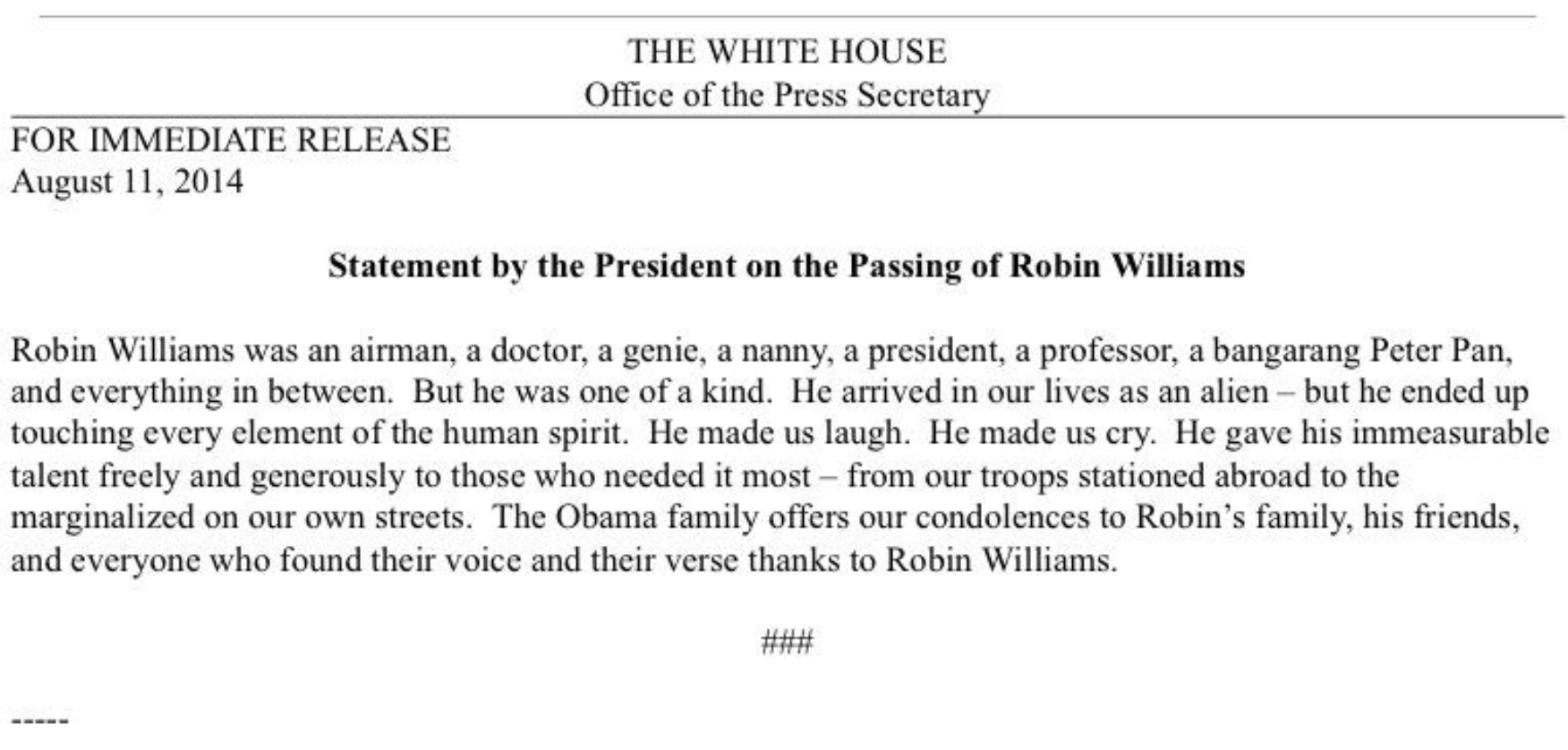
Robin Williams, the prolific Oscar-winning actor and comedian, died by suicide on August 11, 2014. He was 63. Read more from Historyhere.
“From entertaining thousands of service men and women in war zones, to his philanthropy that helped veterans struggling with hidden wounds of war, he was a loyal and compassionate advocate for all who serve this nation in uniform,” [Chuck] Hagel said in a released statement. “He will be dearly missed by the men and women of DOD, so many of whom were personally touched by his humor and generosity.” -Stars and Stripes
Department of Defense Press Release for Robin Williams found here.
Statement by the President on the Passing of Robin Williams found here.
Good Will Hunting:
Will (Matt Damon) wants to know what’s in his file, while Sean (Robin Williams) assures him that the abuse he suffered wasn’t his fault. -Miramax
“The most brilliant mind at America’s top university isn’t a student, he’s the kid who cleans the floors. Will Hunting is a headstrong, working-class genius who is failing the lessons of life. After one too many run-ins with the law, Will’s last chance is a psychology professor, who might be the only man who can reach him. Finally forced to deal with his past, Will discovers that the only one holding him back is himself.” –Miramax Official Site
Mira Sorvino presents Robin Williams with the Best Supporting Actor Oscar for Good Will Hunting at the 70th Academy Awards. -Oscars
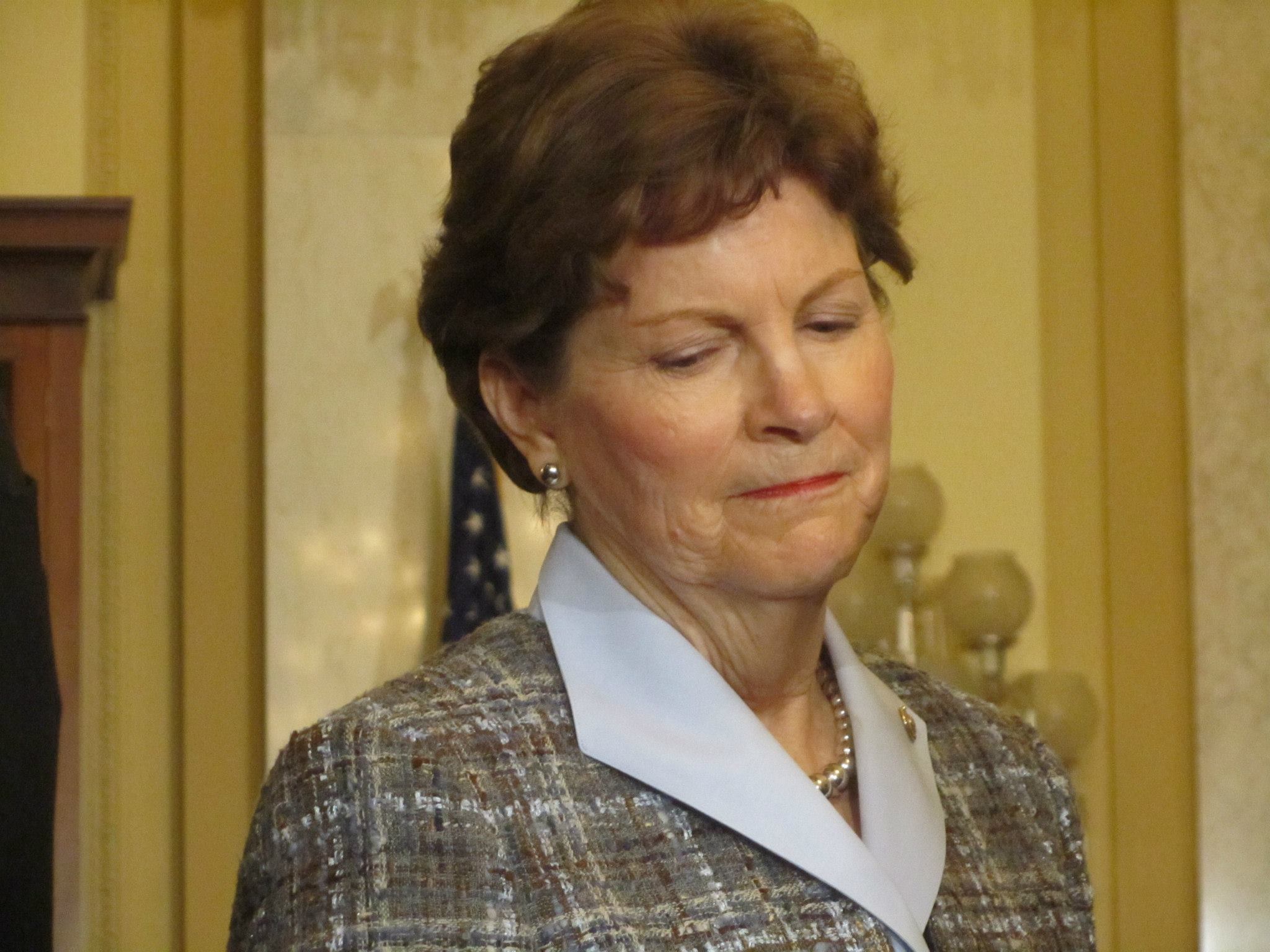
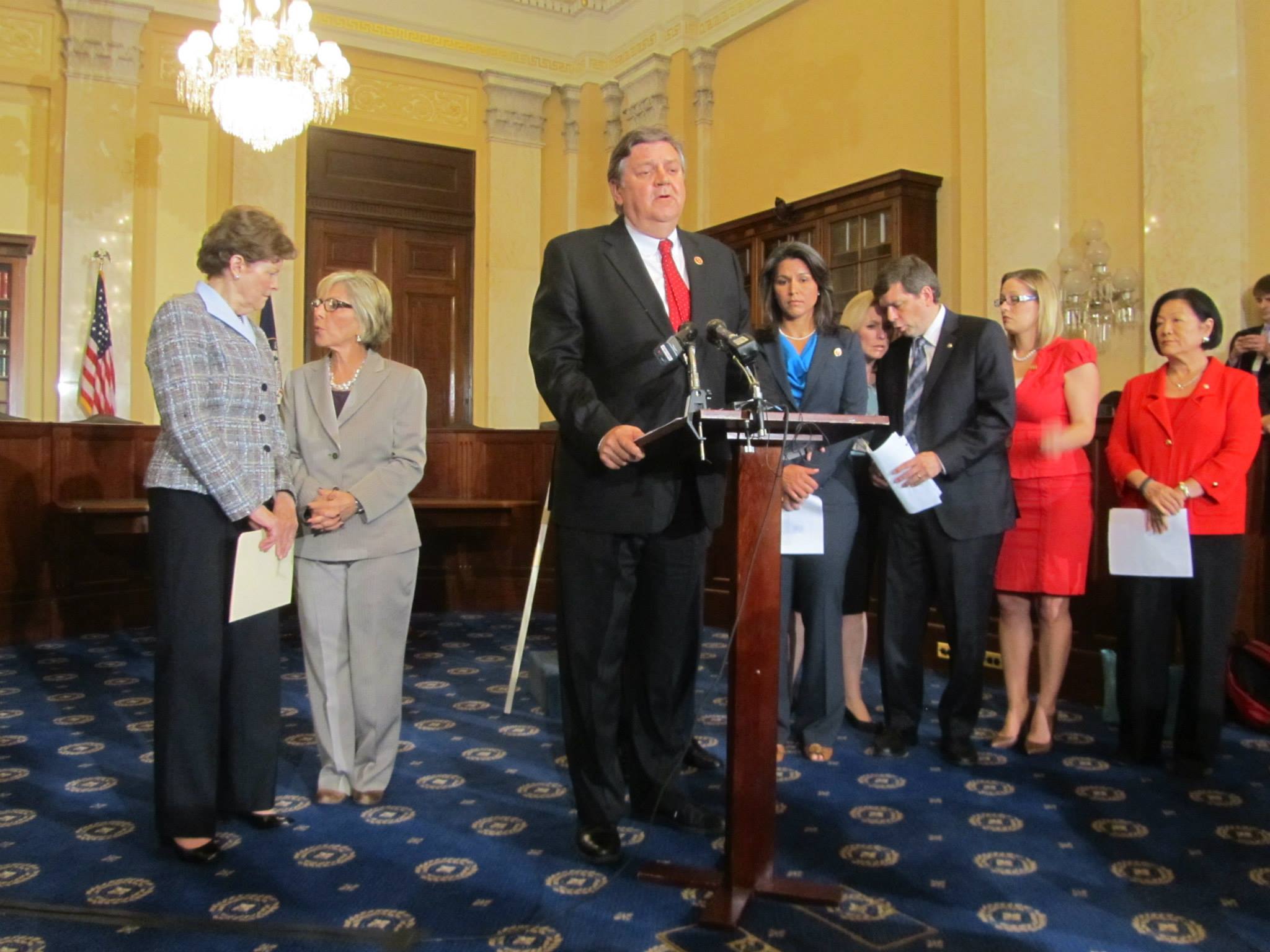
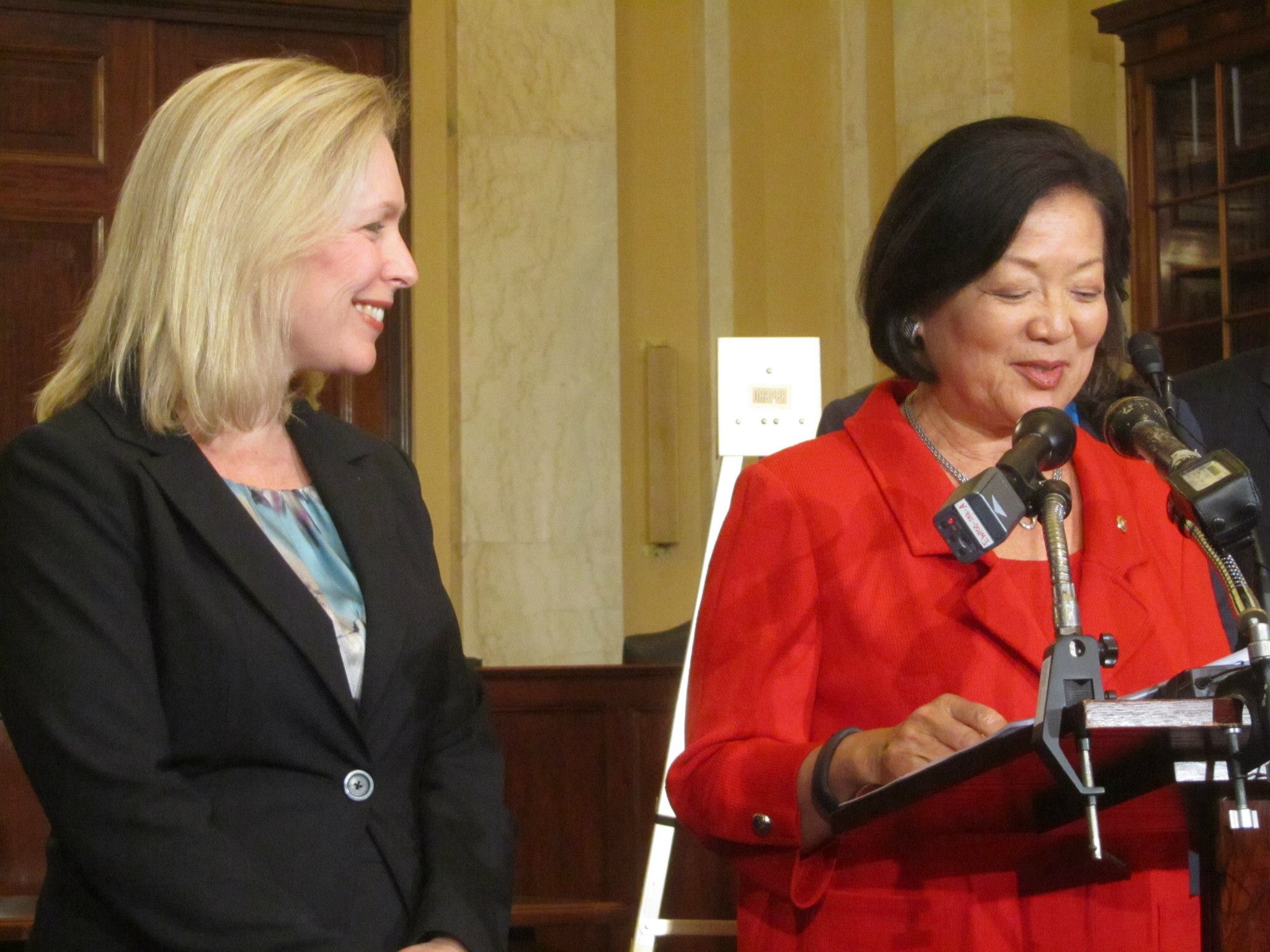
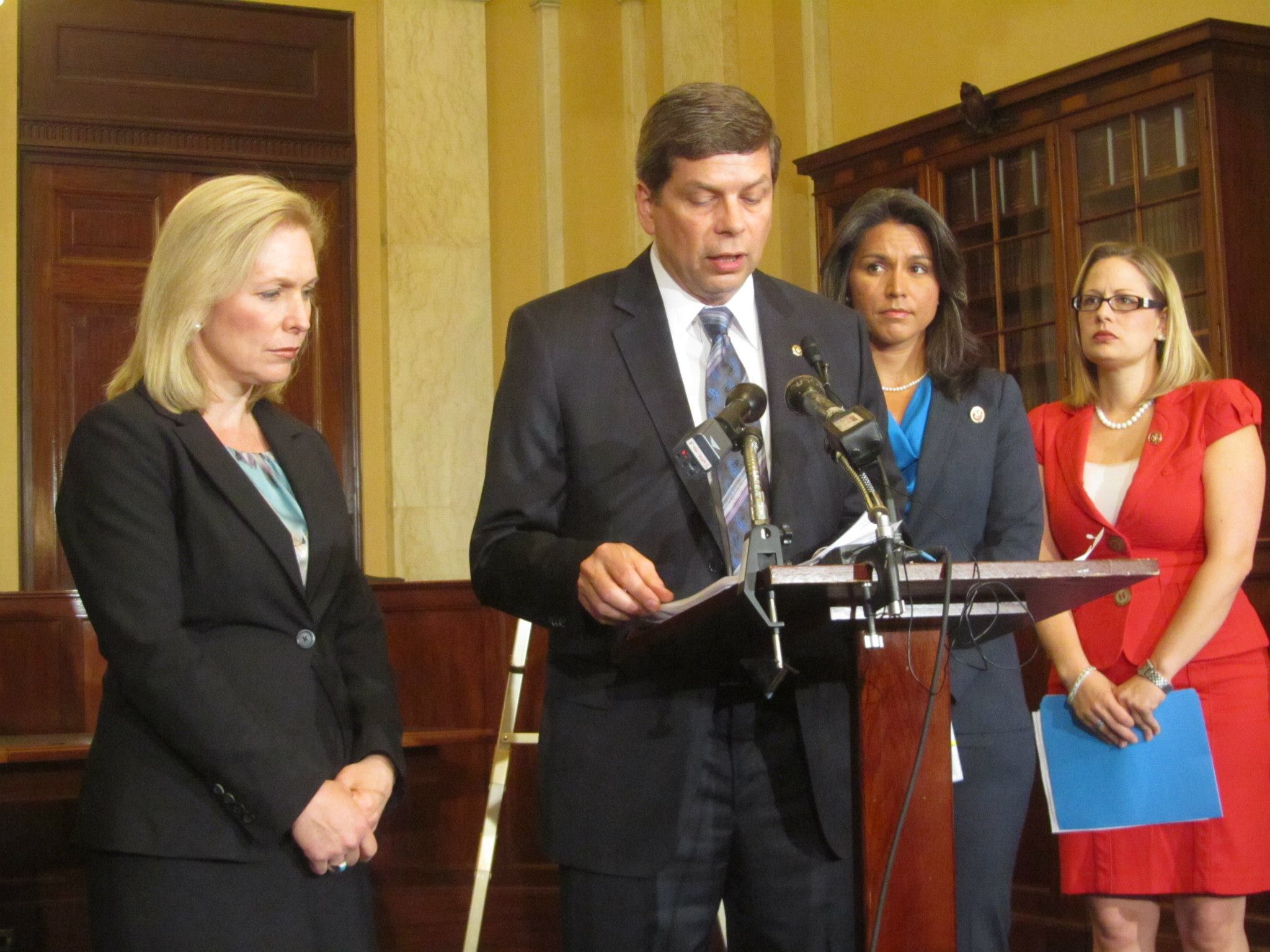
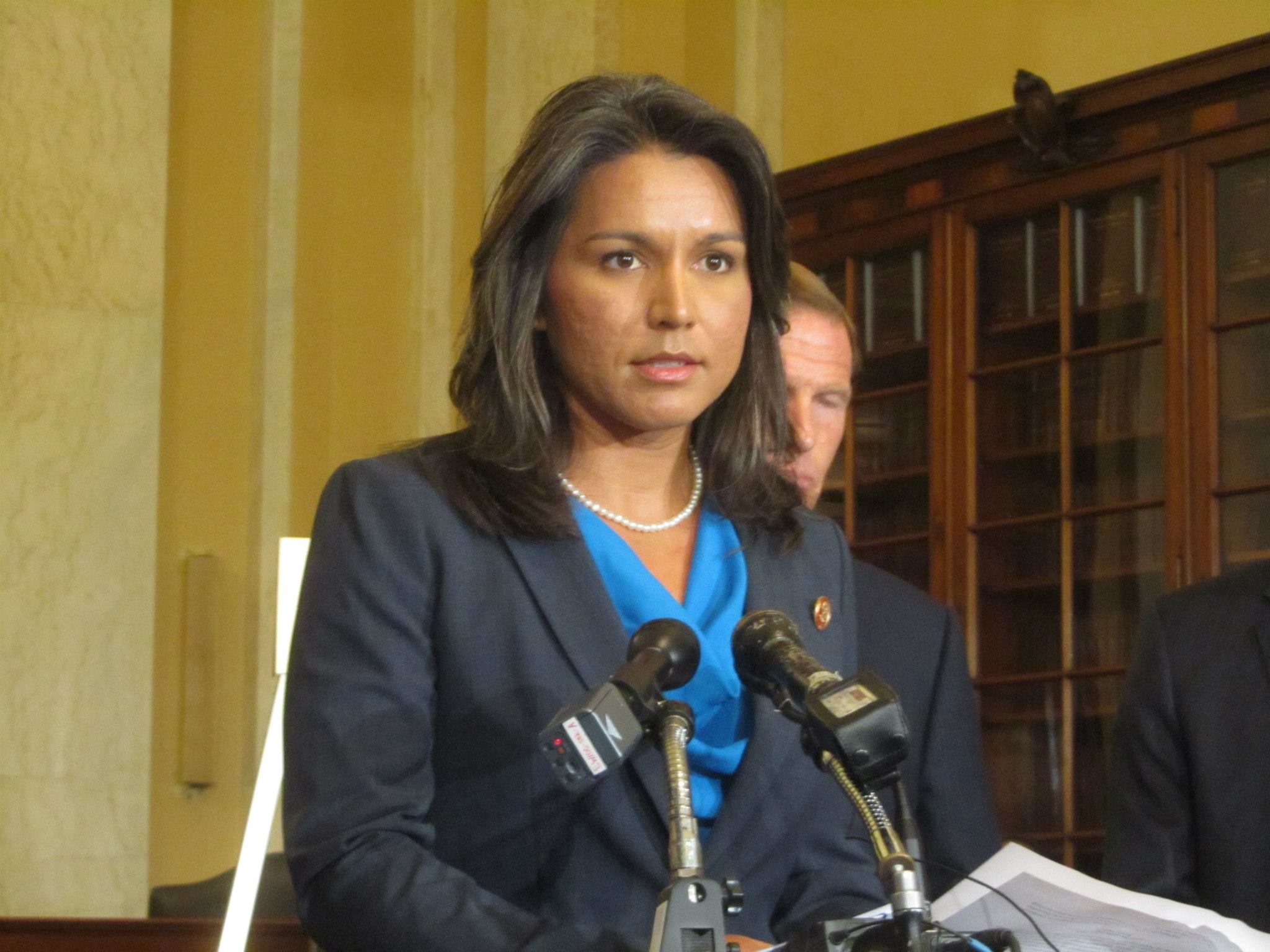
Washington D.C. – During a news conference today, U.S. Senators Susan Collins and Kirsten Gillibrand (D-NY), along with a bipartisan group of their colleagues in the Senate and House, announced new legislation that would reform the military justice system by removing the prosecution of all crimes punishable by one year or more in confinement from the chain of command, except crimes that are uniquely military in nature, such as disobeying orders or going Absent Without Leave.
Senators Collins and Gillibrand were joined by survivors of sexual assault in the military, including Jennifer Norris of Maine, and by representatives from organizations who assist victims of Military Sexual Trauma. The Military Justice Improvement Act would for the first time remove the decision whether to take a case to special or general court-martial completely out of the chain of command and give that discretion to experienced military prosecutors for all crimes punishable by one year or more in confinement, except crimes that are uniquely military in nature, such as disobeying orders or going AWOL.
“To be sure, the vast, overwhelming majority of our military personnel are honorable, conscientious, and respectful individuals, not rapists or harassers. It is for their sake that the pattern of covering up, blaming the victim, and failing to provide even the most basic protections that has been all too common for far too long must end,” said Senator Collins. “What does it say about us as a people, as the nation, as the foremost military in the world when some of our service members have more to fear from their fellow soldiers than from the enemy? This epidemic of sexual abuse cannot stand. We must ensure that justice is swift and certain to the criminals who have perpetuated these crimes.”
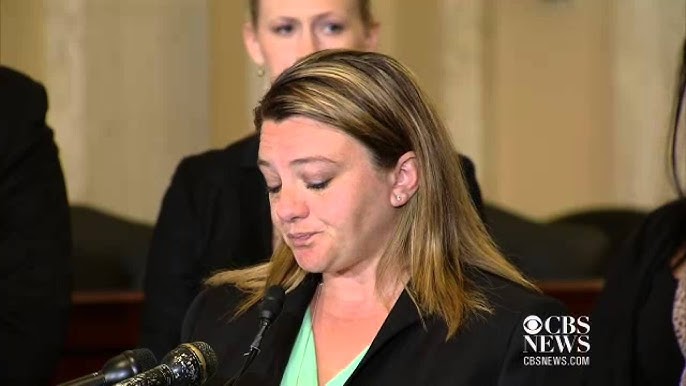
With tears streaming down her face, Jennifer Norris, a former Technical Sergeant in the Air Force, describes her harrowing experience with sexual assault and the difficulty she had in seeking justice within the military chain of command, saying, “The system is rigged against the victims” and in favor of the “often higher-ranking perpetrators.” [VIDEO]
Norris, who did not serve in Hawaii, said she’d been reluctant to report the rape because, “in the Air Force, I witnessed first hand what happens to those who stepped forward to report their assaults. I did not want to be stigmatized for reporting my assault — as I tried to move forward with my career. Instead, the best option for me was to try and endure it, to suck it up and try and make it until I could get transferred somewhere else — only to have it happen over and over again, like a recurring nightmare.”
She never did get justice, she said, even when she did come forward. “My perpetrators were allowed to resign in lieu of Administrative Hearings, which would have become a matter of public record. My command never offered the chance to proceed with a court martial.”
She said, “If the chain of command had been removed from handling sexual assault cases before I was attacked I believe justice would have been served or perhaps it would have been prevented in the first place.”
“At first I was too afraid to report my assault to my chain of command, but two years later I was forced to report due to the escalation of the behavior and the fear that I would be raped again.” -Jennifer Norris (Civil Beat, May 16, 2013)
Gillibrand: “I’m Distressed That The Victims’ Voices Aren’t Being Heard In This Debate
Hearing is Gillibrand’s First As Chair Of Senate Armed Services Subcommittee On Personnel – Has Been Leading The Fight To End Sexual Violence In Military
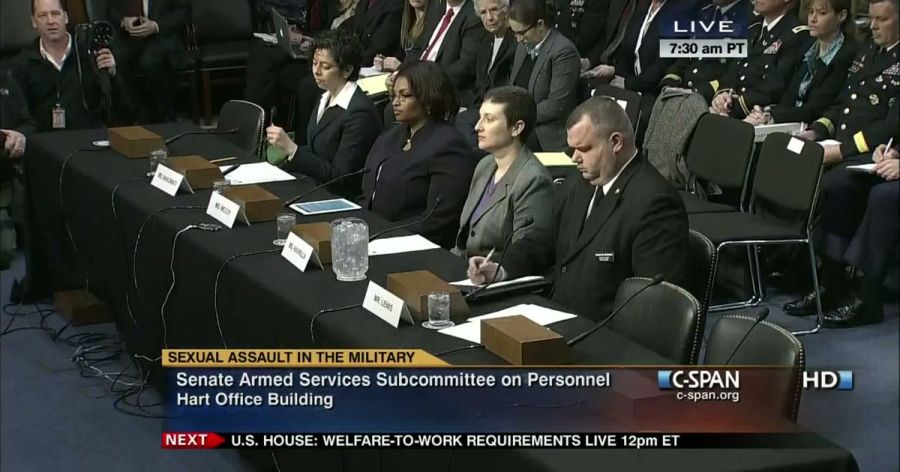
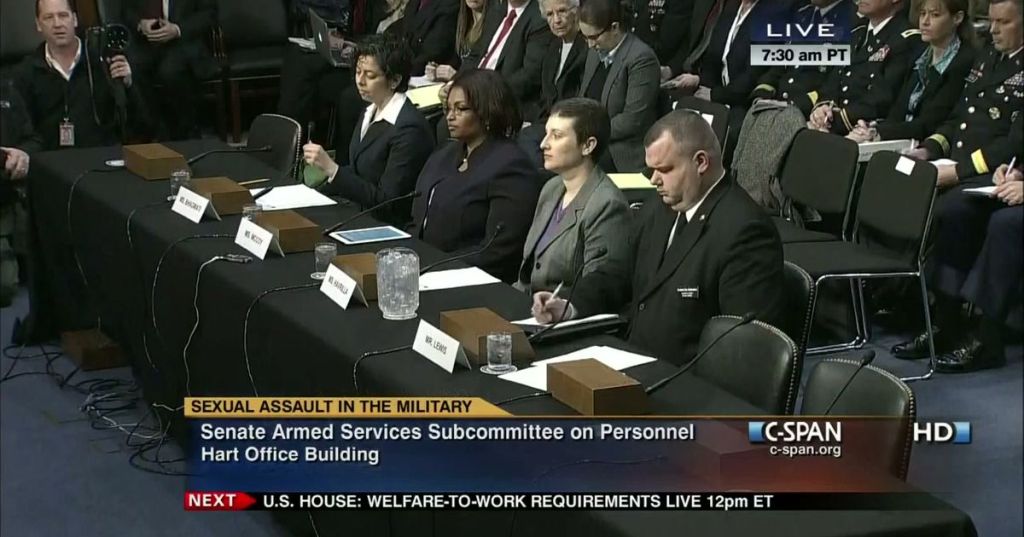
Washington, D.C. – U.S. Senator Kirsten Gillibrand released the following prepared remarks of her opening statement at today’s Senate Armed Services Subcommittee on Personnel hearing examining sexual assault in the military:
“It is an honor and privilege to Chair this hearing of the Personnel Subcommittee this morning. I want to thank the Ranking Member of this Subcommittee, Senator Lindsey Graham, for his support and working with me to move this hearing forward as quickly as possible.
“I know that all of our colleagues on the Armed Services Committee share our deep commitment to improving the quality of life of the men and women who serve in our all-volunteer force on active duty, or in the National Guard and Reserves, their families, military retirees, and Department of Defense Civilian personnel.
“And that is why this hearing today is so important to me personally…and to thousands of servicemembers…and their families across the country.
“The issue of sexual violence in the military is not new. And it has been allowed to go on in the shadows for far too long. The scourge of sexual violence in the military should be intolerable and infuriating to us all. Our best, brightest, and bravest join our armed forces for all the right reasons – to serve our country, protect our freedom, and keep America safe.
“The United States has the best military in the world and the overwhelmingly vast majority of our brave men and women serving in uniform do so honorably and bravely. But there is also no doubt that we have men and women in uniform who are committing acts of sexual violence and should no longer be allowed to serve.
“Too often, women and men have found themselves in the fight of their lives not in the theater of war – but in their own ranks, among their own brothers and sisters, and ranking officers, in an environment that enables sexual assault.
“And after an assault occurs, an estimated 19,000 sexual assaults happened in 2011 alone according to the Defense Department’s own estimates…some of these victims have to fight all over again with every ounce of their being just to have their voice heard…their assailant brought to any measure of justice… and the disability claims they deserve fulfilled. Congress would be derelict in its duty of oversight if we just shrugged our shoulders at these 19,000 sons and daughters…husbands and wives…mothers and fathers…and did nothing. We simply have to do better by them.
“When brave men and women volunteer to serve in our military they know the risks involved. But sexual assault at the hands of a fellow service member should never be one of them.
“Because not only does sexual assault cause unconscionable harm to the victim — sexual violence is reported to be the leading cause of post-traumatic stress disorder among women veterans — but it destabilizes our military, threatens unit cohesion and national security. Beyond the enormous human costs both psychologically and physically, this crisis is costing us significant assets – making us weaker both morally and militarily.
“Already, this Committee and the Pentagon took some first steps on this issue as part of last year’s National Defense Authorization bill that President Obama signed into law. While obviously our work is not done, I am hopeful that we can build on these initial changes which include:
Ensuring that all convicted sex offenders in the military are processed for discharge or dismissal from the Armed Forces regardless of which branch they serve in;
Reserving case-disposition authority for only high-ranking officers in sexual assault cases;
Pushing the Pentagon to lift the combat ban that prevents women from officially serving in many of the combat positions that can lead to significant promotion opportunities. By opening the door for more qualified women to excel in our military, we will have increased diversity in top leadership positions, improving response from leadership when it comes to preventing and responding to sexual violence;
And an amendment introduced by my colleague Senator Jeanne Shaheen and based on my legislation, the MARCH Act, means that troops who become pregnant as a result of an act of rape no longer have to pay out of pocket to have those pregnancies terminated.
“Concerning our first panel of witnesses, I want to salute each of you for your courage today in telling your very painful and personal stories. It is my hope and belief that by committing this selfless act you are encouraging others to step forward and are also helping to prevent other crimes from going unpunished.
“We have a duty to you, and the thousands of victims you represent, to examine whether the military justice system is the most effective and fairest system it can be.
“Despite some very dedicated JAG officers, I do not believe the current system adequately meets that standard. The statistics on prosecution rates for sexual assaults in the military are devastating. Of the 2,439 unrestricted reports filed in 2011 for sexual violence cases – only 240 proceeded to trial. Nearly 70 percent of these reports were for rape, aggravated sexual assault or non-consensual sodomy.
“A system where less than 1 out of 10 reported perpetrators are held accountable for their alleged crimes is not a system that is working. And that is just reported crimes. The Defense Department itself puts the real number closer to 19,000! A system where in reality less than 2 out of 100 alleged perpetrators are faced with any trial at all is clearly inadequate and unacceptable.
“My view is that emphasizing institutional accountability and the prosecution of cases is needed to create a real deterrent of criminal behavior. The system needs to encourage victims that coming forward and participating in their perpetrator’s prosecution is not detrimental to their safety or future, and will result in justice being done. Because currently, according to the DOD, 47 percent of service members are too afraid to report their assaults, because of fear of retaliation, harm or punishment. Too many victims do not feel that justice is likely or even possible.
“We need to take a close look at our military justice system, and we need to be asking the hard questions, with all options on the table, including moving this issue outside of the chain of command, so we can get closer to a true zero tolerance reality in the Armed Forces. The case we have all read about at Aviano Air Base is shocking, and the outcome should compel all of us to take the necessary action to ensure that justice is swift and certain, not rare and fleeting.
“I had the opportunityto press Secretary Hagel on the issue of sexual violence in the military during his confirmation hearing. Secretary Hagel responded by saying, ‘I agree it is not good enough just to say zero tolerance. The whole chain of command needs to be accountable for this.’
“I could not agree more. I was very pleased with the Secretary’s public statement earlier this week that he is open to considering changes to the military justice system as well as legislation to ‘ensure the effectiveness of our responses to the crime of sexual assault.’
“It is with this spirit as our guide that I look forward to hearing from our witnesses.
“After Ranking Member Graham makes his opening remarks, we will hear testimony from my colleague from California, Senator Barbara Boxer who has been a leading voice on this issue. In last year’s Defense bill she successfully included an amendment that prohibits any individual who is convicted of a felony sexual assault from being issued a waiver to join the military.
“We will then have the following witnesses who have either been the victims of sexual assault while serving in the military, or are very knowledgeable advocates for addressing the issue of sexual assaults in the military:
Anu Bhagwati is Executive Director and Co-Founder of the Service Women’s Action Network. Anu is a former Captain and Company Commander, she served as a Marine officer from 1999 to 2004. While serving, Anu faced discrimination and harassment as a woman in the military, and has borne direct witness to the military’s handling of sexual violence.
BriGette McCoy, former Specialist in the U.S. Army. BriGette served in the U.S. Army from 1987 to 1991. She was just eighteen years old when she signed up to serve her country in the first Gulf War. While stationed in Germany from 1988 to 1991, she was sexually assaulted by a non-commanding officer.
Rebekah Havrilla, former Sergeant in the U.S. Army. Rebekah served in the U.S. Army from 2004 to 2008. She was the only female member of a bomb squad in eastern Afghanistan and was attacked by a colleague at Salerno Forward Operating Base near the Pakistani border during her last week in the country in 2007.
Brian Lewis, former Petty Officer Third Class, US. Navy. Brian enlisted in the U.S. Navy in June of 1997. During his tour aboard USS Frank Cable (AS-40), he was raped by a superior non-commissioned officer and forced to go back out to sea after the assault.
“I encourage you to express your views candidly and to tell us what is working and what is not working. Help us to understand what we can do to address this unacceptable problem of sexual assaults in the military.
“Later this afternoon at 2:00 p.m., we will have a third panel of witnesses from the Department of Defense, and the military services, including the Coast Guard. I want to acknowledge that many of those witnesses are here this morning to listen to the critically important testimony from our first and second panels and I would like to thank them for their participation.”
Today, Defense Secretary Leon E. Panetta and Chairman of the Joint Chiefs of Staff, Gen. Martin Dempsey announced the rescission the 1994 Direct Ground Combat Definition and Assignment Rule for women and that the Department of Defense plans to remove gender-based barriers to service.
“Women have shown great courage and sacrifice on and off the battlefield, contributed in unprecedented ways to the military’s mission and proven their ability to serve in an expanding number of roles,” Secretary of Defense Leon E. Panetta said. “The Department’s goal in rescinding the rule is to ensure that the mission is met with the best-qualified and most capable people, regardless of gender.”
Today, women make up approximately 15 percent, or nearly 202,400, of the U.S. military’s 1.4 million active personnel. Over the course of the past decade, more than 280,000 women have deployed in support of operations in Iraq and Afghanistan.
Today’s announcement follows an extensive review by the Joint Chiefs of Staff, who unanimously concluded that now is the time to move forward with the full intent to integrate women into occupational fields to the maximum extent possible. It builds on a February 2012 decision to open more than 14,000 additional positions to women by rescinding the co-location restriction and allowing women to be assigned to select positions in ground combat units at the battalion level.
“The Joint Chiefs share common cause on the need to start doing this now and to doing this right. We are committed to a purposeful and principled approach,” said Chairman of the Joint Chiefs of Staff Gen. Martin Dempsey.
The Department of Defense is determined to successfully integrate women into the remaining restricted occupational fields within our military, while adhering to the following guiding principles developed by the Joint Chiefs of Staff:
• Ensuring the success of our nation’s warfighting forces by preserving unit readiness, cohesion, and morale.
• Ensuring all service men and women are given the opportunity to succeed and are set up for success with viable career paths.
• Retaining the trust and confidence of the American people to defend this nation by promoting policies that maintain the best quality and most qualified people.
• Validating occupational performance standards, both physical and mental, for all military occupational specialties (MOS), specifically those that remain closed to women. Eligibility for training and development within designated occupational fields should consist of qualitative and quantifiable standards reflecting the knowledge, skills, and abilities necessary for each occupation. For occupational specialties open to women, the occupational performance standards must be gender-neutral as required by Public Law 103-160, Section 542 (1993).
• Ensuring that a sufficient cadre of midgrade/senior women enlisted and officers are assigned to commands at the point of introduction to ensure success in the long run. This may require an adjustment to recruiting efforts, assignment processes, and personnel policies. Assimilation of women into heretofore “closed units” will be informed by continual in-stride assessments and pilot efforts.
Using these guiding principles, positions will be opened to women following service reviews and the congressional notification procedures established by law. Secretary Panetta directed the military departments to submit detailed plans by May 15, 2013, for the implementation of this change, and to move ahead expeditiously to integrate women into previously closed positions. The secretary’s direction is for this process to be complete by Jan. 1, 2016.
In the News:
Senior defense officials say Pentagon chief Leon Panetta is removing the military’s ban on women serving in combat, opening hundreds of thousands of front-line positions and potentially elite commando jobs after more than a decade at war. –Associated Press (January 23, 2013)
Defense Secretary Leon Panetta has announced that newly re-inaugurated President Obama will allow women to serve in frontline combat roles in the United States military going forward. Appeals for certain units to be excluded from the order to allow females to join men in combat must be resolved by January 2016. –The Daily Conversation (January 23, 2013)
Secretary of Defense Leon Panetta decided to lift the ban on women in the military serving in combat, opening thousands of front line jobs to women and reversing the 1994 policy that kept them out of those positions. Gwen Ifill talks with James Kitfield of National Journal about the historic change and implications. –PBS NewsHour (January 23, 2013)
Defense Secretary Leon Panetta announced a historic change Wednesday, allowing women to serve in military combat positions. Ret. Gen. Richard Myers, former chairman of the joint chiefs of staff, talks to Charlie Rose and Norah O’Donnell about the historic policy shift. –CBS News (January 24, 2013)
The US military officially dropped its ban on women serving in ground combat Thursday after a policy review by top commanders, Defense Secretary Leon Panetta said. –AFP News Agency (January 24, 2013)
Defense Secretary Leon Panetta, in lifting a ban on women serving in combat, said women have become integral to the military’s success and have shown they are willing to fight and die alongside their male counterparts. –Associated Press (January 24, 2013)