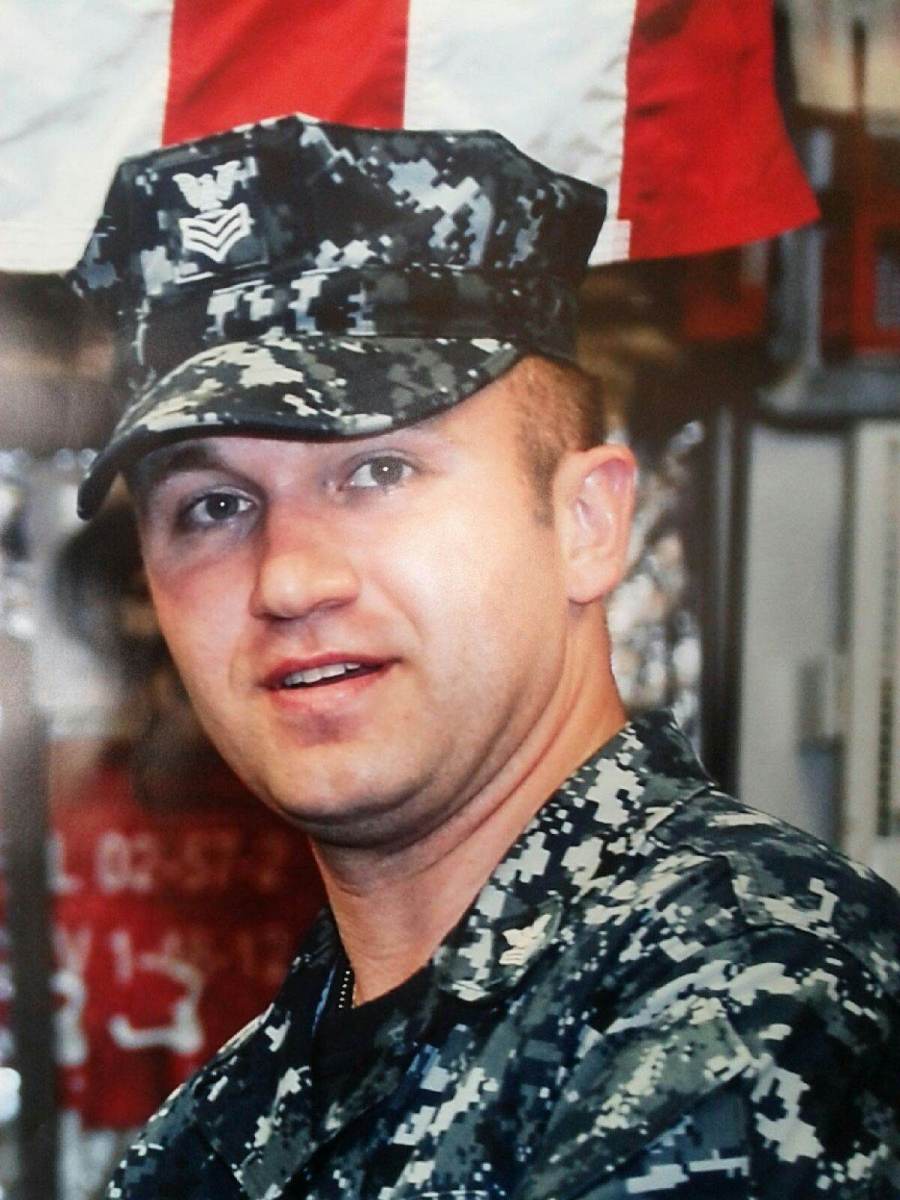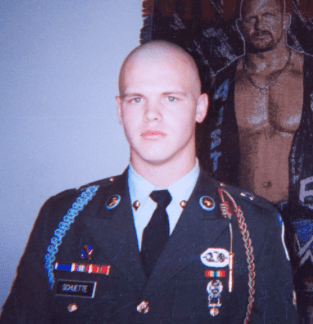
Army SSG Devin Schuette Found Dead in Vehicle at Recreation Area Near Fort Hood; CID Ruled Suicide, Spouse Requests Independent Investigation (January 3, 2016)

screen-shot-2017-02-19-at-4-45-21-pm
SSG Devin Schuette, US Army

SSG Devin Schuette, 35, U.S. Army, originally of Clovis, New Mexico, was found dead inside a car near the recreation area at Fort Hood on January 3, 2016. According to his family, he had been missing since New Year’s Day. SSG Schuette’s service with the Army began in April 1999 as an infantryman and he was serving as an Intelligence Analyst with the 1st Brigade Combat Team, 1st Cavalry Division at Fort Hood at the time of his death. He also served three overseas tours as part of Operation Iraqi Freedom; his deployments were from March 2003 to March 2004, November 2005 to October 2006 and June 2008 to June 2009. As of January 6, 2016, the Criminal Investigation Division was investigating the circumstances surrounding the incident. At the time of reporting, they did not suspect any foul play but were not ruling anything out as they moved forward with the investigation.

***************************************************************

Three weeks prior to his disappearance, Devin Schuette was diagnosed with Post Traumatic Stress Disorder (PTSD). On January 3, 2016, Devin was found dead on Liberty Hill road close to the paintball course at Belton Lake Outdoor Recreation Area (BLORA) near Fort Hood. The Army Criminal Investigation Division (CID) ruled the death a suicide.

Moments Leading Up to Disappearance

Tannie was asleep at her on post home at Fort Hood when she woke up to Devin yelling at their daughter. Devin was asking her if she wanted to go to a friend’s house but she didn’t want to leave the house. Tannie asked him what his problem was and why he was insistent on their daughter going to a friend’s house. At the same time, she realized their oldest daughter and youngest son were already at a friend’s house after Devin urged them to go. Devin went outside to cool down after the encounter and started loading some pallets in the back of his truck.

After Devin completed the task, he drove around to the back of the house and began unloading the pallets. Tannie was concerned that the pallets would leave rusty nails in the backyard where the kids played so she asked Devin to take them back to the carport area. Tannie helped Devin load the pallets back up and in the process threw a piece of wood that broke the front windshield on the passenger’s side of Devin’s truck. Devin returned to the carport and asked their daughter if she wanted to help him build a doghouse. She agreed to help him after her and Tannie got back from getting some coffee nearby on post.

When Tannie returned to the house, Devin was gone but her son was home. Her son told her that as he was walking home, he saw Devin pass by in his truck. He waved at him but said that it appeared Devin didn’t see him because he didn’t wave back. The family assumed he was looking for more wood to build the doghouse with. But after he was gone for awhile, the family started getting concerned. Tannie’s phone had broke so she asked the neighbor if she could use their phone to call Devin. Devin answered the phone and said he was driving around Copperas Cove…and then the line went dead.

Tannie asked to use her friend’s phone and then jumped in her car to go looking for Devin. After awhile, her friend asked Tannie if she would bring her phone back so she did and asked her friend to get in touch with her if Devin calls. But first, Tannie called the Fort Hood military police and they sent an officer out to her home. Tannie tried to convey to them that this is not typical of Devin because he always says he loves her before they hang up. And Devin hates ending calls abruptly. The Fort Hood military police told her she has to wait 24 hours before she could make an official missing person’s report.

Reported Missing to Fort Hood After 24 Hour Waiting Period

Tannie wasn’t going to waste anytime looking for Devin when she knew in her gut that something was wrong with the way their phone call ended. She quickly got on social media to ask her local community and Devin’s co-workers for help looking for him. Tannie’s mom and sister drove great distances to help search for him. Tannie drove to where their camper was stored at the Belton Lake Outdoor Recreation Area. She didn’t have a key because Devin had the only key but she knocked and looked for his truck. After the twenty-four hour waiting requirement, Tannie filed a formal missing person’s report with the Fort Hood military police. They pinged his phone and found the location of where the phone was last active rather quickly but nobody contacted Tannie until the following day.

Tannie received an e-mail from Devin’s NCO (boss) with the general location of where the phone was located on Sunday, January 3rd. The phone pinged in a fifteen mile radius located in the Belton Lake Outdoor Recreation Area. Devin went missing on Friday night, January 1st, Tannie made a formal missing person’s report to the Fort Hood military police on Saturday, January 2nd, and didn’t hear from anyone at Fort Hood until Sunday. Meanwhile, she and many other’s were frantically driving all over the place looking for Devin. U.S. Army W.T.F! moments shared the missing information and that’s when they saw a real social media response including search teams. As soon as they got the general location of where the phone pinged, the search teams began focusing on that area.

Initially everyone focused on searching the left side of the road within that 15 mile radius in BLORA. At 4 pm that same day, Tannie headed back to the Hobby Lobby where she met up with others and they headed to the K-Mart parking lot where there was a huge tent set up as a command post. There were a lot of people there when she arrived and she wasn’t sure if they were all civilians or if some of them were soldiers too. At the tent there was a map with grids. Each pair of searchers was assigned a grid. After they got done searching the left side, they searched the right side of the road. As Tannie was searching, she passed Liberty Hill road, a road that goes to the paintball course at BLORA. Tannie thought about going down Liberty Hill road but something stopped her and she decided not to. Then about five miles outside of the post, Tannie pulled over and parked her car when they saw a man with a flashlight walking down the road.

The man approached them while Tannie was talking to an embedded reporter who wanted to do a story about her missing husband. So Tannie’s mom and sister went to go talk to him. They returned to Tannie and reported the man was very drunk and he said he was looking for a friend’s truck. The pair also observed blood on his clothing and blood spatter on his face. They informed Tannie while she was giving the reporter a brief so she stopped what she was doing and called 911. They wanted to go after him and confront him but were scared and freaked out. Tannie and her family observed him walking away towards a truck with a flat bed trailer on it. When they took off, they were hauling ass.

Eventually the game warden and military police showed up. Tannie and her family shared their observations about the drunk man with blood on him. The police started looking in the area and eventually a game warden did in fact find this mysterious man. The game warden told Tannie the man was a cattle rancher and the blood on his face was from a cut above his eye. The blood had dripped down on his face. Fort Hood uses land for training owned by the Texas Cattle Rancher’s Association therefore this provided the man with an excuse for why he was near the post. Tannie felt like they missed an opportunity to investigate by giving him a reason to be there (negated a means) and made an excuse for the blood spatter (ignored important forensic evidence). They could have at the very least taken a picture as evidence given the fact they were searching for a missing soldier.

Devin Schuette Found Near Paintball Course at BLORA

Tannie reports that she found out Devin was deceased after a man from her church called her while she was on her way to the location with his Commander. This man from church and another male volunteer she didn’t know found Devin deceased in his truck on Liberty Hill road off a little dirt road to the left. It was the first dirt road on the left. He was found about 100 yards from Liberty Hill road which is where the BLORA paintball course is located. Tannie immediately began to wonder what Devin was doing there. Why was he down that road to begin with? Was he by himself?

The Commander may have found out about Devin when she did because he wasn’t the one to tell her. When they arrived at the location, the military police started directing each other to silence their radios as the Commander was approaching them. Tannie wanted to go see Devin but the military police wouldn’t let her see him or go near the truck. Instead, the military police detained Tannie and began questioning her. They asked her, her mom, and sister if they saw anything, did they see him in the truck, did they touch the crime scene? Tannie felt like the investigators were treating them like criminals.

After the interrogation, Tannie started walking towards Liberty Hill road where Devin’s Commander was waiting for her. Her vehicle was parked on the side of the dirt road where Devin was found. She was held at gun point and asked to stop as an ambulance was arriving with their lights and sirens on. They were arriving on the scene and driving towards Devin. Tannie was startled and traumatized, and if seeing her husband wasn’t allowed, she wanted to get back home to comfort her children. They unfortunately learned their dad was found deceased on social media. Tannie observed that the Army CID and coroner didn’t show up until after she left the scene.

Tannie was sleeping with her children when she heard a knock at the door at 1 a.m. on Monday, January 4th. She answered the door and it was Devin’s First Sergeant and an Army Chaplain there to inform her that Devin was officially ruled deceased by the coroner. Tannie admits that she went off on Devin’s First Sergeant because while everyone was on leave, Devin talked to him about his medical issues including Post Traumatic Stress. Not long after they left, two military police showed up to get an official statement from Tannie and Tannie said no because she just found out her husband died. She told them they could come back tomorrow.

The Fort Hood Investigation of Devin Schuette

The next day, a Casualty Assistance Officer (CAO) came to her home as did the Army CID investigators. CID questioned her and she gave them the same story she gave the military police the night before. During the questioning, they accused Tannie of being hostile because Tannie told them they didn’t do everything they could to find Devin and they weren’t doing their job. A couple days later, CID called Tannie into their office to read Devin’s suicide note. Tannie questioned the note in the presence of military personnel and observed that it did not look like Devin’s handwriting. The lettering on this note was enlarged but Devin didn’t write big like that.

Eight months later, Tannie would receive the Army CID investigation package and find a different letter that was on different paper (green military issued notebook paper) and did contain handwriting similar to Devin, unlike the first one she read. The investigation report revealed even more inconsistencies and things that didn’t add up. For example, the investigation package said there were beer cans located in Devin’s truck but the Army did not include the beer cans when they returned Devin’s truck (these beer cans could have valuable evidence on them). Where are they? The investigation package did not include the autopsy report. Where is the autopsy report? It is unknown if a toxicology report was done to confirm if there was a blood alcohol level in Devin’s system.

Devin was taking medication at the time of his disappearance. He was taking effexor, gabapentin, and hydrocodone for the pain from a spinal infusion surgery. Tannie observed another discrepancy when she read in the investigation package that Devin’s medication levels were appropriate given the dosage, but Devin missed a couple days before he died. Tannie believes Devin died on Sunday, January 3rd, shortly before the volunteers found him. One of the volunteers tested Devin for a pulse and observed that he was still warm to the touch. This meant to Tannie that rigor mortis most likely hadn’t set in yet because it takes upwards of twelve hours. Tannie also shared that she learned a stiff body will begin to relax after about 48-72 hours of rigor mortis. Was an official time of death ever determined?

Tannie Schuette Feeling Betrayed by the System

Tannie reflected on her experience with Fort Hood. What concerned her the most is that Devin’s command was never planning on searching for him. Their plan was to consider him Absent without Leave (AWOL) if he didn’t show up to work on Monday, January 4th. The volunteers who found Devin gave her a description of what they witnessed at the scene. One was prior military and he too was questioned by the Army CID about what he witnessed. Tannie spoke to him after his interview with CID and he shared that Devin had blood coming from both legs and blood coming from his left forearm. Tannie also learned that Devin looked out of it.

Tannie was told that Devin died from asphyxiation so why was there blood everywhere? There was blood on Devin. There was blood on a blanket. And there was blood in the seat of the driver’s side of his truck. She also learned that the truck was still running and the heat was on full blast. Tannie theorizes that the blood on Devin’s forearm could be defensive wounds from protecting himself from an attacker. Tannie also thinks that a laceration on the back of his hand is consistent with defensive wounds. The blood droplets on Devin’s face could be consistent with head trauma from a knife. Tannie read in the investigation report that Devin had nine ‘self-inflicted’ stab wounds but none of them were life-threatening.

Devin’s truck was eventually returned to Tannie. She observed knife cuts on the door panel on the driver’s side and on the left shoulder area of the passenger seat. Of course Army CID denies her theories because they apparently investigated the scene as a suicide, not a homicide. This is evidenced by the fact that the Army left the truck sitting out in the elements until they returned it to Tannie. Therefore, what is considered valuable evidence to Tannie wasn’t safeguarded while in their custody. Tannie also noted that before Devin began working with the pallets, he had chopped up vegetables for a new beer can chicken recipe he wanted to try on Friday night. All the prep work was done but they were out of propane. Maybe Devin went to the camper to get propane. A propane tank was found in the cab of the truck so Tannie thought maybe he went to their camper to get the propane tank.

Tannie learned that a bloody blanket and a sewage pipe hose from the camper was also in Devin’s truck. Tannie knew about the sewage pipe hose in the bed of Devin’s truck. Tannie would also learn that in addition to the stab wounds on Devin, he allegedly hooked the sewage pipe hose from the tailpipe of his truck to the opening in the back window of the truck. The opening around the pipe in the back window was sealed with the bloody blanket. In addition to the hose running from the tailpipe to the back window, they found the propane tank sitting in the cab of the truck with the nozzle wide open. The emergency line had been cut allowing the propane gas to escape. Devin knew the propane tanks at the camper were low on fuel.

Tannie’s head has been spinning with theories since the death of her husband. The crime scene description given to her by the volunteers, the CID investigative report, and the evidence she has personally witnessed and still has in her possession do not add up. The Army CID wants Tannie to believe that Devin committed suicide. Tannie is to believe that her husband who left the house to maybe get propane for dinner and was planning on building a doghouse, took off for a couple days and then killed himself. In the end, according to the investigative report, Devin stabbed himself nine times, ran a hose from his tailpipe through the back window of his truck, and put the propane tank he needed for his meal on wide open in an attempt to blow the truck up? If the blanket was bloody, does that mean it was used to seal the window after the self-inflicted stabbing was unsuccessful?

Why would Devin change his mind about dying by self inflicted stabbing and then hook up the sewage pipe so that he could die by carbon monoxide? Was there a blood trail outside the truck? How common is it to stab yourself while dying by carbon dioxide and propane fuel? Is it possible that he was wrapped up in the blanket during the course of a stabbing frenzy by a known or unknown attacker? Tannie believes all these discrepancies alone warrant an independent investigation and ultimately she wants her husband’s death investigated as a murder. It doesn’t add up with his plans for that evening with dinner and the doghouse. It doesn’t add up when you read through the reports and compare the narrative to the witnesses first hand testimony and the evidence found on Devin’s belongings and his vehicle.

Tannie Schuette Wants Truth & Justice for Her Husband Devin

Tannie believes her husband was murdered and she wants justice for Devin. She feels that he was most likely stabbed and knocked out with a head injury. She believes the attacker was most likely known to Devin because the nine stab wounds were overkill. In other stabbing cases, the attacker quickly realizes that sometimes it can take multiple stabs to kill someone. It is up close and personal. And in this case, if Devin was knocked out, this person could have easily set up the scene to look like a suicide to cover up a murder. As soon as Devin lost conscienceness yet still wasn’t dead after nine stab wounds, the attacker was most likely tired. If the attacker was someone on the post, they were most likely motivated by the fact that the Army wants to rule deaths on post as suicides. This is evidenced by the multiple suspicious deaths at Fort Hood over the last couple years starting with Devin Schuette.

If you do the research, you will learn that it is very rare for those who are suicidal to stab themselves let alone use carbon monoxide and propane fuel. You will find that if they do die by stabbing, there are multiple hesitation cuts and maybe even some cutting prior to the act itself. It takes great strength to stab yourself through the bones, muscle, and cartilage in the chest area in order to kill yourself. Multiple stab wounds are more likely to come from an attacker than inflicted on yourself. Defensive wounds help tell the story. Lastly, Devin was affected by an attempted suicide in the family. The whole family was affected by it and are thankful this family member is alive today. Devin knew the devastation it caused the family and that alone made him mindful of the aftermath of suicide.

A propane tank was recovered at the scene. Tannie doesn’t know if Devon fetched this propane tank from their camper. And if he did, he knew all their propane tanks were low on fuel so why use it as an alternative way to kill himself? What was the point of the propane tank in the suicide equation? Was the vehicle running, the heat on full blast and the propane tank on wide open an attempt to create an explosion? The Army CID said they finger printed the truck but found no good prints. None? Really, not even Devin and his family members as if the vehicle was wiped clean inside and out? How is that possible? Why would Devin wipe prints clean from the truck? What’s the motivation to wipe prints in a suicide? The Army CID told Tannie they didn’t fingerprint Devin’s phone. They said it was located under the passenger’s seat but in pictures it was on the passenger seat. The knife was also in the passenger seat in photos but Tannie says the Army CID told her the knife was in Devin’s hands. Tannie’s thinking “these people are supposed to be professionals?”

If Tannie can find this many holes and discrepancies in the investigation report and her conversations with Army CID versus what witnesses observed and physical evidence reveals, how good was this investigation to begin with? Was it simply investigated as a suicide and homicide was never even considered? Tannie believes the system is a vocabulary manipulation from the beginning to end. Tannie learned after connecting with other family members that she’s not the only one questioning suicide as the cause of death at Fort Hood but the investigators tell everyone the same thing. And to add insult to injury, some family members were not allowed to view the body at the funeral home. As a matter of fact, Devin’s body was guarded by Army personnel as well to prevent anyone from looking at the body. Tannie shared that the funeral director opened Devin’s casket for her late one night in what felt like a secretive mission. This is when she observed Devin was wrapped up like a mummy. No foul play suspected?

The Army’s Response is Always the Same

Tannie considered going to the media with her concerns but is afraid that again, the news agencies will create a narrative based on the Army’s version of events and not tell the whole story. She knows they only have so much space and in order for the reader to understand the totality of the circumstances, they need all the information, not a sixteenth of it wrapped up with canned responses from the public affairs office at Fort Hood. This is about finding the truth and justice for Devin not creating a narrative that continues to make the institution look like the authority on these issues. The families deserve a space to tell their truth.

Tannie lives with the memories of Devin hanging up pictures and settling into their home on post, Devin chopping up vegetables so he could make them a new recipe the night he disappeared, Devin wanting to build a doghouse with his kids, and Devin taking care of his health in an effort to get better and continue his career in the Army. Tannie has known Devin since she was twelve years old. They grew up together and were friends long before they started a relationship. As a matter of fact, Devin was best friend’s with Tannie’s oldest brother. Devin and Tannie were in a committed relationship for twelve years when he died. Tannie probably knows Devin better than anyone and ultimately she is the authority.

Tannie thinks Devin may have left the house to get propane at the camper. He was probably taking a ride to get some peace which may be why he wanted the kids to go play and visit with their friends. Devin went through an attempted suicide with Tannie’s family. The family member almost died but someone found him just in time. This family member was in the ICU for a month and Devin comforted his best friend and his wife through the ordeal. Tannie shared that Devin reached out to his command with his medical concerns right before Christmas leave. He talked to his First Sergeant for about an hour. What if he told him something that was a red flag? Did the First Sergeant now see him as a problem and no longer useful to the team?

So Many Unanswered Questions & Things That Don’t Add Up

Why did the Army CID clear out Devin’s phone so Tannie couldn’t see what happened in the days leading up to his death? Tannie knew Devin didn’t wipe his phone or delete things because he wasn’t very good with computers or the phone. They joked about how he referred to himself as a ‘dumb grunt’ who let the soldiers who are geniuses do that stuff. Devin didn’t even know how to erase history but the history was cleared. Tannie reports the Army CID has no desire to get a warrant to obtain the cell phone records that could tell a digital story. Did he chat with others? Did he make any phone calls? Was his phone active the entire time? Did at some point the battery die? Did he do any google searches?

All of these things are relevant to the investigation. As a matter of a fact, any conversations prior to his death could lead one to persons of interests and witnesses. Was he lured to Liberty Hill road? Was he supposed to meet someone? Where was he for two days? These are all logical questions when trying to figure out the victimology; their own words, thoughts, and behaviors tie into the investigation. Tannie feels defeated after realizing it appeared the Army didn’t want to do the work to find Devin or find out what happened to him. Most of the Army personnel involved in this case can’t even look at her and appear to get defensive when she questions them.

Tannie feels like the Army gives families just enough momentary satisfaction and then does something else to distract them. Tannie believes Army investigators create a narrative. She feels like Army personnel give them answers that will suppress any further questions. Some families want all the details to know how it fits together. It’s normal to want to know what happened to your loved one. It’s normal to want to see the body of your loved one. It’s inhumane to keep a family from seeing the body of their loved one even if they can’t have an open casket. Currently, the Army decides whether it is open casket or not, whether the family can see the body or not, and if questioned, will make sure there are Army personnel at the funeral home to ensure families don’t see the body. Why wasn’t a family member asked to identify the body?

Why Does the US Army Control the Funeral Arrangements?

Army CID told Tannie Devin’s body was too far gone therefore no open casket. But Tannie knew that wasn’t true given how quickly they found Devin after he died. Decomposition was not an issue at this time. She wondered “what are they hiding?” Who goes to those kinds of lengths to keep you from seeing the body of your loved one? Everyone was denied access to see Devin’s body. And anyone that did see his body was hauled into Army CID. Tannie wanted to see that her husband was in that casket. Even the funeral director questioned the Army’s decision to have a closed casket and no viewing of the body. He told Tannie there was nothing wrong with the body. They learned the request came from the Department of the Army in Washington DC.

Department of Army told the Army CID and the CAO it was to be a closed casket and that was that. Some families may not want the details and that’s okay. Both ways are okay but for a family that gets inconsistencies throughout the process, wanting to know the truth and getting justice for their loved one is paramount. Soldiers may have learned not to question the institution but by no means does a family member or a veteran have to accept their canned responses and narratives. Tannie wants Devin’s death investigated and the case solved if in fact this is a homicide. And after what she has learned from other families it appears suspicious that when a soldier admits to medical issues they then become a problem and die?

Tannie has every right to be concerned that anyone who admits to issues like Post Traumatic Stress may be picked on, isolated, can’t do anything right, hazed, belittled, and more. After awhile, the soldier may even start believing they are a piece of shit. What kind of response did Devin get when he told his Command about his medical issues? Tannie says none of the programs at Fort Hood are working and it’s all a big waste of money. She admits that she too sought the assistance of counselors at Fort Hood but they didn’t appear to deal well with her candidness and openness. She was processing the confusing death of her beloved husband, they sat there in silence not acknowledging the toxic environment they are a part of.

Areas of Concern:

  • Waiting to report that a soldier is missing, yet lists them AWOL
  • Family knows when there is a cause for concern
  • If piece of equipment goes missing, then lockdown
  • When child or elder goes missing, it’s taken seriously
  • If a soldier goes missing, consider serious especially if there if previously noted mental health diagnosis or concerns
  • If a soldier visits mental health, are they treated differently because of the visit and/or the diagnosis?
  • How many cases have we witnessed where a soldier has gone missing, but is considered AWOL, yet later show up dead?
  • Has anyone considered that it’s hurts a man’s pride to go AWOL because they are suffering from some kind of mental health breakdown?
  • Men, especially military men, are trained to think “I’m not supposed to be weak”
  • Spouse felt like CID investigation report did not reflect her account of what happened, report had lots of discrepancies, and she felt dismissed as if they were not even listening to her; they said photos in report blacked out Devin’s body to protect her
  • Do the Texas Rangers have jurisdiction of the land owned by the Cattle Rancher’s Association? If so, will they conduct an investigation alongside, not with, Fort Hood investigators?
  • Did the Commander coordinate with the military police located at the scene? If so, is it protocol to point a gun at a military spouse who just found out her husband was dead?
  • Why did Tannie’s children learn about their dad’s death on social media? How did this happen? How can we prevent it from happening again?
  • Why was the bloody handprint on Devin’s clothing not significant to investigators? Why was it not tested?
  • It appears they did no forensic testing at all. If so, why did they rule a suicide?
  • Tannie observed that the first note she was allowed to read in the presence of military personnel was not the same note found in official investigative report
  • Tannie observed the handwriting on the first suicide note did not look like Devin’s handwriting; the handwriting on the second suicide note did look like Devin’s but was ruled inconclusive
  • Tannie questioned the Army CID about the note found in the official investigative report because this one did look like Devin’s handwriting, unlike the first note she read a couple days after he died; she also observed the second note was on different paper and wanted to know how they could account for the discrepancies; Where is the original note? How do we get it released for forensic examination?
  • Tannie received pictures of the crime scene that were blacked out to protect her; she wants copies of the original pictures to help make an assessment between what the volunteers witnessed at the scene versus what the Army CID is telling her; again, why the inconsistencies?
  • Is it possible the truck’s heater was on full blast to affect decomposition rate?
  • Is it possible to create an explosion with a propane tank leak, carbon monoxide leak, a heater blasting on high, and a vehicle running? An explosion would destroy evidence?
  • Some families may benefit from doing a FOIA for medical records and all families should FOIA the investigation report for the cause of death ruling
  • Where is the autopsy report? The autopsy report should be included with every investigation package. Does the family have to make a separate FOIA request?
  • Why does the Army get to decide whether or not the family views the body of their loved one? Why does the Army get to decide if open casket or not?

Source: Tannie Schuette (Devin Schuette’s wife)

“One of the most difficult situations I have ever faced in my life. Please share this video with everyone and anyone you can.” -Devin Schuette

Related Links:
Obituary: SSG Devin L. Schuette
Man found dead at Fort Hood
Army IDs soldier found dead at Fort Hood
Soldier found dead at Fort Hood identified
Soldier found dead on Fort Hood identified
Soldier who was found dead at Fort Hood identified
Fort Hood officials ID soldier who was found dead at BLORA
New Mexico man found dead at Fort Hood
Fort Hood: Clovis soldier found dead
Soldier who died at Fort Hood was from Clovis
Death of a Fort Hood Soldier: Staff Sgt. Devin Lee Schuette
Staff Sgt. Devin L. Schuette, 35, of Fort Hood died Sunday, Jan. 3
Dead soldier identified as Clovis native; Investigation continues
Army continues investigation into death of Clovis soldier
Army Soldiers at Fort Hood in Texas Are Dying at Alarming Rates Stateside
Violent Crime, Suicide, and Non Combat Death at Fort Hood, Texas (US Army)
Military Policy and Legislation Considerations for the Investigations of Non Combat Death, Homicide, and Suicide of US Service Members
From My Heart to Yours (YouTube)
Military Spouse and Widow Tannie Schuette Live Facebook (video)


Murder for Insurance: Highlighting Military Risks

In a recent episode of Deadly Women, profiler Candice DeLong highlighted the case of Paul Berkley, a US Navy reservist living in Raleigh, North Carolina. After returning from a deployment overseas to the Middle East in 2005 without injury, he returned home to his wife, Monique, who had him murdered by her teenage lover less then a week later. The motive was a common one I see in both murders and murder for hire cases in the military: Servicemen’s Group Life Insurance (SGLI) policy. The SGLI insurance plan offers increments of $50,000 up to $400,000. This case emphasizes the fact that military men and women are at risk of becoming victims of murder by their abusive, manipulative spouses or those who benefit from the large financial payout that comes with the death of a service member.

I recognized the motive to kill for the insurance money because I had studied other cases in the military involving this motive. It’s a pattern. Civilians are targeting our military members for the benefits and insurance money. So I googled “murder insurance military” today and found more examples to bolster this theory. Based on the research, it is mostly civilian women who murder their military husbands for the SGLI. Other cases involved military members who killed their spouse for the insurance payout. Although most of the cases are female civilians targeting military men, I did find two examples of male civilians targeting female soldiers for the insurance money.

In Their Name:
James Goodyear, US Air Force (Orlando, Florida, 1971)*
Kenneth Barnes, US Army (Fort Gordon, Georgia, 1972)*
Chester Garrett, US Army (Fort Bliss, Texas, 1977)*
Lee Hartley, US Navy (Jacksonville, Florida, 1982)*
Bill Lipscomb, US Air Force (Lackland AFB, Texas, 1986)
Anthony Riggs, US Army (Fort Bliss, Texas, 1991)*
Joseph Snodgrass, US Air Force (Clark AFB, Philippines, 1991)
David Russo, US Navy (Lemoore Naval Air Station, California, 1994)*
Elise Makdessi, US Navy (NAS Oceana, Virginia, 1996)*
Doug Gissendaner, US Army Veteran (Auburn, Georgia, 1997)*
Kevin Spann, US Army (Fort Gordon, Georgia, 1997)*
Marty Theer, US Air Force (Fayetteville, North Carolina, 2000)*
Lynn Reister, US Army (Fort Bliss, Texas, 2002)*
David Shannon, US Army (Fort Bragg, North Carolina, 2002)*
Jeremy Meyers, US Army (Fort Lewis, Washington, 2003)
Gary Prokop, US Army (Fort Hood, Texas, 2003)*
Philip Shue, US Air Force (Lackland AFB, Texas, 2003)*
Paul Berkley, US Navy Reserve (Raleigh, North Carolina, 2005)*
Michael Severance, US Air Force (Dyess AFB, Texas, 2005)*
Donald Gower, US Army (Fort Hood, Texas, 2007)
Gilbert Hart, US Army Retired (Clarksville, Tennessee, 2009)*
Travis McGraw, US Air Force Reserve (Saluda, North Carolina, 2011)
Patricia MacCallum, US Army Veteran (Medford, Oregon, 2012)
Isaac Aguigui, US Army (Fort Stewart, Georgia, 2014)*
Alphonso Doss, US Navy (Orange Park, Florida, 2014)*
John Eubanks, US Army (Fort Stewart, Georgia, 2014)*
Brandon Horst, US Army (Minnesota National Guard, 2014)*
Michael Walker, US Army (Aliamanu Military Reservation, Hawaii, 2014)
Michael Andrews, US Army (Fort Benning, Georgia, 2015)*
Dmitry Chepusov, US Navy (Armed Forces Network, Germany, 2015)*
Jonathan & Lenin Otero, US Army (Florida National Guard, 2015)
Nathan Paet, US Air Force (Nellis AFB, Nevada, 2015)*
Elizabeth Shelton, US Navy (Naval Station Norfolk, Virginia, 2015)**
David Wi, US Army (Fort Campbell, Kentucky, 2015)

The asterisk (*) denotes that the soldier was a victim of alleged homicide, homicide or attempted homicide for the insurance money. **Elizabeth Shelton and unborn baby survived the murder-for-hire plot.

Indeed the Servicemen’s Group Life Insurance has been a motive for murder as recently as 2015. As military members, we have the option to decline this insurance plan but most of us want to make sure our loved ones are cared for in the event something does happen.  If at any point, you choose your spouse as the beneficiary and then remove them as a beneficiary from the insurance policy, they are informed. It’s sad that a program created to ensure our families are taken care of in the event we die in combat has turned out to be a motive for sociopathic spouses to murder the insured. In this research, most of the cases involved civilian women targeting men serving in the Army.

In an effort to always look out for our troops and present information in a way that educates them, it is my hope that those serving in the military realize that they are in fact a target because of the benefits they have including the Servicemen’s Group Life Insurance policy. It’s unimaginable to most, that a person, let alone a woman, would be capable of these heinous crimes but it’s happening as evidenced by the Paul Berkley case on Deadly Women and the above listed cases.

As with most things, it is important to have a large data set to work with so the next part of this research could include a more in-depth look at cases on the internet and an analysis of the spousal relationship prior to the homicide. If there were red flags such as abuse, financial difficulties, etc., was there a place the soldier could turn to in an effort to help escape what could be a dangerous situation. There are lots of variables to consider and this helps open up the dialogue.

Both males and females are abusers, rapists, and murderers. Although most crimes are committed by men according to the research, we must have empathy for the situation male soldiers may find themselves in when they become victims of crimes. It’s also important to note that according to the Department of Defense over half the victims of sexual assault in the military are men and very little report the crime.

How many are victims of domestic abuse?
Where do they turn to for help if they are being abused by their spouse?
Do they go to the Commander and risk tarnishing their career in any way?
Do they turn to resources on base and risk them informing the Commander that they reached out for services?
Are they fearful they will risk the very career that provides for their children and families?
Are men not reporting being abused by their spouses because they are afraid the Chain of Command won’t believe them?
Are they afraid the Chain of Command will believe their spouse instead?
Are soldier’s being exploited and/or extorted by their spouses?

We need to make it clear to both our male and female soldiers that they have a safe place to turn to in the event they find themselves a hostage of a domestic violence relationship or a sexual assault by one of their own.  We most certainly do not want our male soldiers to feel isolated and end up dead simply because people can’t fathom that they can be victims and women can be wicked too.

Related Link:
Paul Berkley, US Navy Reserve, Murdered by Wife & Friends in North Carolina while Home on Leave from Middle East, SGLI was the Motive (2005)

Scorned, Love Kills Premiered ‘The Doctor and the Beauty Queen’ on ID: Michele MacNeill Found Unresponsive in Utah Home Bathtub (April 4, 2015)

Rich doctor and devoted Mormon, Martin MacNeill begins a torrid affair with fiery vixen, Gypsy Willis while his wife Michele tends to their children. But when Michele finds out and demands Martin end the affair, someone is bound to get burned. -The Doctor and the Beauty Queen, Scorned: Love Kills (S5,E4)

Editor’s note: With a cable subscription, you can download the free ID Go app and watch Investigation Discovery programming at your convenience. And for those who do not have cable, you can watch “unlocked” episodes on the ID Go app including the latest premieres. For those who prefer commercial free programming during your binge session, Prime Video has an ID channel: ‘True Crime Files by Investigation Discovery” available for $3.99 a month. It’s a compilation of older seasons but totally worth the cost if you are a true crime addict. Download the ID Go app or purchase ID True Crime Files & binge away.

Related Links:
The Doctor and the Beauty Queen | Scorned: Love Kills | ID (S5,E4)
The Doctor and the Beauty Queen | Scorned: Love Kills | ID (website)
The Doctor and the Beauty Queen | Scorned: Love Kills | ID (Prime Video)
Michele MacNeill Found Dead in Utah Home; Spouse Martin MacNeill Sentenced to Life in Prison for Murder, Died by Suicide in Prison (April 11, 2007)

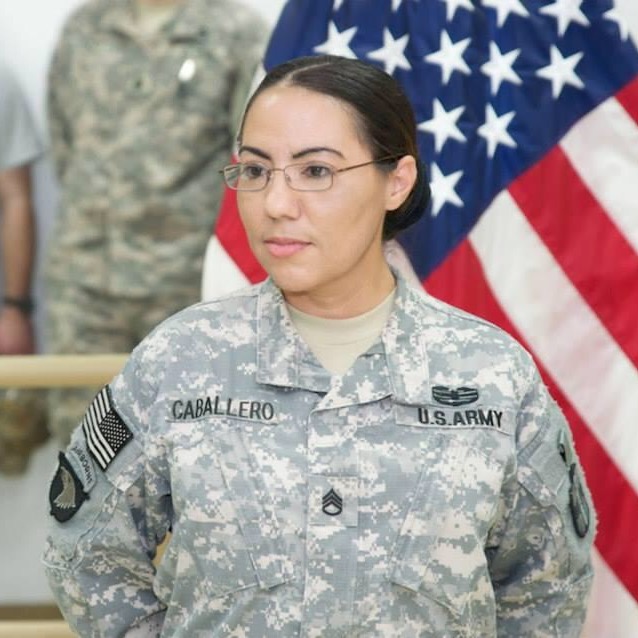
Army Reservist SSG Virginia Caballero Died on Plane Enroute in US After Deployment in Kuwait, Family Received Conflicting Accounts of Cause of Death (September 13, 2014)

If you have any information that could help this family find answers, please contact us at militaryjusticeforall@gmail.com. Thank you.

FullSizeRender-2 copy
SSG Virginia Caballero, US Army Reserves (2014)

Honoring SSG Virginia Caballero, US Army Reserves, who became ill while en-route from Kuwait and then died unexpectedly shortly thereafter at a hospital in Rockford, Illinois on September 13, 2014. Apparently the commercial plane needed fuel and/or had to do an emergency landing for Virginia in Rockford, Illinois. It appears that they were on their way to Fort McCoy in Wisconsin. According to reports, Caballero was a Reservist stationed with the 452nd Combat Support Hospital, 330th Medical Brigade out of Milwaukee, Wisconsin but trained at Fort McCoy prior to her deployment to Kuwait.  She served in Kuwait for roughly eight months and for some reason was coming home a month early with a high ranking travel companion. Media reports claim she wanted to surprise her family in Texas. It is believed Caballero suffered from a blood clot which was exacerbated with the altitude on the flight. She was not listed as a non-combat death by the Department of Defense but this would in fact be considered a non-combat death due to medical. The family admits in newspaper articles that a lot of the details are sketchy.

Here are the questions we have after combing through the below articles. Why was she coming home a month early accompanied by a high ranking travel companion if she was going to surprise her family? Did something happen in country prior to her boarding that plane? Was this an early surprise for family in Texas or an expedited transfer from Kuwait back to the states? The military isn’t in the business of assigning high ranking travel companions unless there is an issue. Were there any concerns about medical health prior to boarding the plane? Where were they flying to? Rockford, Illinois is only a couple hour drive from Fort McCoy. Why did they not land the plane sooner at a larger airport like Chicago when the medical issues began to develop or the fuel began to get low? Why did the DoD not send out an official notification of non-combat death considering she was on active duty orders in support of war efforts in Kuwait? Criminal Investigation Division (CID) was assigned to investigate the cause of death of Virginia. The family was asked to submit a FOIA request for the results of the investigation.

Related Links:
Army Soldier Reflects on Life Overseas and Time Back Home
Lubbock movers reach out to help purple heart recipient
Soldier flying home to surprise family in Texas dies en route
Decorated soldier flying home to surprise family in Abernathy dies en route
Local Purple Heart Recipient Died While On Active Duty
Purple heart recipient’s body to arrive in Lubbock on Saturday
Family, friends remember Virginia Caballero as Veterans Day approaches
The Heart of a Soldier: Sergeant earns hero’s salute from hometown
USAR SSG Virginia Caballero, 41 (Noonie Fortin)
Non Combat Deaths of Female Soldiers in the US Military (Other Areas)
Tribute to SSG Virginia Caballero from her Family
Abell Funeral Home Tribute to Virginia Caballero

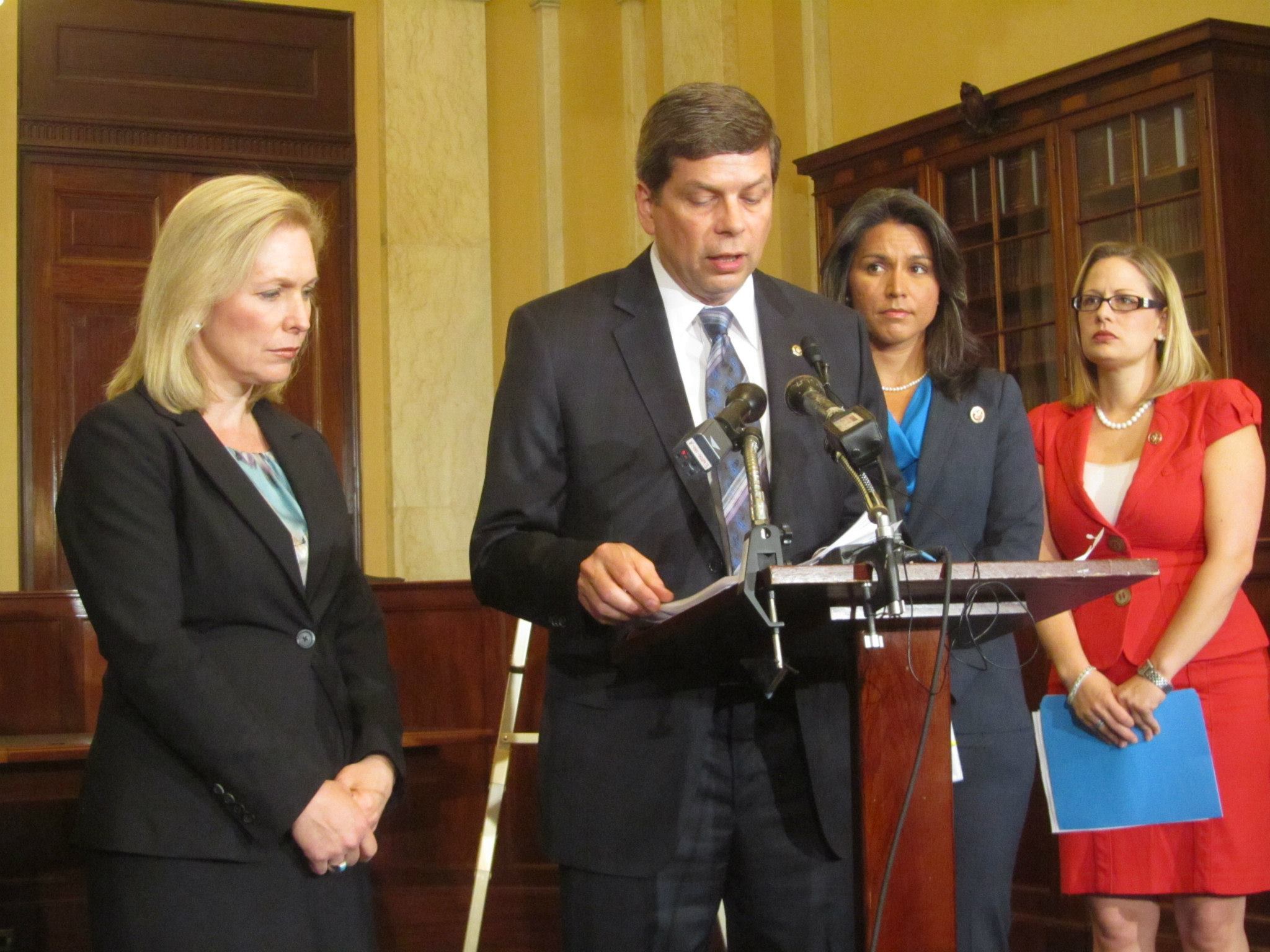
Senator Kirsten Gillibrand Leads Bipartisan Coalition to Reform the Military Justice System: Introduced the Military Justice Improvement Act (2013)

Gillibrand Leads Bipartisan Coalition to Reform Military Justice System
Senator Susan Collins Leads Effort to Reform Military Justice System to Address Sexual Assaults

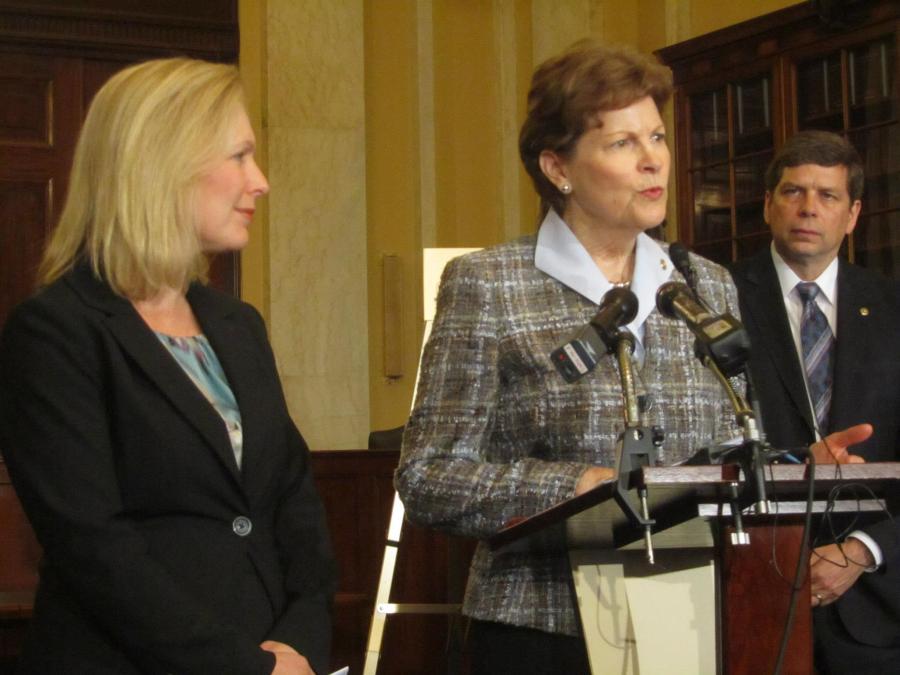
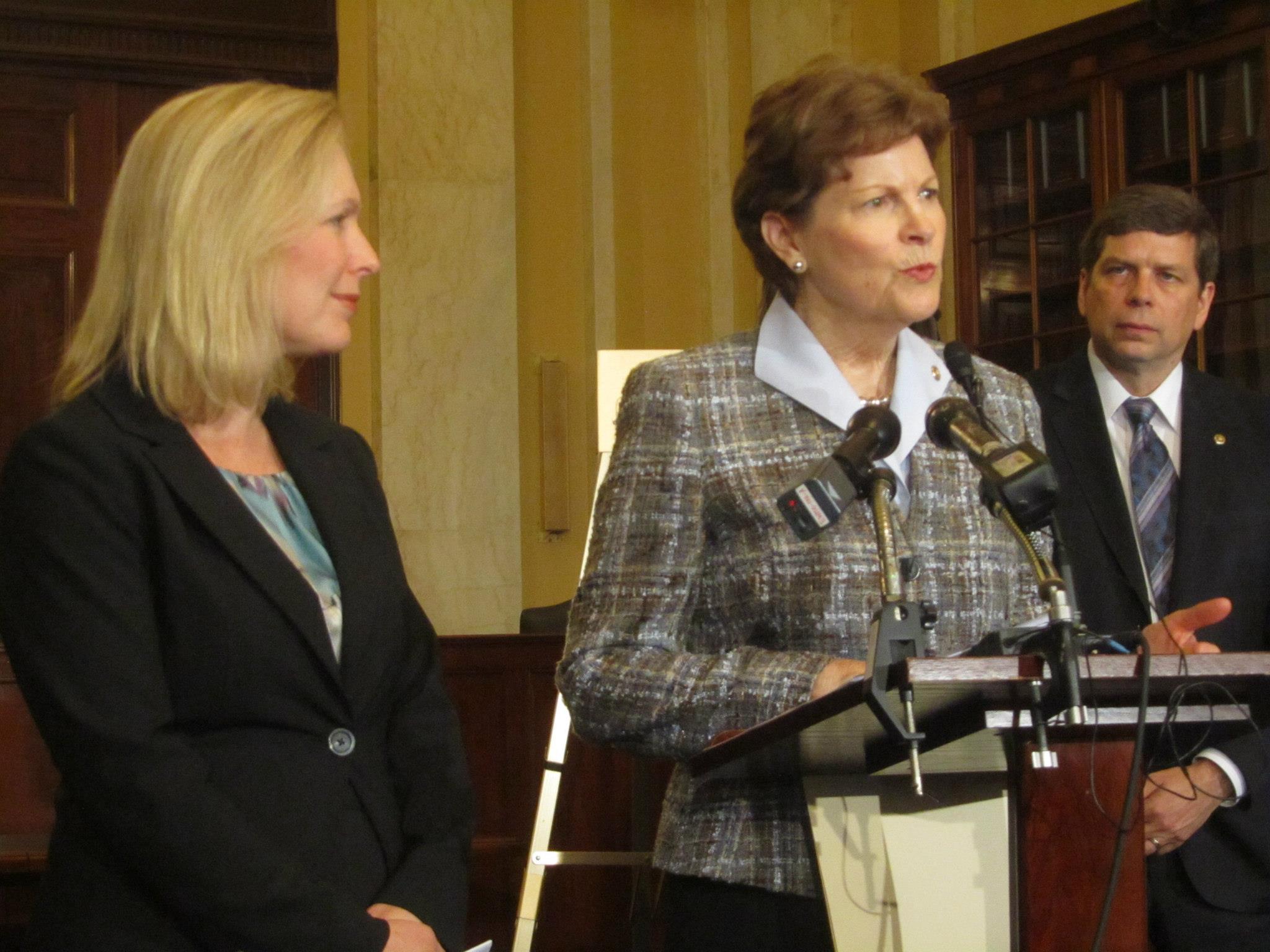
Washington D.C. – During a news conference today, U.S. Senators Susan Collins and Kirsten Gillibrand (D-NY), along with a bipartisan group of their colleagues in the Senate and House, announced new legislation that would reform the military justice system by removing the prosecution of all crimes punishable by one year or more in confinement from the chain of command, except crimes that are uniquely military in nature, such as disobeying orders or going Absent Without Leave. 

Senators Collins and Gillibrand were joined by survivors of sexual assault in the military, including Jennifer Norris of Maine, and by representatives from organizations who assist victims of Military Sexual Trauma. The Military Justice Improvement Act would for the first time remove the decision whether to take a case to special or general court-martial completely out of the chain of command and give that discretion to experienced military prosecutors for all crimes punishable by one year or more in confinement, except crimes that are uniquely military in nature, such as disobeying orders or going AWOL. 

“To be sure, the vast, overwhelming majority of our military personnel are honorable, conscientious, and respectful individuals, not rapists or harassers. It is for their sake that the pattern of covering up, blaming the victim, and failing to provide even the most basic protections that has been all too common for far too long must end,” said Senator Collins. “What does it say about us as a people, as the nation, as the foremost military in the world when some of our service members have more to fear from their fellow soldiers than from the enemy? This epidemic of sexual abuse cannot stand. We must ensure that justice is swift and certain to the criminals who have perpetuated these crimes.”

Gillibrand Leads Bipartisan Coalition to Reform Military Justice System (Full Video)

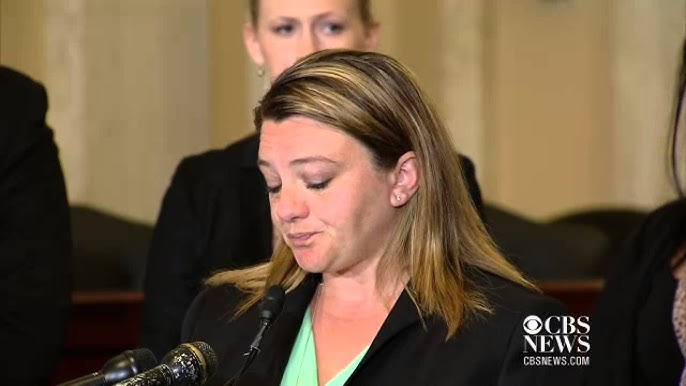
With tears streaming down her face, Jennifer Norris, a former Technical Sergeant in the Air Force, describes her harrowing experience with sexual assault and the difficulty she had in seeking justice within the military chain of command, saying, “The system is rigged against the victims” and in favor of the “often higher-ranking perpetrators.” [VIDEO]

Norris, who did not serve in Hawaii, said she’d been reluctant to report the rape because, “in the Air Force, I witnessed first hand what happens to those who stepped forward to report their assaults. I did not want to be stigmatized for reporting my assault — as I tried to move forward with my career. Instead, the best option for me was to try and endure it, to suck it up and try and make it until I could get transferred somewhere else — only to have it happen over and over again, like a recurring nightmare.”

She never did get justice, she said, even when she did come forward. “My perpetrators were allowed to resign in lieu of Administrative Hearings, which would have become a matter of public record. My command never offered the chance to proceed with a court martial.”

She said, “If the chain of command had been removed from handling sexual assault cases before I was attacked I believe justice would have been served or perhaps it would have been prevented in the first place.”

-Jennifer Norris (Civil Beat, May 16, 2013)

Gillibrand: “I’m Distressed That The Victims’ Voices Aren’t Being Heard In This Debate

Gillibrand: “I’m Distressed That The Victims’ Voices Aren’t Being Heard In This Debate

Related Links:
Sexual assault victim: “The system is rigged”
‘A Place to Begin’ by Jennifer Norris, USAF Retired [Video]
Air National Guard Recruiter Drugs and Rapes New Recruit (1996)
Sexual Assault and Abuse of Authority at Keesler Air Force Base (1997)
Non Combat Deaths of Female Service Members in the U.S. Military (Iraq)
House Armed Services Committee Initiatives Regarding Military Sexual Assault (2011)
Combat Military Rape, Jackie Speier Introduces Legislation and Campaign (2011)
Air Force TSgt. Jennifer Norris Testified Before the HASC in Washington DC (2013)
Defense Department Rescinds Direct Combat Exclusion Rule; Services to Expand Integration of Women into Previously Restricted Occupations and Units (January 24, 2013)
Pentagon battling military rape “epidemic” (2013) – CBS News
Now That Women Are Cleared For Combat, How About A Rape-Free Workplace? (2013)
Senator Collins Leads Bipartisan, Bicameral Effort To Reform Military Justice System (2013)
Military sexual assault victim Jennifer Norris discusses new bill – Democrat & Chronicle
Bill would take sexual assault cases out of commanders’ hands – Democrat & Chronicle
Legislation Aims to Strengthen Prosecution of Sexual Assaults in Military
Senators Lead Push To Change Military’s Sexual Assault Policy – NPR
Bill attacks ‘epidemic’ of military sex assaults – Portland Press Herald
Hawaii Delegation Backs Reforms Against Military Sexual Assaults
Changes proposed as military struggles with sex assaults
Military cracks down on rampant sexual abuse – CBS News
Obama, lawmakers tackle military sexual assault – The State
Gillibrand Builds Bipartisan Support for Change of Military Justice Code (UPDATED)
US Military Officials Call Sex Abuse In Ranks Serious Problem
The Deep Cultural Roots of Military Sex Abuse – CT Mirror
Military sex assault victims get aspirin: Our view – USA Today Editorial Board
Sexual assault victims say military’s promises of reform don’t go far enough
S. 967: Military Justice Improvement Act of 2013 – U.S. Senate Voting Record (March 6, 2014)
Senator Collins speaks in support of efforts to address military sexual assault (March 7, 2014)
Gillibrand turns empathy into political stock in trade (Poughkeepsie Journal)
The Modus Operandi of Social Justice Warriors (2016)
Vox: The War in Congress Over Rape in the Military, Explained (June 8, 2016)
Trends in Active-Duty Military Deaths Since 2006 | Congressional Research Service (2020)
“Veteran Advocates” Use Defamatory Newspaper Article & the Small Town Cops Who Created the Narrative to Bounce Medically Retired Service Members Out of the Advocacy Game (2024)
Military Injustice: Nowhere to Turn, Nowhere to Run, Nowhere to Hide; The Story of Kamisha Block and How U.S. Army Leadership Contributed to Her Death

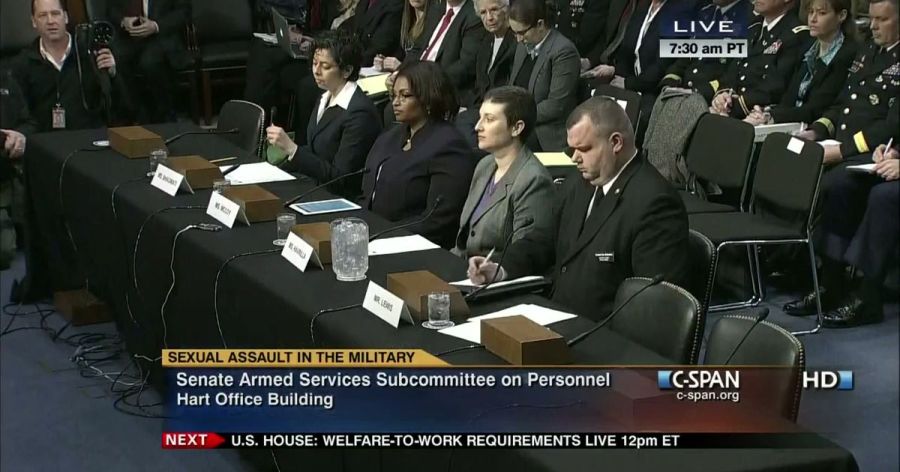
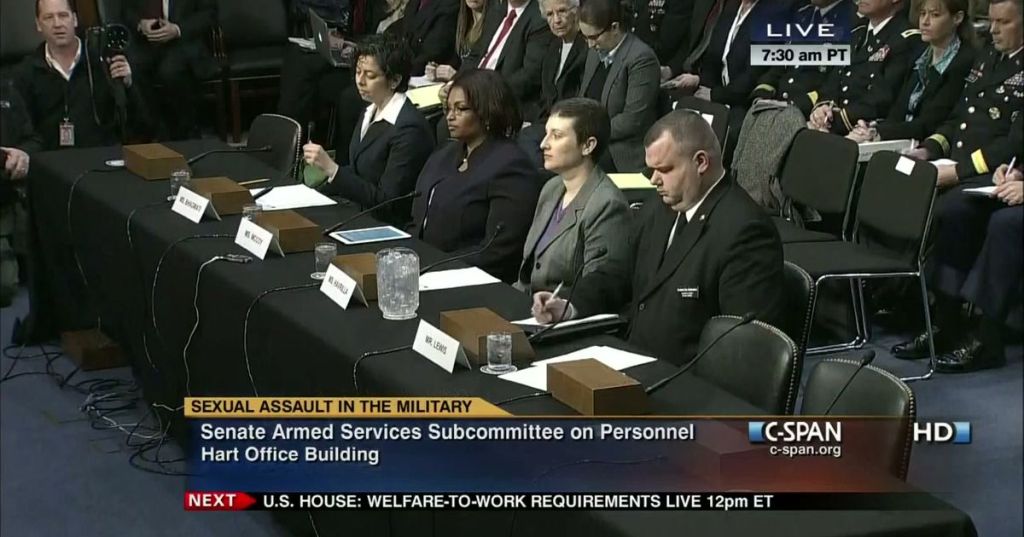
Senate Armed Services Subcommittee on Personnel: Hearings on ‘Sexual Assault in the Military’ (March 13, 2013)

Senate Armed Services Subcommittee on Personnel: Sexual Assault in the Military (Photo: C-SPAN)

Senator Gillibrand’s Opening Statement at Armed Services Subcommittee Hearing Examining Sexual Assaults in the Military

Hearing is Gillibrand’s First As Chair Of Senate Armed Services Subcommittee On Personnel – Has Been Leading The Fight To End Sexual Violence In Military

Washington, D.C. – U.S. Senator Kirsten Gillibrand released the following prepared remarks of her opening statement at today’s Senate Armed Services Subcommittee on Personnel hearing examining sexual assault in the military:

“It is an honor and privilege to Chair this hearing of the Personnel Subcommittee this morning. I want to thank the Ranking Member of this Subcommittee, Senator Lindsey Graham, for his support and working with me to move this hearing forward as quickly as possible.

“I know that all of our colleagues on the Armed Services Committee share our deep commitment to improving the quality of life of the men and women who serve in our all-volunteer force on active duty, or in the National Guard and Reserves, their families, military retirees, and Department of Defense Civilian personnel. 

“And that is why this hearing today is so important to me personally…and to thousands of servicemembers…and their families across the country.

“The issue of sexual violence in the military is not new. And it has been allowed to go on in the shadows for far too long. The scourge of sexual violence in the military should be intolerable and infuriating to us all.  Our best, brightest, and bravest join our armed forces for all the right reasons – to serve our country, protect our freedom, and keep America safe.

“The United States has the best military in the world and the overwhelmingly vast majority of our brave men and women serving in uniform do so honorably and bravely. But there is also no doubt that we have men and women in uniform who are committing acts of sexual violence and should no longer be allowed to serve.  

“Too often, women and men have found themselves in the fight of their lives not in the theater of war – but in their own ranks, among their own brothers and sisters, and ranking officers, in an environment that enables sexual assault. 

“And after an assault occurs, an estimated 19,000 sexual assaults happened in 2011 alone according to the Defense Department’s own estimates…some of these victims have to fight all over again with every ounce of their being just to have their voice heard…their assailant brought to any measure of justice… and the disability claims they deserve fulfilled. Congress would be derelict in its duty of oversight if we just shrugged our shoulders at these 19,000 sons and daughters…husbands and wives…mothers and fathers…and did nothing. We simply have to do better by them.

“When brave men and women volunteer to serve in our military they know the risks involved. But sexual assault at the hands of a fellow service member should never be one of them.  

“Because not only does sexual assault cause unconscionable harm to the victim — sexual violence is reported to be the leading cause of post-traumatic stress disorder among women veterans — but it destabilizes our military, threatens unit cohesion and national security. Beyond the enormous human costs both psychologically and physically, this crisis is costing us significant assets – making us weaker both morally and militarily.   

“Already, this Committee and the Pentagon took some first steps on this issue as part of last year’s National Defense Authorization bill that President Obama signed into law. While obviously our work is not done, I am hopeful that we can build on these initial changes which include:

Ensuring that all convicted sex offenders in the military are processed for discharge or dismissal from the Armed Forces regardless of which branch they serve in;

Reserving case-disposition authority for only high-ranking officers in sexual assault cases;

Pushing the Pentagon to lift the combat ban that prevents women from officially serving in many of the combat positions that can lead to significant promotion opportunities. By opening the door for more qualified women to excel in our military, we will have increased diversity in top leadership positions, improving response from leadership when it comes to preventing and responding to sexual violence;

And an amendment introduced by my colleague Senator Jeanne Shaheen and based on my legislation, the MARCH Act, means that troops who become pregnant as a result of an act of rape no longer have to pay out of pocket to have those pregnancies terminated. 

“Concerning our first panel of witnesses, I want to salute each of you for your courage today in telling your very painful and personal stories. It is my hope and belief that by committing this selfless act you are encouraging others to step forward and are also helping to prevent other crimes from going unpunished.

“We have a duty to you, and the thousands of victims you represent, to examine whether the military justice system is the most effective and fairest system it can be.  

“Despite some very dedicated JAG officers, I do not believe the current system adequately meets that standard.  The statistics on prosecution rates for sexual assaults in the military are devastating.  Of the 2,439 unrestricted reports filed in 2011 for sexual violence cases – only 240 proceeded to trial. Nearly 70 percent of these reports were for rape, aggravated sexual assault or non-consensual sodomy.

“A system where less than 1 out of 10 reported perpetrators are held accountable for their alleged crimes is not a system that is working. And that is just reported crimes. The Defense Department itself puts the real number closer to 19,000! A system where in reality less than 2 out of 100 alleged perpetrators are faced with any trial at all is clearly inadequate and unacceptable.

“My view is that emphasizing institutional accountability and the prosecution of cases is needed to create a real deterrent of criminal behavior. The system needs to encourage victims that coming forward and participating in their perpetrator’s prosecution is not detrimental to their safety or future, and will result in justice being done.  Because currently, according to the DOD, 47 percent of service members are too afraid to report their assaults, because of fear of retaliation, harm or punishment. Too many victims do not feel that justice is likely or even possible.

“We need to take a close look at our military justice system, and we need to be asking the hard questions, with all options on the table, including moving this issue outside of the chain of command, so we can get closer to a true zero tolerance reality in the Armed Forces. The case we have all read about at Aviano Air Base is shocking, and the outcome should compel all of us to take the necessary action to ensure that justice is swift and certain, not rare and fleeting.   

“I had the opportunityto press Secretary Hagel on the issue of sexual violence in the military during his confirmation hearing. Secretary Hagel responded by saying, ‘I agree it is not good enough just to say zero tolerance. The whole chain of command needs to be accountable for this.’

“I could not agree more. I was very pleased with the Secretary’s public statement earlier this week that he is open to considering changes to the military justice system as well as legislation to ‘ensure the effectiveness of our responses to the crime of sexual assault.’

“It is with this spirit as our guide that I look forward to hearing from our witnesses.

“After Ranking Member Graham makes his opening remarks, we will hear testimony from my colleague from California, Senator Barbara Boxer who has been a leading voice on this issue. In last year’s Defense bill she successfully included an amendment that prohibits any individual who is convicted of a felony sexual assault from being issued a waiver to join the military.

“We will then have the following witnesses who have either been the victims of sexual assault while serving in the military, or are very knowledgeable advocates for addressing the issue of sexual assaults in the military:

Anu Bhagwati is Executive Director and Co-Founder of the Service Women’s Action Network. Anu is a former Captain and Company Commander, she served as a Marine officer from 1999 to 2004. While serving, Anu faced discrimination and harassment as a woman in the military, and has borne direct witness to the military’s handling of sexual violence.

BriGette McCoy, former Specialist in the U.S. Army. BriGette served in the U.S. Army from 1987 to 1991. She was just eighteen years old when she signed up to serve her country in the first Gulf War. While stationed in Germany from 1988 to 1991, she was sexually assaulted by a non-commanding officer. 

Rebekah Havrilla, former Sergeant in the U.S. Army. Rebekah served in the U.S. Army from 2004 to 2008. She was the only female member of a bomb squad in eastern Afghanistan and was attacked by a colleague at Salerno Forward Operating Base near the Pakistani border during her last week in the country in 2007.

Brian Lewis, former Petty Officer Third Class, US. Navy. Brian enlisted in the U.S. Navy in June of 1997. During his tour aboard USS Frank Cable (AS-40), he was raped by a superior non-commissioned officer and forced to go back out to sea after the assault. 

“I encourage you to express your views candidly and to tell us what is working and what is not working.  Help us to understand what we can do to address this unacceptable problem of sexual assaults in the military. 

“Later this afternoon at 2:00 p.m., we will have a third panel of witnesses from the Department of Defense, and the military services, including the Coast Guard. I want to acknowledge that many of those witnesses are here this morning to listen to the critically important testimony from our first and second panels and I would like to thank them for their participation.”

Sexual Assault in the Military Senate Hearing:

Senator Gillibrand’s opening statement at the SASC Committee Hearing on Sexual Assault in the Military (March 13, 2013)
Survivors Share Sexual Assault Experiences in the Military (March 13, 2013)

Related Links:
Sexual Assault in the Military, Part 1 (C-SPAN)
Sexual Assault in the Military, Part 2 (C-SPAN)
Senator Gillibrand’s Opening Statement at Armed Services Subcommittee Hearing Examining Sexual Assaults in the Military
Gillibrand Opening Statement at SASC Hearing on Military Sexual Assault
Survivors Share Sexual Assault Experiences in the Military [Video]
Air Force TSgt. Jennifer Norris Testified Before the House Armed Services Committee in Washington DC (January 23, 2013)
Defense Department Rescinds Direct Combat Exclusion Rule; Services to Expand Integration of Women into Previously Restricted Occupations and Units (January 24, 2013)
CBS News: Sexual assault victim, “The system is rigged” (May 16, 2013)
Stars and Stripes: ‘White House, Congress bear down on military sexual assault’ (May 16, 2013)
S. 967: Military Justice Improvement Act of 2013 – U.S. Senate Voting Record (March 6, 2014)
Vox: The War in Congress Over Rape in the Military, Explained (June 8, 2016)

Navy CPO John Keith Bemis Found Dead in California Residence; Death Ruled Suicide But Totality of Evidence Suggests Homicide (August 7, 2012)

John Keith Bemis
CPO John Keith Bemis, U.S. Navy

Navy CPO John Keith Bemis, 30, was found fatally shot in his Spring Valley, California residence on August 7, 2012. Keith enlisted in the U.S. Navy in 2000 and was an air conditioning and refrigeration mechanic assigned to the U.S.S. Independence docked in San Diego, California. Although the exact time of death is unknown, Keith was found dead on Tuesday morning, August 7th, by Navy co-workers and the Sheriff’s Department. Keith was found in his bedroom lying on his back in full uniform wearing a motorcycle helmet with a single intraoral gunshot wound. Keith’s death was quickly ruled a suicide but Keith’s parents, Tony and Sue Bemis, who never believed Keith died by suicide, want Keith’s death to be reopened and investigated as a homicide. They have conducted their own investigation and have determined the evidence simply doesn’t add up. Keith was a happy and healthy young man with a stellar military career; he was a suicide prevention advocate for the Navy; there were no medical or mental health issues or stressors noted in Keith’s naval medical records; and he did not leave a note. The San Diego County Sheriff’s Department (Lemon Grove) were tasked with investigating and documenting the incident and the San Diego County Medical Examiner’s office conducted an autopsy. Photos were taken at the scene and at autopsy.

Tony and Sue Bemis elicited the help of the Armed Forces Medical Examiner (AFME) because they wanted a second autopsy conducted. Now both the San Diego County Medical Examiner and the AFME had ruled the cause of death suicide. After the family received a copy of the autopsy reports and photos, they began to notice upon closer examination that there were words like “gay” and “fag” written on Keith’s body. They found other oddities like numbers and words written on Keith’s body and on items in the bedroom where he was found. They found markings consistent with writing on the back of Keith’s neck. They observed two bullet holes in the ceiling; only one bullet was recovered. And were surprised by the damage caused to the motorcycle helmet where the bullet that killed their son apparently exited. They learned Keith was last seen on August 6 around 9 p.m. and suspect Keith was met with foul play shortly after returning home. Neighbors told the family he parked his truck in handicap parking (which he normally would not do) upon returning home. Neighbors also reported hearing a loud thud. After the family examined the evidence known to them (and to police), they found enough compelling evidence to warrant concern. Keith didn’t have any of the associated risk factors with suicide. But Keith did have a recent break up with a woman he had dated off and on for three years.

Keith met his ex-girlfriend in Tijuana and the relationship dynamics and reasons why they broke up are unknown. Those who interacted with Keith prior to his death did not observe any depression associated with the break-up. In the days following the break-up Keith celebrated an upcoming promotion on Sunday August 5, 2012; he spoke with family during a party at his condominium. He had recently purchased some new t-shirts and none of his electronic communications prior to the incident indicated any kind of unusual behavior. Unfortunately, Keith’s computer was of no use; the hard drive was wiped. Some mystery could have been alleviated with gun shot residue (GSR) testing of Keith’s hands but this testing was not conducted by either the San Diego County or Armed Forces medical examiners. The family tested Keith’s three guns for forensic evidence (including the gun allegedly used to take his own life) and no blood, blowback, or remains were found on any of Keith’s guns. The family wants homicide investigators to explore the various motives and theories because they know Keith didn’t die by his own hand. They can’t have peace until there is justice for their son. And none of us are safe if we turn the other way and ignore what quite possibly could be a homicide. Keith was concerned about a missing key to his place. Was a known offender able to gain access with the missing key? Nothing appeared to be stolen from Keith’s residence. Was it a personal crime?

If Keith’s death was a homicide, then a killer roams free. And because of this, we need to make death and missing persons investigations a priority. Every death investigation should be a homicide investigation initially until evidence proves otherwise. And we should always use gun shot residue testing to confirm suicide by gun. We should conduct a victimology, interview family and friends, and look at the totality of the evidence before making premature determinations that control the future of an investigation. The interviews, electronic records, and necessary forensic testing speak for the victim. We should take a look at all the possible theories. Some theories in this case include but are not limited to: ex-girlfriend angry Keith broke off with her, feels rejected, wants revenge; mistaken identity, intruder meant to target roommate; the missing house key was used to enter residence, intruder known; roommate was in Navy, maybe Keith suspected illegal activity and co-workers wanted him to remain silent; was this a national security incident or an act of terrorism? Tony and Sue Bemis created a website in Keith’s name. They are determined to find out what happened to their son because the evidence collected doesn’t support a suicide ruling. Take a look at the evidence for yourself and make your own determination. The more eyes on the case, the better. Please sign the petition, follow Death of Navy CPO John Keith Bemis on Facebook, and for tips, please contact Tony and Sue by e-mail.

Sources: Tony & Sue Bemis, Unsolved Mysteries, Attached Documents

The Official Unsolved Mysteries:

CPO John “Keith” Bemis’ death was declared a suicide in August 2012, but the evidence doesn’t add up and his parents need your help. -Unsolved Mysteries (February 27, 2015)

San Diego County Sheriff’s Department Report (August 7, 2012):

San Diego County Sheriff’s Department Report (Download PDF)

Armed Forces Medical Examiner’s Report (August 17, 2012):

Armed Forces Medical Examiner’s Report (Download PDF)

San Diego County Medical Examiner’s Report (September 28, 2012):

San Diego County Medical Examiner’s Report (Download PDF)

Able Legal Investigations Summary Report (January 12, 2014):

Able Legal Investigations Summary Report (Download PDF)

Ryan Forensic DNA Consulting Report (September 2, 2014):

Ryan Forensic DNA Consulting Report (Download PDF)

DNA Diagnostics Center Forensic Report (October 27, 2017):

DNA Diagnostics Center Forensic Report (Download PDF)

Related Links:
John Keith Bemis | Obituary
John Keith Bemis | Dignity Memorial
John Keith Bemis | Legacy.com
Together We Served – Keith Bemis, ENC
In Memoriam: Chief Petty Officer John Keith Bemis
CPO John Keith Bemis (website)
Death of Navy CPO John Keith Bemis (Facebook)
Reopen death investigation of CPO John Keith Bemis (petition)
Unanswered Questions in the Death of Keith Bemis
Family wants Navy to take another look at son’s death
CPO John Keith Bemis Dropbox Link
CPO Keith Bemis (Unsolved Mysteries)
CPO Keith Bemis – Unsolved Mysteries (website)
Keith Bemis | Unsolved Mysteries Wiki
Armed Forces Medical Examiner Office
Armed Forces Medical Examiner 3
San Diego Medical Examiner Office 1
San Diego County Medical Examiner 3
Lemon Grove Sheriff Department Reports
Reasons why we believe Keith was murdered
Decommissioned USS Independence arrives in Texas
What Causes Rigor Mortis?
What Are The 4 Postmortem Stages Of Death?
How Long Does It Take for Rigor Mortis to Set In?
6 weird things that happen after you die

Army Spc. Mikayla Bragg Death Ruled Suicide in Afghanistan; Report Calls for Continuity of Healthcare in Deployed Locations (December 21, 2011)

Mikayla Bragg
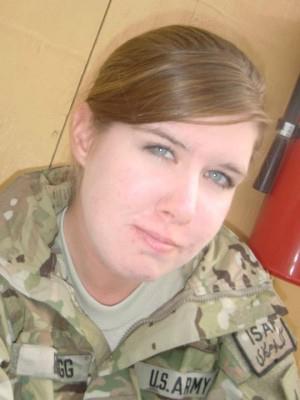
Spc. Mikayla Bragg, U.S. Army

Army Specialist Mikayla Bragg died of a non combat death in Khowst province, Afghanistan on December 21, 2011. Spc. Bragg was supporting Operation Enduring Freedom on behalf of the 201st Brigade Support Battalion, 3rd Brigade Combat Team, 1st Infantry Division in Fort Knox, Kentucky. The Army ruled that Spc. Bragg’s cause of death was suicide. After an investigation it was revealed that commanders at Fort Knox failed to properly track Spc. Bragg as a “high-risk” soldier who could potentially hurt herself or others before she was cleared to deploy to Afghanistan. The Army investigators also made three recommendations in the report.

  1. Mental-health providers stateside should share more information about high-risk soldiers with mental-health providers in war zones. Camp Salerno’s behavioral-health officer said she had been unable to get mental-health records for Bragg because of privacy laws.
  2. Commanders should develop better procedures to ensure personnel data is not lost while transferring soldiers between units.
  3. No soldier, regardless of gender, should be stationed in a guard tower alone.

Related Links:
DOD Identifies Army Casualty
Army Spc. Mikayla A. Bragg
Fort Knox soldier killed in Afghanistan
Longview soldier killed in Afghanistan
Longview soldier killed in Afghanistan (KOMO)
Longview soldier killed in Afghanistan (HeraldNet)
U.S. Army specialist from Longview killed in Afghanistan
Army Specialist with Ties to Shelton Killed in Afghanistan
Family, friends remember U.S. Army specialist from Longview killed in Afghanistan
Army Spc. Mikayla A. Bragg honored in dignified transfer Dec. 24
Flags lowered to honor Longview soldier
Jan. 5: Flags at Half-Staff in Honor of Mikayla Bragg
Report Finds Female Soldier Committed Suicide In Afghanistan
Longview soldier killed herself, report says
Longview soldier killed herself, report says (AP)
Report: Longview soldier committed suicide
Public Federal Way memorial honors Spc. Mikayla Bragg
Updated: The War Dead Since Sept. 21, 2011
The Unknown Soldiers: A Box of Flowers
Signs of respect in Holliston for Memorial Day
Vancouver Memorial Day ceremony pays tribute to region’s war dead
Confidentiality Speaking
‘Fell through the cracks’: Could Longview soldier’s death have been avoided?
139 Female Soldiers Have Died in Iraq and Afghanistan
How Longview, Wash.’s Mikayla Bragg ‘fell through the cracks’
How Mikayla Bragg and 31 Soldiers “Fell Through The Cracks”
Army vet leads charge to create memorial for fallen Longview soldier
Thieves steal monument to Washington soldier who died in Afghanistan

Deadly Women Premiered ‘Secrets & Lies’ on Investigation Discovery: Everything You Need to Know About Serial Killer Anjette Lyles (October 28, 2010)

Preview: Anjette Lyles felt the best way to deal with her problematic home life was to poison the people around her. -Secrets and Lies, Deadly Women (S4, E11)

City Confidential:

Macon, Georgia | City Confidential | Anjette Lyles [Full Episode]

Editor’s note: With a cable subscription, you can download the free ID Go app and watch Investigation Discovery programming at your convenience. And for those who do not have cable, you can watch “unlocked” episodes on the ID Go app including the latest premieres. For those who prefer commercial free programming during your binge session, Prime Video has an ID channel: ‘True Crime Files by Investigation Discovery” available for $3.99 a month. It’s a compilation of older seasons but totally worth the cost if you are a true crime addict. Download the ID Go app or purchase ID True Crime Files & binge away.

Related Links:
Anjette Lyles to be one of Discovery’s ‘Deadly Women’
Deadly Women- More Than A Pretty Face (Preview)
Secrets and Lies | Deadly Women | Investigation Discovery (website)
Secrets and Lies | Deadly Women | Investigation Discovery (Amazon)
Anjette Lyles | Macon, GA | City Confidential [Full Episode]
WWII Army Veteran Ben Lyles Jr. Died & Nobody Could Figure Out What Was Wrong; Poisoned by Wife, Anjette Lyles Sentenced to Death (January 25, 1952)
Deadly Women: 30 Military and Veteran Homicide Cases Featured on Investigation Discovery

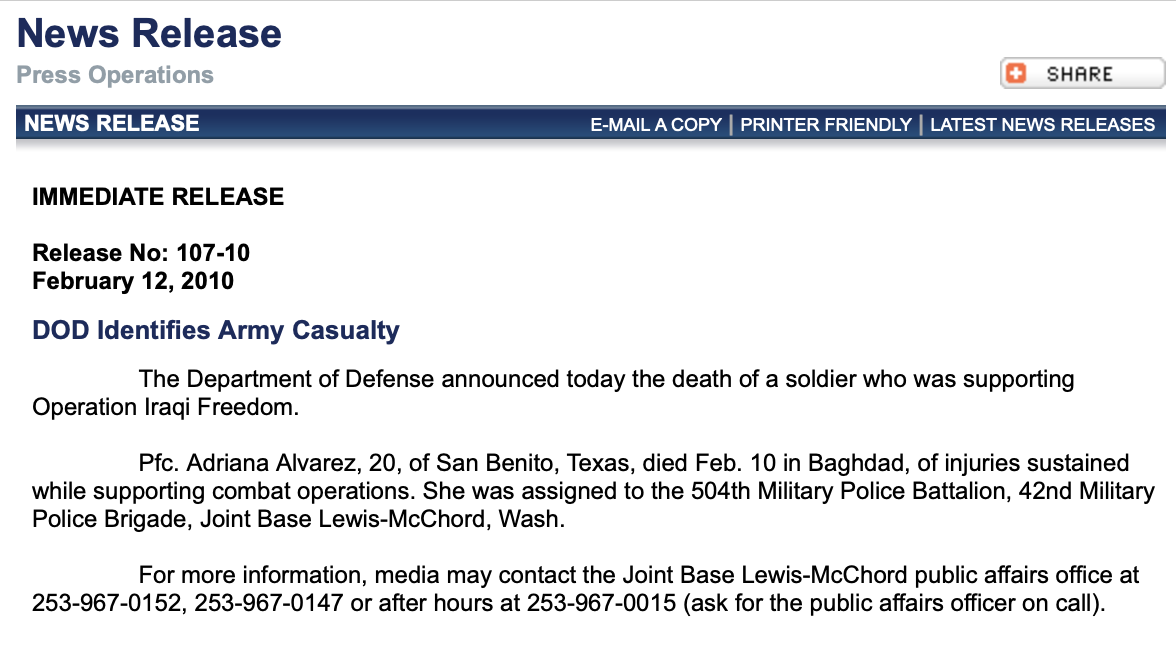
JBLM Army Pfc. Adriana Alvarez Died of a Gunshot Wound of an Unexplained Nature Sustained While Supporting Combat Operations in Baghdad, Iraq (February 10, 2010)

Adriana Alvarez
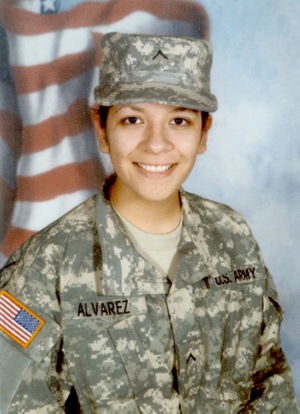
Pfc. Adriana Alvarez, U.S. Army

Army Pfc. Adriana Alvarez, 20, died of injuries sustained while supporting combat operations on February 10, 2010 in Baghdad, Iraq. Pfc. Alvarez was supporting Operation Iraqi Freedom on behalf of the 504th Military Police Battalion, 42nd Military Police Brigade at Joint Base Lewis-McChord, Washington. According to the Department of Defense press release, the incident was under investigation yet the outcome of the investigation is unknown. According to the Brownsville Herald, Pfc. Alvarez’s sister indicated that she was found with a gunshot wound. An official cause of death could not be determined based on any official statements from the Army or media reports. Although, the Olympian reported “Pfc. Adriana Alvarez, 20, belonged to a military police company at Lewis-McChord and died from injuries of an unexplained nature…in Baghdad, according to a separate report.”

“The U.S. Army policewoman was found Wednesday in Baghdad with a gunshot wound. Military officials were investigating Alvarez’s death, her sister said.”  –Brownsville Herald (February 12, 2010)

Adriana Alvarez DoD
Click here for DoD press release.

“Army PFC Alvarez was assigned to the 504th Military Police Battalion, 42nd Military Police Brigade, Joint Base Lewis-McChord, Washington. She was found dead of a gunshot wound – under investigation. Adriana always had dreams of becoming a police officer so after she graduated in 2008 from San Benito High School in San Benito, Texas, she joined the Army. She knew the best way to pursue a career in law enforcement would be through the military. In August she deployed to Iraq and kept in touch with her family thru e-mails and phone calls. Two days before her death, she spoke to her sister and said everything was fine. Adriana loved photography, classic rock music and proudly served her country.” (Adriana Alvarez, Find A Grave)

Related Links:
DOD Identifies Army Casualty
Army Pfc. Adriana Alvarez
Pfc. Adriana Alvarez | Find a Grave
Area soldiers die in Iraq, Afghanistan
Female soldier from San Benito dies in Iraq
AT A GLANCE: Valley Servicemen who were killed in war in Iraq
Two Lewis-McChord soldiers killed this week in separate incidents
Violent Crime, Suicide & Non Combat Death at Joint Base Lewis-McChord, Washington
Non Combat Deaths of Female Soldiers in the US Military (Iraq)
List of Washington’s Iraq War dead
Facing Our Losses – Iraq 2010

MJFA on Social:
Facebook: http://www.facebook.com/militaryjusticeforall
Instagram: http://www.instagram.com/military_crime
Twitter: https://www.twitter.com/@military_crime
Email: militaryjusticeforall@gmail.com