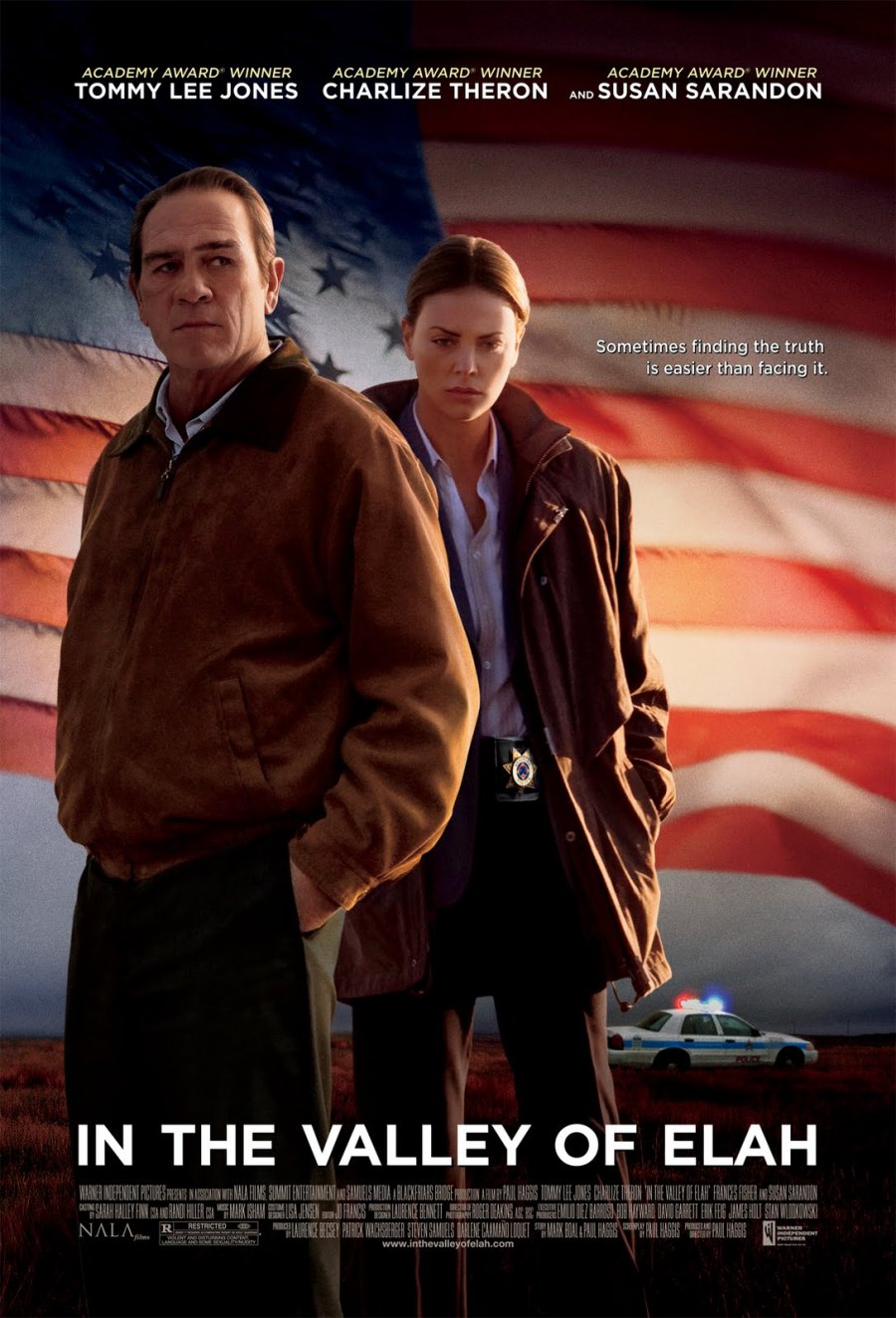
“In the Valley of Elah” tells the story of a war veteran (Tommy Lee Jones), his wife (Susan Sarandon) and the search for their son, a soldier who recently returned from Iraq but has mysteriously gone missing, and the police detective (Charlize Theron) who helps in the investigation. -Warner Bros. (September 14, 2007)
“Your son is missing.” It’s the phone call every soldier’s father dreads. Hank Deerfield (Tommy Lee Jones) had never thought that this call would come whilst his son was in the U.S., home from serving in Baghdad. Facing military indifference to the disappearance, Hank takes matters into his own hands. -YouTube (March 20, 2014)
“In the Valley of Elah” tells the story of a war veteran (Tommy Lee Jones), his wife (Susan Sarandon) and the search for their son, a soldier who recently returned from Iraq but has mysteriously gone missing, and the police detective (Charlize Theron) who helps in the investigation. -YouTube Movies (April 12, 2011)
“Desperate to solve the mystery behind their son’s disappearance, his father, also a war Veteran, and mother seek the help of seasoned police detective to uncover his true fate.” –In the Valley of Elah, Warner Bros.
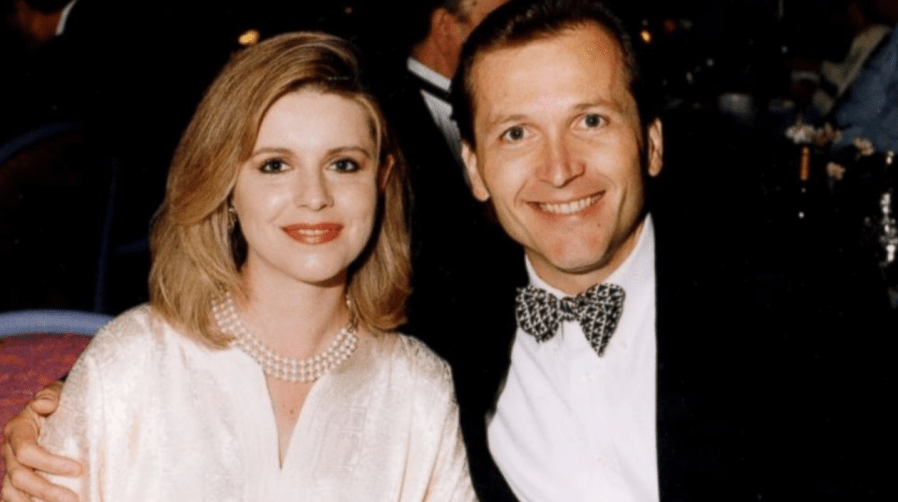
Martin MacNeill, a respected physician, calls 911 after finding his wife Michele clinging to life on April 11, 2007. The beauty queen and the doctor had been married for nearly 30 years and had eight children. -True Crime Daily (October 31, 2016)
“Investigators traced Martin [MacNeill’s] first lie back to when he got into the military at age 17. He was put on disability leave two years later when a medical officer deemed him a ‘latent schizophrenic’ with ‘other mental and psychological infirmities,’ according to documents Utah County investigators obtained in their research. Rachel and Alexis never saw signs of schizophrenia in their father and they do not believe he ever had such tendencies. Witney and even U.S. District Judge Dee Benson questioned whether or not Martin’s schizophrenia was real. But Martin had been receiving Veteran’s Administration and Social Security benefits for his alleged disability — even after he became a doctor and a lawyer with a six-figure income. He had been receiving VA benefits up until January 2010, Alexis said.” -Deseret News (December 4, 2010)
Remembering Michele Somers MacNeill:
Michele married Martin MacNeill, who became a doctor, and quickly built a big family with eight children. When he turned 50, he made some big life changes, and convinced his wife to get a facelift. -ABC News (June 15, 2019)
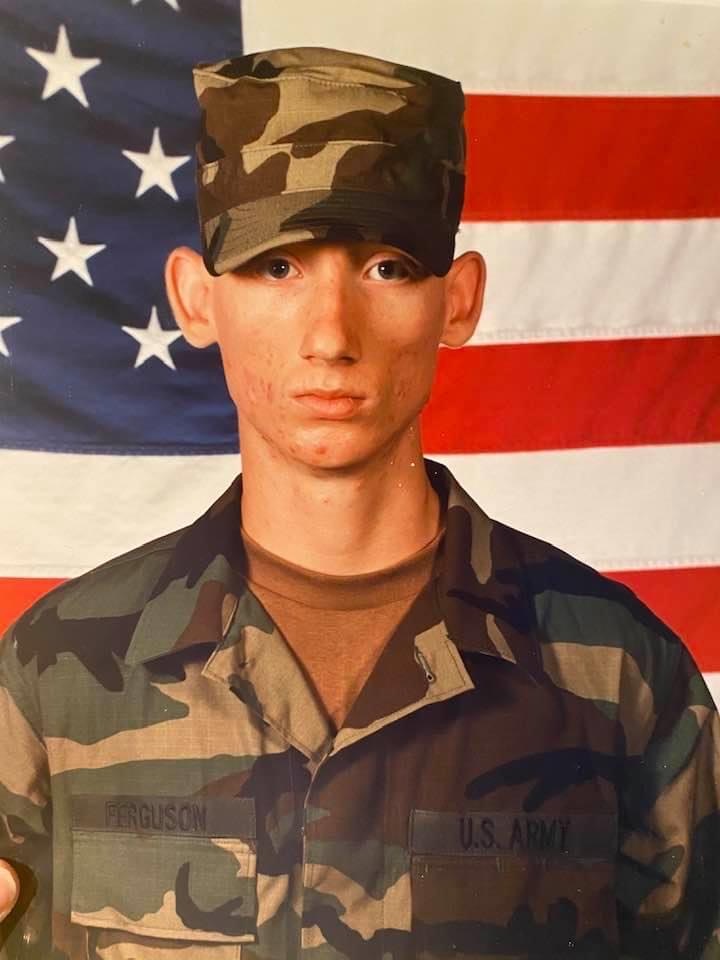
Fort Hood Army Cpl. Christopher Martin Ferguson, 21, died of undetermined causes on March 25, 2007 in Killeen, Texas. Christopher was born and raised in Pataskala, Ohio and enlisted in the U.S. Army in May 2004 after graduating from high school. Cpl. Ferguson worked as a combat infantryman on behalf of the Bravo Company, 3-67 AR Battalion, 4th Brigade Combat Team, 4th Infantry Division at Fort Hood in Texas. Cpl. Ferguson deployed in support of Operation Iraqi Freedom in 2005; he conducted over 200 combat patrols and participated in over 30 joint operations with Iraqi counter-parts in Baghdad.
Christopher Ferguson was born on April 12, 1985, in Columbus, Ohio, the son of Theophil Ferguson of Florida, and Patty Gibson Ferguson of Pataskala. He attended the Watkins Memorial School system, and graduated from the Criminal Justice program at Licking Co JVS, Class of 2004. He was fascinated by security systems and the military since a small child. He was described as a “peacekeeper.” He entered the U.S. Army in 2004, spent one year in Iraq, and was stationed at Ft. Hood at the time of his death. Cpl. Ferguson was survived by his mother and two sisters of Pataskala, Ohio when he passed.
******************************************
July 13, 2020:
“My brother is Corporal Christopher Martin Ferguson…he passed away March 25, 2007 at Scott and White Hospital in Texas…he was stationed at Fort Hood…he had just got back from Iraq and was at a party right off of base with fellow soldiers…story was that he fell from a three-story building on his head (alcohol involved or not, you don’t fall from a balcony to your head and not fracture one other bone, not have anything broken, only have your brain bleeding)…my mom, myself and my sister were flown out to see him and he was never awake…he was on life-support for seven days…everybody that came to the hospital was not allowed to talk to us…they told us that they had been told that they were not allowed to talk about anything that happened that night…we were left with no answers…my brother’s Sergeant brought us his blazer so we had something to drive while there and my sister and myself found a grocery bag in the back of his blazer that had the clothes he was wearing that night…the paramedics had cut them off him…it was just stuffed in the back of his blazer…there was a detectives card in there that was just placed in his shoe so I called and the detective let me know that the army had taken the investigation from Killeen PD…At the same time we found his camera and his blazer, there were fellow soldiers in the pictures with him that night who claimed that they were not there…my brothers death certificate says cause unknown [undetermined]…No one would tell us what happened and it was ruled as an accident years later…One of his fellow soldiers that does surfing for veterans put my brother on national news with his picture, his name along with saying that he committed suicide, but my family was never told that…there’s a lot more to the story…it’s very fishy and there was a lot of no talking or lies and I really want to know what happened to my brother.” -Christina McDonald (sister)
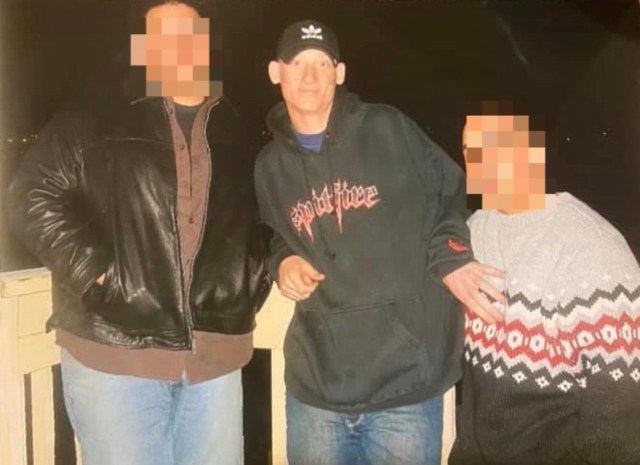
Christopher Ferguson with two Army soldiers. Picture taken on the balcony in question in 2007.
CBS Evening News with Norah O’Donnell:
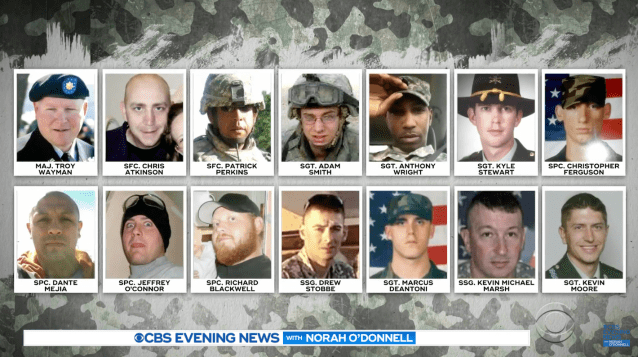
About 20 veterans die by suicide each day. A hotline launched in 2007 has answered more than 3.5 million calls, sending help to thousands of people. Dean Reynolds got an inside look. -CBS News with Norah O’Donnell (August 26, 2019)
Screenshot of the soldiers Army veteran Danny O’Neel claimed died by suicide. (CBS News)
“This is the national news episode that a fellow soldier of my brothers did! He added my brother to posters and news saying he committed suicide! If this was the case, why weren’t we told this?! The Army took the investigation from Killeen Police Department. If there was a real investigation going on, why did my sister and I find my brothers belongings, clothes, and shoes from that night…there’s blood on them, they stuffed everything in a grocery bag, and had it in the back of his blazer…they treated it like it was trash…wouldn’t you think they would need that as part of their investigation? Cpl. Christopher M. Ferguson deserves justice..please help our family find out what exactly happened to him at Fort Hood.” -Christina McDonald (sister)
We are not exactly sure when Army Pfc. LaVena Johnson’s CID Report was dumped on-line by the government but it appears to have shown up after the death of Vanessa Guillen. (Source: US Army CID)
Dr. John Johnson clarified in an interview on the Donny Walker Morning Show that wound statin was found on LaVena’s genitals. Listen to the full interview here.
Under the Sabers: The Unwritten Code of Army Wives or Army Wives by Tanya Biank was an excellent read. I first heard about the book when I was researching the 2002 Fort Bragg murders of Teresa Nieves, Jennifer Wright, Marilyn Griffin, Andrea Floyd and Major David Shannon. I ordered it from Amazon and threw it in a pile with all my other military crime books until I saw a Forbidden: Dying for Loveepisode about the murder of Army spouse Jennifer Wright. The show didn’t mention it but I knew Jennifer’s murder was one of five homicides at Fort Bragg that occurred within a two month period in 2002. I learned more about Jennifer Wright from Investigation Discovery than what’s available on-line. And at the time, the national media was quick to speculate whether war & violence, frequent deployments or anti-malaria drugs were to blame. But after the Army investigated itself, it determined that the high operational tempo after September 11, 2001 placed a great strain on already troubled marriages.
In other words, some form of domestic abuse, financial issues, and adultery in some cases were to blame for stained marriages. I researched the five murders and the motives were similar in four of the cases. Arguments were a pre-cursor to the murders and three out of four of the spouses wanted to leave the relationship. Was rejection the trigger? Domestic violence experts agree leaving the relationship is the most dangerous time. In Major Shannon’s case, it appears that the motive was greed, pure and simple, as greed is one of the most common motives for female killers. Major Shannon’s wife Joan stood to gain a large amount of money from his Serviceman’s Group Life Insurance (SGLI) if he died. This time the Army was most likely correct but unfortunately things haven’t changed to this day. There have been many more victims of domestic violence in the military since 2002 and this book inspired me to honor each and every one of them.
The author Tanya Biank grew up in a military family and covered military issues at Fort Bragg as a reporter for the Fayetteville Observer. Tanya was able to give us a realistic perspective of what was going on at Fort Bragg during the time period right before and after September 11, 2001. Tanya was the one writing about the rash of homicides for the local newspaper during the summer of 2002. As a result of Tanya’s reporting, the main stream media picked up the story and it went national and international. Fort Bragg was forced to answer to a frenzied pack of media outlets and in typical fashion, the Army investigated itself and found themselves not responsible. Although Tanya reported in the book that Congress authorized $5 million for domestic violence programs in the military that year. And on December 2, 2002, President Bush signed into law an act that makes domestic violence protective orders enforceable on military installations.
Tanya was the perfect person to write about Fort Bragg. She had a great understanding of the various perspectives and this was revealed in the book. She talked about how September 11th changed things for both the service member and the families. I found myself feeling thankful for the education about Fort Bragg’s missions and how they fit into the big picture. They train hard for a reason. They are some of the first on the front lines and some of the families have no idea where they are going or how long they will be gone. Unexpectedly, I experienced a myriad of emotions as I read along. Emotions about 9/11, emotions about what was happening at my own squadron, and emotions around the notifications of death. My Commander and a Chaplain informed me of my father’s unexpected death. And my colleagues helped me get home safely. I realized this was standard protocol while reading this book.
I couldn’t put the book down once I started, despite the emotions and memories it triggered. Tanya Biank did a great job of enticing the reader to learn more about the individual and the family, and just when you least expected, the unexpected would happen. It reminded me of my own life and how hard it was to put mission before self year after year when all one was doing was stuffing down the pain. But like those in the book, we don’t seek counseling because it’s considered a career ender. We don’t trust the system so most of us just keep our troubles to ourselves. And for those who want to maintain a security clearance, we know they are going to ask the question about mental health treatment. I understand why the question has to be asked because it’s important to identify someone with suicidal tendencies or anger problems but it prevents the rest of us from asking for the help we need, until it’s too late.
Tanya talked about the unusually high crime rates in Fayetteville and she said its civilians who commit most of the crime. She admitted Fort Bragg was under the shadow of the the murders of Colette, Kimberley & Kristen MacDonald in 1970 because former Captain Jeffrey MacDonald, despite being found guilty, swears he’s innocent. As recently as December 2018, MacDonald was denied a new trial by a federal appeals court and he continues to be the subject of both media and true crime programming. Tanya also talked about the racially motivated murders of Michael James & Jackie Burden in 1995. Army privates James Burmeister and Malcolm Wright were found guilty of the crime. This too made national news and the Army was forced to weed out any perceived Neo-Nazis, white supremacists, and skinheads. The media speculated the Army was full of them; turns out this random attack by Fort Bragg soldiers was an isolated incident.
After researching the five Fort Bragg murders in 2002 on-line, I realized that Tanya’s book was the most comprehensive discussion of the incidents. The book gave us an inside look at the people involved and the way it unfolded real-time. Tanya shared that the military likes to keep their problems under wrap because of the way the media speculates. I can see why they would be annoyed with how scandals are reported. Once the information is out there, it’s hard to fight off the perception. But the bottom line is the acts of a few don’t represent the whole. Unfortunately, I could write book after book about clusters of domestic violence related homicides in the military since 2002. This book made me realize how long the military has known about the problems and that throwing money at the problem doesn’t fix it. We need real solutions that save lives.
Editor’s Note: Tanya Biank’s book Under the Sabers inspired the creation of Army Wives on Lifetime television. After reading the book, I can understand why the series was created in 2007. I included links to the show below if you are interested in watching the series. It was cancelled after seven seasons.
Joshua Omvig, U.S. Army Reserve Veteran (Photo: The Courier)
“On December 22, 2005, Joshua Omvig, a 22-year-old reservist from Davenport, Iowa, committed suicide with a gun in his pickup truck, after returning from a tour of duty in Iraq a year earlier. He suffered [from] post traumatic stress disorder, a common problem with soldiers returning from Iraq and Afghanistan. Omvig’s parents, Randy and Ellen, began lobbying for comprehensive PTSD care for all veterans.” Read more from The American Prospecthere.
Joshua Omvig Veterans Suicide Prevention Act Signed Into Law:
[Former] Rep. Bruce Braley speaks in favor. -Nancy Pelosi (October 23, 2007)
Congressman Boswell’s floor statement before the final passage of the Joshua Omvig Veterans Suicide Prevention Act. (October 23, 2007)
“The sergeants and fellow soldiers in A Co., 2nd Battalion, 1st Infantry Regiment, Ft. Wainwright, AK began tormenting and threatening one of their own. A portion of his unit even paid a visit to one of Nick’s friends from college, threatening to beat him up if he did not stop associating with Nick. He was an injured, isolated soldier who wanted to serve his country however he could. He would have done anything in his power to remain one of the elite. But he was no good to his unit and they saw him as an easy target. He feared for his life several times. It became hell for him and Nicholas saw no way to survive other than to leave.”
“Nick went AWOL for the month of February 2005. He was set up by an acquaintance and caught by his company commander and the MP’s. It was reported to me that he was not taken in easily. The MP’s turned their backs while the unit beat him up. It was soon after this that Nicholas attempted suicide. I’ve been told that the mental ward was where my son felt safe. After a couple of weeks he was returned to his unit. In April he left again, this time flying to his home town in West Virginia. He stayed with some friends, got a job and enrolled in college. But Nick was a patriot and knew the commitment he had made. He decided to return to the Army, hoping that he would not be sent back to his unit in Alaska.”
“He was taken to the US Army Personnel Control Facility (PCF), US Army Armor Center, Ft. Knox, KY. The day he arrived. near the end of May, he signed paperwork for a dishonorable discharge in lieu of a court martial. Somehow, the abuse he suffered in Alaska found him at Ft. Knox. On June 15th he was admitted to a hospital in Radcliff, KY for another suicide attempt. Again, he chose the safety of the mental ward. On June 27th his discharge was approved. Nick was released from the hospital on July 12th. He made arrangements to go home on the 14th but he never made it. Nicholas was murdered in the latrine and hung on the back of a latrine door in the 7pm hour of July 13, 2005.”
Hundreds of suspicious deaths occur within our military branches each year. Our military kills their own soldiers to satisfy their needs.
Be careful: if you see too much, they’ll kill you.
If you struggle with something, they will kill you.
If you ask the wrong questions, they’ll kill you.
If you are in the wrong place… even simply by chance… they will kill you.
You are not protected by the government you serve. The people who “stand behind you” are the ones who will stab you in the back. They will give the order to have you killed.
Kim Slapak-Smith
If you have any information about this case, please contact me through this website.
Army Sgt. Ronna R. Valentine, 28, was found shot to death in her Fayetteville, North Carolina home hours after she returned stateside from Iraq on May 21, 2005. The Fayetteville Police Department said Sgt. Ronna Valentine was shot by her Army spouse, James Valentine, 42, who then turned the gun on himself. Reports indicate police received a call from a man who said he just shot his wife and was about to turn the gun on himself. When officers arrived at the apartment, they found the couple dead inside. Sgt. Ronna Valentine’s home of record was listed as Brandenburg, Kentucky and she was an equipment records and parts specialist for the 327th Signal Battalion of the 35th Signal Brigade at Fort Bragg. Sgt. Ronna Valentine enlisted in the Army in 1997 and deployed to Iraq in November 2004; she was home on leave when the murder-suicide occurred.
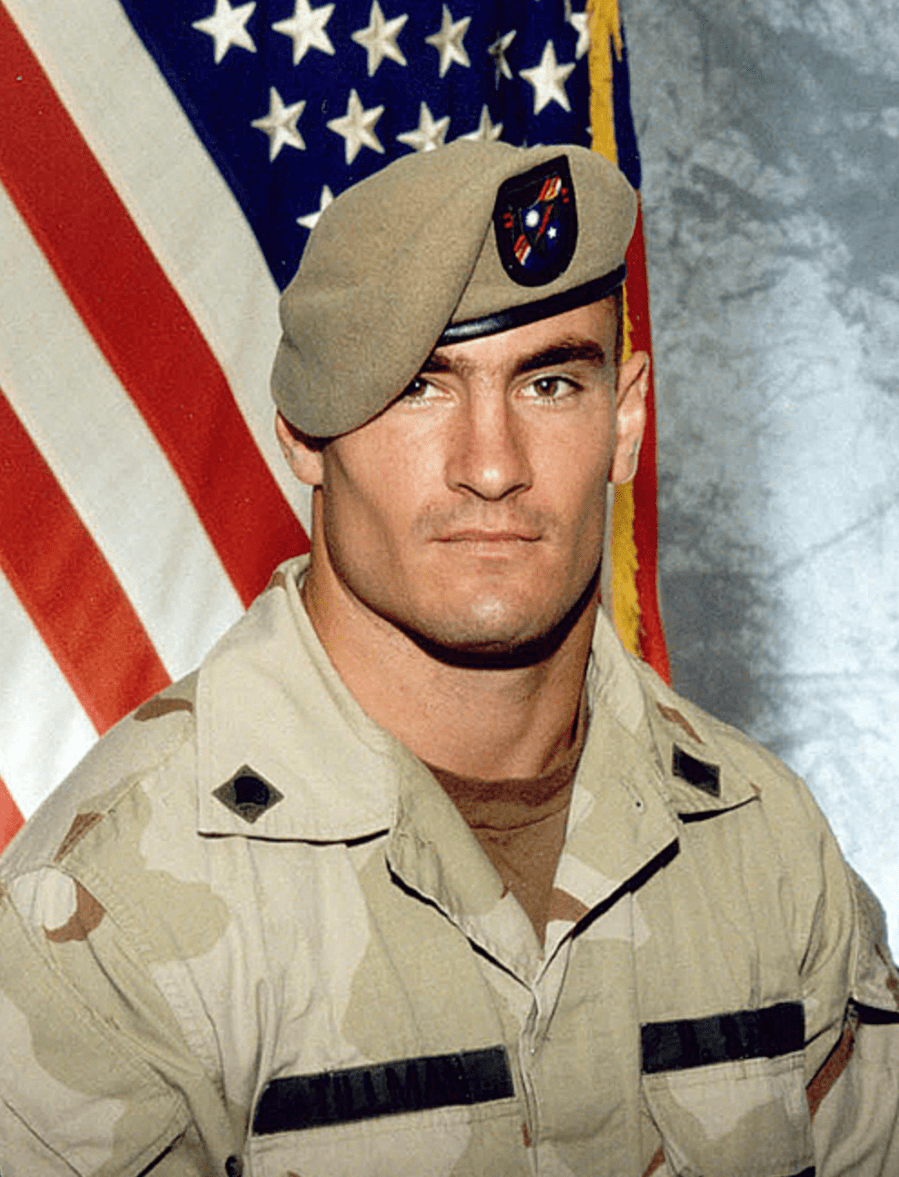
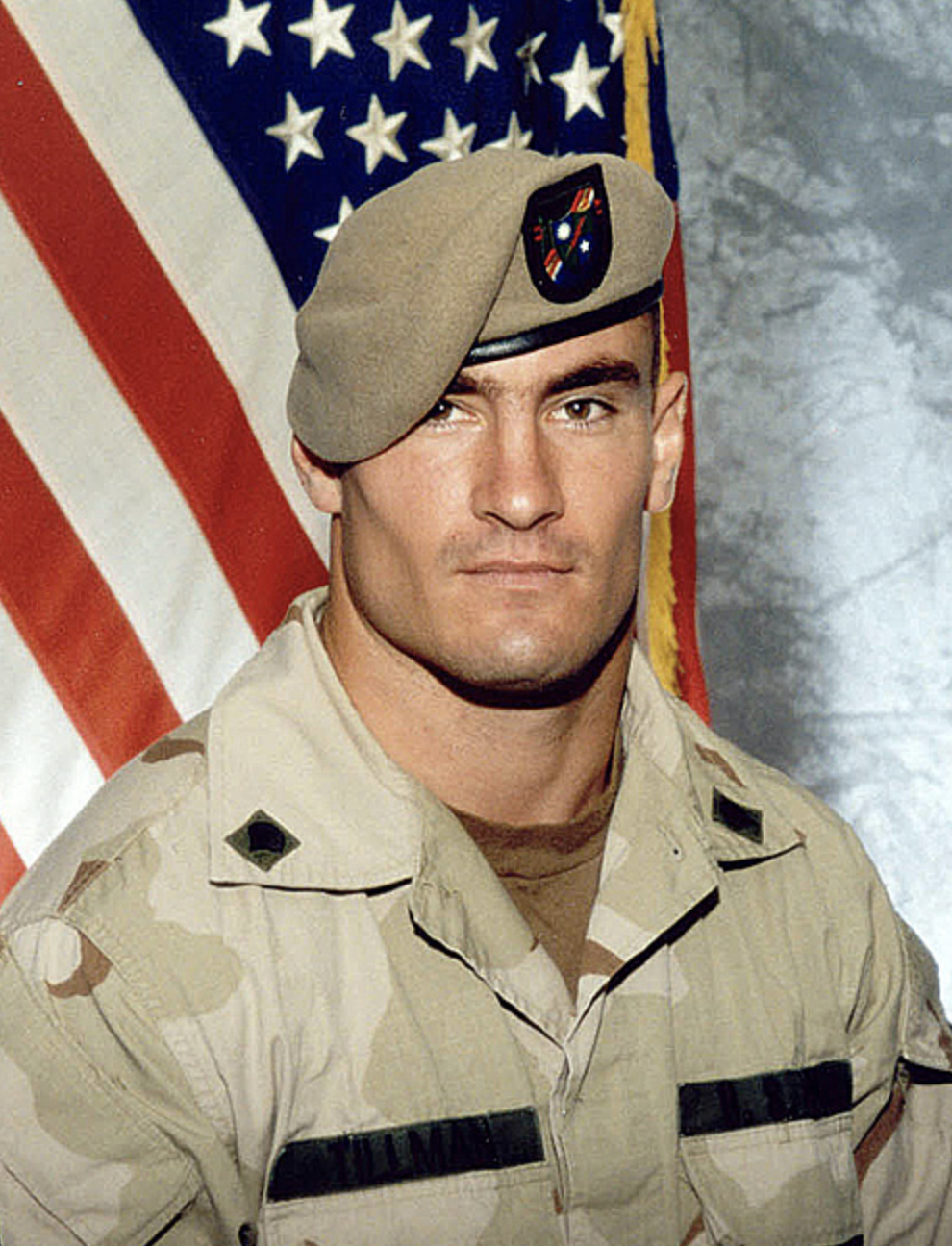
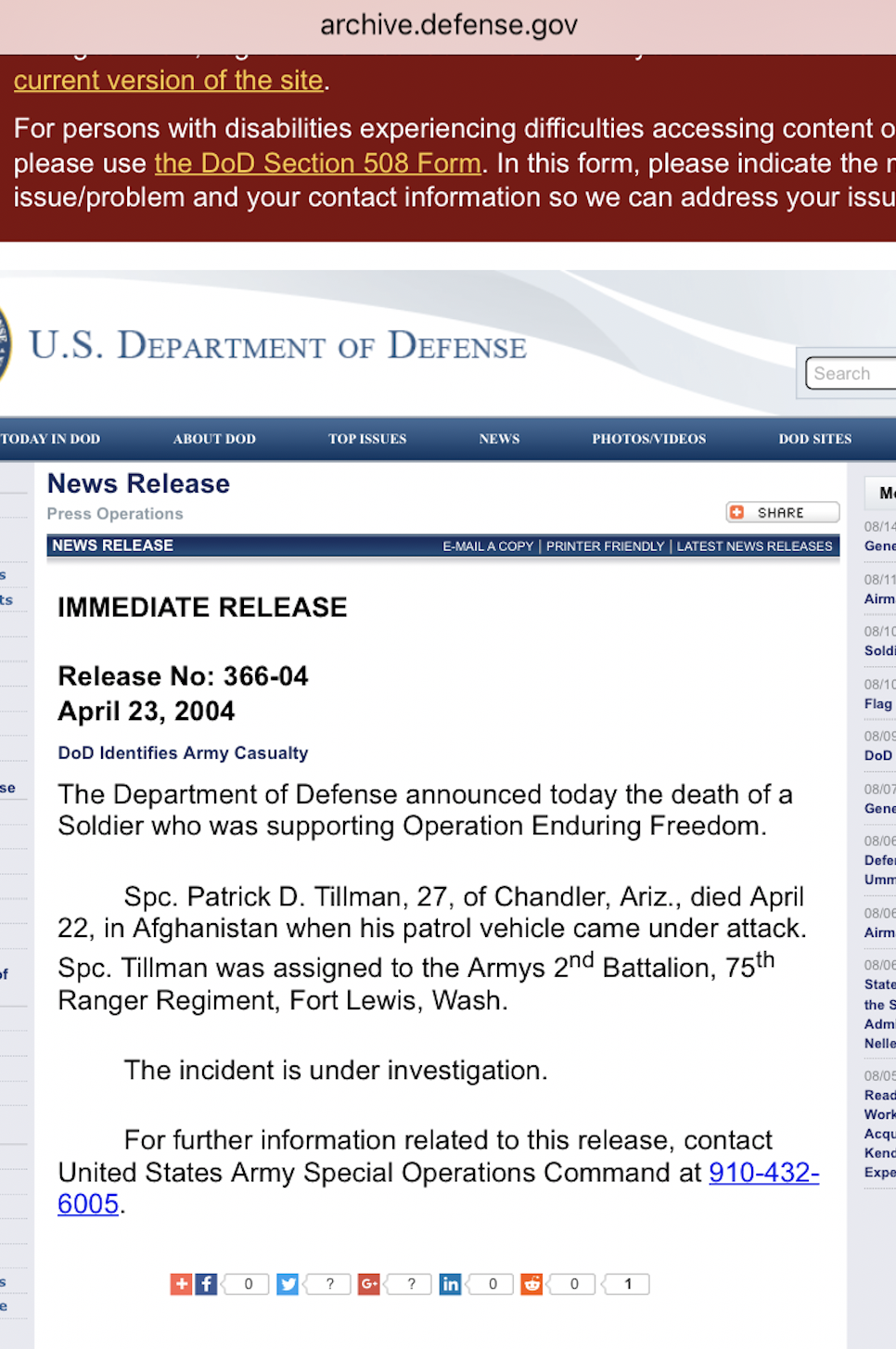
This screenshot of this press release for Patrick Tillman is no longer on the DoD press releases website. They deleted the original site and created a new one that only goes back to 2014.
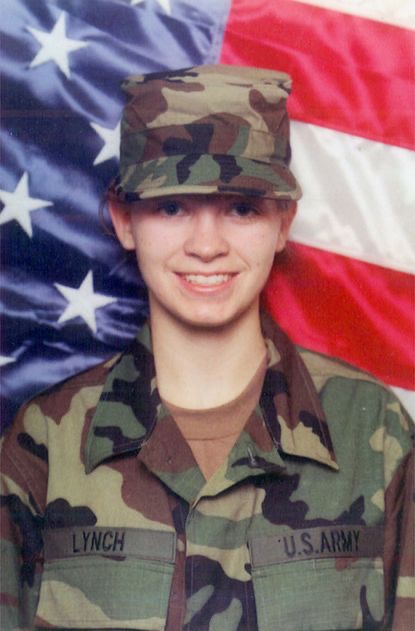
“On July 22, 2003, U.S. Army Private Jessica Lynch, a prisoner-of-war who was rescued from an Iraqi hospital, receives a hero’s welcome when she returns to her hometown of Palestine, West Virginia. The story of the 19-year-old supply clerk, who was captured by Iraqi forces in March 2003, gripped America; however, it was later revealed that some details of Lynch’s dramatic capture and rescue might have been exaggerated.”
In April 2007, Lynch testified before Congress that she had falsely been portrayed as a “little girl Rambo” and the U.S. military had hyped her story for propaganda reasons…“I am still confused as to why they chose to lie and tried to make me a legend when the real heroics of my fellow soldiers that day were, in fact, legendary. The truth of war is not always easy to hear but is always more heroic than the hype.”






 MILITARY JUSTICE FOR ALL