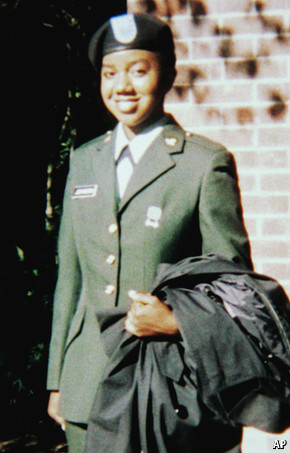
“Lavena Johnson was a smart, witty woman, born and raised in Missouri. Her senior year of high school she decided she would join the Army in an effort to not burden her parents with out of state tuition for college. Although Dr. Johnson (Lavena’s dad), begged her not to join the Army – she did so anyway. She thought the Army was a good deal – you serve your country a few years and then you get 4 years of college paid! Recruiters promised her she would likely not deploy, even though in 2004 there was an uptick in deployed troops.”
Listen to Ep 40: Did Lavena Johnson commit suicide? on the Military Murder Podcasthere.
“U.S. Sens. Kirsten Gillibrand (D-N.Y.), Chuck Grassley (R-Iowa) and I recently announced that we will offer the bipartisan Military Justice Improvement Act as an amendment to this year’s National Defense Authorization Act. The Military Justice Improvement Act would professionalize how the military prosecutes serious crimes by moving the decision over whether to prosecute them to independent, trained, professional military prosecutors.
Despite years of Congressional reforms, thousands of service members are raped and sexually assaulted every year. In many of those cases, the assailant is someone in the survivor’s own chain of command. Only a small fraction of the perpetrators are ever held accountable for their violent crimes. Last year, the Department of Defense announced a record number of sexual assaults reported by or against service members, and yet, less than 10 percent of cases considered for command action ever proceeded to trial. Worse yet, despite repeated efforts to stamp out the scourge of retaliation against military sexual assault survivors, the most recent Pentagon survey found that 64 percent of survivors say they have experienced some form of retaliation for reporting the crime. That figure is statistically unchanged from 2016.”
The bill named in Caserta’s honor would create “Brandon Act” reporting, making it easier for service members to seek mental health care anonymously
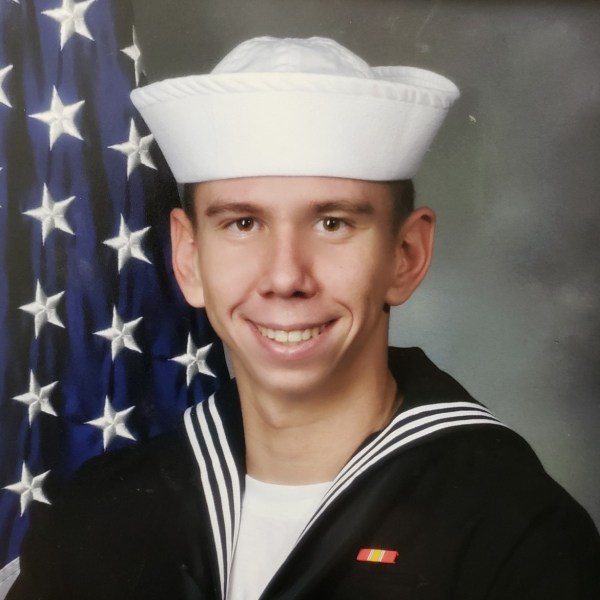
PO3 Brandon Caserta, U.S. Navy
WASHINGTON — Today, Representative Seth Moulton (D-MA) and Teri and Patrick Caserta, parents of fallen United States Navy Petty Officer Third Class Brandon Caserta, announced the introduction of The Brandon Act.
The bill would allow service members to anonymously report and seek mental health treatment by using a safe word like “Brandon Act.” It is designed to protect service members who experience mental health emergencies that result from hazing, bullying, or any other issue. It would allow them to seek help anonymously and, if necessary, outside of the chain of command. The bill’s introduction comes on the second anniversary of Brandon Caserta’s death from suicide, which he said was prompted by bullying and hazing within his unit.
“Brandon had a smile that made everyone want to smile. He was a very charismatic and upbeat young man. He made everyone’s day better no matter what they were going through. Brandon has always helped everyone he could. The Brandon Act would do this for his fellow service members in his death,” Teri and Patrick Caserta said, “Brandon did not die in vain and his legacy for helping others will continue long after his death when The Brandon Act is passed.”
Rep. Seth Moulton said: “Brandon tragically lost his life because he wasn’t able to get support for his mental health—something we should provide every American, especially every American hero in uniform. This bill will ensure our service members can get help and have no fear of retaliation for doing so, as it’s the right thing to do. Although we’ll never get Brandon back, his legacy will be the lives of many more great Americans he saves through this bill, and I’m proud of his parents who have fought so hard to tell his story and make this change.”
Brandon Caserta died by suicide on June 25, 2018 on the flight line at Naval Air Station Norfolk, Virginia. After his death, his parents and friends discovered six notes in which Brandon attributed his suicide to persistent hazing and bullying from some members and leaders of his Navy helicopter squadron.
The Brandon Act expands the existing law that regulates how service members are referred for mental health evaluations, in order to provide a confidential channel for service members to self-report mental health issues. The process would protect the anonymity of service members, similar to the restricted reporting option that protects victims of sexual assault.
Moulton made expanding mental health care and breaking the stigma around seeking help a top priority since disclosing last year that he is managing post traumatic stress from his service in Iraq as a United States Marine. In addition to The Brandon Act, Moulton has secured mandatory mental health check ups for service members who saw combat within 21 days of leaving the battlefield in the FY20 National Defense Authorization Act.
He also co-introduced, with fellow veteran Rep. Chris Stewart (R-UT), the National Suicide Hotline Designation Act, which would make 9-8-8 the national number for mental health emergencies. The bill has passed in the Senate, and is one step away from a vote on the House floor. Yesterday, the FCC announced that it would issue a final rule on the designation of 9-8-8 as the national suicide prevention hotline in mid-July.
A copy of The Brandon Act is available for download here.
A legislative summary for The Brandon Act is available for download here.
Read more from the original source on Rep. Seth Moulton’s website here.
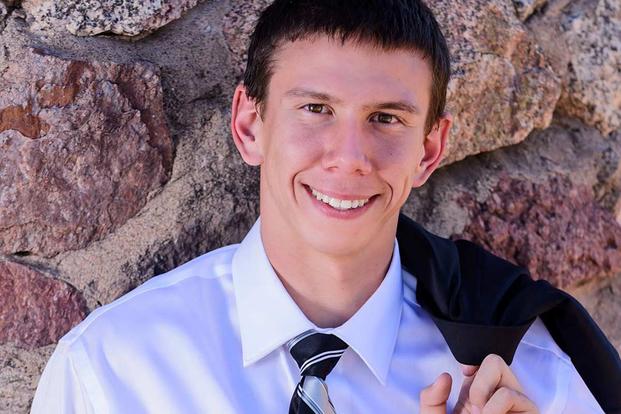
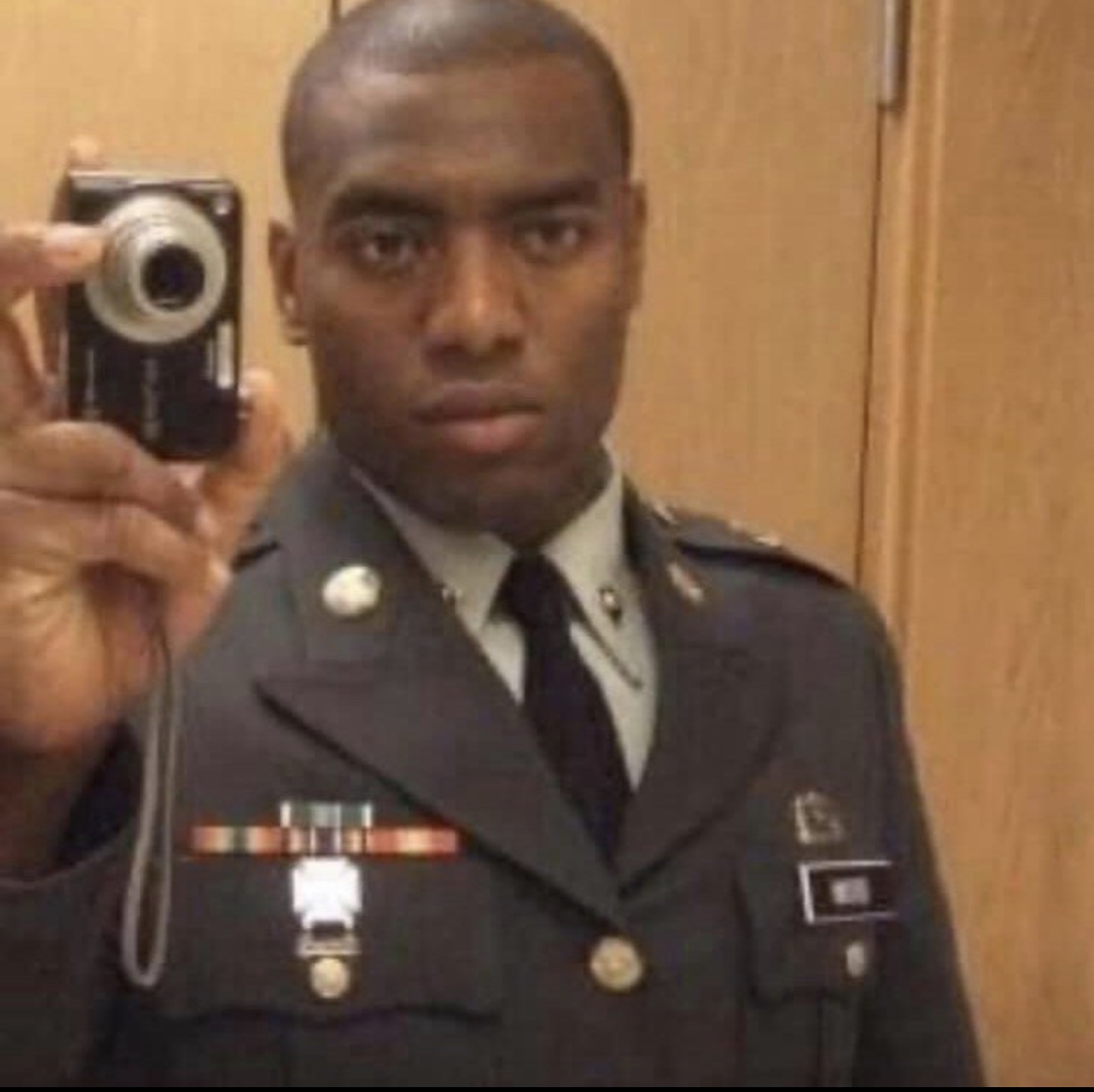
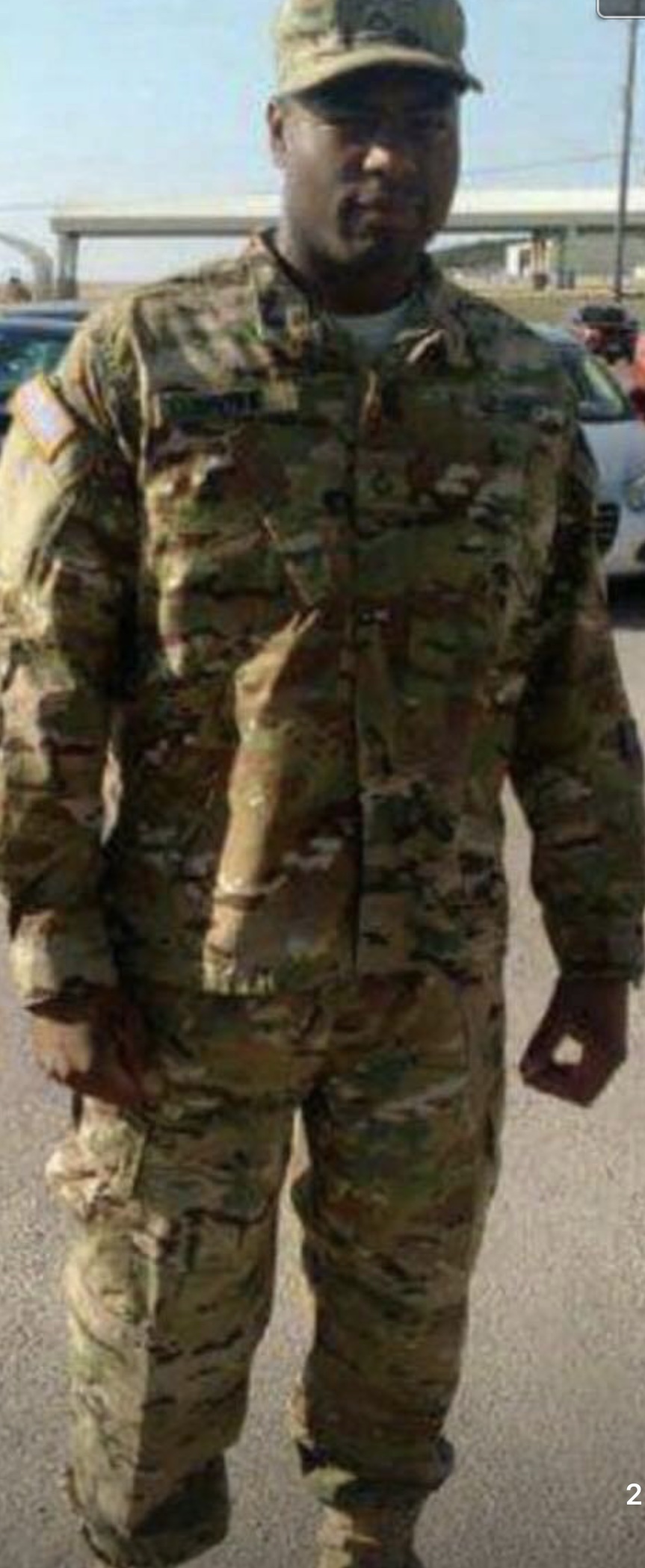
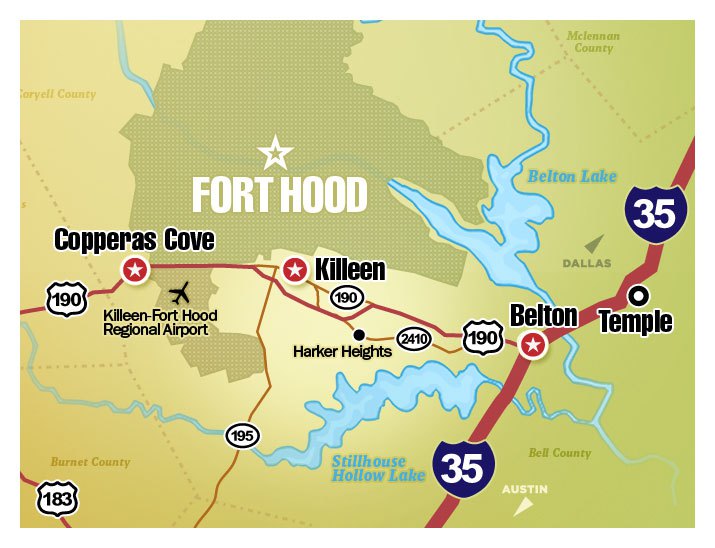
Army veteran Brandon Brown 34, of Harker Heights, Texas, formerly of Shelbyville, Tennessee was found unresponsive on March 20, 2020 in his Harker Heights, Texas home. The Harker Heights Police Department’s cause of death ruling was suicide (self-inflicted gunshot wound). Brandon was preceded in death by his brother, Cameron Matthew Murray. He is survived by his parents and six siblings. According to family, Brandon was honorably discharged from the U.S. Army in 2013 and his last place of duty was at Fort Hood, Texas. Brandon was diagnosed with Post Traumatic Stress Disorder and Depression; he sought care from the Department of Veterans Affairs.
The family feels uneasy about the entire situation and rightfully wants answers and justice for their loved one. Why would the local police department refuse entry in a “crime scene” when the death was ruled suicide? Why was the family not allowed to make an identification? Why did it take so long for them to receive Brandon’s body? Why was the Justice of the Peace pressuring the family to agree with the suicide ruling? Why pressure the family to cremate their loved one when it’s entirely up to them to make that decision. Help us hold the Harker Heights Police Department accountable and elevate the family’s voices so they can get Justice for Brandon Brown.
The circumstances surrounding the death of Brandon Brown are described in the below testimony by family:
On March 20, 2020 my brother, Brandon Brown, was found deceased in his home in Harker Heights, Texas. My mother received two phone calls before the detective called, one phone call she received was informing her the police gained access to the house, and then the other was a female telling my mother “She needed to get a pen and paper and write down this phone number. It’s not good but you have to hear it.” Then she went on to say, “It’s bad but not that bad.” Leaving us with false hope that Brandon was okay. Once the detective called my mother he informed her Brandon was found his home deceased and it was an apparent suicide. No one had heard from Brandon since around March 11, 2020. Family members called asking the Harker Heights Police Department to do a welfare check numerous times and we had the Veterans Affairs on the phone expressing the importance to get into his house due to Brandon having PTSD and depression. In the police report the detective wrote,” … there was no indication anything was wrong…”
On March 21, 2020 we arrived in Harker Heights, Texas at Brandon’s residence and there were two vehicles in the driveway. Two of my siblings got out of the vehicle to see who was at Brandon’s house and a man answered the door and quickly pulled the door up to his neck when my siblings stated who they were. He told them and my mother they could not come in because it was an active crime scene. As they were walking back from the house, another vehicle pulled up and a female got out with an attitude, and told my mother the man in the house was correct, it’s an active crime scene, he was the only one allowed in the house. (She was also on the phone with a person I choose not to identify at the moment.) The police were called and we got back into the vehicle to wait for them to arrive. While we were waiting both the male and female were on the porch laughing, pointing at the car, and going in and out of Brandon’s house. Neither of these individuals know any of us in the vehicle but gave statements to the police on March 20, 2020 saying we were “wretched” and “… it could get ugly.” The other individual stated “she was familiar with the family and was actually on the phone with her brother…”
It took exactly a month for them to release Brandon’s body so we could bring him back to Tennessee. They did not allow my mother or Brandon’s father to identify his body. The Justice of the Peace even tried to pressure my mother into say she believed Brandon died by suicide. They were pushing for cremation telling us his skin was falling off the bone.
We, the Brown family, need your help to find out what really took place with our loved one. We have reasonable doubt that foul play has taken place with our loved one. We do not believe the Harker Heights Police Department’s investigation was thorough or efficient in their findings.
“In August of 2012, Tony and Sue Bemis received the news no parent wants to hear. Their son, Chief Petty Officer John Keith Bemis had died by suicide. As they struggled to make sense of their loss, things didn’t add up. Seven years later, they still have questions about what exactly did happen to their son.” –CPO John Keith Bemis, Crimelines True Crime Podcast (December 22, 2019)
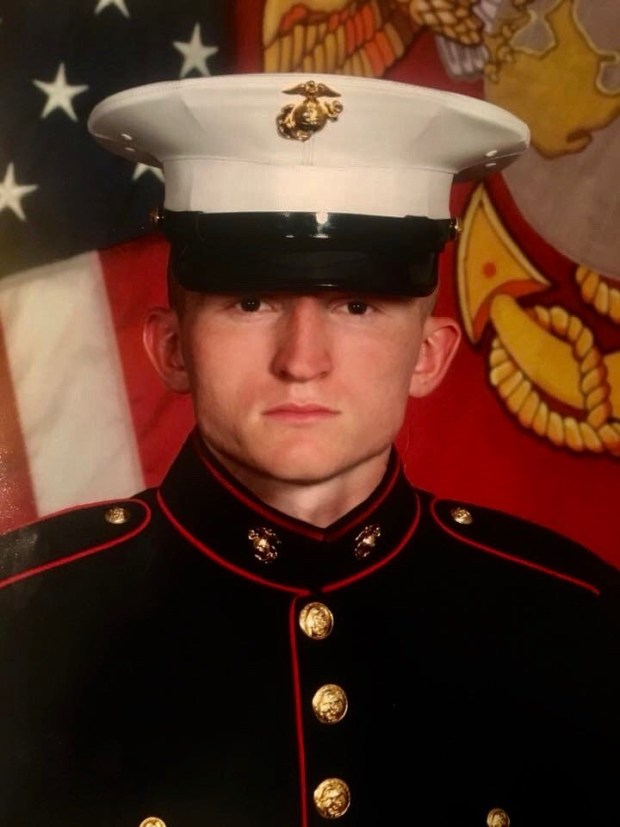
In the early morning hours of March 15, 2019, Marine Corps Lance Corporal Riley Schultz was found dead near a guard shack with a gunshot wound in his head. Nineteen-year-old Lance Corporal Schultz was on guard duty at Camp Pendleton in California when this tragic incident occurred. Riley was discovered by a Marine who was assigned to replace him at this entry control point. The Naval Criminal Investigative Services (NCIS) were assigned to investigate Riley’s suspicious death but their investigation appeared to conclude when the medical examiner ruled that Lance Corporal Riley Schultz died by suicide via a self-inflicted gunshot wound. Riley’s family isn’t going to simply accept the outcome of the investigation. His family knows him better than anyone and his brother said Riley was the happiest he had ever been. Riley’s mom told the press that becoming a Marine was his dream and he worked hard and prepared for his enlistment before joining the USMC at the age of 17. Riley’s mom said he loved being a Marine and things were going well in his personal life when he died. Although this investigation appears to be an open and closed case with the Marine Corps, Riley’s family disputes the cause of death and plans to continue to fight for justice for Riley.
In the News:
The Marine from Colorado found dead at a Southern California base earlier this month died by suicide, according to 1st Lt. Cameron Edinburgh, a Marine Corps spokesperson. Rob Low reports. -FOX31 Denver (March 27, 2019)
The Navy is investigating after a Marine from Colorado was shot to death while on guard duty at Southern California’s Camp Pendleton. -CBS Denver (March 27, 2019)
Lance Cpl. Riley Schultz was discovered dead around 4 a.m. March 15 with a gunshot wound to the head. -Denver7 – The Denver Channel (March 27, 2019)
Is the Army botching its investigations into noncombatant deaths?
I. The Gun Tower
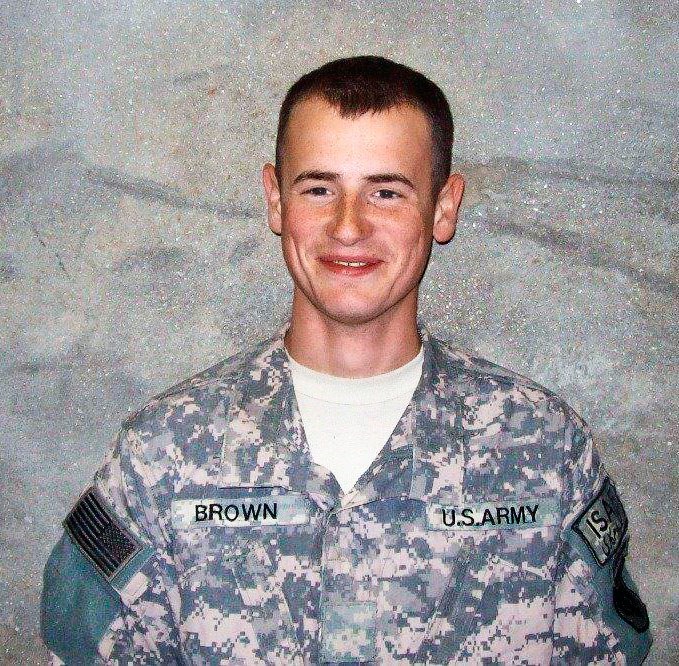
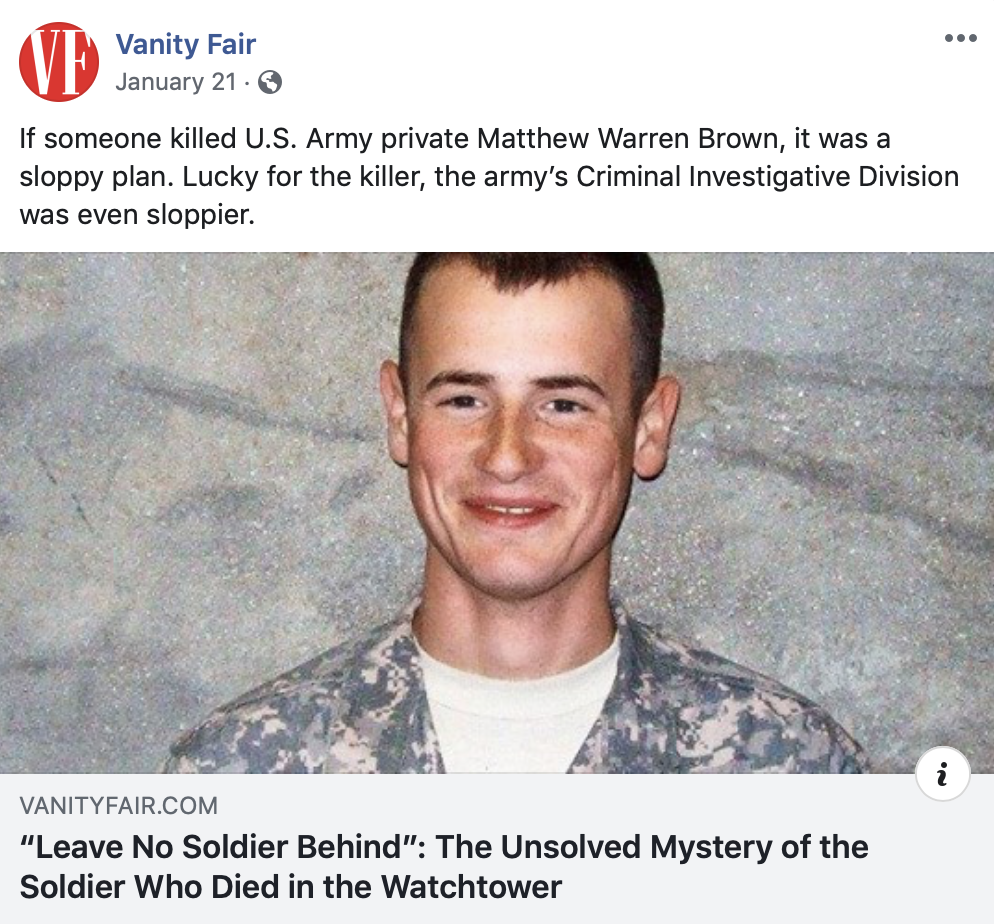
“On the morning of May 11, 2008, a U.S. Army private second class named Matthew Warren Brown died of a single gunshot wound to the head while manning a watchtower at a forward operating base in Afghanistan. Brown was 20 years old. He was a skinny, all-American kid, a bit aimless but affable and unassuming. He was a good guy. You could see it in his face. At his funeral back home in Pennsylvania, some 200 people showed up. In the aftermath of Brown’s death, army investigators created files about the circumstances. The bullet that killed him was fired from his own weapon, an M4 carbine. He was working the six A.M. shift, alone in the watchtower by the fortified main gate to the base. The tower was known as the Gun Tower. It was made of concrete, and looked medieval when viewed from the outside. It was three stories tall. On the second and third floors it had openings covered with two-piece Plexiglas windows, some of which had broken off and been left lying in shards on the floors.” Read more from Vanity Fairhere.
























 MILITARY JUSTICE FOR ALL