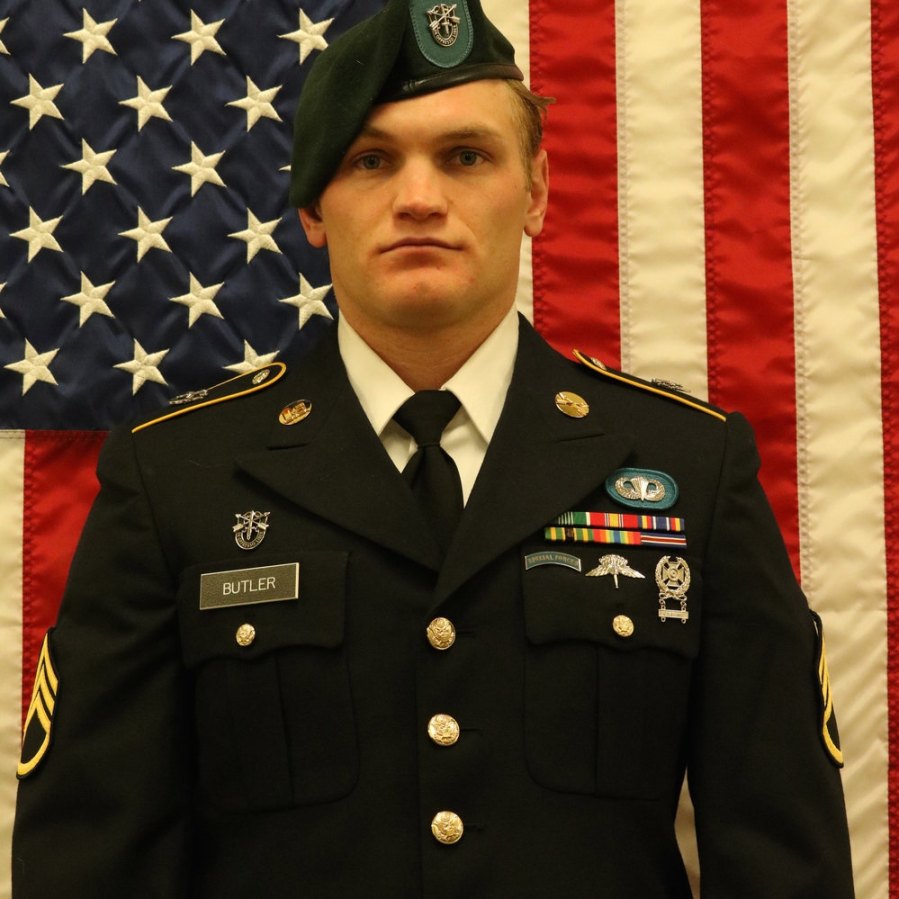
Utah Army National Guard Staff Sgt. Aaron Butler Died of Injuries Suffered from Improvised Explosive Device in Afghanistan (August 16, 2017)

ZSQXPIA2OBESNHNLM5ZDOPD4ZE
Staff Sgt. Aaron Butler, Utah Army National Guard

Army Staff Sgt. Aaron Butler, 27, died of injuries suffered from an improvised explosive device while conducting combat operations in Nangarhar Province, Afghanistan on August 16, 2017. Staff Sgt. Butler was supporting Operation Freedom’s Sentinel on behalf of the 19th Special Forces Group (Airborne) at Camp Williams, Utah Army National Guard.

Utah National Guard member Aaron Butler called Monticello home. Now, that community — along with the rest of the state — is mourning his loss. News Specialist Sam Penrod reports in San Juan County where family friends are remembering a man who never let anything get in the way of his goals. -KSL News

Related Links:
DoD Identifies Army Casualty
Pentagon identifies Green Beret killed in Afghanistan
Green Beret Killed in Afghanistan Identified By Pentagon
Utah National Guard member killed in Afghanistan
Details released, identity confirmed of Utah Nat’l Guardsman killed in Afghanistan
Family identifies Utah soldier killed in Afghanistan as Aaron Butler
Family identifies US soldier killed in booby-trapped building in eastern Afghanistan
The Latest: Family IDs Utah soldier killed in Afghanistan
Pentagon identifies Special Forces soldier killed battling Islamic State in Afghanistan
‘A force of nature:’ Monticello remembers hometown hero killed in Afghanistan
Sen. Lee Releases Statement of Support for Family of Aaron Butler
Utah governor extols National Guard staff sergeant killed in booby-trapped Afghanistan building as ‘one of Utah’s best’
The Latest: Family IDs Utah soldier killed in Afghanistan

West Virginia Air National Guardsman TSgt. David Board Died of a Non-Combat Related Incident in Kuwait (August 2, 2017)

Screen Shot 2017-08-05 at 7.19.34 PM
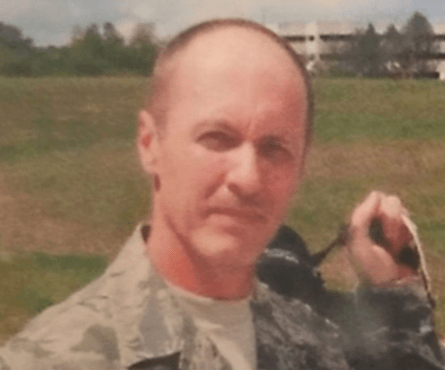
TSgt. David Board, West Virginia Air National Guard

Air Force TSgt. David Board, 49, died in a non combat related incident on August 2, 2017 in Kuwait. TSgt. Board was supporting Operation Inherent Resolve on behalf of the 130th Airlift Wing at McLaughlin Air National Guard Base in West Virginia.

Related Links:
DoD Identifies Air Force Casualty
Pentagon identifies Air Guardsman who died in Kuwait
Airman Who Died in Kuwait in Non-Combat Incident Identified
WV Guard airman from Barboursville dies in Kuwait
West Virginia Air National Guard Airman Dies in Kuwait
Airman killed in Kuwait incident identified
US airman casualty in Kuwait identified as Tech. Sgt. David Board
National Guardsman from Barboursville who died in Middle East remembered fondly

American Monster Premiered ‘Family Snapshot’ on ID: Bob Yates’ Family Shocked Military Hero Father & Spouse is a Serial Killer (July 16, 2017)

The Yates family moves to Spokane, WA only to find it besieged by a serial killer who’s targeting young women and confounding the police. Now, the family’s never-before-aired home videos provide a chilling look of one of America’s most notorious killers. -Family Snapshot, American Monster (S2,E2)

Editor’s note: With a cable subscription, you can download the free ID Go app and watch Investigation Discovery programming at your convenience. And for those who do not have cable, you can watch “unlocked” episodes on the ID Go app including the latest premieres. For those who prefer commercial free programming during your binge session, Prime Video has an ID channel: ‘True Crime Files by Investigation Discovery” available for $3.99 a month. It’s a compilation of older seasons but totally worth the cost if you are a true crime addict. Download the ID Go app or purchase ID True Crime Files & binge away.

Related Links:
The Spokane Murders | TIME
Death Sentence Upheld for Spokane Serial Killer
Social worker who served Yates’ victims supports end of death penalty
Robert Lee Yates | Murderpedia, the encyclopedia of murderers
Retired Army National Guard Pilot & Serial Killer Robert Lee Yates, Jr. Convicted of 2 More Murders of Women in Washington (September 19, 2002)
Unusual Suspects Premiered ‘Monster in Spokane’ on ID: Serial Killer in Washington is Retired National Guard Pilot Robert Lee Yates, Jr. (July 19, 2010)
Scene of the Crime w/ Tony Harris Premiered ‘Down by the River’ on ID: Retired Army Pilot Robert Lee Yates is the Monster in Spokane (June 3, 2018)
Washington State Supreme Court Outlawed Death Penalty; Serial Killer Robert Yates’ Death Sentence Converted To Life in Prison (October 11, 2018)
Family Snapshot | American Monster | Investigation Discovery (S2,E2)
Family Snapshot | American Monster | Investigation Discovery (website)
Family Snapshot | American Monster | Investigation Discovery (Prime Video)
American Monster takes a look at Spokane serial killer Robert Lee Yates

An Open Letter to Congress Regarding the Investigations of the National Guard Recruiting Assistance Program (G-RAP)

screen-shot-2016-03-30-at-7-59-19-am
Guard Recruiting and Assistance Program (G-RAP)

Dear Congress,

Both the New York Times and the Washington Times are reporting that the Army’s investigation of National Guard soldiers and veterans who participated in the Guard Recruiting Assistance Program (G-RAP) has gone far and wide of the intention. Thousands of Guard troops have had their military and civilian careers destroyed over the Army’s accusations and questionable investigations.

They are questionable because of the constitutionality of the Army serving as a police force to investigate citizen soldiers. They are questionable because CID’s tactics do not conform to policy. They are questionable, because in five years of investigations and an estimated $40 million spent by CID, not even a fraction of the alleged fraud has been found. Senator Claire McCaskill took, at face value, Gen Quantock’s testimony that $100 million was lost to G-RAP fraud. Senator McCaskill set loose the largest military criminal investigation in history.

I am just a citizen volunteer: not military, not an attorney, who did background research for a friend caught in this trap. In the process I amassed thousands of pages of documentation that the investigations are unjust, and possibly illegal – That the premise of massive fraud is wrong and that the witch hunt continues only to prove the Army’s wild exaggerations.

G-RAP is a dark and complicated story and one that needs attention. Shining a spotlight on this can only happen in Congress.

I would welcome an opportunity to share what I have found.

Sincerely,

Liz Ullman

Related Links:
Defend Our Protectors
Stop G-RAP Injustice on Facebook
The Conspiracy Behind the G-RAP War on American Soldiers
If You Look at the Dollars, Guard Recruiting Assistance Program Investigations Make No Sense
Top Ten Problems with the National Guard Recruiting Assistance Program (G-RAP) Investigations

Questionable Practices Continue at Fort Belvior Warrior Transition Battalion: One Delaware Army National Guard Soldier’s Story After Injured in the Line of Duty

National Guard

Guest Post Submitted by Jill Lee

I cannot in good conscience remain silent about the treatment of our wounded and injured service members and their families. I am writing this letter on behalf of my husband Sgt. Thomas Lee. He medically retired from the Delaware National Guard’s 153rd MP Company in August 21, 2016. He deployed to Afghanistan January to September 2013. Upon returning from deployment he was sent to the Wounded Transition Battalion (WTB) at Fort Belvoir, VA in October 2013 for neck, back, shoulder, skin and stomach issues. The time frame for service members to spend at the WTB is approximately 12 months; my husband was there for 3 years. When my husband arrived, there were around 300 service members there. Every service member is assigned a nurse case manager who oversees the scheduling of appointments and does weekly check-ins with them. The nurse case manager’s job is to support and facilitate the care of service members; however, often they are misleading and at times lying to get information which is used by the command against the service members. The WTB does not promote an atmosphere of healing but rather one of harassment and punishment, where they provide the bare minimum of care, distribute medications and focus on the symptoms rather than diagnose and treat the actual issues. The WTB along with Fort Belvoir Community Hospital has failed my husband along with countless other service members. Our service members and families sacrifice so much for our country and it is a shame to see how they get treated when they return from combat broken physically and mentally.

My husband and I lived through a nightmare for the past 3 years, he was fortunate enough to survive 2 deployments only to be permanently disabled by a military doctor here in the states. Do you know what it’s like to watch helplessly someone you love whose served their country go from injured to permanently damaged and not to be able to hold any one accountable? My husband came to the WTB with 2 careers, 21 years with the Postal Service and 18 years of military service, he left the WTB unable to return to either career. Below are the events that forever changed our lives.

Continue reading “Questionable Practices Continue at Fort Belvior Warrior Transition Battalion: One Delaware Army National Guard Soldier’s Story After Injured in the Line of Duty”

Fatal Vows Premiered ‘Second Chance at Death’ on Investigation Discovery: Father and Son Julian & CJ Lewis Murdered in Virginia Home (May 13, 2017)

While mourning the death of his wife, Julian falls hard for his much-younger coworker Teresa. For a time, her spunk lifts him out of to his sorrows until a sordid affair plunges him even deeper into the abyss. -Second Chance at Death, Fatal Vows (S5,E1)

Preview: Teresa Michelle Lewis used sex for currency to get what she wanted. -To Love and To Murder, Deadly Women (S5,E5)

Marriage is a lifelong commitment of love, and wedding vows. ‘To have and to hold; for better, for worse; until death do us part’. But for these monstrous wives, it was only the vow of ‘death do us part’ they upheld. -To Love and To Murder, Deadly Women (S5,E5)

Editor’s note: With a cable subscription, you can download the free ID Go app and watch Investigation Discovery programming at your convenience. And for those who do not have cable, you can watch “unlocked” episodes on the ID Go app including the latest premieres. For those who prefer commercial free programming during your binge session, Prime Video has an ID channel: ‘True Crime Files by Investigation Discovery” available for $3.99 a month. It’s a compilation of older seasons but totally worth the cost if you are a true crime addict. Download the ID Go app or purchase ID True Crime Files & binge away.

Related Links:
Second Chance at Death | Fatal Vows | Investigation Discovery (S5,E1)
Second Chance at Death | Fatal Vows | Investigation Discovery (website)
Second Chance at Death | Fatal Vows | Investigation Discovery (Amazon)
The Puppetmaster | Deadly Women (Preview)
To Love and To Murder | Deadly Women | Investigation Discovery (S5, E5)
To Love and To Murder | Deadly Women | Investigation Discovery (website)
To Love and To Murder | Deadly Women | Investigation Discovery (Amazon)
To Love and To Murder | Deadly Women | Investigation Discovery (Hulu)
Army National Guardsman Charles Lewis Fatally Shot Before Deployment to Iraq; Step-Mother Teresa Lewis Conspired, Executed by State of Virginia (October 30, 2002)
Deadly Women Premiered ‘To Love and To Murder’ on Investigation Discovery: Teresa Lewis Used Sex to Get What She Wanted (August 26, 2011)
Deadly Women: 30 Military and Veteran Homicide Cases Featured on Investigation Discovery

Massachusetts School of Law Interviews Veteran Jennifer Norris About Violent Crime in the Military & Post Traumatic Stress Disorder

Massachusetts School of Law explored violent crime in the military with Jennifer Norris, Military Justice for All, and the impact it has on civilians too. Jennifer talked about her experiences with four different perpetrators within the first two years of her enlisted career, the reporting & adjudication process, and the retaliation that ensued and eventually ended a fifteen year career. Also discussed was the jurisdictional hurdles that arise with a transient population like the military. For example, Jennifer was not able to press charges against one perpetrator because he moved out of state after learning he was getting reported. Another perpetrator was active duty Air Force at Keesler Air Force Base, therefore a state National Guard commander did not have jurisdiction of a federal employee. And finally, although Jennifer was able to move forward with two other cases involving high ranking National Guard members with over eighteen years of service, unlike the civilian world, after the cases were adjudicated, they retired with full military retirement benefits and no public records.

Jennifer also shared that although the Department of Defense downplays violent crime in the military and sexual assault appears to be closely monitored by some female members of Congress, everything is not under control. The crime appears to be escalating. The military doesn’t just have a sexual assault issue, they have a domestic violence and homicide issue as well. They also have a pattern of ruling soldier’s deaths both stateside and overseas as suicides, training accidents, and illness despite families strongly protesting and evidence revealing otherwise. Domestic violence is more likely to lead to homicide and unfortunately the two issues have not been given the attention they deserve because until you do the research yourself and see how many families and communities have been impacted by the crimes, suspicious death, and homicide of a soldier or civilian, you wouldn’t know because Congress and the main stream media do not give it the attention it deserves. Homicide and independent investigations of all suspicious deaths should be given the highest priority not only because people have lost their lives and families deserve answers but because someone needs to be held accountable. We must prevent others from becoming victims of these crimes too.

Jennifer discussed the lasting impacts the crimes and retaliation had on her. Jennifer was empowered after doing all that she could do to protect others from getting harmed by the same people, but her squadron did not see it the same way. After the cases were adjudicated, Jennifer faced hostility from a couple of the perpetrator’s friends and her Chain of Command once she returned back to work. She eventually had to transfer to another squadron. It was the professional and personal retaliation that made her start feeling more intense feelings of anxiety, depression, and even suicidal thoughts. And unfortunately her next squadron wasn’t any more welcoming then the last. She was told shortly after arriving that ‘no female makes it in the satellite communications work center’ and that she was experiencing hostility from her new Chain of Command because the old squadron called and informed them she was a ‘troublemaker.’ The retaliation had a direct impact on her mental health and cemented an already traumatizing experience with further abuse, indifference, and judgement. By the time she got to her third squadron (almost ten years after the first attack), she learned that the Department of Veterans Affairs treated Post Traumatic Stress resulting from military sexual trauma.

After Jennifer informed her third squadron that she was getting help for the PTS at the Department of Veterans Affairs, she was immediately red flagged and asked to leave the squadron until she could produce a note from her doctor giving her permission to be at work. She did this and jumped through the other hoops asked of her in an attempt to save her career but lost confidentiality in the process. Jennifer walked away from her career in the end because she refused to release her VA records for a security clearance investigation. The entire experience not only opened her up to judgement again (simply because she asked for some counseling due to what someone else did) but she had to prove that she was ‘fit for duty’ while the perpetrators were enjoying full military retirement benefits. Jennifer chose a second chance at a civilian career when she refused to release her confidential VA records for her security clearance investigation because she wanted to ensure a future free of a tainted security clearance. It makes zero sense that someone who is a victim of crime be negatively impacted by the crimes of others in yet another way. The hypocrisy of the system is truly revealed when you look at how the perpetrators were let off the hook but the victim of crime loses their military career because they had the strength to first report and then eventually ask for help.

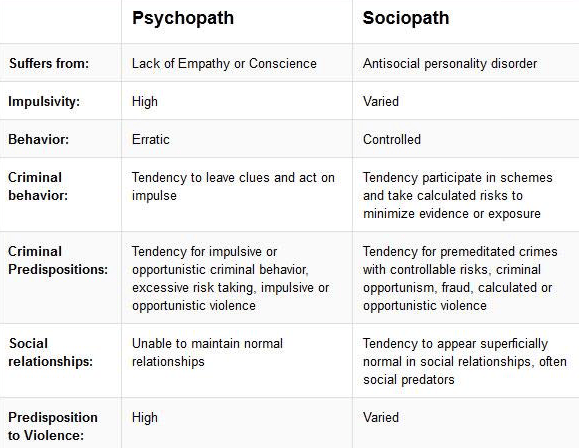
11 Signs of a Sneaky Sociopath

Lack of Empathy

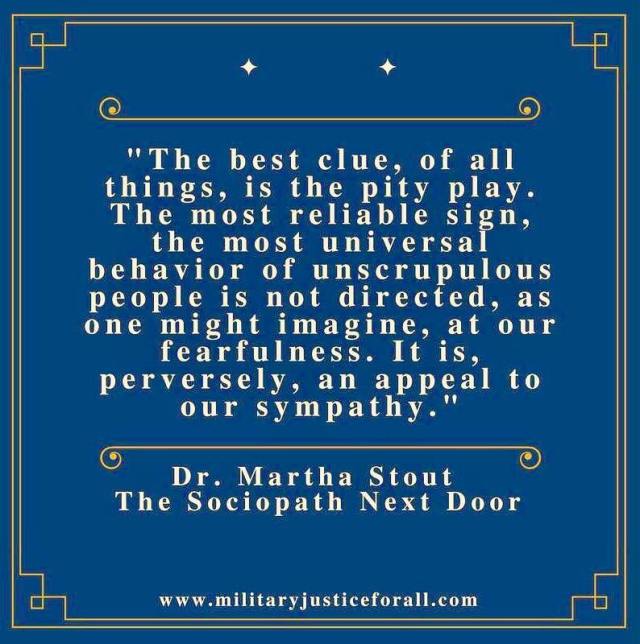
Psychopaths and sociopaths behave differently but both can be just as dangerous. This public service announcement will help educate the reader about the sociopath specifically because sociopaths are both non-violent and violent and use charm and pity to enter your life. There is limited research available on the non-violent sociopath but Dr. Martha Stout, the author of The Sociopath Next Door, does a great job at helping the reader understand how the charming sociopaths operate. Many people have asked Dr. Stout how to protect themselves from the non-violent sociopath. Dr. Stout’s advice to those who want to protect themselves from these social predators is beware of those who use the ‘pity play’ in an effort to appeal to your sympathies.

The Sociopath Next Door is an eye-opening book and highly recommended reading for everyone, especially those interested in criminal justice reform and military justice reform. Research of sociopaths has revealed that the non-violent sociopath has a tendency to abuse the court processes and level false allegations against their enemy in an effort to harm reputations, improve their financial situation, or simply for revenge because you rejected them. Rejection is the trigger for sociopaths. If you find yourself dealing with a vindictive personality, it is best not to engage. If you provoke the non-violent sociopath, it will only make the situation worse. Learn more about the modus operandi of sociopaths to prevent getting entangled in their web of lies.

15741180_1671101012907392_1230412025192901896_n

We are accustomed to think of sociopaths as violent criminals, but in The Sociopath Next Door, Harvard psychologist Martha Stout reveals that a shocking 4 percent of ordinary people have an often undetected mental disorder, the chief symptom of which is that that person possesses no conscience. He or she has no ability whatsoever to feel shame, guilt, or remorse. One in twenty-five everyday Americans, therefore, is secretly a sociopath. They could be your colleague, your neighbor, even family. And they can do literally anything at all and feel absolutely no guilt… (Inside Jacket Cover of The Sociopath Next Door)

1 in 25 ordinary Americans secretly has no conscience and can do anything at all without feeling guilty. Who is the devil you know?The Sociopath Next Door

Think you can easily spot a sociopath? Think again. Sociopaths aren’t always the stereotypical “serial killer type” you might be thinking of. These individuals come in all shapes and sizes. Your best friend, significant other, roommate, or family member could be hiding a dark secret. Instant Checkmate compiled the 11 signs of a sneaky sociopath. Ready to learn more? Run a background check on them. -www.InstantCheckmate.com

Sociopaths are experts at presenting themselves as everyday people, so they can be difficult to identify…Unless you know the signs of a sociopath. Sociopathy is also known as antisocial personality disorder. A sociopathic person will typically have no understanding of right or wrong. There is no treatment for sociopathy. The disorder can be prevented in children who show early signs but among adults, the disorder is permanent. You may know an actual sociopath, though you may not even be aware of it. So what indicators can we look for?

  1. Superficial Charm: Sociopaths often appear to be very charming on the surface in order to manipulate trust.
  2. Narcissism: Sociopaths are extremely egocentric. They believe that everyone should agree with their actions and opinions.
  3. Pathological Lying: Sociopaths will lie in order to create a false persona. They aim to hide their true motives.
  4. Manipulative & Cunning: Sociopaths attempt to find and exploit other people’s weaknesses in order to get what they want.
  5. Shallow Emotions: Sociopaths do not genuinely feel emotions. Many can fake their emotions to fool the people around them.
  6. Lack of Remorse, Shame, or Guilt: Sociopaths do not feel bad about their actions, even if they hurt others.
  7. Incapable of Human Attachment: Sociopaths can’t form genuine relationships with others. They may form relationships in order to appear normal.
  8. Constant Need for Stimulation: Sociopaths may take unnecessary risks that put themselves and others in dangerous situations.
  9. Lack of Empathy: Sociopaths are unable to relate the perspectives or problems of other people.
  10. Impulsive Nature: Sociopaths will exhibit hostility, irritability, and aggression. They act on their impulses without caring without caring about any potential consequences.
  11. Promiscuous Sexual Behavior: Sociopaths are likely to be unfaithful and promiscuous, which is connected to their tendency to get bored easily.

Sociopaths may have problems with drug and alcohol use. They may also have a criminal record related to their behavior. You can get a background check at Instant Checkmate.

screen-shot-2017-01-02-at-5-41-07-pm
Psychopath vs. Sociopath

Top Ten Problems with the National Guard Recruiting Assistance Program (G-RAP) Investigations

the-constitution-was-written-very-precisely-to-restrain-the-power-and-force-of-government-and-to-protect-the-liberties-of-each-and-every-one-of-us-ron-paul-2

Guest post submitted by:

Doug O’Connell
O’Connell & Associates, PLLC Doug@DougOConnell.com

Attorney Doug O’Connell has represented former Recruiting Assistants for the past two years in both criminal and civil matters. A former state and federal prosecutor, Doug is also a Special Forces Colonel in the Texas Army National Guard. In addition to his own practice, Doug is Of Counsel to Fluet, Huber + Hoang law firm.

The G-RAP accusations and investigations have now lingered for over five years. At least 90,430 (1) National Guard Soldiers (88% of all G-RAP participants) have been subjected to investigations as part of a massive dragnet to recover bonuses (2). 125 Soldiers have been prosecuted in Federal or State Courts; at least 2633 Soldiers remain under investigation (3). While a handful of unscrupulous participants took advantage of the ever-changing rules of this contractor-run program, those cases were adjudicated years ago. What the Army CID is now doing is nothing more than pursuing anyone whose G-RAP tenure spanned the years with the most rules’ changes in an effort to prove up the Army’s exaggerated fraud estimate.

It’s hard to pick the Top 10 issues with G-RAP. The items below represent issues apparent in almost every case. This list omits, but hardly overlooks, such things as inappropriate command pressure to participate in G-RAP, forcing accused Soldiers to undergo DNA collection (4), active surveillance of National Guard Soldiers by Army CID (5), coercion to make reimbursements to the Army (6) in lieu of punishment and other notable violations of Soldier’s rights.

1 Letter to Representative Mike Coffman from Daniel M. Quinn, Chief of Staff, USACIC.
2 The U.S. Army and U.S. Department of Justice consistently refers to G-RAP payments as bonuses in sworn testimony, official documents and court filings. The payments were paid by a contractor directly to the Soldier and IRS form 1099 was issued to every participant. Payments were not processed by DFAS and did not appear on a LES. Finally, Congress did not authorize a bonus related to this program. Nevertheless, Government officials consistently refer to G-RAP payments as bonuses, perhaps wishing it were true so that legal recoupment would be possible.
3 Per letter to Rep Coffman.
4 Collected by a cheek swab without a warrant in violation of the 4th Amendment.
5 Related to an allegation of fraud which if true occurred years prior.
6 Possibly an illegal augmentation of appropriations in violation of the Miscellaneous Receipts statute, 31 USC §3302.

1. GUILT BY ALGORITHM.

Auditors, instead of seasoned law enforcement professionals, launched the G-RAP investigations. Rather than using any type of proper legal standard like probable cause, the Army Audit Agency assembled lists of Soldiers branded “high risk” by the auditors. The definition for “High Risk” was listed as “an inability to follow the rules.” Because the rules changed 60 times in seven years, almost everyone who successfully participated in G-RAP became a target. Soldiers connected to the “high risk” Soldiers were in turn investigated. This self-perpetuating, system of guilt by association crushes any notion of justice and the rule of law. Years later, many of these Soldiers still are under the cloud of a CID investigation and are being forced to defend (at great financial and emotional cost) their names and careers.

2. COMPULSORY INTERROGATIONS.

Federal CID agents lack any authority to compel National Guard Soldiers (or veterans) to submit to interrogations. Unfortunately, neither CID nor most Guard Soldiers and veterans understand that they cannot be forced to appear or answer questions from Army-dispatched agents. CID agents repeatedly violate this bright line legal standard. Worse yet, some Guard Commanders aren’t sufficiently knowledgeable about the law to protect their Soldiers. Once confronted with apparent military authority, many individuals, honestly believing they did nothing wrong, provide answers, later cherry picked and twisted to supposedly show guilt. The unfortunate individual is left having to prove he or she didn’t say something or that the statement was taken out of context.

3. INVESTIGATORS WITH A PERSONAL FINANCIAL INCENTIVE.

The CID Investigators pursuing G-RAP allegations include Army Reserve CID Agents voluntarily on active duty orders. At a minimum, the perception exists that the Reserve Agents have a financial incentive to perpetuate the investigations. The longer the investigations continue, the longer these agents remain employed. Further compounding this problem is the very logical assumption that few agents would volunteer for active duty if it meant a pay cut from their civilian employment.

4. VIOLATIONS OF THE POSSE COMITATUS ACT.

National Guard Soldiers not mobilized into federal service, are like any other civilian citizen under the law. The Posse Comitatus Act prohibits federal military personnel from investigating and enforcing the law. Yet, that is exactly what is happening. The PCA is a federal criminal offense punishable by a term in prison. In the G-RAP investigations, federal military agents are investigating allegations of criminal violations by Guard Soldiers, who are the same as civilians under the law (7). This is a clear violation of the PCA. Unfortunately, this flawed law requires the same prosecutors who are prosecuting Soldiers to levy charges against the same agents investigating the cases they prosecute.

7 See Perprich vs. Department of Defense, 496 U.S. 334 (1990).

5. TRAMPLING THE STATUTE OF LIMITATIONS.

In our system of justice, a statue of limitations exists to limit the Government’s ability to bring charges so remote that the defendant can’t reasonably mount an effective defense. In G-RAP cases, the Government is circumventing the statue of limitations with a World War II era tolling statute. Most applicable criminal offenses have a 5 year statute of limitations. Since G-RAP ended in 2012 the statute of limitations has long expired in most cases. However, in G-RAP investigations and prosecutions the Government is relying on the Wartime Suspension of Limitations Act (8) to continue to bring criminal cases. First enacted in 1948, the WSLA is designed to protect the Country from fraud during times of war. This law likely made sense during World War II, the Korea and Vietnam conflicts. However, the nature of warfare has changed. The current war against terrorism and global extremist groups will continue indefinitely. Relying on the outdated WSLA during today’s conflicts effectively terminates the deeply rooted equitable concept of a statue of limitations.

8 18 USC §3287

6. SPENDING $40 MILLION -TO COLLECT $3 MILLION.

Our Government has spent at least an estimated $40 million dollars (9) to investigate Soldiers. The ensuing recoupment actions and prosecutions have recovered, at most $3 million dollars (10). Army CID agents have repeatedly conducted full field investigations to determine if a Soldier’s single $2,000.00 bonus was righteous (11). In an era of constrained defense spending with persistent and emerging global terrorist threats, this massive boondoggle sets a new record for fraud, waste and abuse. The CID agents’ limited time and resources would be much better spent working to prevent the next Fort Hood terrorist attack.

9 This is a conservative estimate which includes the personnel cost associated with bringing the USAR agents onto duty status.
10 This figure is also an estimate based on all federal cases reported in the Pacer.gov system and media reports from around the country.
11 At least one National Guard officer is currently under indictment for a single G-RAP recruitment.

7. INACCURATE TESTIMONY TO CONGRESS & POLITICAL PRESSURE

The entire G-RAP controversy is based on inaccurate and irresponsible testimony to Congress. During Senate hearings chaired by Senator Claire McCaskill (12), Army General Officers testified that the total G-RAP fraud could be as high as $99 million (13). This estimate was wildly inaccurate (14). To date, the Government has only collected $3 million in fraudulent payments. Senator McCaskill immediately branded these Soldiers as criminals despite their Constitutional right to be presumed innocent (15). Many have speculated that the hearings and estimates of widespread fraud were designed to embarrass the National Guard during budget battles. Others suggest that it was an attempt to appease this powerful member of the Senate Armed Services Committee and self styled “accountability advocate.” Still others contend that the hearings were an attempt to shift focus from sexual assaults in the military. Whatever the reason, the McCaskill hearing set off a chain of events abrogating the presumption of innocence justice toward service members and veterans.

12 United States Senate Hearing: Fraud and Abuse in Army Recruiting Contracts, February 4, 2014.
13 Id.
14 It appears that this testimony has never been revised, amended or updated to correct the record.
15 Id.

8. AT LEAST 60 CHANGES TO THE “RULES.”

In the eyes of CID, violations of the program “rules,” indicates intentional fraud worthy of criminal investigation. However, the G-RAP “rules” changed at least 60 times during the life of the program (16). Understanding the “rules” of G-RAP at any given point in time requires a detailed analysis based on a significant review of multiple documents (17). In the vast majority of cases, if the Soldier violated the “rules,” it is more likely due to confusion rather than a deliberate desire to cheat the system. With unrelenting intensity, CID doesn’t investigate an alleged crime; they gather slanted “evidence” to prove that a crime was committed. CID, in fact, has been responsible for elevating an inability to follow the rules of a program run by a private contractor to the level of a crime. One example: at various times full time members of the National Guard were authorized to participate in G-RAP, at other times they were ineligible. If a Soldier entered G-RAP when full time members were allowed, but submitted data for payment months later when full time members were not allowed, that Soldier is investigated for fraud.

16 See Agent’s Investigation Report, CID Special Agent Julie Thurlow, November 22, 2013.
17 National Guard Bureau changed the rules via a contract change order sent to Docupak.

9. “SPHERE OF INFLUENCE” AND OTHER VAGUE GUIDANCE.

Soldiers participating in G-RAP received instruction to recruit from their “sphere of influence.” This term was never defined. It’s unclear if the intent of this language was to limit recruitment to pre-existing relationships. Regardless of NGB’s intent, the Soldiers received a very different message. For example, once hired by Docupak, Soldiers were provided marketing items such as t-shirts with the message “ask me about the National Guard.” None of the marketing items provided would have been necessary to recruit people already known to the Soldier. Now, these same Soldiers are investigated and some prosecuted for recruiting outside their sphere of influence. Likewise, Soldiers were told that they “shouldn’t” wear their uniform when conducting recruiting activities. If this were truly a prohibited action worthy of investigation, the “rule” would have been written as “you are prohibited from wearing your uniform.”

10. “I DON’T REMEMBER = GUILTY.”

When CID agents track down and contact recruits many years after their enlistment into the National Guard, most don’t remember the details of their interaction with the recruiting assistant. To the CID agents, this means the RA committed misconduct. The alternative explanation is unfathomable to the agents: the recruit, 7 years later, just doesn’t remember. This is especially problematic since Government prosecutors use this lack of memory to charge the Soldier with Aggravated Identity Theft (18), a charge that carries a mandatory minimum term of prison sentence of two years.

18 18 USC § 1028A.

“EXTRA CREDIT:” CID KNEW ABOUT ALLEGED FRAUD FOR FIVE YEARS BEFORE TAKING ACTION.

On May 22, 2007, five years before G-RAP was shut down, Agents from Army CID, Air Force OSI, and Defense Criminal Investigative Service (DCIS) met with Docupak to discuss potential fraud in the program (19). A representative of the United States Department of Justice (20) was also in attendance. The agents specifically instructed Docupak not to notify the State Adjutant Generals, National Guard Bureau, or the contracting officer regarding alleged fraud. This effectively cut off any ability to clarify confusing rules and or enhance fraud prevention measures. Importantly, it also prevented Governors and Adjutants General to execute their Constitutional duty of regulating their National Guard force and apply appropriate discipline (21). Likewise, notification the responsible contracting officer at NGB would have triggered remedial action. Instead, the CID sat on this information for five years, causing a relatively minor amount of confusion to escalate into what we have now – another major bonus scandal ensnaring thousands of junior Soldiers facing accusations.

19 2014 Inspector General Report, page 40, paragraph g, and footnote 142.
20 Presumably a licensed attorney.
21 The Governor’s and TAG’s Constitutional authority to regulate and discipline Guard members included the full time recruiting force in each state, some of whom were suspected of misconduct. These Soldiers operate under the exclusive military jurisdiction of the relevant State Military Code of Justice.

CONCLUSION

Few Soldiers have the financial resources to mount a proper defense to federal criminal charges. Faced with the possibility of prison time, many take a plea bargain to avoid the risk of prison, financial ruin or deepening emotional trauma to themselves and their families. Even if the accused Soldiers are not prosecuted, the collateral consequences seem never ending. The investigation will continue to haunt them for years to come. Security clearances will be revoked or suspended, and the Government will initiate proceedings to “debar” the Soldier from future employment as a government contractor. Eventually, the case file will be forwarded to the State National Guard headquarters for military justice or administrative action. The range of administrative sanctions includes separation boards, official reprimands and being required to rebut CID’s flawed conclusions to a promotion review board. The administrative flag on their personnel file will continue until all military administrative actions are complete (22). Finally, many of these same Soldiers, never prosecuted in a court of law will have a federal criminal history created as a result of being investigated, “titled” and “founded” by CID.

22 A “flag” prevents any favorable action including re-enlisting, awards, and promotions. The flag does not prevent orders to deploy overseas (again). Flags as a result of G-RAP investigations have been in place for four or more years at this point.