Full Episode: The evidence suggested the woman had been bound, sexually assaulted and murdered. Afterwards, the killer spent hours at the crime scene, wiping away his fingerprints and disposing of everything which might incriminate him, including the woman’s body. Police now face a daunting task: they not only have to find the killer, they also have to find the body of the victim. -Waste Mis-Management, Forensic Files (S13,E46)
Editor’s Note: Full episodes of Forensic Files are available on a variety of media platforms. FilmRise Channel and Forensic Files Channel both feature full episodes of Forensic Files on YouTube. You can also find full episodes of Forensic Files on both Netflix and Amazon Prime Video. On Netflix, the seasons are grouped as collection 1-9. On Amazon Prime Video, you can find Season 1-10 here; Season 11; Season 12; Season 13; Season 14; Season 15; Season 16; Season 17; Season 18; Season 19; Season 20; and Season 21. Start bingeing and see for yourself why Forensic Files is such a hit!
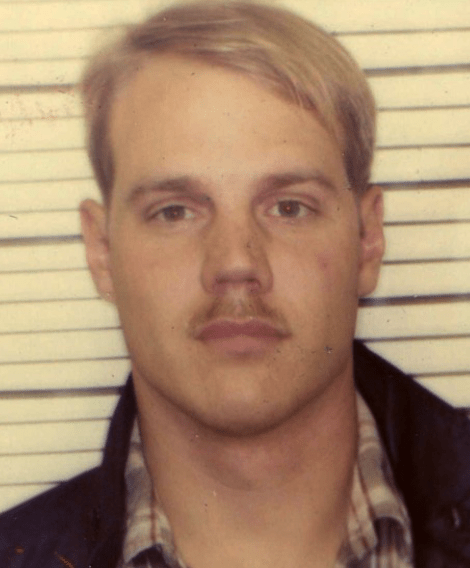
In 1985, a young military officer’s wife and two of her three little girls were viciously murdered in their Fayetteville, North Carolina home. Kathryn Eastburn was also raped. The crime occurred six miles from the location of where Jeffrey MacDonald was accused of killing his wife and two children on the base at Fort Bragg. Army sergeant Timothy Hennis became a suspect from the beginning because a day or so earlier, he bought the Eastburn’s family dog. In a background check, they found that he had 3 convictions for writing bad checks and a witness identified him as the same person leaving the Eastburn home during the time in question. Eventually he was charged and found guilty of the murders of Kathryn, Cara, and Erin Eastburn; he was sentenced to death by the civilian authorities in North Carolina. But he appealed, was granted a new trial and at his second death penalty trial, he was found not guilty.
After his acquittal, he joined the Army again for two more tours, worked his way up to E-8, and retired as a MSG from Fort Lewis, Washington. Twenty years later, DNA evidence from a vaginal swab taken from Kathryn Eastburn linked Hennis to the crimes. Civilian prosecutors could not charge Hennis due to double jeopardy; but the US military did claiming they have federal jurisdiction because Hennis is a retiree. As a result, he was ordered back into service due to his retirement status. Hennis tried to claim consensual sex which contradicted original testimony. In 2010, a military jury found him guilty of three counts of murder and he was sentenced to death again. Hennis sits on death row at Fort Leavenworth with three other service members: Ronald Gray, Hasan Akbar, and Nidal Hasan.
In 1985, a young military wife and two of her three little girls are viciously murdered in their home. In a twisted case filled with unusual suspects, the man who gets convicted goes free. But nothing is what it seems. -Discovery ID
3 People on Death Row Who May Be Innocent | Criminally Listed
A man tried three times for his life but is he a killer? Find out! Death Row Stories.
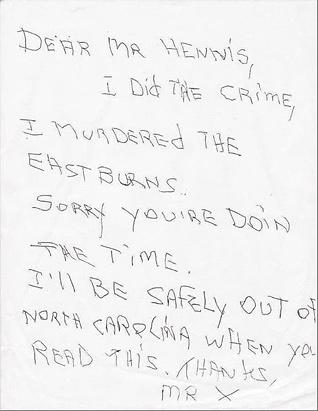
While on death row, Tim Hennis received an anonymous letter confessing to the murders. The note didn’t produce any leads. -Death Row Stories
The star witness in Tim Hennis’ trial had doubts about whether Hennis committed the murders. -Death Row Stories
Timothy Hennis Double Jeopardy | Death Row Stories | CNN
Air Force spouse Kathryn Eastburn was found brutally raped and murdered on May 9, 1985 in her Fayetteville, North Carolina home. Two of her three children, Cara and Erin, were also murdered in the same vicious way. All three were stabbed and their throats were slashed. Kathryn and her three children were home alone while Gary Eastburn was on temporary duty at Maxwell Air Force Base in Alabama. The youngest daughter Jana was found dehydrated but otherwise unharmed. The crime occurred six miles from the location of where Jeffrey MacDonald was accused of killing his wife and two children at Fort Bragg. Army Sergeant Timothy Hennis was a suspect from the beginning because he had visited the Eastburn home a couple days earlier to buy the family dog.
Kathryn placed a dog for sale ad in the local post paper. Investigators sent out a press release looking for the person who bought the dog. In the meantime, a neighbor reported seeing someone leaving the Eastburn residence at the time in question. The neighbor provided details for a composite drawing; the suspect drove a white Chevy Chevette. At the urging of his wife, Hennis contacted the police station and investigators were stunned at how much he looked like the composite drawing. He also drove a white Chevy Chevette. In a background check, they found that Hennis had three convictions for writing bad checks. This was significant because the perpetrator stole Kathryn’s ATM card and used it on one occasion. Another witness identified Hennis as the person who used the ATM at the time in question.
In 1986, the State of North Carolina tried Hennis for the triple murders. Hennis was found guilty and sentenced to death. But he appealed and was found not guilty in the second death penalty trial. After his ‘exoneration’ Hennis was the subject of a book and an ABC made for television movie “Innocent Victims”. Meanwhile, against lawyers advice, Hennis enlisted in the Army again for two more tours, worked his way up to E-8, and retired as a MSG outside of Fort Lewis, Washington. Cold case investigators took a second look at the cold case and because of the advances in DNA technology, they retrieved a vaginal swab from the rape kit test and submitted it to the lab. DNA evidence linked Timothy Hennis to Kathryn Eastburn.The State of North Carolina prosecutors could not charge Hennis a third time because he was found ‘not guilty’ of the triple homicides in the second death penalty trial.
The Double Jeopardy Clause of the Fifth Amendment to the United States Constitution provides: “[N]or shall any person be subject for the same offence to be twice put in jeopardy of life or limb…” [wikipedia]. The civilians couldn’t try him in State court but the Army could because of federal jurisdiction; Hennis was an Army retiree therefore still under their jurisdiction. As a result, Hennis was activated and order to report to Fort Bragg for his third death penalty trial. The defense attempted to justify the DNA match to consensual sex but it contradicted his original testimony. The defense also called into question the ethics of the lab who made the DNA match. A military jury found Timothy Hennis guilty of three counts of murder and sentenced him to death. He awaits his execution date at Fort Leavenworth in Kansas.
Source: Unusual Suspects ‘Mother’s Day Murders’
In 1985, a young military wife and two of her three little girls are viciously murdered in their home. In a twisted case filled with unusual suspects, the man who gets convicted goes free. But nothing is what it seems. -Discovery ID
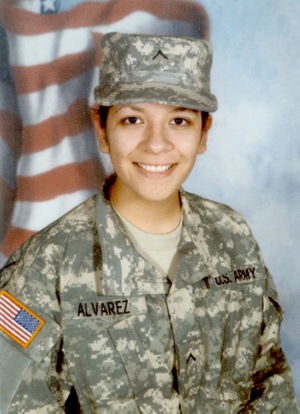
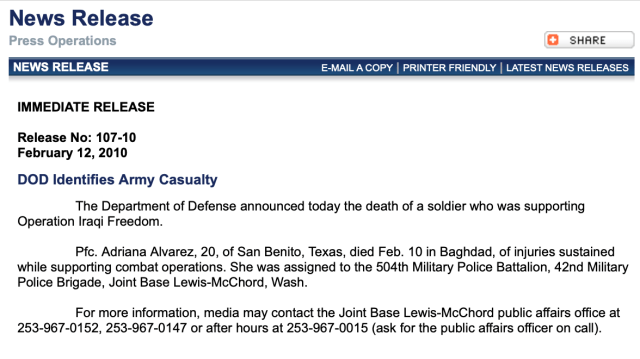
Army Pfc. Adriana Alvarez, 20, died of injuries sustained while supporting combat operations on February 10, 2010 in Baghdad, Iraq. Pfc. Alvarez was supporting Operation Iraqi Freedom on behalf of the 504th Military Police Battalion, 42nd Military Police Brigade at Joint Base Lewis-McChord, Washington. According to the Department of Defense press release, the incident was under investigation yet the outcome of the investigation is unknown. According to the Brownsville Herald, Pfc. Alvarez’s sister indicated that she was found with a gunshot wound. An official cause of death could not be determined based on any official statements from the Army or media reports. Although, the Olympian reported“Pfc. Adriana Alvarez, 20, belonged to a military police company at Lewis-McChord and died from injuries of an unexplained nature…in Baghdad, according to a separate report.”
“The U.S. Army policewoman was found Wednesday in Baghdad with a gunshot wound. Military officials were investigating Alvarez’s death, her sister said.” –Brownsville Herald (February 12, 2010)
“Army PFC Alvarez was assigned to the 504th Military Police Battalion, 42nd Military Police Brigade, Joint Base Lewis-McChord, Washington. She was found dead of a gunshot wound – under investigation. Adriana always had dreams of becoming a police officer so after she graduated in 2008 from San Benito High School in San Benito, Texas, she joined the Army. She knew the best way to pursue a career in law enforcement would be through the military. In August she deployed to Iraq and kept in touch with her family thru e-mails and phone calls. Two days before her death, she spoke to her sister and said everything was fine. Adriana loved photography, classic rock music and proudly served her country.” (Adriana Alvarez, Find A Grave)
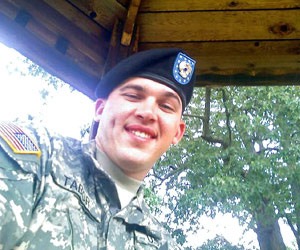
Sgt Carlos Gill, 25, US Army, died of a non combat related illness at Walter Reed Army Medical Center on January 26, 2010 after being evacuated from Kandahar Air Field, Afghanistan. Sgt. Gill was supporting Operation Enduring Freedom on behalf of the 2nd Battalion, 1st Infantry Regiment, 5th Stryker Brigade Combat Team, 2nd Infantry Division in Fort Lewis, Washington.
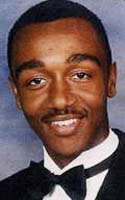
Pfc. Gifford E. Hurt, Jr., 19, US Army, died of a non combat related accident on January 20, 2010 in Mosul, Iraq. Pfc. Hurt was supporting Operation Iraqi Freedom on behalf of the 1st Battalion, 14th Field Artillery Regiment, 214th Fires Brigade, 4th Infantry Division in Fort Sill, Oklahoma. According to the Department of Defense, the circumstances surrounding the incident are under investigation.
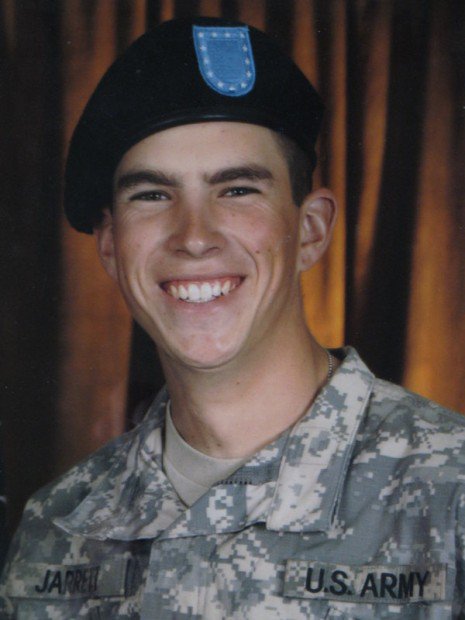
Pfc. Michael Jarrett, 20, US Army, died of a non combat-related incident on January 6, 2010 in Balad, Iraq. Pfc. Jarrett was supporting Operation Iraqi Freedom on behalf of the 2nd Battalion, 159th Aviation Regiment, 12th Combat Aviation Brigade in Illesheim, Germany. According to the Department of Defense, the circumstances surrounding the incident are under investigation.
“The incident is under investigation. Brenda Jarrett said she does not know how her son died, but she said she does not think anyone harmed him intentionally.” ~The San Diego Union-Tribune








 MILITARY JUSTICE FOR ALL