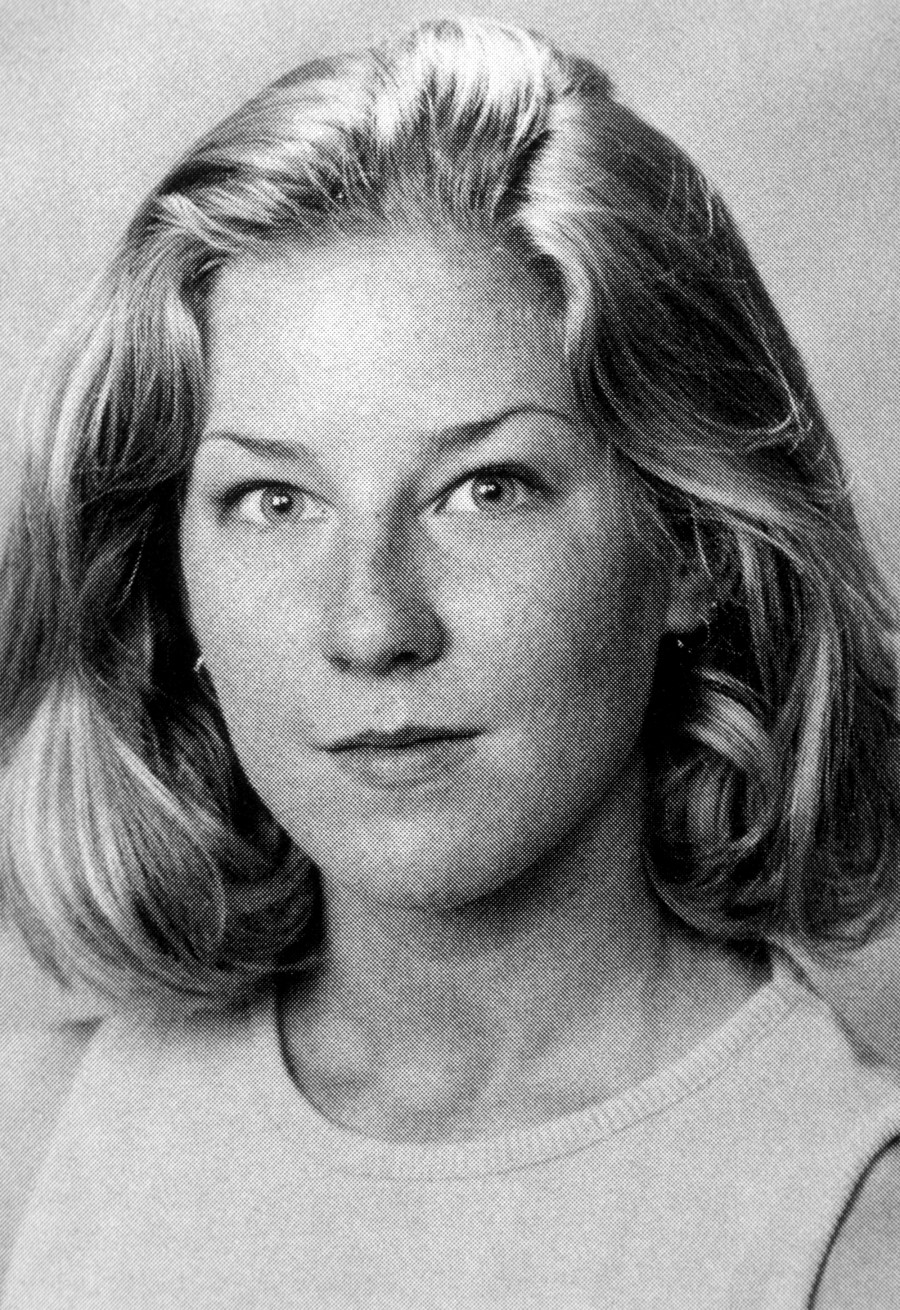
Adrianne Jones was murdered December 4th, 1995 by Air Force Academy Cadet David Graham and his girlfriend and Naval Academy Cadet Diane Zamora. The crime occurred while they were all still in high school in Texas prior to David joining the Air Force Academy and Diane joining the Naval Academy. All three of them had very bright futures. Adrianne Jones was missing for quite some time before her body was discovered. The case went unsolved until Diane Zamora admitted to some friends at the Naval Academy that she had killed someone with her boyfriend. David Graham admitted to his role in the crime; he was sentenced to life in prison. Diane Zamora denies her role in the crime to this day; she was sentenced to life in prison.
“In 1995, bright 16-year old student Adrianne Jones is found shot to death in Grand Prairie, Texas. Police don’t have any strong suspects, until nine months later when a game of Truth-or-Dare leads to a startling confession.” -Investigation Discovery
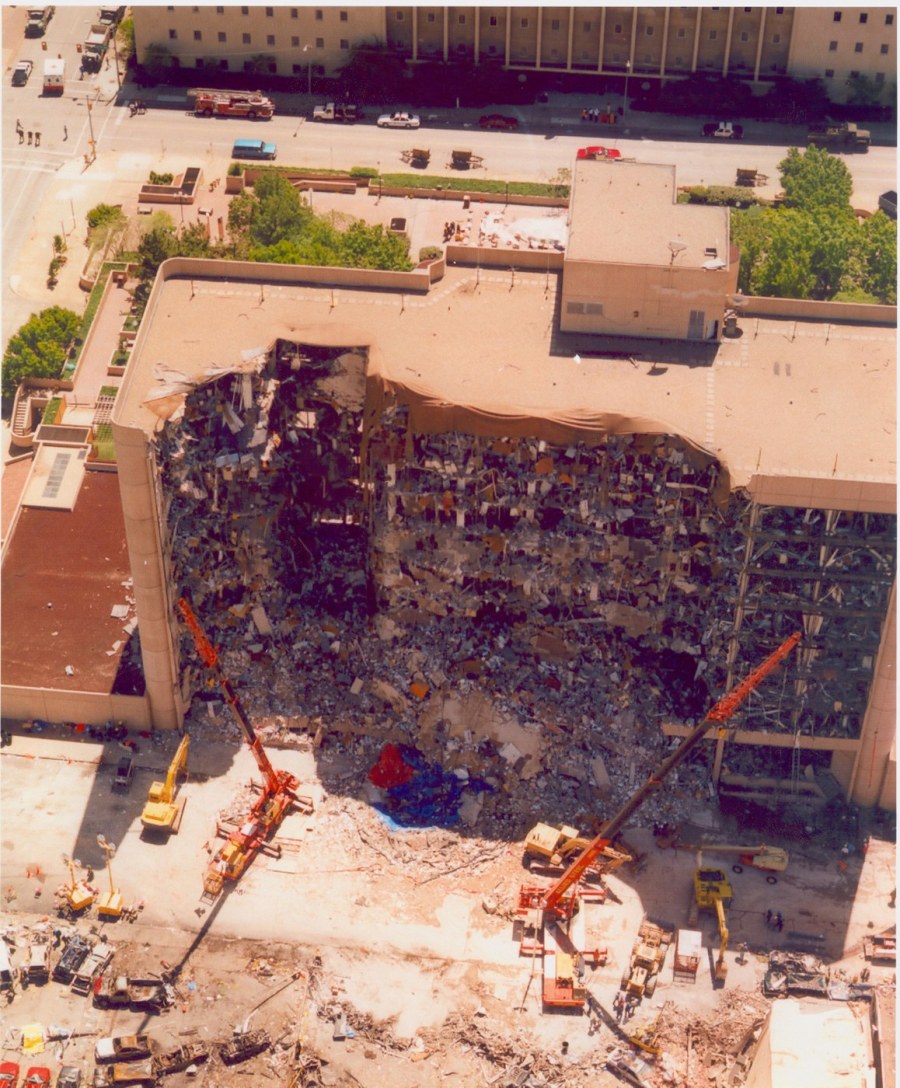
Alfred P. Murrah Federal Building, Oklahoma City, Oklahoma (Photo: FBI.gov)
“On the morning of April 19, 1995, an ex-Army soldier and security guard named Timothy McVeigh parked a rented Ryder truck in front of the Alfred P. Murrah Federal Building in downtown Oklahoma City. He was about to commit mass murder.
Inside the vehicle was a powerful bomb made out of a deadly cocktail of agricultural fertilizer, diesel fuel, and other chemicals. McVeigh got out, locked the door, and headed towards his getaway car. He ignited one timed fuse, then another.
“The events of April 19, 1995, dramatically changed Oklahoma City and all of us who remember that spring morning. But the stories of the 168 people killed live in our hearts as well as in the Oklahoma City National Memorial & Museum. Learn more about the victims here.” -Oklahoma City National Memorial
Learn what motivated domestic terrorists Timothy McVeigh and Terry Nichols to commit the Oklahoma City Bombing, which killed 168 people on April 19, 1995. Discover the federal and local clean up efforts and the fate of McVeigh and Nichols. -History
USA: Oklahoma City Bombing Rescue – 1995 | Today in History | 19 Apr 16 -AP Archive
In the News:
The FBI has released long-secret security tapes showing the chaos immediately after the 1995 bombing of the Oklahoma City federal building. The soundless recordings show people rushing from nearby buildings after the fertilizer bomb went off. (Sept. 27) -Associated Press
Don Lemon talks with the child survivors of the Oklahoma City bombing 15 years after the attack. -CNN
20 years after the terror attack, survivors and families of victims look back on the devastating terror attack. -CBS News
20 years ago tomorrow, domestic terrorist Timothy McVeigh and his co-conspirators set off an enormous truck bomb in downtown Oklahoma City. The blast killed 168 people, including 19 children. Anna Werner reports on that awful day after visiting the site. -CBS This Morning
Americans remember the bombing that killed 168 people and injured hundreds more. -ABC News
Remembering the April 19, 1995 tragedy in Oklahoma when a truck bomb exploded outside of the Alfred P. Murrah Federal Building injuring hundreds and leaving 168 people dead. -NBC News
Today marks the 23rd anniversary of the Oklahoma City bombing, a time to remember the 168 lives lost in an act of domestic terrorism that rocked the nation. -CBS News
On the morning of Wednesday, April 19, 1995, a former Army soldier parked a rented Ryder truck in front of the Alfred P. Murrah Federal Building in Oklahoma City, Oklahoma.He got out, locked it and ignited two fuses. At 9:02 a.m., the explosion ripped through the building where 500 people worked and children attended America’s Kids day care. The blast killed 168 people including 19 children under the age of 6. -PennLive.com
USA: Oklahoma City: Remains of Bombed Building to be Demolished. -AP Archive
Oklahoma City National Memorial & Museum:
At the 20th anniversary remembrance for the Oklahoma City bombing, the former president says it’s important for all Americans to remember how much they owe Oklahomans. -CBS News
Video of The Oklahoma City National Memorial and Museum. -CNN
American Experience PBS:
Premiering at the 2017 Sundance Film Festival. Coming to American Experience PBS on February 7, 2017 at 9/8c. -American Experience, PBS
After the Oklahoma City Bombing, Clinton’s ability to reach Americans on a personal level did much to help the nation’s grief. “It’s kind of a throwaway line now, I feel your pain, but he literally could,” says Robert McNeely. “I mean he could take people and just hug them and connect to them in a way and really listen to them.” -American Experience, PBS
Oklahoma City explores how a series of deadly encounters between American citizens and federal law enforcement—including the standoffs at Ruby Ridge and Waco—led to the bombing of the Murrah Building in Oklahoma City in April 1995, the worst act of domestic terrorism in American history. -American Experience, PBS
At the time of the Oklahoma City bombing in 1995, the Alfred P. Murrah Federal Building was home to several government agencies — and a daycare. -American Experience, PBS
During the stand-off between federal agents and the Branch Davidians in Waco, Texas in 1993, people gathered on a hill roughly three miles away to see what was happening at the compound. One of those drawn to Waco was a 24-year-old Army veteran named Timothy McVeigh. -American Experience, PBS
Filmmaker Barak Goodman and editor Don Kleszy discuss their newest documentary, “Oklahoma City” and how it led to the creation of another one-hour film about Ruby Ridge. -American Experience, PBS
The 1995 Oklahoma City Bombing was the largest act of domestic terrorism in U.S. history. A new documentary on the PBS series American Experience takes a fresh look at the events and motivations that led to the attack by Timothy McVeigh, and finds resonance for today. -PBS NewsHour
At the 20th anniversary, we look back at the Oklahoma City bombing. Public television station OETA shares reflections from survivors and victims’ families, and Judy Woodruff talks to former Deputy Attorney General Jamie Gorelick, former Director of Homeland Security of Oklahoma Kerry Pettingill and Barry Grissom, U.S. attorney for the district of Kansas, for lessons learned from the attack. -PBS NewsHour
On April 19, 1995, Timothy McVeigh, a former soldier deeply influenced by the literature and ideas of the radical right, parked a Ryder truck with a five-ton fertilizer bomb in front of the Alfred P. Murrah Federal building in Oklahoma City. Moments later, 168 people were killed and 675 were injured in the blast. OKLAHOMA CITY traces the events — including the deadly encounters between American citizens and law enforcement at Ruby Ridge and Waco — that led McVeigh to commit the worst act of domestic terrorism in American history. With a virulent strain of anti-government anger still with us, the film is both a cautionary tale and an extremely timely warning. -YouTube Movies
March 11, 1995: Denise Maney, 32, Palm Springs, California
Marine veteran Andrew Urdiales is accused of murdering eight women from 1986 to 1996, five in California and three in Illinois, and raping and abducting 19 year old Jennifer Asbenson who escaped and survived. Urdiales was indicted for three murders in Illinois and was sentenced to death but the death sentence was commuted after Governor Pat Quinn of Illinois abolished capital punishment in 2011. Instead he received three life sentences for the murders of Laura Uylaki, Cassandra Corum, and Lynn Huber. A gun confiscated in a separate incident linked the three murders in Illinois together and during an interrogation, Urdiales admitted in detail to five cold case murders in California too.
After years of legal wrangling, Urdiales was eventually extradited to California and indicted in 2009 on five counts of first degree murder. He was accused of killing Robbin Brandley, Julie McGhee, Mary Ann Wells, Tammie Erwin, and Denise Maney while stationed at Camp Pendleton Marine Corps base. On May 23, 2018, Andrew Urdiales was convicted of five murders by a jury that deliberated for about a day before recommending in June 2018 that he be sentenced to death for each of the five murders. On November 2, 2018, corrections officials said they found Urdiales unresponsive during a security check at San Quentin State Prison; former Marine and serial killer Andrew Urdiales died by suicide.
In the News:
The murders occurred when Andrew Urdiales was stationed at various Marine Corps facilities in Southern California. -CBS Los Angeles (October 5, 2018)
Fort Bragg, North Carolina, had seen it all before – when Dr. Jeffrey MacDonald was convicted of savagely slaying his wife and children. Now another officer’s wife had been raped and murdered, another pari of children viciously butchered. And another member of the military was brought to trial. This time the state had no trouble winning a conviction. Tim Hennis was found guilty and sentenced to death. Only Hennis’ parents, wife, and dedicated defense team refused to give up. Piece by piece they ripped the state’s case to shreds, revealing a stunning story of perversion of justice, false witnesses, hidden evidence, and, incredibly, a baby-sitter who had a fascination with Dr. Jeffrey MacDonald. With the brutal truth and chilling suspense of Fatal Vision, this riveting account recreates a vicious crime, the behind-the-scenes story of its investigation, the compelling drama of one of the very few men ever released from Death Row, and an unsolved mystery that still casts a spell of terror. (Innocent Victims by Scott Whisnant)
Book Review:
I read the Innocent Victims book while I was camping and honestly I could not put it down. I was reminded of it while listening to the Military Murder Podcast and inspired to read it because of the level of detail available in the book. It was a great read because there were so many twists and turns in the case. If I didn’t know about the fact that a DNA match to Timothy Hennis helped prove his guilt in a 2010 military trial, I would have been convinced Timothy Hennis was wrongfully convicted. Timothy Hennis was luckier than most because he had the staunch support of his adopted family and wife Angela, who all believed wholeheartedly in his innocence. This case is one for the history books because it’s not every day someone is found guilty in a civilian trial, then found not guilty in a civilian trial on appeal, and then tried again by the military in a third trial and found guilty. Timothy Hennis was sentenced to death and is one of four service members languishing on military death row. The military hasn’t executed anyone since they hanged Army Pvt. John Bennett on April 13, 1961.
Journalists and scholars have questioned the military’s ability to try someone found not guilty in a civilian court because of the double jeopardy concerns. Due to the fact that Timothy Hennis was found not guilty in a second civilian trial, he was allowed to resume his career in the U.S. Army and retired as a MSG in 2004. As far as we know, Timothy Hennis committed no other crimes and was well respected by those he served with. It would be because of his retirement from the military, the Army was able to bring him back on active duty status and try him in a third trial for the murders of the Eastburn family. This practice is also controversial. On appeal Timothy Hennis challenged the military’s jurisdiction to recall him to active duty status to prosecute him and questioned the double jeopardy concerns. In January 2020, an Appeals Court decided military retirees can be recalled to active duty status and court-martialed. In February 2020, the U.S. Court of Military Appeals rejected Hennis’ constitutional rights challenges to the military court’s jurisdiction to try him.
September 28, 1992: Jennifer Asbenson, 19 (at the time of crime), survived a rape and abduction by former Camp Pendleton Marine Andrew Urdiales in California. She was able to escape from his trunk and run into the arms of two other Marines driving in the area. She did not know who her attacker was at the time of the crime but eventually was able to identify Andrew Urdiales in a police photo line-up. She testified on behalf of three women murdered by Urdiales in Illinois and continues to await his trial in California for five more homicides and her case.
Camp Pendleton Marine veteran Andrew Urdiales is accused of murdering eight women from 1986 to 1996, five in California and three in Illinois, and raping and abducting a 19 year old, Jennifer Asbenson, who escaped and survived. Urdiales was indicted for three murders in Illinois and was sentenced to death but the death sentence was commuted after Governor Pat Quinn of Illinois abolished capital punishment in 2011. Instead he received three life sentences for the murders of Laura Uylaki, Cassandra Corum, and Lynn Huber. A gun confiscated in a separate incident linked the three murders in Illinois together and during an interrogation, Urdiales admitted in detail to five cold case murders in California too. After years of legal wrangling, Urdiales was eventually extradited to California and indicted in 2009 on five counts of first degree murder. He was accused of killing Robbin Brandley, Julie McGhee, Mary Ann Wells, Tammie Erwin, and Denise Maney. Initially California was seeking the death penalty but Proposition 62 was repealed in November 2016. Urdiales continues to await trial in California.
A woman’s story of survival is truly inspiring after she was abducted and tortured by a notorious serial killer. Jennifer Asbenson was 19 when she was abducted by Andrew Urdiales. 24 years later, she returned to California’s Desert Hot Springs to record a video explaining her daring escape to encourage others never to give up. Asbenson was walking to a bus stop near Palm Springs, California, in September 1992 when she was offered a ride by Urdiales, who is believed to have killed eight women. –Inside Edition
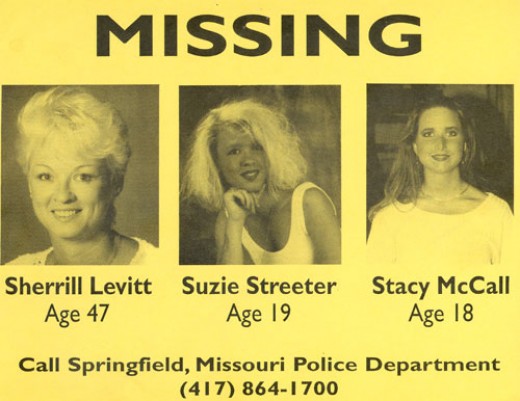
Sherrill Levitt, Suzie Streeter, & Stacy McCall (The Springfield Three) went missing from Springfield, Missouri on June 6, 1992.
Sherrill Levitt, Stacy McCall, and Suzanne Streeter disappeared from Sherrill’s Springfield, Missouri home on June 6, 1992. ‘The Springfield Three’ were spending the night together and when the home was inspected there didn’t appear to be a struggle of any kind. It’s as if the three women just vanished, which still gives the families hope, despite the harsh reality they were probably the victims of foul play. Army veteran Robert Cox was named a person of interest in their disappearance. In California, Cox pleaded guilty to kidnapping and assault with a deadly weapon and was sentenced to nine years in prison and dishonorably discharged from the Army. After his release, Cox was convicted and sentenced to death in 1988 for the 1978 murder of Sharon Zellars in Orlando, Florida. But in a rare ruling that conviction and death sentence was overturned in 1989 due to lack of evidence. After released, Robert Cox moved to Springfield, Missouri where he coincidentally worked with Stacy McCall’s father. But there was no evidence linking him directly to ‘The Springfield Three’ disappearance, therefore he was never charged with any crime. In the meantime, Cox was arrested in Texas for aggravated robbery and it was while he was in custody that he declared he believed ‘The Springfield Three’ were dead and whoever did it was someone who knew what they were doing. To this day, the three women are still missing and no one has been charged with any crimes. If you have any information that could help solve this mystery, please contact the Springfield Missouri Police Department.
In the News:
June 6, 1992 – Stacy McCall, 18, graduates from Kickapoo High School in Springfield. She meets her friend Suzie Streeter, 19. The two plan to travel to stay in Branson overnight. McCall phones her mother to say she and Suzie will be staying at a friend’s house in Battlefield. They left the home and decided to spend the night at Suzie’s home at 1717 E. Delmar St. -KY3 News (June 3, 2010)
Three Missing Women 1992 Springfield, MO 2 -KY3 News (June 3, 2010)
Three Missing Women 1992 Springfield, MO 3 -KY3 News (June 3, 2010)
Three Missing Women 1992 Springfield, MO 4 -KY3 News (June 4, 2010)
Looking back 21 years of The Springfield Missing Three -Ozarks Sentinel
True Crime Daily:
What happened to Stacy McCall, Suzanne “Suzie” Streeter, and Sherrill Levitt? These three women vanished in Springfield, Missouri in 1992, after Susie and Stacy attended a graduation party. Crime Watch Daily’s Kim Goldman is determined to find out what happened to them. -True Crime Daily (Part 1)
What happened to Stacy McCall, Suzanne “Suzie” Streeter, and Sherrill Levitt? -True Crime Daily (Part 2)
What happened to Stacy McCall, Suzanne “Suzie” Streeter, and Sherrill Levitt? -True Crime Daily (Part 3)
YouTube, Podcasts & Documentaries:
BrainScratch: The Springfield Three -LordanArts
The Springfield Three -True Crime Garage
June 6th, 1992 was an important day for the seniors at Kickapoo high school, Missouri. After years of hard work, it was finally graduation, a time of excitement and uncertainty, the future full of promise. But for Suzie Streeter and Stacy McCall the night would end in mystery, when they and Suzie’s mother Sherrill seemingly vanished into thin air. This is the story of the Springfield Three. -Case Remains
The Springfield 3 I Missing Presumed Dead #9 -Deadbug Says
Twisted 2’s #12: Springfield 3 & Eyeball Killer -Scary Mysteries
The Following Is A True Crime Documentary Based Off The Unfortunate Disappearances Of Three Women In Springfield Missouri. -Skinned Locus
Where are the Springfield Three? -Vanished Without a Trace -Shauna Rae
The Tragic Case of Gina Clark & The Springfield 3 – Without a Trace -Creepypasta.com
Investigation Discovery:
Preview: June 6, 1992, hours after their graduation, Stacy McCall, Suzie Streeter and her mother Sherrill Levitt go missing without a trace. They are later dubbed, “The Springfield Three”. -Disappeared, Investigation Discovery
Preview: More than 15 years after the disappearance of “The Springfield Three”, clues to their location may lie beneath a parking garage at Cox Hospital. Will investigators find the answers they need to bring the missing women home? -Disappeared, Investigation Discovery
Military sexual assault is not a new phenomenon. A second look at the Tailhook scandal in 1991 reveals what happened then. And what it all means now. -NY Times
“Milwaukee, Wisconsin, police officers spot Tracy Edwards running down the street in handcuffs, and upon investigation, they find one of the grisliest scenes in modern history: Jeffrey Dahmer’s apartment.
A forensic examination of the apartment turned up 11 victims–the first of whom disappeared in March 1989, just two months before Dahmer successfully escaped a prison sentence for child molestation by telling the judge that he was desperately seeking to change his conduct. Dahmer later confessed to 17 murders in all, dating back to his first victim in 1978.”
Investigators Probing Whether Accused Killer Had German Victims With AM-Body Parts, Bjt (AP, July 26, 1991):
“BONN, Germany (AP) – Police across Germany on Friday reopened files of unsolved murders and disappearances, seeking possible links to an accused mass killer in Milwaukee who served with the U.S. Army here. Dahmer was stationed from July 1979 to March 1981 with the 68th Armored Regiment in Baumholder in central Germany’s Rhineland-Palatinate state, where officials say five unsolved murder cases were being re-examined to seek any connection to Dahmer.
But four of the five murder victims were women, and no links to Dahmer have been made, said Christiana Kleinschmidt, a federal police spokeswoman in Wiesbaden. In addition, federal authorities said they were reviewing all cases of unidentified male murder victims or missing men during the time Dahmer was in Germany. Dahmer joined the Army in 1978 after dropping out of Ohio State University. He was discharged from service early because of alcohol problems.” Read more from AP here.
Little-Known Fact #5 about Dahmer from The Lineup:
#5 He served as a combat medic in the U.S. Army
“In January 1979, Dahmer enlisted in the U.S. Army. He trained as a medical specialist in San Antonio, Texas, and was deployed to Baumholder, West Germany. From 1979 to 1981, Dahmer served as a combat medic, during which time he reportedly raped two soldiers; the first victim claimed Dahmer raped him once after drugging him. The second, who was Dahmer’ roommate, stated that he was raped repeatedly while they shared a living space. Dahmer’s alcoholism followed him to West Germany as well. In 1981, after being declared unsuitable for military service, Dahmer was honorably discharged and sent back to the United States.” Read more from The Lineup here.
Six weeks after the murder of Steven Hicks, Dahmer enrolled at Ohio State University with hopes of majoring in business. However, his alcoholism meant that he only achieved low grades and he dropped out after just three months. In 1979, his father then encouraged him to join the U.S. Army where he trained as a medical specialist.
During his time in the army, two soldiers came forward with claims they had been drugged and raped by Dahmer. In 1981, he was deemed unfit for military service and received an honourable discharge.
Preston Davis, who was in the military service at the same time as Dahmer, recalled, “Jeffrey had killed his first victim a year before joining the military, and he would get drunk in the barracks and say, ‘I killed the guy in Ohio,’ and we’d say, ‘You didn’t kill nobody!’ He became a monster once he started drinking. Alcohol is what turned him into a monster.”[5] Read more from Listverse here.
ID Go: The Phillips’ family moves to a quiet seafront town in Maine to escape a crime wave in Indiana. But their dream home comes with a not so dreamy ex-military neighbor. A barrage of gunfire between the houses one night shatters both families forever. -Red Picket Fences, Fear Thy Neighbor (S1, E2)
On August 29, 1989, Navy veteran Richard Uffelman and his two sons opened fire from their living room window and shot and killed their neighbors Michael and Florence Phillips in Machiasport, Maine. The Phillips family moved back to Maine so they could be closer to their family and the ocean, and they wanted to escape crime in Indiana. Shortly before they moved to Maine, a murder occurred outside their home and this was it for them; they wanted to raise their son Michael in a safe environment. Richard and Anita Uffelman and their two sons were the new neighbors of the Phillips in Maine. Richard was described as an authoritarian and a believer in good order and discipline. He worked at the local post office and taught his two children to shoot guns. Initially the neighbors were good friends and their boys played together. At some point, family came to visit the Phillips for a week. The happy family reunited outside on the front lawn while they barbecued, drank some beers, and enjoyed one another’s company. Apparently Richard found a broken bottle on his lawn during the event and automatically assumed the Phillips threw the bottle on his lawn. Richard called the police to complain about the incident but there was no proof since the Phillips denied doing it. This was it for Richard; the Phillips home interfered with his view of the ocean and he was going to exact his revenge.
After this first broken bottle incident, Richard continued to call the police complaining that the neighbors were throwing bottles on his property. He would bag them up and give them to the police as evidence. The Phillips continued to deny the allegations. The police were beginning to get concerned for the Phillips. Then Richard’s wife Anita called the Phillips family and told them that Richard did not want their two sons playing with Michael anymore. Florence was confused. Soon Richard began harassing them while they were outside on their lawn. He used a megaphone and yelled at them until they went back into their house. The Phillips became fearful of him because he was quite literally bullying them. Richard upped the anti and put up some bright lights that shined directly on their home. He also shot guns in front of his home with his two boys on a regular basis which to the Phillips began feeling threatening. They called the police to ask Uffelman to stop shooting the guns because it felt like he was flexing his muscles but their was nothing illegal about shooting guns for target practice in Maine. The police couldn’t do anything. They needed evidence so Michael and Florence set up a video camera to start taping the behavior because they were not the gun types.
Tension and fear was building daily. The Phillips called the police on Richard Uffelman and Uffelman called the police on them. Now Richard wanted a protection order. It was obvious to police that Richard was getting paranoid and he had some fear that could not be alleviated by the police. Uffelman wanted to play war. Uffelman began dressing in full military fatigues with his two sons and they all carried guns and marched together as if they were in the military or a militia. The kids were impacted by Richard’s paranoia as well; as a matter of fact the whole family was brainwashed. Eventually the Phillips were afraid of Uffelman and his two sons. The Phillips left the city to get away from violence and now they were in the middle of it. They decided to file a harassment suit to get Richard Uffelman to stop. At this point, they felt trapped in their own home and they continued to videotape because it was their only option. One day Richard and his two sons armed with guns started chasing the Phillip’s son after school as if he was prey. The trio scared the entire Phillips family and they called the police again. The cops took it seriously and knew things were not going to turn out right. The Phillips got a protection order and then went on a vacation to Indiana to visit family in July 1989.
Richard Uffelman, US Navy Veteran
While the Phillips were visiting with family, they began viewing the videotapes. All of them were terrified at what they were witnessing but the Phillips were stuck financially. They assured their family they would be fine but in reality they were afraid Richard Uffelman would kill them when they got back. They asked their family to raise their son Michael if Uffelman killed them. They left for Maine the next day because it was their home and they had no other option. They got back to the war zone and the front lines had moved closer to home. When they got out of their vehicle, they realized that someone had dumped gasoline on their front porch. They witnessed someone running in the shadows from their home to Uffelman’s home. They called the police again but they didn’t have any proof that Uffelman had done it. They all recognized that Uffelman was raising the stakes. Unfortunately the system was at a stand still until someone made an overt act. On August 29, 1989, family visited the Phillips because they were celebrating a pregnancy in the family. The Phillips revealed to them that dealing with Uffelman was very stressful because they hadn’t caught anything of value for their harassment case. In this case, the best evidence would come too late.
Michael and Florence Phillips left the house that evening for a walk, just like every other night. This time Michael was carrying a gun as they walked in an effort to let Richard know that they were not going to take it. Then all of a sudden Richard and both of his sons began shooting at both of them from the living room of their home as they walked. The remaining family in the home were fearful that they were going to kill young Michael next. Meanwhile, Michael and Florence are struggling to move to safety in the woods to escape the barrage of gunfire. Uffelman did go to the Phillips home but turned around and left. After this near miss, the three family members in the home left to protect young Michael. They were not sure how Michael and Florence were doing at this point; they were not sure if they had been murdered or if they were still alive. Police arrived on the scene and knocked on Richard Uffelman’s door. They found him sitting at his kitchen table which was covered with handguns and firearms. The police were worried about their own safety but Uffelman surrendered without incident and he was taken into police custody. Michael and Florence Phillips both died at the scene in the woods where they attempted to escape the gunman.
Richard Uffelman was arrested for murder after the Phillips’ bodies were found. His two sons participated in the shootings as well and together they fired twenty-five rounds or so from the inside of their home. Investigators concluded the two boys were doing what they were told to do; they were victims too and as a result were not charged. Upon search of the property, police learned that Uffelman’s land was rigged with trip wire and his home was riddled with explosives. Bomb technicians were called in to remove the undetonated devices. Police also found secret passageways and tunnels. Uffelman tried to claim self-defense at his trial but the video coverage the Phillips had showed otherwise. The videotapes revealed that Uffelman went outside to check to see if his prey were dead; his murderous intent was all captured on film. Richard Uffelman was sentenced to life in prison for the first degree murders of Michael and Florence Phillips. Young Michael sued Richard Uffelman in Maine Superior Court and was awarded a wrongful death judgement for $513,320 but he has never received a dime. According to a YouTube site called Abandonment of Maine, shortly after new owners moved into the Uffelman home, the house caught on fire and burned to the ground.
April 15, 1989: Tammie Erwin, 18, Palm Springs, California
Marine veteran Andrew Urdiales is accused of murdering eight women from 1986 to 1996, five in California and three in Illinois, and raping and abducting 19 year old Jennifer Asbenson who escaped and survived. Urdiales was indicted for three murders in Illinois and was sentenced to death but the death sentence was commuted after Governor Pat Quinn of Illinois abolished capital punishment in 2011. Instead he received three life sentences for the murders of Laura Uylaki, Cassandra Corum, and Lynn Huber. A gun confiscated in a separate incident linked the three murders in Illinois together and during an interrogation, Urdiales admitted in detail to five cold case murders in California too.
After years of legal wrangling, Urdiales was eventually extradited to California and indicted in 2009 on five counts of first degree murder. He was accused of killing Robbin Brandley, Julie McGhee, Mary Ann Wells, Tammie Erwin, and Denise Maney while stationed at Camp Pendleton Marine Corps base. On May 23, 2018, Andrew Urdiales was convicted of five murders by a jury that deliberated for about a day before recommending in June 2018 that he be sentenced to death for each of the five murders. On November 2, 2018, corrections officials said they found Urdiales unresponsive during a security check at San Quentin State Prison; former Marine and serial killer Andrew Urdiales died by suicide.
In the News:
The murders occurred when Andrew Urdiales was stationed at various Marine Corps facilities in Southern California. -CBS Los Angeles (October 5, 2018)











 MILITARY JUSTICE FOR ALL