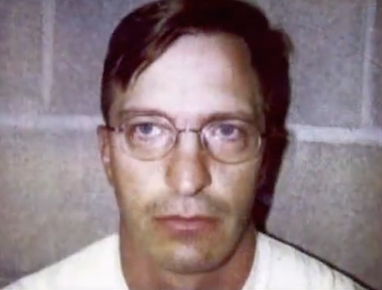
Navy Petty Officer James Kuenn, 40, was found guilty on February 9, 2000 for the first-degree murder of his teen girlfriend Carol Hutto on December 13, 1976 in Largo, Florida. Carol Hutto’s half-brother found her dead in a pond in the neighborhood; she was weighed down with cement blocks. An autopsy revealed Carol was hit and strangled, lost consciousness, and then thrown in the water alive. Initially, police suspected Carol’s half-brother committed the crime but they did not have enough evidence to charge him so the case went unsolved for nearly two decades. Then in 1994, two Largo Police Department investigators reopened the cold case.
The detective’s determination to find the killer led them to a former Largo resident who by then was an eleven year Navy veteran stationed at U.S. Naval Submarine Base in Groton, Connecticut. In 1996, DNA testing was making it’s way into police departments across the country so the investigators submitted several unknown hairs to the FBI lab. But they needed a sample of Kuenn’s DNA to see if it was a match. Investigator’s obtained a search warrant to get the DNA via a blood sample and used the interrogation to elicit a confession while they waited for the results. Since Kuenn was active duty Navy, detectives brought in the Naval Criminal Investigative Services (NCIS) in Mayport, Florida to assist with the interrogation.
On July 15, 1998, the NCIS used the interrogation to push Kuenn into a confession. Investigators had no physical evidence linking Kuenn to the scene but that didn’t stop them from bluffing and hoping Kuenn would cave. Kuenn eventually admitted to investigators that the whole thing was an accident and he brought Carol to the lake to cover up the crime. Kuenn claimed that Carol tripped and fell and became unconscious so he took off her clothes to make it look like someone else did it. Despite Kuenn’s tears, detectives believed he was lying because Carol’s injuries did not come from an accidental trip and fall; they came from blunt force trauma and strangulation. Kuenn was charged with murder, convicted, and sentenced to life in prison without the possibility of parole for twenty-five years.
“Kuenn recalled the fateful night when he and Carol met at the house under construction. They kissed but the young woman was reluctant to have sex with him. As she struggled, her screams rang out through the foggy night air. Kuenn, under the influence of alcohol and marijuana, hit her with a 2 by 4 to quiet her. He then dumped her in the pond, where she drowned, according to the autopsy.” –Tampa Bay Times
16-year-old Carol Hutto is a dependable friend, daughter and sister. She’s a good student, loves wrestling and hanging out with friends. So when she misses her curfew one evening, her mother knows something awful has happened. -Swamp Murders
Offender: Troy Graves, 29, US Air Force service member Victims: Shannon Schieber, 23, University of Pennsylvania student (rape/homicide), multiple rape victims in Pennsylvania & Colorado
Circumstances: Shannon Schieber was enrolled as a Phd. student at the Wharton School of Business, on May 7, 1998, Shannon was studying for exams when a neighbor heard what sounded like cries for help, he called 911 to report that his neighbor was asking for help, the police arrived but no one answered the door and the neighbor backed off his statement, they searched the property and the neighbor said it could have been outside so they left, Shannon’s brother showed up the next day and Shannon didn’t answer the door, the neighbor told her brother what he heard the night before, they broke into the apartment and found Shannon naked on her bed, Shannon was strangled to death and it appeared she tried to fight off her attacker, police found DNA at the scene, DNA ruled out those close to Shannon, Shannon’s parents were outraged that the man who killed their daughter was in the apartment when the police knocked on her door, but the police did their job right and by the book, a few days before the murder, Shannon reported being followed home one night, she was scared, so police started investigating the stranger angle, perhaps this is a serial rapist, they look into sex crimes in the area, they want to match the DNA to other sex crimes in the area.
In February 1999, they got a DNA match, 2 other sexual assaults had occurred but they were coded as misdemeanors, the assaults occurred just a few blocks from Shannon’s apartment, in June and July 1997, two more sexual assaults were connected to the offender bringing the total to 5, the PPD coded these sexual assaults as misdemeanors as well, they downgraded the offenses because it lessoned the load for the police, and made the arrest rate look better than it was, Shannon’s case helped enact change in Philadelphia, if they had investigated these cases, everyone would have known there was a serial rapist, Shannon would not be dead if she knew what was going on, the DNA still didn’t have a match to the offender, in 1997, a sketch was drawn from the recollections of the first victim, they got a new composite, this offender would enter the home, hold the victim down on the bed, rape them or make them perform oral sex, it was about control and domination for this guy and he was also somewhat of a romantic, once they acquiesced, he would treat them like a date, he would get comfortable with the victims, they determined he was a light skinned black male based on information he shared with one victim about his life growing up with bi-racial parents.
He was dubbed the Center City rapist, in August 1999, no other cases were reported since Shannon’s murder, the case went cold, the police got a bulletin in 2001 from Fort Collins, Colorado, the offenders modus operandi sounded familiar to the Philadelphia PD, on June 13, 2001, one victim was home when she was attacked from behind and raped, after she acquiesced, the rapist became gentle as if he was a boyfriend, after he left, she called 911, she was his third victim in Fort Collins, they were all blitz attacked, FC police were investigating a serial rapist, a fourth & fifth rapes were reported, he made a mistake and left behind a ball cap at the fifth victims home, Fort Collins DNA was matched to the rapes in Philadelphia, PPD gave FCPD the composite drawing, police received a letter in the mail from the suspect, he was taunting them, in the fall of 2001, the attacks in Fort Collins stopped, meanwhile the PPD started focusing on cross referencing names of suspects with the two geographic locations, they got a match for Air Force service member Troy Graves, he was in Philadelphia, Fort Collins, and now at Warren AFB in Cheyenne, Wyoming, in 2002, the police had the new suspect in their sites.
The police learned that Troy was also investigated by the Office of Special Investigations, it was over charges of harassing a female colleague, the charges were dropped but there was still something suspicious there, Graves has a clean criminal record and no finger prints on file, the case was circumstantial, they reached out to Graves to come to the police department and do an interview, Troy Graves and his wife showed up to the Fort Collins PD, the police immediately separated the couple, his wife admitted that he had insomnia and went for walks and drives at night and that honestly she thought he was having an affair, meanwhile Troy denied knowing anything about the crimes, the police confronted him about the rapes in Fort Collins, he denied being arrested for any sex crimes, he denied being investigated by the Air Force, he did not want to provide his fingerprints but a warrant was issued to compel him, the fingerprints were a match, Troy Graves was arrested and booked into custody on April 23, 2002, this case changed the PPD policies on sexual assault to include how evidence is handled and how the victims are treated and interviewed.
Disposition: Troy Graves feared a trial would not go in his favor in Fort Collins, Colorado, he pleaded guilty in exchange for a life sentence without the possibility of parole; Pennsylvania wanted to seek the death penalty but Shannon’s family did not want that because Shannon wouldn’t have wanted that, Graves entered into a plea agreement and got life in prison plus sixty years
Notable Quotes: “We have to change the system but not put people to death.” -Vicki Schieber (Shannon’s mom)
In 1998, a gifted Philadelphia graduate student is found murdered in her bed. The hunt for her killer forces police to reevaluate a series of unsolved crimes, turning the city upside down. Will her killer be caught or will he strike again? -Terror in Philadelphia, People Magazine Investigates (S3,E2)
Editor’s note: With a cable subscription, you can download the free ID Go app and watch Investigation Discovery programming at your convenience. And for those who do not have cable, you can watch “unlocked” episodes on the ID Go app including the latest premieres. For those who prefer commercial free programming during your binge session, Prime Video has an ID channel: ‘True Crime Files by Investigation Discovery” available for $3.99 a month. It’s a compilation of older seasons but totally worth the cost if you are a true crime addict. Download the ID Go app or purchase ID True Crime Files & binge away.
Preview: Seeking freedom from his controlling wife, Dennis Hawley begins seeing drug-addicted prostitute Brandita Taliano and supporting her financially. In 1993, when Joan receives an inheritance and makes plans to divorce, Dennis, fearing financial ruin, enlists his lover to help murder his wife. -Second Best, Deadly Women (S8, E10)
Air Force retiree Dennis Dawley, 61, with the help of prostitute and mistress, Brandita Taliano, bludgeoned to death his wife Joan Dawley of 35 years for financial gain in Van Nuys, California. Joan wanted a divorce and Dennis and Brandita wanted her inheritance money. The 1991 case went cold for years until DNA technology under Joan’s fingernails yielded a match to Brandita Taliano. Both Dennis and Brandita were charged with murder, conspiracy & solicitation and faced the death penalty. On April 15, 1997, a California jury sentenced Dawley and Taliano to life in prison without the possibility of parole. The pair were spared the death penalty because they didn’t have any prior violent felony records and the jury heard the emotional pleas from Dawley’s daughters.
Investigation Discovery:
Being the other woman’ is a lonely life. Some turn rejection into rage. A call girl craved the high life, a teen mom eradicated her rival, and a lesbian love affair ripped a family apart. These Deadly Women refused to play Second Best’. -Second Best, Deadly Women (S8, E10)
In suburban California, an intruder brutally attacks and kills Joan Dawley. As the Dawley family grieves, it’s up to LAPD detectives to crack the case. Secret home movies uncover a shocking tale of deceit, and a monster lurking behind the scenes. -Stages of Grief, American Monster (S3, E1)
Editor’s note: With a cable subscription, you can download the free ID Go app and watch Investigation Discovery programming at your convenience. And for those who do not have cable, you can watch “unlocked” episodes on the ID Go app including the latest premieres. For those who prefer commercial free programming during your binge session, Prime Video has an ID channel: ‘True Crime Files by Investigation Discovery” available for $3.99 a month. It’s a compilation of older seasons but totally worth the cost if you are a true crime addict. Download the ID Go app or purchase ID True Crime Files & binge away.
Fort Bragg, North Carolina, had seen it all before – when Dr. Jeffrey MacDonald was convicted of savagely slaying his wife and children. Now another officer’s wife had been raped and murdered, another pari of children viciously butchered. And another member of the military was brought to trial. This time the state had no trouble winning a conviction. Tim Hennis was found guilty and sentenced to death. Only Hennis’ parents, wife, and dedicated defense team refused to give up. Piece by piece they ripped the state’s case to shreds, revealing a stunning story of perversion of justice, false witnesses, hidden evidence, and, incredibly, a baby-sitter who had a fascination with Dr. Jeffrey MacDonald. With the brutal truth and chilling suspense of Fatal Vision, this riveting account recreates a vicious crime, the behind-the-scenes story of its investigation, the compelling drama of one of the very few men ever released from Death Row, and an unsolved mystery that still casts a spell of terror. (Innocent Victims by Scott Whisnant)
Book Review:
I read the Innocent Victims book while I was camping and honestly I could not put it down. I was reminded of it while listening to the Military Murder Podcast and inspired to read it because of the level of detail available in the book. It was a great read because there were so many twists and turns in the case. If I didn’t know about the fact that a DNA match to Timothy Hennis helped prove his guilt in a 2010 military trial, I would have been convinced Timothy Hennis was wrongfully convicted. Timothy Hennis was luckier than most because he had the staunch support of his adopted family and wife Angela, who all believed wholeheartedly in his innocence. This case is one for the history books because it’s not every day someone is found guilty in a civilian trial, then found not guilty in a civilian trial on appeal, and then tried again by the military in a third trial and found guilty. Timothy Hennis was sentenced to death and is one of four service members languishing on military death row. The military hasn’t executed anyone since they hanged Army Pvt. John Bennett on April 13, 1961.
Journalists and scholars have questioned the military’s ability to try someone found not guilty in a civilian court because of the double jeopardy concerns. Due to the fact that Timothy Hennis was found not guilty in a second civilian trial, he was allowed to resume his career in the U.S. Army and retired as a MSG in 2004. As far as we know, Timothy Hennis committed no other crimes and was well respected by those he served with. It would be because of his retirement from the military, the Army was able to bring him back on active duty status and try him in a third trial for the murders of the Eastburn family. This practice is also controversial. On appeal Timothy Hennis challenged the military’s jurisdiction to recall him to active duty status to prosecute him and questioned the double jeopardy concerns. In January 2020, an Appeals Court decided military retirees can be recalled to active duty status and court-martialed. In February 2020, the U.S. Court of Military Appeals rejected Hennis’ constitutional rights challenges to the military court’s jurisdiction to try him.
Army Soldier Erin Tynan, 21, was found dead on November 15, 1990 in her off base apartment in Barstow, California. Erin Tynan was an active duty military police officer stationed at the Fort Irwin National Training Center. She had already spent a couple years in Germany and after her enlistment was up, she was going to use her GI Bill to go back to school and get a degree in forensic social work. After she didn’t show up to work, the Army asked the Barstow Police Department to check in on her because they were concerned about a respiratory medical condition she had been diagnosed with in Germany. The Barstow Police Department went to Erin’s home and found her dead at the scene.
Barstow PD detectives determined that Erin had been the victim of a surprise sexual attack and murder. They deduced that whoever killed Erin was someone that she knew and the person was able to gain access inside her apartment and overpower her. The autopsy confirmed that Erin was assaulted, forcibly raped, strangled, and stabbed in the neck post mortem. Investigators believed that the precision stab wound in the back of the neck was the work of someone who served in the military and wanted to make sure she was dead. They first turned to Erin’s last known boyfriend William Jones. He had recently been discharged from the Army and left the day before but there was tension because the six month relationship ended. Jones informed investigators that he had left Erin with a 22 pistol for protection but she was planning on selling the gun to another Army soldier because it jammed. They did not locate the gun in Erin’s apartment and believed the killer stole the gun. Jones was eventually ruled out because his DNA did not match the DNA found at the crime scene and he was in fact physically placed in Illinois at the time of the murder. The next person they turned to was a lead they got from the Army Criminal Investigation Division (CID). CID learned that another soldier by the name of Eugene Knox was in possession of a 22 pistol and had been acting erratically. The Barstow PD spoke with Knox and learned that he had been dating Erin. No one knew the two were seeing one another. Investigators determined that Knox could not have been the killer because he was out in the field on the night of the murder.
A couple years later, evidence from an attempted murder of a young mother in Louisiana was linked to evidence in a murder case in California. The young mother had been shot in the face once with a 22 pistol but her life was spared when the gun jammed the second time the killer pulled the trigger. The murder victim, Curtis Dean, had also been stabbed in the neck in the same precise way that Erin Tynan was stabbed in the neck. The suspect in the murder of Curtis Dean was an Army soldier at Fort Irwin, Christopher Geier. Army CID immediately recognized the similarity in the knife wounds found on both Curtis Dean and Erin Tynan. They contacted the Barstow PD to inform them of what they had learned. Geier admitted to investigators that he was hired to murder Curtis Dean but did not admit to the rape and murder of Erin Tynan when confronted. But it didn’t matter because in the meantime forensic testing revealed the gun used to shoot the young mother in Louisiana who survived matched the 22 pistol missing from Erin’s apartment. And the British Commando knife Geier admitted using on Curtis Dean was consistent with the knife used on Erin Tynan. Hair samples and DNA evidence collected from the rape also matched Geier. The prosecutor determine based on evidence collected at the scene that Geier knew that Erin Tynan would be alone and vulnerable that night. He also knew that her boyfriend Billy Jones was gone. He used the ruse to buy the pistol to gain access into her apartment with one thing in mind: he wanted a sexual encounter with her. After she resisted and rejected him, he raped and strangled her.
On July 21, 1995, Christopher Adam Geier was sentenced to death for the first degree murder of Erin Tyner and Curtis Dean, and the attempted murder of the young mother in Louisiana. Investigators eventually learned that Geier’s Fort Irwin Tank Commander in the Army, Jeffrey Hunter, hired him to kill Curtis Dean. Army soldier Jeffrey Hunter was sentenced to life in prison.
Update: On August 31, 2017, Christopher Geier, 49, collapsed and died in the prison’s recreational yard. The cause of death is unknown, pending the results of an autopsy.
Investigation Discovery:
The discovery of a beautiful military police officer murdered in her own home sends police on a twisted journey for answers. -Blood and Betrayal, On the Case with Paula Zahn (S14,E5)
Editor’s note: With a cable subscription, you can download the free ID Go app and watch Investigation Discovery programming at your convenience. And for those who do not have cable, you can watch “unlocked” episodes on the ID Go app including the latest premieres. For those who prefer commercial free programming during your binge session, Prime Video has an ID channel: ‘True Crime Files by Investigation Discovery” available for $3.99 a month. It’s a compilation of older seasons but totally worth the cost if you are a true crime addict. Download the ID Go app or purchase ID True Crime Files & binge away.
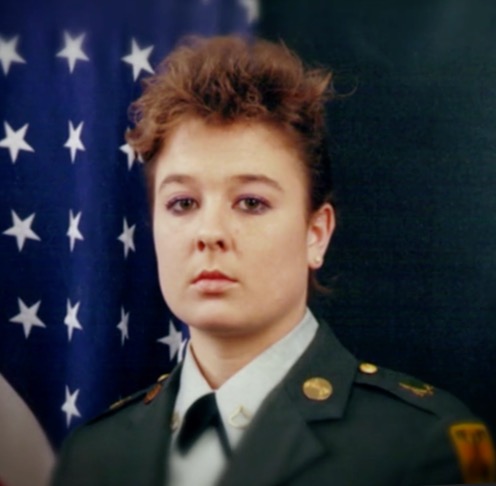
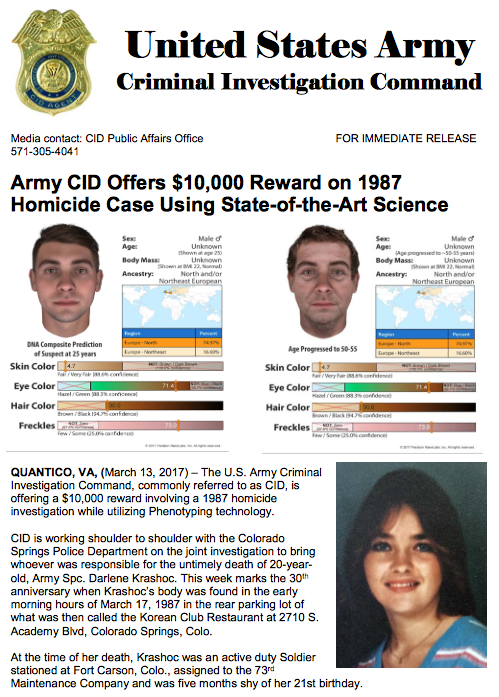
The victim: Darlene Krashoc, 20, a soldier at Fort Carson who worked as a mechanic at the Army post.
The Crime: Two Colorado Springs police officers on routine patrol spotted a partially nude woman laying in the parking lot behind the Korean Restaurant, a nightclub formerly at 2710 S. Academy Blvd., around 5:20 a.m. on March 17, 1987. An autopsy determined that Krashoc had been strangled with a coat hanger and leather thongs after being severely beaten, bitten, sexually assaulted. She may also have been thrown from a moving vehicle.
The investigation: Krashoc’s mother, Betty, last spoke with her daughter a week before her death. Krashoc had changed from a soldier ready to re-enlist to a frightened woman ready to go AWOL to get away from Fort Carson, but wouldn’t tell her mother why.
Colorado Springs Police Department considers a case to be cold if it remains unsolved for more than one year. If you have information that would be of assistance in these investigations, please contact 719-444-7613, by e-mail at CSPDColdCase@springsgov.com or you may remain anonymous and could earn a cash reward by calling Crime Stoppers at 634-STOP (7867). –The Gazette
Thirty years after Krashoc’s body was found, Army Criminal Investigation Command are offering a $10,000 reward to anyone who can lead them to the man they believe killed Darlene Krashoc. If you have any information about the investigation or if the DNA prediction results resemble someone you know or knew at the time, you’re asked to contact your local CID office or CID headquarters in Virginia at (844) Army CID or (571) 305-4375. You can also email army.CID.crime.tips@mail.mil.
The murder of a military wife and two of her young daughters in Fayetteville, North Carolina in 1985 was still making headlines twenty-five years later. The loss of his children and his wife Kathryn would forever haunt former Air Force Captain Gary Eastburn. Katie captivated him from the moment they met and the two got married shortly before Gary joined the United States Air Force. Eleven years later, Captain Eastburn was stationed at Pope Air Force Base in North Carolina as an Air Traffic Control supervisor. By then, the couple had three daughters: five year old Cara, three year old Erin, and Jana who was just under the age of two. They lived on Summerhill Road near the Fort Bragg Army post.
In the spring of 1985, Gary Eastburn was nearing the end of a training program at Maxwell Air Force Base in Alabama. Every Thursday night, Gary called Kathryn from the barrack’s payphone. One week, he couldn’t reached Kathryn and after frantically calling her for a couple days unable to reach her, Gary asked a neighbor to check in on his wife. The neighbors had grown concerned as well when they noticed that the newspaper had not been picked up for a couple days and they heard a child crying. They called the police who went into the Eastburn’s home and discovered Kathryn, Cara, and Erin had been murdered and the youngest toddler, Jana, was crying and severely dehydrated. They would learn that the baby was only hours from death.
The Fayetteville Police Department investigators discovered that Kathryn Eastburn had been raped and murdered. Her underwear had been cut off her, her blouse and bra were ripped opened, her throat was slit, and she had multiple stab wounds. Erin was found in her mother’s room stabbed to death and her throat slashed. And Cara was found in her own bed as if she was hiding underneath a blanket. She too had been stabbed multiple times and her throat was cut. Police believe the surviving toddler was in her crib for nearly three days before neighbors found her. Gary Eastburn received the dreadful call that there had been a death in the family while he was still at Maxwell. Investigators asked him to return home immediately because detectives wanted to give him the news in person.
Desperate police turned to the only living witness, Jana, to see if she remembered anything. The police took Jana to a child psychologist to determine what, if anything, she might know. The police deduced that the child heard the killer but could not identify him; she was just too young. An older Jana admits that she doesn’t remember anything now either. Police theorized that the baby was young and couldn’t identify the intruder which is probably why she was spared. In the meantime, a neighbor came forward claiming he saw a man leaving the Eastburn residence around 3 a.m. and was able to give a description of a suspect who drove a white Chevrolet Chevette. Kathryn also told Gary about a man who came and looked at the family dog they were trying to find a home for. His name was Timothy Hennis and the composite drawing inspired by the neighbor looked just like him.
Timothy Hennis was questioned and asked to give hair, blood, and fingerprint samples. When the detectives escorted Hennis back to his car, they discovered he drove a white Chevrolet Chevette. Later that night, Timothy Hennis was arrested. Hennis was an Army Sergeant stationed at Fort Bragg. Someone had used Kathryn’s stolen ATM card and a witness identified Hennis as the person who used the ATM right before she did at the time of the transaction. At every turn, the evidence overwhelmingly brought them back to Hennis. The prosecutors were puzzled why Hennis would commit such a heinous crime given he had no history of violence. They learned that he had approached a woman for sex that same night and theorized that when he was rejected, he decided to target Kathryn Eastburn.
A trial began roughly a year after the murders in 1986. Hennis’ attorney was quick to point out that the prosecution didn’t have any physical evidence linking Hennis to the murders to include fingerprints, hair, and foot prints. This was at a time before there was any routine DNA testing, therefore even semen found in Kathryn’s body led police nowhere. There was a significant amount of physical evidence showing that a male suspect was in the Summerhill Road house and it wasn’t Gary Eastburn or Timothy Hennis. Hennis’ attorney also pointed out that there was no possible way someone could leave that house without transferring evidence to their personal belongings. On July 4, 1986, the jury returned it’s verdict and Timothy Hennis was found guilty on all counts. Four days later, Hennis was sentenced to death.
While Timothy Hennis was sitting on death row, he received a letter from someone claiming to have committed the crimes. This person appeared to show remorse because Hennis was serving time for his crimes. In spite of the verdict, Hennis’ attorney and wife Angela continued to claim that Hennis was not the killer. As a result, Hennis’ attorney fought to have the murder conviction overturned and filed an appeal. The attorney felt he did not provide adequate representation in the first case and admitted that it was a heavy burden to carry. In a precedent setting decision, the Supreme Court overturned the guilty verdict. It found the prosecutors used information to inflame the jury, a graphic parade of disturbing images taken at the crime scene. After two years on death row, Hennis was awarded a new trial.
The second trial began in 1989, four years after the murders. The prosecution’s case was still strong and the star witness was back to swear that he saw Hennis leaving the Eastburn home on the night in question. In this new trial, the defense delivered compelling theories of their own. They produced a witness who claimed to have seen another man (not matching the description of Timothy Hennis) near the Eastburn home. The defense also reminded the jury there was no physical evidence connecting Hennis to the murders. Additionally, they opined there were others who could have committed the crimes including the person who wrote to Hennis while he was in prison. And in this case, Hennis took the witness stand and denied having anything to do with the murders. On April 19, 1989, a jury found Timothy Hennis not guilty on the triple murder charges and set him free.
Gary Eastburn wasn’t convinced of Hennis’ innocence because he never once apologized to the family for their loss. The verdict just didn’t sit right with Gary and he strongly believed that Hennis was guilty despite the jury’s decision. Gary admits he was angry after the verdict but he knew he had to let it go for his health. A month after Hennis was released from prison, ‘A Current Affair’ paid Hennis and his wife to appear on the program. Hennis suggested the prosecution wanted to pin the murder on anyone so they could get it out of the news; he also denied committing the murders. Timothy Hennis was free and for over twenty years no new suspects emerged. Whoever committed the murders in Fayetteville had gotten away with murder until one day a cold case detective took another look at the case.
After the murders, Gary Eastburn was transferred to a military base north of London, England where he met an English nurse and married her in 1991. Jana was 8 years old and now had a step-mother. Timothy Hennis returned to his family and resumed a career in the Army which often took him away from home. He served in the first Desert Storm war, he served in the war in Somalia, he got promoted multiple times, and had nothing but good marks from military leadership. Journalist Scott Whisnant wrote a book called ‘Innocent Victims’ which was later featured as a television movie. The point of view of the book was that Timothy Hennis was not guilty of these crimes. Investigators never read the book or saw the show. They claimed they were not interested in fiction; instead they were annoyed and pissed.
Twenty years later, new detectives were working on cold cases and decided to take a second look at the Eastburn murders. A cold case investigator found the one clue that could lead them to the killer, a vaginal swab from Kathryn Eastburn. In the 1980s, DNA testing was not available but now it was and they sent it to the lab. The lab testing revealed that the vaginal swab from Kathryn was a match to Timothy Hennis’ DNA. Still, Hennis’ attorney wasn’t convinced because he didn’t understand how someone could commit such a heinous crime then go twenty five years without committing another one and also lead an exemplary life. Billy Richardson believed the sample may have been contaminated and he pointed out that the lab that conducted the testing had been called into question on numerous occasions.
Author Scott Whisnant also believed that something was wrong and Hennis couldn’t have committed these crimes. He asked: “How could he be guilty of this? How could he fool everyone all these years?” Meanwhile, investigators contacted Gary Eastburn to inform him they got a match to Timothy Hennis. Eastburn admitted he had given up hope and the new information was overwhelming. But one thing stood in the way of justice: the Constitution. Hennis had been found not guilty by the State of North Carolina and they were prohibited from trying him a second time because of the double jeopardy clause. But the State found a loophole and because Timothy Hennis was a retired Army soldier, the Army could try him. They ordered Hennis out of retirement and back into uniform to stand trial in the military justice system.
Hennis retired in Washington state in a community near Seattle which was a shock to Gary Eastburn because that’s where he and his wife had settled and Jana and her boyfriend had settled. They learned that Hennis lived 30 minutes away from them. Jana was shocked he lived so closely to them because he was walking free in a community near her. But the Army would soon move Hennis; he was ordered back to Fort Bragg to face triple murder charges. After two decades of freedom, Hennis was being tried for the murders of Kathryn, Cara and Erin Eastburn, a third time for the same crime, except this time in a military court martial. If convicted, Hennis could again face the death penalty again. Hennis’ attorney was stunned that in America, Hennis could be charged for a third time for the same crime.
Billy Richardson referred to the double jeopardy clause in the US Constitution and reminded the public it doesn’t say anything about jurisdiction. He tried to get a federal court to intervene on the issue but failed. And in this third Hennis trial, there would be a new witness, Jana, the only survivor that night. She wanted the jury to know how this crime impacted her life. The trial began in the spring of 2010 and Timothy Hennis’ wife and grown daughter continued to stand by his side. They believed he was innocent. Hennis’ new attorney, Frank Spinner, argued at trial that the facts of Hennis’ life do not paint the portrait of a man who could commit such a heinous crime. He questioned how a man who led such an exemplary life could be the same person who would commit three murders in one night.
Timothy Hennis served his country with distinction, raised his family, and never committed another crime in the twenty five years after the Eastburn murders. And yet on one single night, Hennis slaughtered a family? The prosecutors said the motive didn’t matter because there was DNA linking Hennis to the murders. Spinner reminded jurors that DNA does not mean a case is open and shut. He argued that the DNA does not mean Hennis raped and murdered Kathryn Eastburn because Hennis admitted to consensual sex with her. Hennis suggested Kathryn was lonely while her husband was away at training. Gary Eastburn was angry the defense would have the audacity to suggest that Kathryn was a ‘whore’. Hennis’ old attorney Billy Richardson shared that Hennis denied having sex with Kathryn twenty years ago.
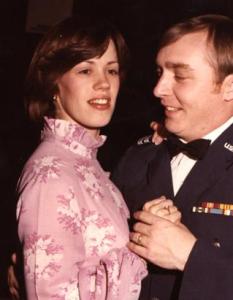
Kathryn and Gary Eastburn
The military panel didn’t believe Timothy Hennis and they found him guilty of the murders of Kathryn, Cara and Erin Eastburn. Hennis was lead away in handcuffs and for the second time in his life, he was sentenced to death. Timothy Hennis maintains his innocence, filed an appeal, and is fighting for a reversal of his conviction. Gary and his daughter Jana spoke to the press minutes after the verdict and expressed empathy for Timothy’s family despite their belief that justice was finally served. Jana Eastburn admitted she feels more at peace knowing that Hennis is behind bars. As of 2011, Timothy Hennis appealed his conviction and challenged the federal ruling regarding the double jeopardy clause. Timothy Hennis remains on military death row at Fort Leavenworth in Kansas.
Source: 20/20 on ID ‘Witness’
In 1985, a young military wife and two of her three little girls are viciously murdered in their home. In a twisted case filled with unusual suspects, the man who gets convicted goes free. But nothing is what it seems. -20/20 on ID












 MILITARY JUSTICE FOR ALL