“April 16, 2003. San Antonio, Texas. Colonel Michael Philip Shue said goodbye to his wife and was supposed to drive to Lackland Air Force Base where he worked. But he was seen driving erratically on the highway away from both his work and his home later on. The Colonel’s car then smashed into a tree, killing him. But he sustained injuries prior to the accident that suggested that he may have been the victim of a crime. Some of these injuries included: duct tape on his wrists and ankles, a six inch wound down the center of his chest and his nipples had been cut off. A world renowned medical examiner surprisingly deemed the Colonel’s death a suicide. After Col. Shue’s wife hired two other experts a different picture came into focus. One of abduction and torture. What exactly happened to Col. Shue? Was he suicidal? Or did someone want him dead? Can Justin & Aaron get to the bottom of this mystery?” –Death of Colonel Shue, The Generation Why Podcast (November 4, 2018)
“In 2010, statistics came out that 120 female U.S. soldiers stationed in Iraq had died. Half of those deaths were reported to be non-combat related. 30 those non-combat related deaths were ruled suicides, but there is evidence to suggest many of them may have actually been murders. In this episode, we dive into the case of LaVena Johnson and other women of the U.S. military who died very suspicious deaths during Operation Iraqi Freedom.” –Conspiracy: Women in the US Military, Crime Junkie Podcast (10/22/18)
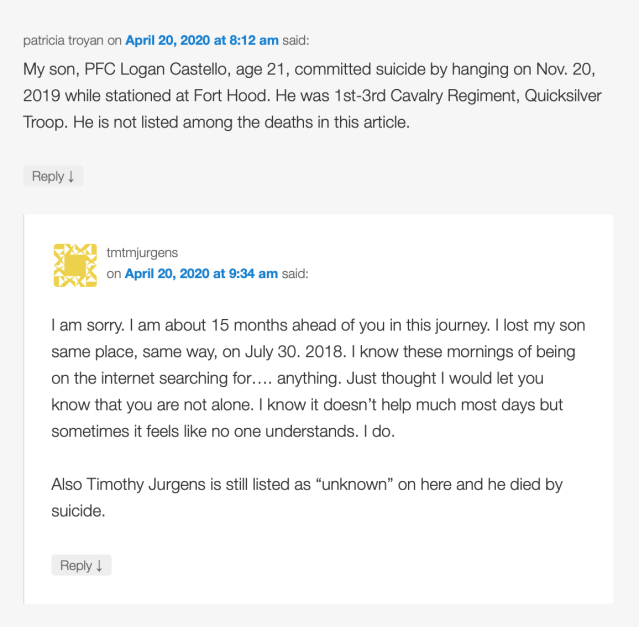
Obituary: “Timothy James “TJ” Jurgens passed away July 30, 2018 in Fort Hood, Texas.TJ was born July 5, 1999 in Effingham, Illinois. He is survived by his parents Thad and Tommi Jurgens of Golconda, IL, his brothers Hunter (Katie) Jurgens of Jasper, Indiana, Lane Jurgens of Litchfield, IL and one sister Josie Jurgens of Golconda, IL. He is also survived by his grandparents Carol and John Sheehan of Teutopolis, IL, Tom and Tammy Logsdon of St. Elmo, IL, Greg and Elaine Lilly of Mode, IL, Paul and Doris McConkey of Brownstown, IL, great-grandparents Marilyn Logsdon of St. Elmo, Lydia Hemrich of Effingham. TJ was preceded in death by his grandfather Harold “Tubby” Jurgens, his uncle Louis Jurgens, great grandfather William “Bill” Logsdon, and great grandparents Arthur and Ruth Forbes. TJ was a 2017 graduate of Pope County High School, and enlisted in the US Army before graduation. He enjoyed music and drama club in high school, as he loved to make people laugh. No one laughed harder than him, he was a joy to all he encountered. TJ loved the Lord. He loved his family and his friends. He loved his church family and kept strong relationships with every church he participated in.”
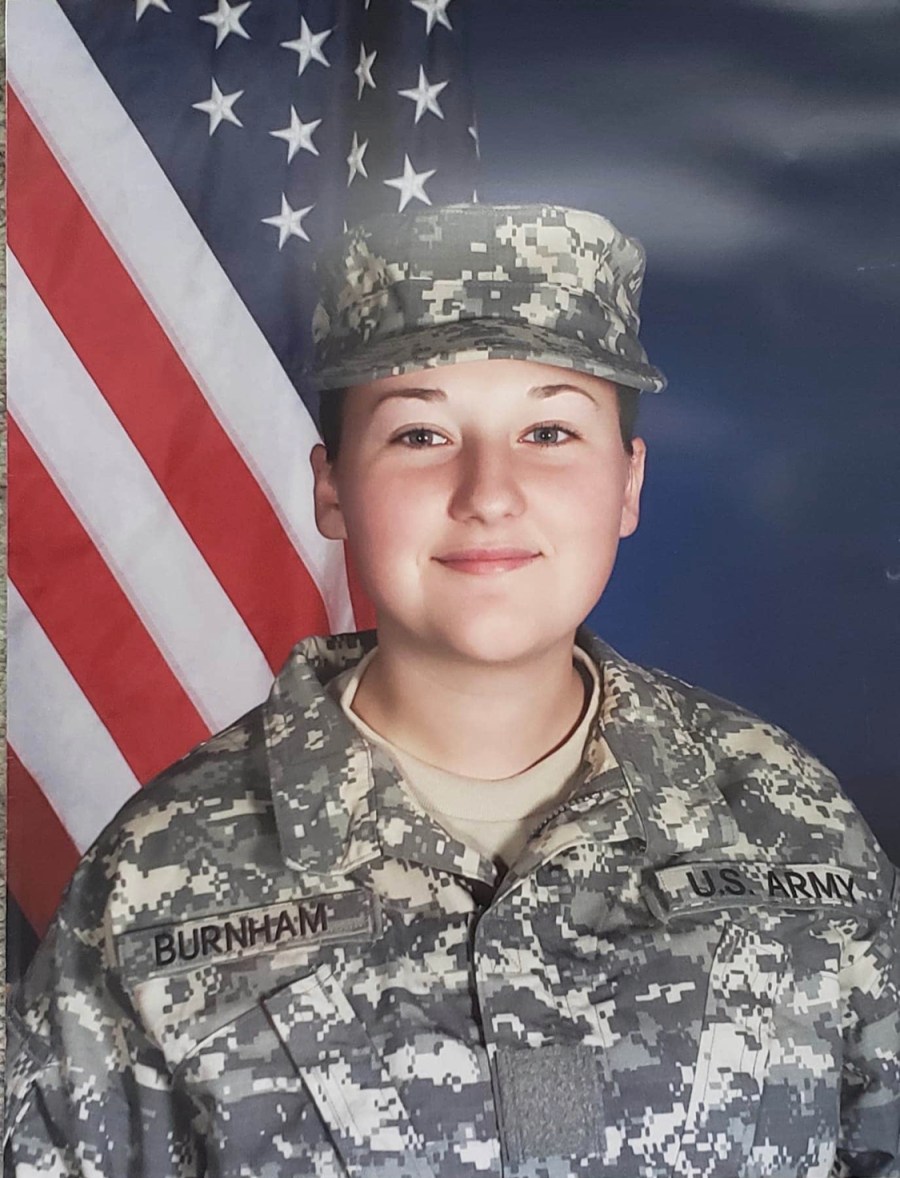
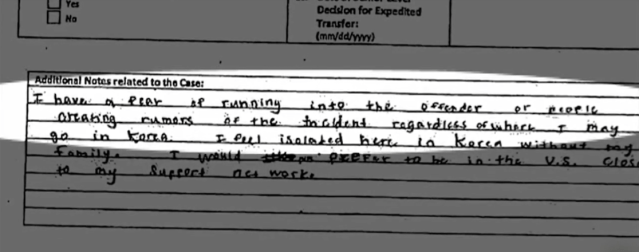
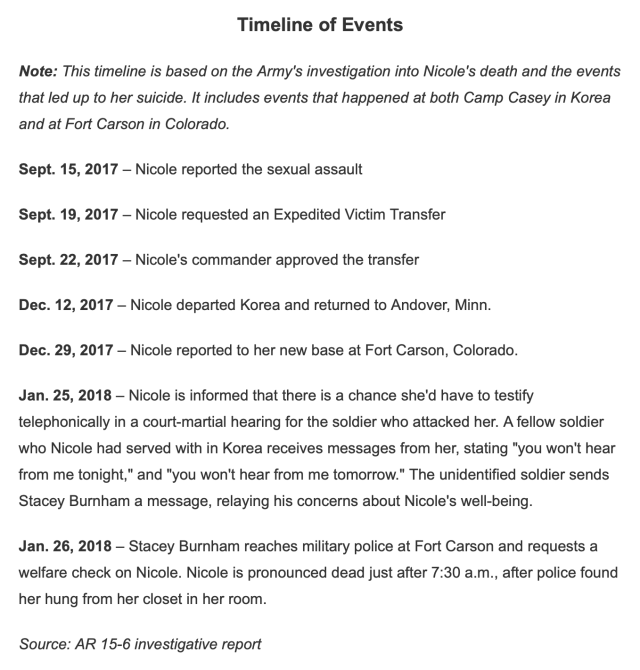
Army Pvt. Nicole Burnham reported a sexual assault at Camp Casey in Korea on September 15, 2017. Four days later, she requested an expedited victim’s transfer (EVT) asking for reassignment back to the United States. Nicole’s Commander approved the request a few days later but it would be 82 days before the transfer occurred. In the meantime, Nicole Burnham shared the same barracks with her attacker. And there was no evidence to suggest the Army even addressed the fact that Nicole shared the same barracks as her attacker until an incident occurred three weeks later when he allegedly jumped out in front of her in an attempt to scare her. It was at this time, the Commander separated the two and put them in different barracks. In the weeks that followed, Nicole suffered verbal harassment and cyberbullying from within the ranks. She received comments from soldiers and their wives over social media calling her a “slut” and “deserving of rape.” Investigators claimed Nicole did not report the harassment to the Chain of Command but in a sworn statement a fellow soldier said most of the leadership was aware of the harassment yet turned a blind eye.
Nicole Burnham Justification for Expedited Transfer (photo: KSTP-TV)
In October 2017, a tearful Nicole told her supervisor she couldn’t “take it” anymore and the supervisor believed she was eluding to suicidal ideation. She was referred to the Officer in Charge (OIC) who then handed her off to the Chaplain for counseling. But according to the A.R. 15-6 investigation, it doesn’t appear leadership in the Chain of Command was aware of what the supervisor believed was suicidal ideation. Nicole reported a sexual assault on September 15, 2017 and experienced three months of retaliation before Army leadership finally transferred her on December 12, 2017. In addition, KSTP reports Army leadership at Camp Casey failed to inform Fort Carson that Nicole was a victim of sexual assault (and harassment, bullying, & cyberbullying). Nicole should have been offered mental health care and compassion. Don Christiansen of Protect Our Defenders said in a statement that the Chain of Command was without a doubt responsible for the failures in Nicole’s case that ultimately lead to her ending her life. Nicole’s death triggered two investigations, one into the allegation of sexual assault that allegedly included Nicole being attacked by multiple men at Camp Casey and the other into the cyberbullying. Of course, the Army declined to comment until the investigation was completed. According to the family, Nicole’s main attacker was courtmartialed and agreed to a plea deal that forced him to leave the Army with a less than honorable discharge. The outcome of the cyberbullying investigation of military personnel and military spouses is unknown.
“It’s inconceivable that they let her languish in Korea. After all these failures, we had this tragic ending to her life.” -Don Christiansen, Protect Our Defenders (January 13, 2020)
Editor’s Note: The military wives who lived on a federal base overseas do not fall under the jurisdiction of the military Chain of Command. Civilians living on base fall under the federal jurisdiction of the FBI who at this point are reluctant to investigate anything but murder. The federal government uses a crisis oriented approach with military personnel and crimes on military bases as opposed to a homicide prevention approach. And in the case of reservations, there has been no justice for missing and murdered Native Americans.
AR 15-6 Timeline of Events for Nicole Burnham (Source: KSTP-TV)
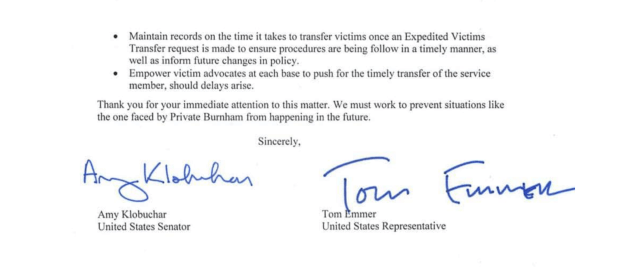
As a result of Nicole’s tragic and untimely death and the KSTP-TV investigation, Senator Amy Klobuchar and Representative Tom Emmer of Minnesota pushed the Army to take action and make changes to the expedited victims transfer policy. The pair asked the Army to track the time it takes to transfer victims of sex assault to another military base, citing the ‘unfortunate delays’ in the transfer of Pvt. Nicole Burnham. In response, the Secretary of the Army directed staff to update policies regarding the treatment of victims of sexual assault who request an off-base transfer. He asked that the Army update policies to mirror the timelines in the Department of Defense (DoD) policy. According to Secretary of Defense Mark Esper, DoD policy states an EVT should occur within 30 days and Esper said the Army’s policies will now reflect that timeline. Nicole’s mother, Stacey Burnham, said 30 days is too long. She also said, “I cannot imagine being a victim, having your EVT approved but knowing you may still be there for another 30 days.” Stacey Burnham has called for more significant changes in the wake of her daughter’s death suggesting the timeline should be condensed even further. She runs a public Facebook page called Pooters Peeps in honor of her daughter.
Letter from Amy Klobuchar & Tom Emmer to the Secretary of the Army (photo: KSTP-TV)
Sources: KSTP-TV, Senator Amy Klobuchar, and Stacey Burnham
In the News:
A 21-year-old Fort Carson soldier who died after being found unresponsive on post last Friday was honored with a dignified transfer. -KOAA 5 (February 2, 2018)
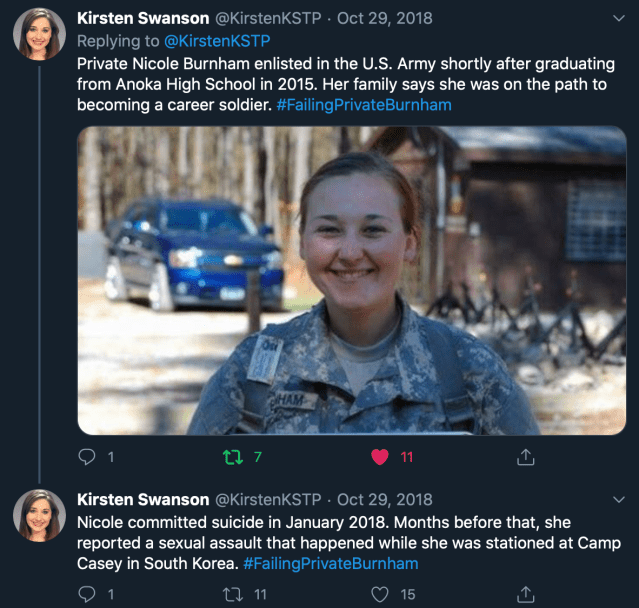
Retweet on Twitter in honor of Pvt. Nicole Burnham.
Photos of Nicole Burnham:
Nicole Burnham (photo: Pooters Peeps)Pvt. Nicole Burnham, U.S. Army (Image: Alex Wentz)
“Death of LaVena Johnson. July 19, 2005. Balad, Iraq. Nineteen years of age and recently deployed to Iraq, LaVena Johnson had everything going for her. A great education, determination, goals, and a great family. In letters and calls to home, she seemed quite candid about conditions there, both the good and the bad, but was also looking forward to being home for Christmas. On July 19th, though, a grim discovery was made. LaVena was found in a contractor’s tent, dead from an apparent gunshot wound to her head. An aerosol can was used to burn printed emails from a recent boyfriend. The Army ruled her death a suicide. Upset over the recent breakup with her boyfriend she must have hit her breaking point. The first autopsy didn’t really find anything to question this as a suicide. The Johnson family had her exhumed and two additional autopsies would make some startling discoveries. LaVena Johnson had suffered a broken nose, loose teeth, a black eye, and chemical burns on her genitals just to name a few. The Johnson family never believed that LaVena would take her own life and despite the questions surrounding her death, no one seems to want to go beyond saying that this case is ‘inconclusive’. Join us for a difficult discussion of losing a loved one under mysterious circumstances, not getting answers from investigators, and the possible reasons for why LaVena Johnson died back in 2005 in Iraq.” –Death of LaVena Johnson, The Generation Why Podcast (November 19, 2017)
(Could not find this Unsolved Mysteries episode anywhere!)
3. Unsolved Mysteries with Robert Stack – Season 7, Episode 19 – Full Episode (Justin Burgwinkel, U.S. Army, California)
4. Unsolved Mysteries with Robert Stack – Season 5, Episode 20 – Full Episode (Chad Langford, U.S. Army, Alabama)
5. Unsolved Mysteries with Robert Stack – Season 3, Episode 13 – Full Episode (Mark Dennis, U.S. Navy, Vietnam)
6. Unsolved Mysteries with Robert Stack – Season 8 Episode 15 – Full Episode (David Cox, U.S. Marine Corps, Massachusetts)
7. Unsolved Mysteries with Robert Stack – Season 8 Episode 1 – Full Episode (Joe O’Brien & Kuwaiti Air Force fighter pilot Mohammed “Sammy” Mubarak, Iraq)
BONUS EPISODE:
8. Unsolved Mysteries with Robert Stack – Season 4, Episode 11 – Full Episode (Jeffrey Digman, U.S. Marine Corps, California)
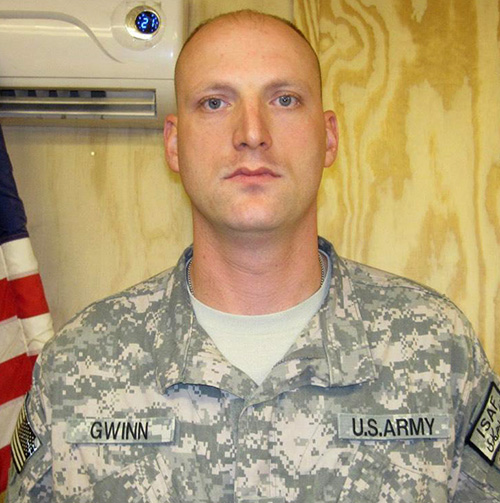
Fort Hood Army Master Sergeant Alva ‘Joe’ Gwinn, 39, died of an apparent self-inflicted gunshot wound on October 12, 2017 near the Williamson-Bell County line in Texas. Although the exact set of circumstances that led to MSG Gwinn taking his own life are unknown, the media reported that MSG Gwinn took his own life during an exchange of gunfire after leading the Killeen Police Department (KPD) on a high speed car chase. Prior to the incident, a concerned family member contacted the Fort Hood chain of command to report that Joe was experiencing a mental health breakdown and may be suicidal. The command contacted the military police who then asked the Killeen Police Department to do a ‘welfare check’ on MSG Gwinn. According to the KPD, MSG Gwinn was located in his car but took off when approached; they said MSG Gwinn then led police on a high speed car chase. According to reports, Alva fled on foot after pulling over, there was an exchange of gunfire with the KPD, and MSG Gwinn ended his life with a self-inflicted gunshot wound to the head. An officer involved shooting investigation was launched because gunfire was exchanged. Joe left behind two sons from a previous marriage and a wife and family who loved him very much. He is missed dearly.
On March 21, 2018, the media reported that a “Bell County Grand Jury reviewed the completed investigation done by the Texas Rangers and decided no indictment should be returned to the deputy in connection with the events leading to the death of a Fort Hood soldier.” MSG Gwinn’s home of record was listed as Richwood, West Virginia. MSG Gwinn served in the Army National Guard from 1996-1999 and then enlisted in the active-duty Army in September 1999 as a combat engineer. At the time of his death, MSG Gwinn was assigned to the 20th Engineer Battalion, 36th Engineer Brigade at Fort Hood since April 2012. MSG Gwinn served in the military for over twenty years and was eligible for retirement. When the media reported on the death of MSG Gwinn, they also mentioned a sexual assault accusation lodged against him in June 2016. They reported MSG Gwinn was scheduled to go to court in November 2017 as if they were implying there was a connection between the suicide and the court date scheduled the following month. One media source reported MSG Gwinn was a highly decorated combat veteran who was known for being a perfectionist and respected by his peers. MSG Gwinn deployed to Iraq and Afghanistan a total of five times while he served with the U.S. Army.
Editor’s Note: The circumstances that led to MSG Gwinn’s suicide inspired us to include him in a Fort Hood status of forces presentation we prepared for congressional representatives in Washington D.C. We believe things could have been handled better and we hope authorities learn from this experience in an effort to prevent it from happening again. We also found it in poor taste that the media mired MSG Gwinn’s reputation at the time of his death with an accusation of which he had not been found guilty of.
Areas of Concern:
On October 12, 2017, family informed the chain of command that MSG Gwinn was experiencing a mental health breakdown & may be suicidal; at the request of the chain of command, the military police asked the Killeen Police Department to do a ‘welfare check’ on MSG Gwinn; according to the KPD, they located MSG Gwinn in his car but he took off when approached and then led them on a high speed car chase that ended with an exchange of gunfire and MSG Gwinn taking his own life
How can we prevent a ‘welfare check’ from turning into an officer involved shooting, suicide by cop or suicide? Why was the high speed car chase necessary?
According to media reports, in June 2016, MSG Gwinn was arrested, indicted and charged by civilian authorities with “aggravated sexual assault” of a 12-year-old girl in 2012; the accusations surfaced in the midst of a child support and child custody case; MSG Gwinn maintained his innocence but a potential trial loomed and his military career and child visitation rights were on hold; Joe loved his family
The accusations negatively impacted MSG Gwinn’s military career and ability to spend time with his two sons; this in turn negatively impacted his mental health; the stress of the child custody case & accusations took their toll; up until this point, MSG Gwinn had a stellar military career and had never been accused of any crimes
According to local media, Alva was facing a trial in November 2017 and they made a loose connection between a pending trial date and MSG Gwinn’s suicide
What prompted the media to mire MSG Gwinn’s memory with an accusation when they reported on his death? Is that fair when the accused can’t defend themselves?
Whether guilty or innocent, this is a tragic end for a man accused of a crime
What does the Army do with the accused who are awaiting criminal trial?
Is Fort Hood responsible for the mental health of those accused of crimes?
What is the military’s policy on child visitation when a military member is accused of a crime against a child other than their own?
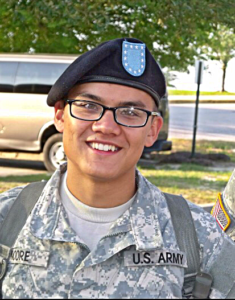
Spc. Zachary Moore, 23, of Virginia Beach, Virginia, was found unresponsive August 1, 2017 in his barracks room at Camp Hovey in South Korea. Spc. Moore was transported to St. Mary’s Hospital and pronounced deceased on August 2, 2017. Spc. Moore entered active-duty military service in March 2014 as a signal support systems specialist. He was assigned to the 9th Cavalry Regiment, 2nd Armored Brigade Combat Team, 1st Cavalry Division at Fort Hood in Texas since July 2016. The circumstances surrounding the incident were investigated by the U.S. Army Criminal Investigation Division (CID) and the cause of death was ruled a suicide.
*****************************************
Was Zachary Moore’s Death Preventable?
In May 2017, Fort Hood announced they were deploying 3,500 troops to South Korea over the summer. Twenty-three (23) year old Zachary Moore was one of the soldiers deployed to South Korea. With full knowledge of Zachary’s recent mental health issues, the Chain of Command gave him a mental health waiver against his will, and most likely against medical advice, so they could deploy him to South Korea.
In October 2016, Zachary had a mental health breakdown and went Absent without Leave (AWOL). After a successful intervention, Zachary was found and returned to the custody of his Chain of Command at Fort Hood. Zachary’s command then sent him to an emergency room where he was hospitalized and prescribed medication. After Zachary was discharged from the hospital, he continued to seek treatment for mental health issues. Six months later, Zachary was given a mental health waiver by his command to deploy to South Korea.
About a month after Zachary arrived at Camp Hovey in South Korea, his depression medication was changed. As a matter of fact, his depression medication was changed the day before he was found unresponsive in his barracks room. Zachary attempted to kill himself on August 1st, less than 24 hours after the medication change. It was Zachary who called his Command for help as there is no 911 on the base in South Korea. He was found unresponsive and finally transported to the hospital about 1 ½ to 2 hours later. He was admitted to the Intensive Care Unit, listed as critical then stable, yet passed away on August 2, 2017.
Why did Zachary Moore go AWOL?
The Chain of Command contacted Jeanette to report Zachary hadn’t been seen since October 18, 2016. They also informed her they were not actively looking for him but would file AWOL status on October 20th. When asked if they filed a missing persons report, Jeanette claims they told her they did but she says she was lead to believe Zachary trashed his room, took his things, and left willingly. She immediately flew to Texas from Florida to find him.
Jeanette contacted the Killeen Police Department as soon as she got to Fort Hood and the local law enforcement found Zachary the same day she arrived. Over the phone, the Command told Jeanette they filed a missing persons report but she learned from the Killeen Police Department that they never did. The Killeen PD noticed recent activity on Facebook so they pinged Zach’s cell phone & found that he was in a remote area of a local state park.
Zachary attempted to flee initially but after negotiations, he surrendered and was returned to the police station where his mom was waiting. Jeanette could tell Zachary was mentally broken and he admitted to her that he wanted to hurt himself. The Killeen PD found Zachary and he had a knife in his possession. Zachary was returned to the custody of his Chain of Command at Fort Hood. Shortly after Zachary informed his mom that his superiors told him to tell her to leave town and stop interfering.
Jeanette reports that Zachary never had any mental health issues prior to this and suspected that Zachary was “singled out by his command and harassed.”
Areas of Concern in Zachary Moore’s Case:
Zachary revealed he was harassed by his Chain of Command. For example, his leave papers to visit family before deploying were denied; he was denied permission to see the Fort Hood Inspector General officer; he was harassed during training exercises; he was given exhausting extra duties; and was accused of taking a radio which was later found on a military officer’s desk. Why was he denied the opportunity to speak to the IG officer?
Zachary was accused of trashing his room and taking his belongings when he went AWOL. Jeanette believes the circumstances surrounding the vandalism of his room and the theft of his property could be evidence of harassment.
During mental health treatment, Zachary was facing the consequences of going AWOL; Zachary was accused of trashing his own room; and Zachary was accused of stealing a secure radio? What are the additional mental health impacts of the way the Chain of Command uses the military justice system?
The circumstances of the mental health waiver and the justifications for sending Zachary to South Korea while he was undergoing treatment for mental health issues and medication management should be investigated.
The effects of the medication change in South Korea should be investigated. Is Command aware that some medications can cause serious negative reactions? (Some depression medication causes suicidal ideation.) Who monitors serious medication changes in deployed locations? Is it safe to deploy soldiers in the early phases of medication management for mental health issues?
Finally, the delay in the Command’s response to Zachary’s call for help in South Korea should be investigated. Why did it take so long to respond to Zachary and why did it take so long to get Zachary to the hospital? Did anyone attempt to administer help while waiting for the ambulance?
If the Command was the cause of the mental health break, where was Zachary supposed to turn? How do we hold the Chain of Command accountable? How do we prevent the Chain of Command from retaliating and using the military justice system or non judicial punishment as a weapon? What was the role of the Commander? What was the role of the Fort Hood Inspector General? How can we prevent a young soldier from feeling like the only way out of their situation is AWOL or suicide? How could we have prevented Zachary’s death?
Soldiers have come forward, given their stories to the family and have offered to testify about what Zachary was put through which may explain why he died. Were these soldiers questioned?













 MILITARY JUSTICE FOR ALL