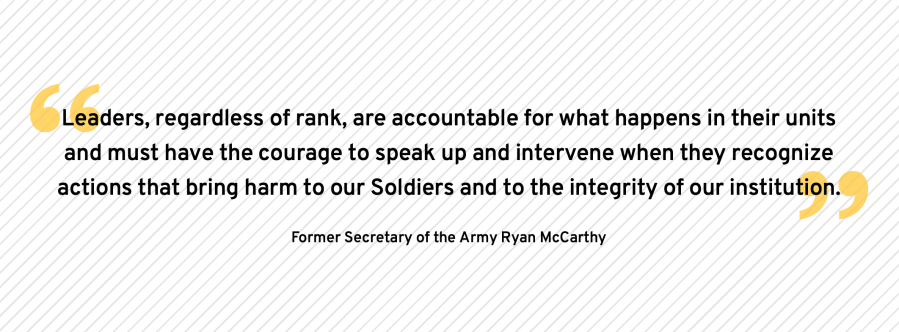
“Former Secretary of the Army Ryan D. McCarthy and the five civilian members of the Fort Hood Independent Review Committee unveiled the results of a three-month examination of the command climate and culture at Fort Hood and the surrounding military community on Dec. 8, 2020.”
“The independent review, which was directed by former Secretary McCarthy, arose from the questions and concerns voiced by family members, Congress, and various Hispanic advocacy groups during the investigation into the disappearance and murder of Spc. Vanessa Guillén.”
“The committee examined the command climate and culture at Fort Hood and the surrounding military community to determine whether they reflect the Army’s commitment to safety, respect, inclusiveness, diversity, and freedom from sexual harassment.”
“Committee members Chris Swecker, Jonathan Harmon, Carrie Ricci, Queta Rodriguez and Jack White conducted a two-week fact-finding mission to the Texas base, meeting with unit leaders, Soldiers, members of the Guillén family, local officials, law enforcement and community groups.”
*Submitted to the House Armed Services Committee on September 11, 2020 and received no response
Dear House Armed Services Committee:
I accidentally stumbled upon Fort Hood while conducting research on the non combat deaths of female service members overseas. Fort Hood, along with a few other big Army bases in the U.S., was the common denominator in non combat death overseas. I also learned there are countless numbers of non combat deaths of male service members as well. They shouldn’t have to face death as a way to escape their situation (whether they are a victim of crime and/or it’s a mental health emergency). This issue in and of itself is its own animal and the reason we need policy enacted immediately to create a “bug out” plan for those in danger (or mental health emergencies) in overseas locations, especially if the chain of command fails them. There is no 911 overseas. Why is it the military is not accountable to the American public with the outcome of the investigations of a U.S. service member’s death? They conveniently get to hide behind the non combat death label and because they don’t disclose why or how the service member died in most cases, we are not able to make informed consent as to whether we want to join an organization that appears to hide their misdeeds in an effort to protect the reputation of the institution. I was inspired to look into the other non combat deaths of women overseas after learning the military labeled the obvious rape and murder of LaVena Johnson as a suicide. My research found this isn’t an anomaly, this is a pattern.
After noticing the pattern of the same bases tied to the non combat deaths overseas, I decided to start researching crime in and around the bases in question. Crime knows no boundaries. I took a look at JBLM, Fort Bragg, Fort Hood, Fort Carson, Fort Campbell, JBER, Fort Wainwright, Camp Pendleton, etc. I not only discovered violent crime in and around the bases but I discovered suicide and homicide in garrison were significant issues as well. In late 2016, I noticed a large cluster of deaths at Fort Hood on the heels of learning about all the other violent crime, non combat death and suicide at Fort Hood since 9/11/2001. I was especially upset with the way Fort Hood handled the missing person case of Dakota Stump and how they treated his family. As a result of me taking an interest in the issues at Fort Hood, families of the fallen started contacting me. What I learned collectively was startling. Please keep in mind, each family didn’t know about my conversations with the other families as all this information is considered confidential unless they want to tell their loved ones story on my website: www.militaryjusticeforall.com
As a result of the intel I was getting from families of the fallen at Fort Hood, I decided I was going to start paying closer attention to what was going on at this base. It was by far the most problematic compared to any other base. But please understand Fort Hood is symbolic of the other bases; they all have these same problems. The Army is by far the worst offender concerning death and violent crime in the military. The patterns that emerged from the Fort Hood families included lack of interest in missing persons cases, mislabeling deaths, shoddy death investigations, reports and information from Army leadership that didn’t add up or make sense, evidence goes missing, computer devices and phones are erased, secretiveness, dismissiveness, misleading, and cover-up. When it comes to an untimely or dubious death, it’s hard to find a family who won’t stop fighting for their loved one until justice is served. No justice, no peace. We currently have a group of families at Fort Hood and elsewhere who want to file a class action lawsuit to get the suspicious deaths of their loved ones reopened so they can be investigated properly by independent investigators. The Army did not investigate each death as a homicide until ruled out, therefore the scene was not preserved for evidence collection; they quickly ruled the death a suicide and moved on. According to Stars and Stripes, in the last five years, we’ve lost 165 soldiers at Fort Hood and 70 of those deaths were deaths ruled suicide. I have not included all cases because a lot of families have not come forward to share their story publicly because they are heartbroken, traumatized, confused, and overwhelmed. This experience leaves the families feeling helpless. Even if the death was in fact a suicide, these families want answers, they want the truth, and they want an avenue to find the truth. I was so concerned with the number of deaths stateside at Fort Hood, I went to Washington D.C. in December 2017 to ask for help and it fell on deaf ears including the office of the chair of the House Armed Services Committee, Mac Thornberry.
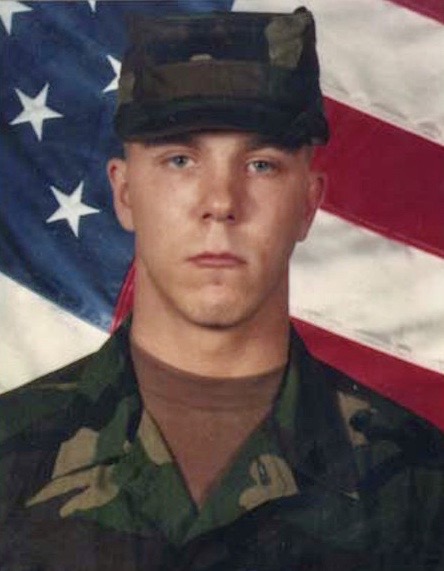
Vanity Fair Confidential featured an episode called Don’t Ask Don’t Kill on Investigation Discovery highlighting the case of Army Pfc. Barry Winchell at Fort Campbell, Kentucky in 1999. Winchell was bludgeoned to death by a fellow soldier while he lay asleep in his cot on July 5 in the barracks. Winchell was described by his friends as someone who would give the shirt off his back for you. He was a model soldier and had dreams of becoming a Warrant Officer. He was a member of the elite Screaming Eagles, 101st Airborne and was considered a perfect fit for the military. He was described by fellow soldiers as a 50 caliber expert.
After Barry Winchell died, the military immediately began downplaying what had occurred on base at Fort Campbell. They initially claimed it was a fight that had gone too far. They told the family that Barry Winchell had been kicked in the head with a boot but his injuries did not match that theory. As a result, the family and media outlets were convinced the military was hiding the real story and believed they were trying to cover up the crime. Why? The military concluded that this was a rare soldier on soldier attack in their barracks but the claim that he was kicked in the head did not match the crime scene either. Although the military was tasked with the investigation of the murder, they declined to speculate on a motive.
The Army was not cooperating with anyone. ~Vanity Fair Confidential
When Barry’s girlfriend Calpernia Addams learned about what happened to Barry, he was on life support and considered brain dead. He died twelve hours after the attack and she didn’t get an opportunity to see him. Calpernia learned that he had been murdered on base and believed that there was more to this story then what the Army was sharing. As a result, she set out to make sure both Barry’s parents and the media knew what she knew and suspected had happened. Calpernia was born a boy. She served in the US Navy as a transsexual and then once she got out of the military, she began her transition from man to woman. When Calpernia and Barry met, they hit it off immediately and started dating. When she met Barry, she was halfway to becoming a woman. She lovingly shared that Barry accepted her for who she was and supported her in her transition from man to woman.
Calpernia strongly believed that people were blurring the lines between whether Barry was gay or straight. She wanted people to know that he was straight and he liked women. Calpernia believed that Barry’s troubles began with an anonymous accusation that Barry was gay. She claimed that a fellow soldier said he saw Barry giving oral sex to a man in a Nashville gay bar. But no one believed it and his military comrades didn’t think he was gay. Calpernia believed that it was Barry’s roommate, Justin Fisher, who started spreading the rumors in an effort to cause harm to Barry. In 1999 the Don’t Ask Don’t Tell policy was in effect and a soldier could in fact lose their career if they were found out. Justin Fisher didn’t have the best reputation. He was described as someone who thought he was a gangster even though he was from Nebraska. And some believed that Justin never should have been allowed to join the military.
According to Calpernia, Justin Fisher and Barry Winchell had a love/hate relationship. Fisher tormented him, joked about his sexuality, about him being a homosexual, and kept calling him a faggot. He told others that he didn’t trust him and eventually openly spread rumors that Barry was gay. Fisher also blackmailed Barry with his alleged homosexuality. He told their Non Commissioned Officers (NCOs) about him being gay knowing that Barry could lose his career under the Don’t Ask Don’t Tell (DADT) policy. Back in those days, once accused of being gay, you were dead in the water in a military setting. Some believe this case reveals that if gone unchecked the military can become an incubator for hate. At the time of DADT, it was virtually impossible to report anti-gay harassment and Barry’s family and friends were not quite sure how he dealt with the regular doses of harassment. As evidenced in this case and many others, he had nowhere to turn without fear of losing his cherished career.
At the time of DADT, it was virtually impossible to report anti-gay harassment without fear of losing your career. ~Vanity Fair Confidential
The military was in charge of the investigation because the crime occurred on a federal base. As with many cases, family, friends, and the media forced the Army to be accountable for what happened on their base on their watch. So as the investigation into Barry’s Winchell’s death continued, we learned what actually happened. Calvin Glover, an eighteen year old new recruit, was ultimately charged with the murder of Barry Winchell. Observers felt that he did it because of a combination of too many men, too much alcohol, and too little to do. The day before the murder, Calvin and Winchell got into a fight. Apparently Winchell dealt him one punch in the face and he went down. Calvin who was highly intoxicated swore he would get him back but Winchell apologized to him the next day and it appeared that everything was fine. Unfortunately, Justin Fisher (Winchell’s roommate) was provoking Calvin all day long asking him if he was going to take Winchell’s abuse.
That same night after Calvin Glover had consumed seventeen beers, he decided he was going to bed. Fisher went to his room and told him that Barry was telling everyone that he beat him up and they were all laughing about it. Fisher handed Calvin a wooden bat, suggested he hit Barry with it, and Calvin said he felt compelled to use it. In a drunken, peer pressured stupor, Calvin hit Barry Winchell multiple times in the head with the wooden bat. Barry Winchell was asleep and couldn’t defend himself. After Calvin was done hitting Barry, Fisher was laughing, jumping up and down, and told Calvin that they would keep it in the family. Then Calvin immediately began to destroy evidence. Fisher acted like he stumbled upon Winchell on the cot and was trying to help him. The soldiers tried calling 911 but they were not able to get through to emergency services on a base phone. Barry was taken to the hospital and twelve hours later, he was dead. Everyone in the barracks was wondering who would come in the barracks and kill them.
The soldiers tried calling 911 but they were not able to get through to emergency services on a base phone. ~Vanity Fair Confidential
In the course of the investigation, Justin Fisher eventually identified Calvin Glover as the culprit. As a result of Calpernia Addams and others that stepped forward, we learned that there was more to the story underneath the surface. We learned that Justin Fisher had a much larger role in the crime then he was willing to admit. Justin Fisher introduced Calpernia Addams to Barry Winchell. Apparently Justin Fisher was interested in Calpernia Addams and after she chose Barry, he asked her if she would hook him up with one of her drag queen friends. Justin ended up hooking up with Kimmie Mayfield, who was a man. Everyone suspected that Justin was interested in guys because of his relationship with Kimmie. They hooked up several times in the course of a few months. We also learned this wasn’t Justin’s first walk on the wild side. He had a history of experimentation. Barry shared with Calpernia that one time he woke up to Justin playing with his feet. Calpernia deduced that Justin may have been jealous of Calpernia being with Barry or vice versa. It was noted that people tend to hate those who remind them of something they don’t want to face.
In the end about 90% of the soldiers who served with Barry Winchell, Calvin Glover, and Justin Fisher didn’t think this was a hate crime but instead a crime of passion. They did not witness any anti-gay rage; but they did witness too much alcohol. One of the soldiers believed that Justin Fisher also hit Barry Winchell with the bat because of the blood spatter evidence left at the crime scene. It matched someone who was left handed and Fisher was left handed. One of the soldiers mentioned this to Fisher and Fisher told him he was in the wrong career and should be a detective instead. The soldiers who served with them believed that Justin Fisher was the murderer and Calvin Glover was the murder weapon. Calvin felt pressured by Justin Fisher to hit Winchell while he was intoxicated. It is suspected that Fisher hit Winchell with the bat as well and may have been the one that dealt the fatal blows. Calvin participated in the Vanity Fair programming by phone from prison and did in fact express remorse for his role in Barry Winchell’s death.
Both Calvin Glover and Justin Fisher were court martialed. In the end, Calvin Glover was convicted of pre-meditated murder and was sentenced to life in prison with an opportunity for parole. Justin Fisher was charged as an accessory and restricted to his barracks while he was going through trial. Observers felt that it was ridiculous that Fisher was restricted to his barracks when in fact he was the mastermind of the murder. He too was convicted and sentenced to twelve and half years but was released early in 2006 after only serving seven years. Observers felt that Justin Fisher’s sentence was a miscarriage of justice considering it never would have happened if it wasn’t for him pushing Calvin Glover to hit Barry Winchell with the baseball bat that night. Justin Fisher now lives in the Mid-West and declined to comment on this Vanity Fair episode. He walks as a free man. In retrospect, Calvin Glover shared that he feels like this was a love triangle gone wrong and he wishes that he could take it all back.
At the end of the programming, Pat and Wally Kutteles (Barry’s parents) shared that they sent their son off to serve in the military, they did not send him off to be beaten to death with a bat while he was sleeping. Dixon Osborn from the Servicemen’s Legal Defense Network (SLDN) believed that the military simply wanted to sweep it under the rug with no connection to the gay reference. The military hoped the general public, the media, and Barry’s parents would just accept that it was a drunken brawl. All those involved felt like the military investigation was a joke. Calpernia Addams, Barry’s parents and friends, and the SLDN wanted to honor Barry’s memory by exposing the truth about Barry’s untimely death. They used Barry Winchell’s case as a catalyst to lift the dangerous Don’t Ask Don’t Tell policy. According to those involved, President Bill Clinton’s DADT policy was the biggest mistake ever for the military because it taught people to lie. At the peak of DADT, there were 3-4 soldiers discharged per day for their sexual orientation. DADT was a failure of the Clinton administration.
All those involved felt like the military investigation was a joke. ~Vanity Fair Confidential
In an interesting twist, the Commander who was in charge at the time of the death of Barry Winchell sparked protest in Washington DC in 2000 when he was reassigned to the Joint Chiefs of Staff at the Pentagon. In response, Eric Shinseki, the Army’s Chief of Staff, stated that General Clark’s command at Fort Campbell had been “distinguished by great competence and compassionate leadership. The Army has placed its trust and confidence in Major General Clark and I am confident he will continue to excel in service to our nation.” The military concluded in a public statement that this was the first gay bashing murder in over ten years and that soldier on soldier violence was rare. In October 1999, President Clinton signed an executive order increasing penalties for hate crimes in the military justice code and allowed a sentencing authority to hear evidence that a violent crime was based on race, color or sexual orientation. However, the order only applied to crimes committed after Nov. 30, 1999.
Barry Winchell’s parents lobbied with the SLDN to help change the DADT policy after losing their son. Even though their son was not gay, he was accused of being gay which eventually led to his death. Roughly ten years later in 2010, President Barack Obama signed a historic bill ending the DADT policy, a policy that compelled gay and lesbian service members to hide their sexual orientation. The ending of the policy made it official for gays and lesbians to serve openly in the Armed Forces. President Obama said he “hopes all those who left the service because of the policy will seek to re-enlist. And he encouraged all gays to consider service.” Although, gays and lesbians were cautioned to keep their identity to themselves until the law was official in 2011. This comes as one of the first major actions by Secretary Defense Leon Panetta, who had been on the job for three weeks. SecDef Panetta also lifted the ban on women in combat in 2013. Our military is now officially equal in all respects.





 MILITARY JUSTICE FOR ALL