Objective: Provide support to families who have lost loved ones to non combat death, homicide, and suicide. Prevent non combat death, homicide and suicide by providing an expedited transfer option to whistleblowers and those who feel like their lives may be in danger.
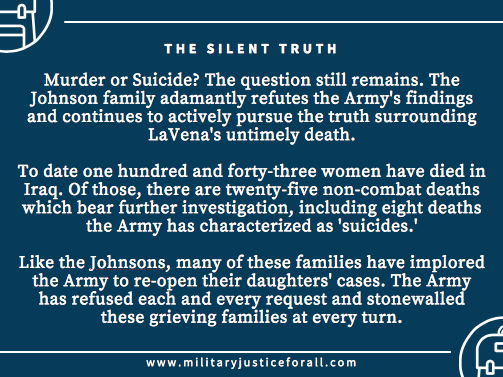
This is a small sample of the many soldiers that have died of non combat deaths, homicide, and suicide. It was hard for me to choose which ones to feature. Given the amount of families who have questioned a ruling of suicide while their loved one was serving in the US military, it’s fair to say that some suicide rulings should have a second look to determine if a homicide was ruled out. It’s important to note that if the cause of death is determined to be suicide, then the military never has to investigate again.
My experiences as a victim of crime in the United States military inspired me to do the work I do today as a military justice policy analyst. Not only did I witness first hand how a predator operates but I witnessed multiple predator types in real time while serving my country. If these people committed these acts of crimes at work in the civilian world, they would have been in jail or I would have been rich after taking my employer to civil court. Well maybe not because the deck is stacked against the accuser but we do in fact have a civilian justice system that allows us to hold others accountable, while it simultaneously protects the due process rights of the accused. This cannot be said of the military justice system. There is no guarantee a military Commander will do anything with a crime report let alone process the felony crime effectively. We do not want a justice system where one man or woman decides whether to do nothing, give a non judicial punishment for a felony crime, or railroad the accused or accuser. We do want a justice system where we can hold our employer accountable without roadblocks from the Pentagon, Congress, and the Feres Doctrine. We cannot effectively tackle the violent crime issue in the military until the victims of crimes, like sexual assault and domestic violence, feel safe enough to report. Crime victims have expressed that they do not want to report crimes to a Commander for fear of retaliation. The Department of Defense admitted that of those of who did report the crime, 62% perceived that they faced retaliation. If service members felt safe enough to report, it could help us prevent homicide, suicide, and non combat death.
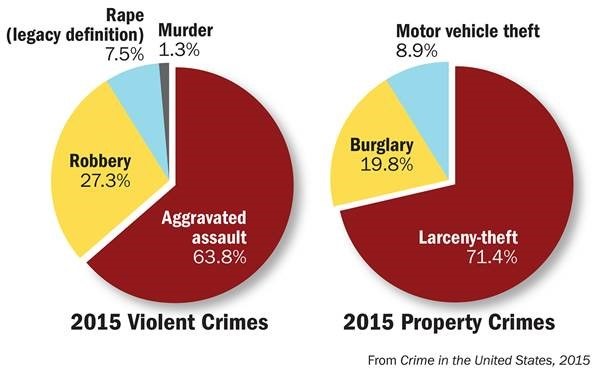
If we think about violent crime committed by military personnel compared to violent crime statistics in the United States (reference above graph), at first glance it appears the military has a homicide ‘issue’ among the ranks. Please see the below links for a sample of crime on some of the U.S. military bases. All military bases worldwide will eventually be included in this research. And the research for sexual assault, rape, domestic violence, and physical assault specifically has not been conducted yet either. Because the research is far from being complete, it is too early to make any assumptions so I will put the data in one place and let you come to your own conclusions. But if military crime mirrors civilian crime statistics, one can deduce that if the military has a lot of homicide, there is even more rape. Currently the number one concern in the military is a Commander’s ability to give a non judicial punishment for a felony crime. A Commander can bypass the courts martial process simply by punishing and/or discharging the accused with a preponderance of the evidence. This does nothing to protect our military personnel and the civilians who live near our bases in America and worldwide. Predators do not discriminate. They are just as likely to harm civilians as they are military personnel. They know their rights and they know that jurisdiction issues and lack of communication among law enforcement agencies will help prolong getting caught. We need to be one step ahead.
We can’t get real violent crime numbers for the military bases unless we include those who died of non combat deaths while they were deployed. Veterans Noonie Fortin and Ann Wright inspired me to initially look into the non combat deaths of female soldiers overseas because they observed the unusually high number of female soldiers who died of non combat deaths during the wars in Iraq and Afghanistan. Their chief concern was that although the military labels a non combat death as a suicide, there are suspicions that some female soldiers were murdered, like LaVena Johnson, Amy Tirador, and Ciara Durkin. I did the research on every single female soldier who died from non combat deaths overseas and their concerns are valid. My research on non combat deaths in Iraq alone revealed that roughly 30% of female soldiers died as a result of homicide, suicide, and other unknown causes. I am working on collecting the data for male soldiers who died from non combat related injuries in Iraq, Afghanistan, and other areas. I started with 2010 so we can get the most recent cases but I will go back to September 11, 2001 in the next phase of data collection. The first male soldier non combat death case I found in 2010 was an unsolved homicide. His name was SSG Anton Phillips and he was stabbed to death in Afghanistan. Further research in this area has uncovered that non combat deaths of male soldiers are just as prevalent.
About the Film: When feminist filmmaker Cassie Jaye sets out to document the mysterious and polarizing world of the Men’s Rights Movement, she begins to question her own beliefs. Jaye had only heard about the Men’s Rights Movement as being a misogynist hate-group aiming to turn back the clock on women’s rights, but when she spends a year filming the leaders and followers within the movement, she learns the various ways men are disadvantaged and discriminated against. The Red Pill challenges the audience to pull back the veil, question societal norms, and expose themselves to an alternate perspective on gender equality, power and privilege.
Learn more about Cassie Jaye & The Red Pill Moviehere.
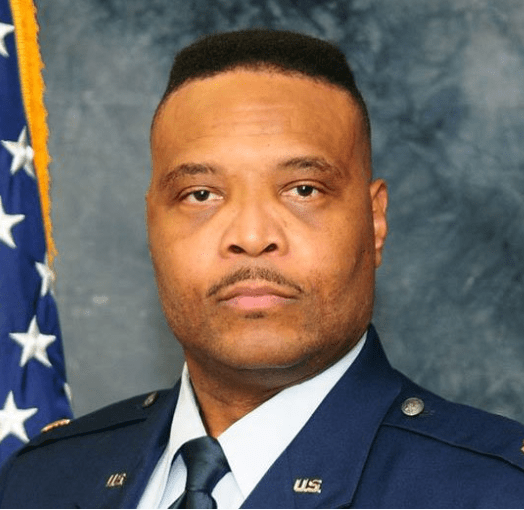
Lt. Col. Flando Jackson, Washington Air National Guard
Air National Guardsman Lt. Col. Flando Jackson died of a non combat related injury at Al Udeid Air Base in Qatar on August 4, 2016. Lt. Col. Jackson was supporting Operation Inherent Resolve on behalf of the 194th Wing, Camp Murray, Washington National Guard. At the time of the press release, the Department of Defense announced the incident was under investigation. The official cause of death is unknown.
The Department of Defense Inspector General’s office held a Worldwide Hotline Outreach Conference today July 28, 2016. One of their keynote speakers was Lt Col Teresa James, US Army, Retired, highlighted before on this site. The DoD IG twitter feed shared excerpts from her presentation summarized below. As she spoke, I tweeted with them to bring awareness to the specifics that Lt Col James noted and why they are so important. For a complete listing of the tweets by the DoD IG, please visit their Twitter feed here.
“We are looking at spending over $600,000 of tax payer dollars for $2,000 that was allegedly stolen, most likely over 3-6 years ago, under a program that was deemed to be flawed, mismanaged and inherently opaque by the US Army’s own leadership.”
It is true, that our forefathers set out to create a judicial system that blindly judged the accused in a manner that afforded them the opportunity to receive a fair trial, regardless of race, sex, beliefs, political stature or societal standings. However, as shown in the Guard Recruiting Assistance Program (G-RAP) scandal, it appears today’s judicial system is more about your ability to secure good lawyers and your civil status than it is about determining guilt versus innocence.
Most soldiers charged for their participation in G-RAP cannot afford an attorney. They are bullied by Army Criminal Investigative Command (CID) Agents to take polygraphs, provide incomplete statements (which are then used as evidence against them) and to accept a plea for criminal acts they did not commit. Without adequate counsel these service members are given ultimatums or forced to accept deals that leave them powerless. At best they are issued overworked public defenders who place them in a pool of other criminals including rapist, murderers and thieves. Soldiers are pushed to take plea bargains by the prosecution in an effort to give CID a quick victory and take the case off the public defender’s plate. However, this system puts a hefty burden on the soldier regardless of what road they take.
“Sexual assault is a huge problem in the US military. And for many victims, the process of reporting their crime and seeking justice can be as traumatic as their assault.
Most members of Congress and military officials agree that these basic facts are true, and that more reforms to the military justice system could help. But there’s a profound disagreement on how, and how much, the system needs to change.
The US Senate is expected to vote this week on the Military Justice Improvement Act (MJIA). Advocates, who have been pushing for the MJIA since 2013, say the reform would make the process of prosecuting sex crimes a lot easier and smoother for victims and help victims feel more empowered to come forward and report the crimes against them.
An unusual bipartisan cadre of senators support the MJIA, from Elizabeth Warren to Ted Cruz. But the Pentagon adamantly opposes it, and many senators listen to the Pentagon when it says the MJIA would undermine “good order and discipline.” So there’s still no filibuster-proof, 60-vote majority for the measure, and it’s been defeated every year it’s come up.”
1st Lt. David Bauders, Washington Army National Guard
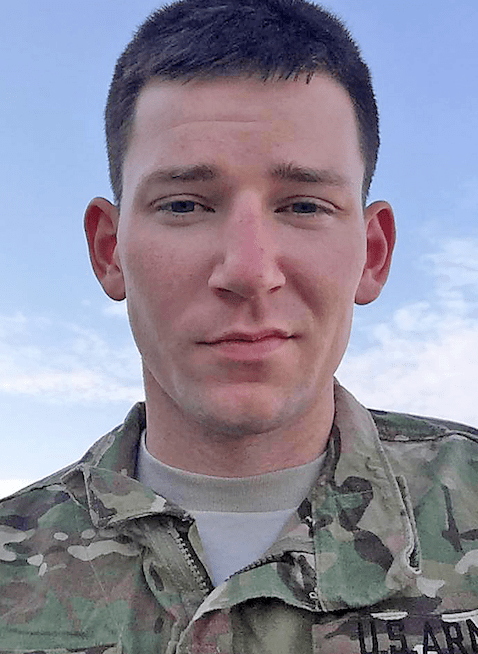
Army National Guardsman 1st Lt. David Bauders, of Seattle, Washington died in a non-combat related incident on May 6, 2016 at Al Asad Air Base in Iraq. 1st Lt. Bauders was supporting Operation Inherent Resolve on behalf of the 176th Engineer Company, Washington Army National Guard in Snohomish, Washington. Bauders was a Washington State Patrol trooper and he deployed with the Army National Guard for a one year deployment beginning in February 2016. At the time of the DoD press release, the incident was under investigation. The official cause of death is unknown.
1st Lt. David A. Bauders, Washington Army National Guard
In a complicated, twisted tale of alleged corruption and betrayal over budgetary wars, a presumed cover-up simmers at a colossal scale between the Army and the National Guard. Soldiers are the exploited pawns in the largest politically motivated fraud investigation ever conducted by a military component against its own forces. This may sound like suspenseful fiction, but as many National Guardsmen and women can attest, this is all too real. An estimated 24,000 National Guard soldiers have been caught in the dragnet, which all stems from a successful military-enlistment recruiting program that financially compensated citizen-soldiers who aided in efforts to boost military strength. Documents and public records obtained through the Freedom of Information Act along with credible sources points to a disturbing persecution of soldiers and veterans as well as the batch processing of mass indictments.
At a time when US forces were scattered among Iraq, Kuwait and Afghanistan, the overall end strength numbers were low. Army National Guard Director, Lt. General Clyde A. Vaughn (ret), and his staff had an idea to resupply the branches with fresh bodies—make anyone a potential recruiter by offering a financial incentive of $2,000.00 for each successful enlistment. Vaughn deeply felt that a peer-enlistment program might ease the hemorrhaging of a nationwide manpower shortage. And he was correct. The program, dubbed G-RAP (Guard Recruiting Assistance Program), ran from 2005-2012 and was an enormous success, as it replenished the ranks. Other branches of the military ultimately mirrored that recruiting program, but none to the magnitude of the NGB (National Guard Bureau). And none of them received the amount of government money that the Guard received to achieve this success.
Though G-RAP stood as a great achievement in strengthening the reserve forces, by 2012, all RAPs (Recruiting Assistance Programs) were suspended indefinitely, primarily due to media publicity of widespread fraud. NGB took the most heat, consistently projected as having lost upwards of $100 million. The truth, however, has been largely obscured. After four years of costly investigations, only $2 to 3 million “has been successfully prosecuted in civil courts.” But what is more disconcerting is that NGB, routinely criticized for its lack of oversight, no longer had the supervision in their control. Based on a previously unpublished Army Inspector General Report, a closed door meeting took place in May 2007 where it was decided by an ad hoc committee comprised of representatives from Army Criminal Investigation Division (CID), Defense Criminal Investigation Service (DCIS) and the Air Force Office of Special Bureau (AFSOI) “that Docupak would turn over any suspected occurrences of fraud directly to CID,” and that NGB, specifically the State Adjutants General (TAG), would be deliberately left out of the information loop. The rationale given at the time was that the DCIS did not want interference from high-ranking Guard officials.
There is evidence, however, that some TAGs were successfully handling all reported incidents of fraud internally in their own states up until that point with detection and prevention controls. It was not until these controls were halted in the May 2007 meeting that the Guard lost the ability to monitor, discipline and correct such incidents of fraud. Perplexingly, all of this was done without the Guard’s knowledge. In a recent interview in the Washington Times, General Vaughn reported that “he was kept in the dark” about the occurrence of fraud in the field and that CID purposely did not inform him about fraud cases. “No one can correct a problem if you do not know it exists,” stated Vaughn.
The CID did not have any prerogative to make such changes to regulation, as it would require a Congressional act; yet, in 2009 (and again in 2014), changes were made to the CID Manual that removed the language to report crimes through the TAG. But simply changing the manual did not mean it was constitutional to do so under the sovereign rights of each state and US territories. What’s more, there has been discussion in legal circles as to whether or not CID is operating outside its jurisdiction in the investigation of National Guard members. According to the Constitution as well as Department of Defense Directives (DoDD) 5105.77, the NGB is under the direct command of the state TAG and ultimately the governor unless a battalion has been mobilized for federal duty, at which point they then fall under Title 10 (active duty status) and the command of the President. The majority of those indicted are known as “M-day soldiers.” In other words, they are “weekend warriors” working for the Guard once a month and two weeks a year in official drill status (aka, Title 32). If an individual under Title 32 were to come under some criminal deed, it is the role of the TAG to take action. In fact, the TAGs have guidance on enforcing discipline and protecting soldier’s rights as it is articulated in the 2015 Commander’s Legal Handbook. The CID, as a faction of the big Army, only has command over Title 10 soldiers; it does not, to this day, have any authority over most members of the National Guard in these investigations, save a select few individuals who were deployed on active duty while participating in G-RAP.
This then raises the question, why is the regular Army harassing National Guard soldiers and violating their constitutional rights in the first place? Most of the soldiers under suspicion for theft of government property are not subject to regular Army discipline. Before that question can be answered, there is another piece of the puzzle to be scrutinized—the alarming results of CID’s investigations.
The U.S. Army Audit Agency had concern regarding the potential of individual fraud within RAPs. After reviewing over 150,000 enlistments ($339 million in payments), the June 2012 Audit identified 3,200 soldiers in the fraud-risk assessment. They found 1,256 recruiters suspicious of medium to high risk for fraud. Additionally, there were 2,022 RAs that “potentially violated program rules.” Of those RAs, only a quarter of them were found to be intentional acts. The remaining 1,400 recruiting assistants appeared to have unknowingly and unintentionally violated the rules of G-RAP, which is entirely plausible considering there were 60 changes to G-RAP rules during its seven years in existence .
This report fueled an investigation of another style from the Senate Subcommittee on Financial and Contracting Oversight. Despite the Audit’s fraud findings, the Army CID quickly dispatched approximately 200 field investigators under “Task Force Raptor” to scrutinize all 106,364 individuals who participated in G-RAP for any possibility of fraud. Senator Claire M. McCaskill (D, MO) set a directive that CID should flood the nation’s landscape and courageously return ill-gotten dollars to the American taxpayers. CID agents were encouraged to flash badges, obtain DNA swabs, issue polygraph tests and secure fingerprints in an effort to scare soldiers into revealing any useful material that could be later used against them. One former CID agent admitted that they were urged to lie to potential witnesses and persons-of-interest if usable information could be extracted. They were then instructed to report the numbers of potential indictments back to Senator McCaskill’s office on a quarterly basis, ostensibly to ensure they were meeting her demands of accountability. But a federal indictment of fraud is a crime requiring specific intent. In other words, conviction relies on the government’s ability prove the individual knew of the specific rules and guidelines and intentionally broke them for monetary enrichment.
Nevertheless, CID’s report prepared for the February 2014 Senate Subcommittee hearing led by Senator McCaskill found over 22,000 soldiers associated with payments that were at risk for fraud. This number is over seven times greater than the original Army Audit estimation at a rate of 1.7-3%. The FBI estimates that insurance fraud—one of the highest areas of civilian fraud—is at a rate of 3-10% of all insurance cases. Conversely, CID is now suggesting that those who proudly wear the uniform are felons at a rate of over 20%. Put differently, 1 in 5 soldiers are alleged criminals, 2 to 7 times more likely to commit fraud than the civilian population. This is clear evidence that these claims are audacious.
How is it possible that so many service members are accused of fraud? How is it that the CID investigations found an additional 18,000-20,000 offenders from the Audit’s estimation? Is it possible that this is a witch-hunt? This fishing expedition turned into a conspiracy theory as Sen. McCaskill stated, “I mean, it is almost like word got out and nobody was paying attention, and all of a sudden everybody was, okay, the bank is open. Let us go for it.” The moderate democrat further opined, “I mean there is no way that there was not a culture of people saying, hey, here is the deal. There is a bounty and we know these people are signing up.” But rather than a vast number of soldiers intentionally scamming the government they swore to protect, a much more plausible answer would be that most all were following a set of murky rules as they understood them.
Senator McCaskill’s supposed effort directed to bring about justice for the American people instead turned into a catastrophe where the wrath eventually rolled downhill to the most vulnerable of peoples, our service members. Let off the hook were Docupak and military Brass who were responsible for the proper administration and oversight of G-RAP. One possible explanation for the morass is a skirmish over federal defense dollars when the Guard received the lion share of contract monies to operate G-RAP. Or perhaps it is something as simple as an attempt to justify the military drawdown of troops currently underway. This time, the scapegoat would be the American soldier, more specifically National Guardsman, as McCaskill’s goons sought to manufacture felons. Unfortunately, those are the casualties of politics, but these service members deserve more. They deserve answers and accountability from our leaders.
[1] Unpublished U.S. Army Inspector General Agency Report of Investigation (ROI) (Recruiting Assistance Program) 2014. [2] Memorandum from U.S. Army Audit Agency to Recruiting Assistance Program Task Force Regarding Audit of Recruiting Assistance Programs – Reserve Components (June 4, 2012) (Report A 2012 0115 IEF), Enclosure 1. [3] CID Investigators report (G-RAP Training) Nov, 2013.







 It is true, that our forefathers set out to create a judicial system that blindly judged the accused in a manner that afforded them the opportunity to receive a fair trial, regardless of race, sex, beliefs, political stature or societal standings. However, as shown in the Guard Recruiting Assistance Program (G-RAP) scandal, it appears today’s judicial system is more about your ability to secure good lawyers and your civil status than it is about determining guilt versus innocence.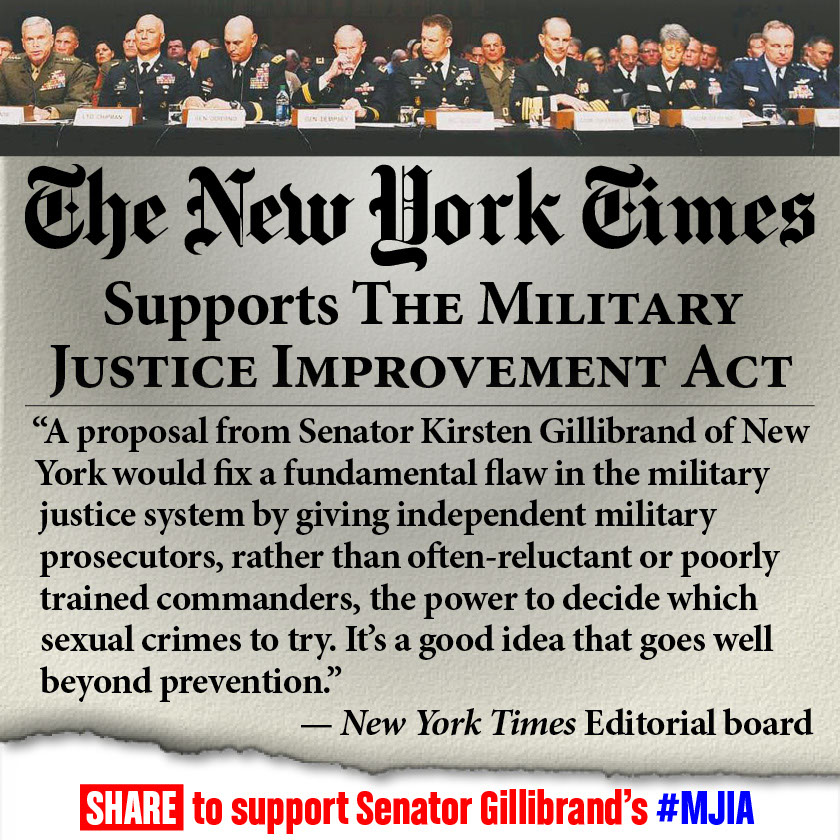

 MILITARY JUSTICE FOR ALL