
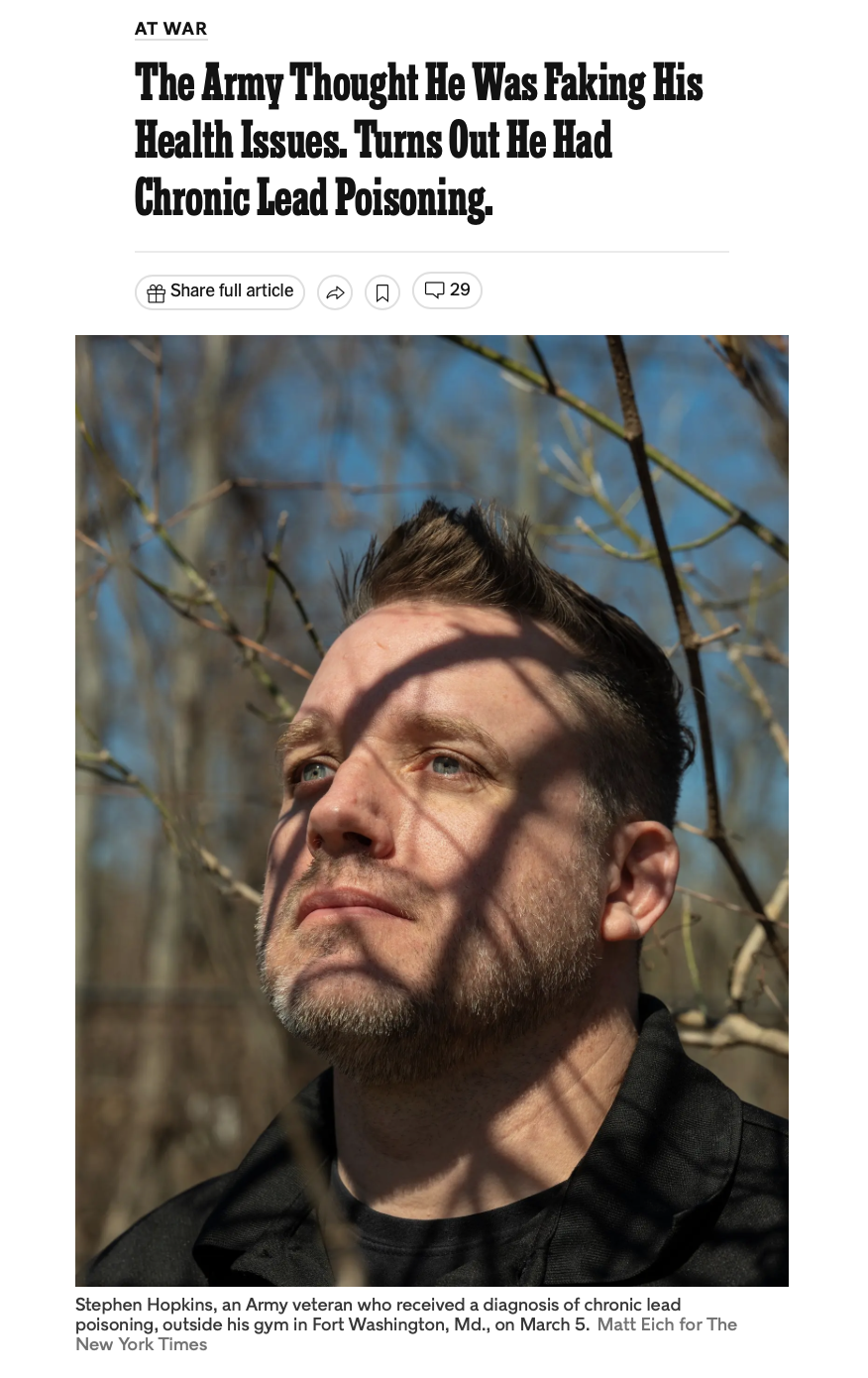
New York Times: The Army Thought He Was Faking His Health Issues. Turns Out He Had Chronic Lead Poisoning. (April 3, 2019)

By Patricia Kime (April 3, 2019)

“…In 2005, Hopkins began experiencing wild swings in blood pressure. And he had other symptoms: crippling nausea, constant dizziness, a skyrocketing heart rate. He was given a diagnosis of common high blood pressure, and for a while he felt better by keeping himself on a high dose of a medication for that condition. He was on deployment in Afghanistan when the nausea returned, with migraine symptoms, abnormal thirst and muddled thinking. Medical tests were inconclusive, leading military doctors and commanders to suspect depression, post-traumatic stress disorder or, worse, “malingering” — the medical term for soldiers who feign sickness to shirk duty.”

“While the number of affected soldiers is small, the diagnosis can be life-changing to these troops, who for years have wrestled with unexplained symptoms that mimic traumatic brain injury or PTSD, including impaired concentration, anger, anxiety and impulsivity, as well as physical manifestations like tremors, high blood pressure, low sperm count and peripheral neuropathy.”

“Lead exposure is a known hazard of military service: The United States armed forces have fired billions of rounds of ammunition containing the toxic material since entering Afghanistan in October 2001. Troops are exposed to the metal while shooting indoors and outside; gathering shell casings; smoking, chewing tobacco or eating on ranges; cleaning their weapons; and living and fighting in polluted environments. But lead monitoring and testing programs at the Defense Department have focused primarily on service members who work on firing ranges and on the civilian staff at ranges, who are regulated by Occupational Safety and Health Administration guidelines. Defense Department policy requires service members who may be exposed to high levels of airborne lead for 30 or more days a year to get a blood test for lead, with follow-up tests at least annually.”

“After he diagnosed Hopkins and another service member with chronic lead poisoning, Dorrance contacted the office of the surgeon at Special Operations Command, the Environmental Health unit at Fort Bragg and officials at Navy and Marine Corps Public Health Command to request that more troops be tested and the problem be researched. But six years after the issue was first raised, little progress has been made. The Department of Defense, which until last year annually tested blood lead levels in just 1,200 out of almost three million troops and civilian employees, has found very few cases of lead poisoning, leading Army officials to believe that there isn’t a widespread problem.”

“Dorrance and Dr. Mark Hyman, director of the Center for Functional Medicine at the Cleveland Clinic, argue that this theory is wrong — and that they have the patients to prove it. Pointing to a growing body of research that suggests that lead in the bones may be more toxic than once thought, they say physicians should be considering lead poisoning as a possible cause for many unexplained symptoms in service members, especially uncontrolled hypertension, fatigue and brain fog. ‘These soldiers are breaking down, and they go to doctor after doctor after doctor, and every single one of them misses what is going on,’ Hyman said. ‘These soldiers aren’t getting the proper care. It’s a huge blind spot.'”

Read more from the NY Times here: The Army Thought He Was Faking His Health Issues. Turns Out He Had Chronic Lead Poisoning.

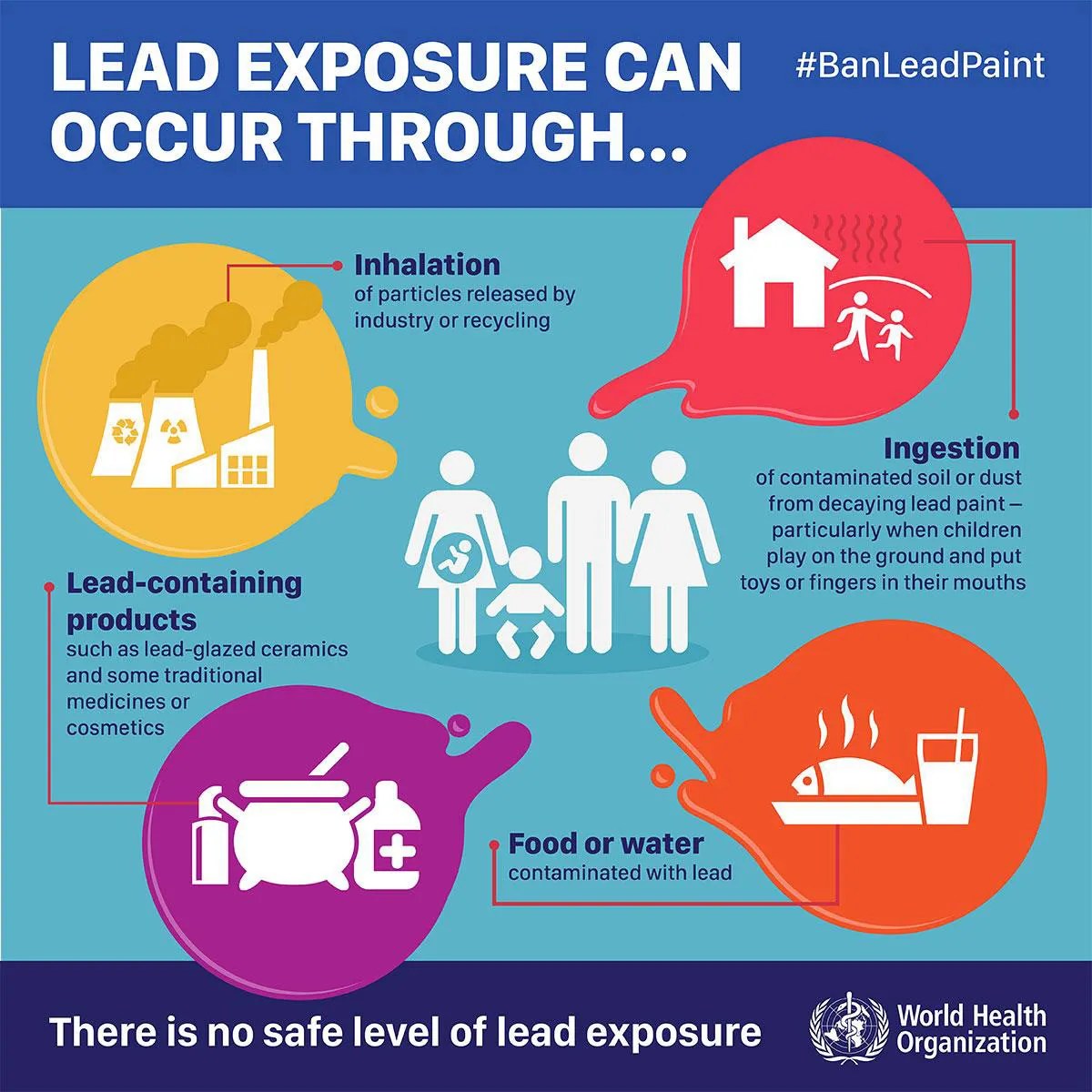
Lead Poisoning Symptoms:

1. Decreased cognitive abilities, especially reduced ability to focus on, learn, and remember new things
2. Fatigue
3. Irritability
4. Abdominal pain or “stomach aches” 
5. Headache
6. Constipation 
7. Loss of appetite
8. Tingling in the hands or feet

Learn more here: Symptoms of Lead Poisoning
Related Stories:
After Lead Poisoning Symptoms Dismissed by PTSD Diagnosis, It Results in Brain Inflammation, Fatigue, Muscle Weakness, Digestion Issues & Chronic Pain
I Watched My Father Die From a Brutal & Painful Battle with Terminal Bone Cancer… And My Toxic Military Leadership Kicked Me While I Was Down
NBC News: Veterans Wait 30 Years on Average for the U.S. to Acknowledge Toxic Exposures (September 18, 2024)
How Lead Poisoning Is Treated And How to Reduce Your Risk

Air Force A1C Kelsey Anderson Found Dead of Apparent Self-Inflicted Gunshot Wound in Hangar at Andersen Air Force Base, Guam (June 9, 2011)

Kelsey Anderson
A1C Kelsey Anderson, US Air Force

Airman First Class Kelsey Anderson was found dead of an apparent self-inflicted gunshot wound at Andersen Air Force Base in Guam on June 9, 2011. According to media reports, she was found in a locked stall in a second-floor women’s bathroom inside an aircraft maintenance hangar at the base. The military investigation indicated that a few months after Kelsey arrived at Guam, she was stripped of her service revolver over mental health concerns. Although Kelsey’s weapons privileges had been restored about a month prior to her death. The reports stated that Kelsey may have been unhappy after trying and failing to be transferred from Guam or released from military service. Kelsey’s parents had to file a lawsuit in U.S. District Court to get the Air Force to turn over its investigation records. They simply wanted answers for their daughter’s tragic and unexpected, untimely death yet the Air Force concealed the details. Chris and Adelia Sue Anderson received the mostly redacted investigation reports almost two years after their daughter’s death. The final court settlement with the Air Force in September 2013 was for the cost of the attorney they had to hire in their quest to get the information they were entitled to have. It’s unfortunate that this family had to wait two years for answers and even more unfortunate that they were forced to go to court during one of the most difficult times of their life.

What could have been done to prevent this? What kind of mental health services were offered to Kelsey? Why did Kelsey want to leave Guam and/or get out of the military? Why was she upset after finding out that she was not able to transfer or get out of the military? What were the extenuating circumstances that made Kelsey feel like she had no options other then suicide? Is this a suicide? After so many families have come forward with concerns that their loved one was murdered despite a ruling of suicide, do we know for sure that this was a suicide? It happened in Guam. There is absolutely no one to hold the Air Force accountable in that setting. There is no way to ensure that the Air Force investigated the scene as both a potential homicide or suicide. It’s as simple as what the Air Force says happens is what happened. Every government entity should have a mechanism by which they are held accountable. Where does a grieving parent turn to when they do not agree with the military investigator’s or medical examiner’s findings? Who holds the individual branches or Department of Defense accountable? The only body of people that can hold the military industrial complex accountable is the US Congress and even they struggle. Time and time again we hear accounts from service members and families that contacting their congressional Representative or Senator did not help. Some help, some don’t, and some never call you back. Every level of government should have accountability of some kind because this country was founded on the principles of checks and balances in our system.

“Enlisting U.S. Sen. Jim Risch‘s office for help still didn’t yield results.” -Chris & Adelia Sue Anderson

In an interview the Andersons’ lawyer emphasized that the prolonged wait and anxiety of suing the federal government in a last-ditch effort for information intensified the couple’s pain after the loss of their daughter. He empathized as a father of three and shared that he could not imagine losing a child thousands of miles away and not knowing what happened to her. No parent should have to wait nearly two years before the government decides to produce the information they deserve to have.

The grieving parents of a 19-year-old Idaho woman who died serving her country thousands of miles from home say the U.S. Air Force won’t give them information about the circumstances of her death. -NewsMedia24

Related Links:
AAFB Mourns Loss of Airman 1st Class Kelsey Anderson
AAFB airman’s death ruled suicide
Grieving parents sue Air Force for answers in daughter’s death
Adelia Sue Anderson Parents Sues Air Force Over Death Daughter
The Long Goodbye: What happened to Kelsey Anderson?
The Long Goodbye: An Idaho Family Fights to Learn the Truth About Their Daughter’s Death
Was it murder? Mystery as Air Force claims 19 year old airwoman committed suicide in Guam base but family deny she was depressed and say they’ve been blocked from getting answers
Family finally getting answers on daughters death
AP: Documents Shed New Light on Suicide of Idaho Airman
Documents reveal mental health struggles of Airman Kelsey Anderson
Idaho airman under mental scrutiny before death
AP: Parents of Kelsey Anderson, Idaho Airman Who Died of Apparent Self-Inflicted Gunshot Wound on Guam Air Base, Settle Lawsuit with Air Force
Idaho airman’s family settles with Air Force
Air Force will Pay Idaho Parent’s Legal Fees in Suicide Case of Daughter
Adelia Sue Anderson Parents Sues Air Force Over Death Daughter