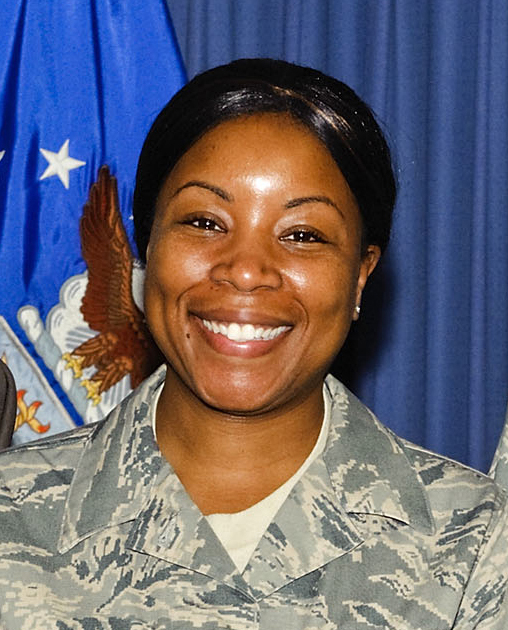
Myah Bilton-Smith is a USAF veteran who was sexually assaulted twice in 2012 at Goodfellow Air Force Base in Texas. She reported the attacks to her Command but according to reports the case is still under investigation by the Air Force Office of Special Investigations (AFOSI) and no meaningful legal action has been taken as of yet. After the second attack, she requested an expedited transfer (a military sexual assault policy passed in December 2011) but it was denied. Instead she was forced to work alongside her attackers in a training environment where you do not have freedom of movement. She experienced retaliation from her peers and leaders, punishment for minor infractions, and was eventually forced out of the military. She was finally granted an expedited transfer to Joint Base Lewis McChord, one of the most problematic bases in the country.
Air Force MSgt Tara Brown died April 27, 2011 in a hail of gunfire near the Kabul Airport in Afghanistan. She was among nine Americans killed when a veteran Afghani pilot opened fire in a training room after an argument with a foreign colleague. The incident is being investigated by the U.S. Department of Defense.
On March 7, 2008, SrA Blanca A. Luna, 27, US Air Force Reserve, was found unresponsive and with injuries consistent with a stab wound in her billeting room at Sheppard Air Force Base in Texas three days prior to graduating and heading back home. She was discovered with a knife in the back of her neck according to the death certificate and no pants or underwear and dried fluid near her groin according to the autopsy. She was taken to a local hospital in Wichita Falls where she died shortly thereafter. She was an Air Force Reservist on temporary duty at Sheppard AFB attending a technical training course for Heating, Ventilation, and Air Conditioning (HVAC). She was a Marine from 1997 to 2002 and then became a Reservist in 2007 at the 434rd Civil Engineer Squadron, Grissom Air Reserve Base in Indiana. She loved the military. She was living in the Chicago, Illinois area and studying Graphic Design.
Because this death occurred on a federal installation, the Air Force Office of Special Investigations (AFOSI) was the lead on the investigation. They initially labeled the death a “suspicious incident”. According to AFOSI, the FBI assisted with the investigation. The FBI processed the crime scene and collaborated with the ensuing Air Force investigation. The AFOSI referred to the death as a homicide in the media in the early stages of the investigation. Six months later they would be accused of leading the family to believe it was a suicide despite evidence suggesting otherwise. Six months after her death, no official determination was made as to the manner of death: homicide, suicide, or accident. Eventually, the family learned from the autopsy report that the official manner of death was considered “undetermined”. No suspects were ever identified.
“AFOSI has been the lead investigative agency since Airman Luna’s death. At AFOSI’s request, the FBI sent an evidence response team to process the scene immediately after Airman Luna was found, and the two agencies have continued to cooperate in the investigation. Agents have been assigned to the case on a full-time basis, and more than 350 interviews have been conducted at locations across the country. Findings have been reviewed by a diverse team of experts, including specialists in forensics, polygraph, computer investigation, behavioral psychology and forensic pathology…More than 200 DNA tests have been done.”
Two of Blanca’s friends who had visited her at the base noted that she had talked about problems with some airman in her classes. She felt that they resented her because of her rank and the fact that she was a woman in a leadership position. When Blanca’s body arrived in Chicago, the family observed bruises on Blanca’s face as if she had been punched or had fallen and scratches between her fingers that appeared to be defensive wounds. Luna’s family insists that she would never commit suicide and that the evidence does not support that suggestion. In October 2008, Gloria Barrios traveled to Texas from Chicago to get some answers, including the autopsy report, from the Air Force but she didn’t get anything except a tour of the base. Gloria had questions about the bruises, defensive wounds, and the fluid found near Blanca’s groin but never received any answers. Blanca’s mom feels that this is a cover-up.
The family believes that AFOSI did not investigate the crime with due diligence and was trying to lead them to believe Blanca committed suicide. They initially determined that it was a homicide and investigated it as a crime. This is problematic because instead of listing the death as an unsolved murder or cold case, it can be written off as a suicide and never investigated again. After Gloria’s visit to Sheppard AFB, the Air Force released a statement that said “deaths are investigated as homicides initially, but that nothing suggests that anyone on base is in danger.” This statement is troublesome because the murder occurred within the confines of a secure military base. One cannot get onto the base without military identification. It had to be someone affiliated with the base that either lives and/or works there. The Air Force cannot guarantee the base’s safety when they do not even know who committed the crime. Blanca’s mom wants answers from military officials, and she wants them to classify Luna’s death as a homicide and find the culprit. Was the DNA collected at the scene compared to the national DNA database (CODIS)? Five years later, still with no answers, Gloria Barrios was battling depression and hospitalized. Eight years later, the case is still considered “under investigation” and highlights the need for cold case squads in the military.
“My gut feeling is they are looking for a culprit outside of the base, but the murderer is on the base. They’re looking in the wrong place…I can’t express what I feel about these people. They’re [Air Force] treating me like dirt. They are driving me crazy. It’s like they’re playing with my mind, giving me bad information.” -Gloria Barrios (Blanca’s mom)
The incident is under investigation by the Air Force Office of Special Investigations and the Sheppard AFB security forces squadron. Anyone with information regarding the case should call Sheppard Air Force Base security forces at (940) 676-2981 [or Sheppard AFOSI at (940) 676-1852].
When the wife of a serviceman was brutally murdered in the Philippines, the Air Force Office of Special Investigators swung into action. Clues led to the victim’s husband, but he insisted he was innocent. Investigators would have to do something unprecedented: Reassemble a 5 1/4 inch computer disk which had been cut to pieces with pinking shears. -Shear Luck, Forensic Files (S10,E9)
Editor’s Note: Full episodes of Forensic Files are available on a variety of media platforms. Medical Detectives Channel features full episodes of Forensic Files on YouTube. You can also find full episodes of Forensic Files on both Netflix and Amazon Prime Video. On Netflix, the seasons are grouped as collection 1-9. On Amazon Prime Video, you can find Season 1-10 here; Season 11; Season 12; Season 13; Season 14; Season 15; Season 16; Season 17; Season 18; Season 19; Season 20; and Season 21. Start bingeing and see for yourself why Forensic Files is such a hit!
On January 2, 2003, Jessica Brakey, a female cadet at the US Air Force Academy, contacted media and congressional representatives asking for help with sexual assault at the Academy. As a result of her coming forward, Senator Wayne Allard’s office was contacted by 38 former cadets, 23 current cadets, and one civilian, all of whom said they had been raped by Air Force Academy men. During the investigation into the scandal, the air force admitted that 16 graduates who were accused of sexual assaults were currently serving as officers in the military. Like every scandal before and since, the USAFA leaders at the time took the fall for the ‘scandal’ and the USAF promised they made sweeping changes in regards to how they will handle allegations of sexual abuse. They also claimed ‘the problem was isolated’ at the Academy in Colorado.
“It’s a terrible feeling when someone does this to you and gets away with it, and then you report it and the system punishes you. It’s almost worse than the actual act, that the system failed you.” ~Sharon Fullilove
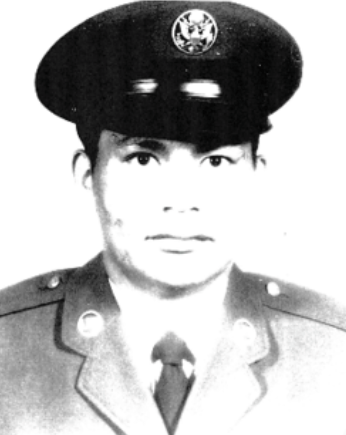
Officials with Holloman Air Force Base say that a 43-year-old cold case involving an AWOL Airman has come to a close after investigators were able to match DNA and dental records to remains found in the Montana wilderness in 1982 to the missing airman. Airman First Class Rudy Redd Victor, 20, from Shiprock, NM was assigned to Holloman Air Force Base in 1974 when he was awarded leave to visit family in Arizona and Colorado.
Witness reports indicate the last location of Victor was near the Wolf Creek Rest area in Lewis and Clark County, Montana. Shortly thereafter, Victor went missing and he was categorized as AWOL by the U.S. Air Force after he failed to return to duty in June 1974…According to the Lewis and Clark Sheriff’s Office and Lewis and Clark County Coroner, Airman Victor’s death was most likely due to suicide [on or about June 15, 1974].






 MILITARY JUSTICE FOR ALL