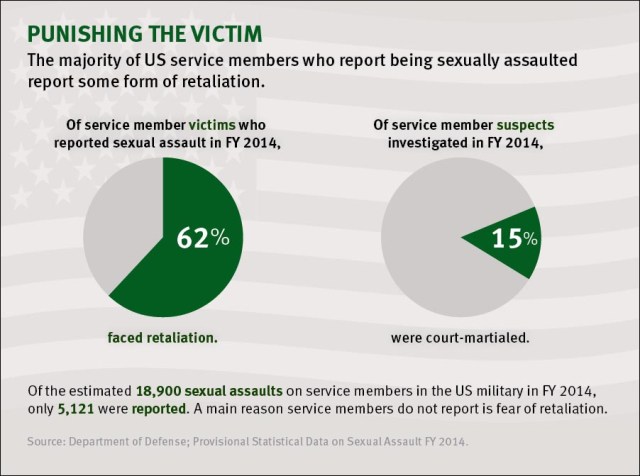
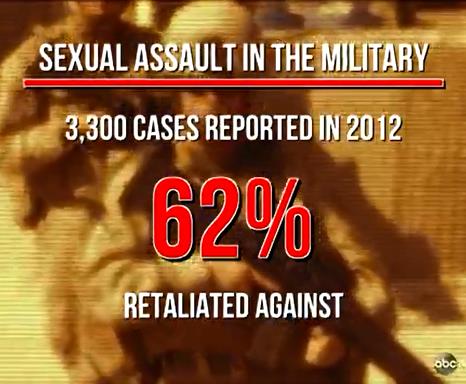
NBC Washington: 62 Percent of Military Sex Assault Reports Result in Retaliation (May 18, 2015)

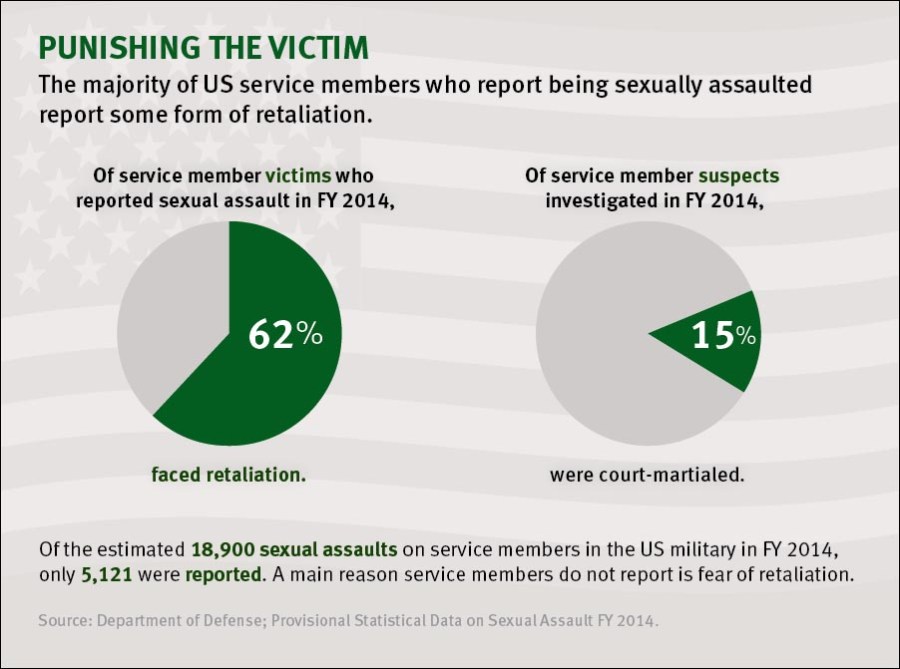
Punishing the Victim Retaliation NBC Washington.jpg

“One of the women interviewed was Lt. Col. Teresa James, the highest ranking officer to come forward with a rape claim in the National Guard, according to a recent report by the Guard. The News4 I-Team first brought you her story when she said she believes her 34-year military career with the West Virginia National Guard was destroyed after she reported her rape. Lt. Col. James attended the news conference and told the I-Team, ‘There’s nothing else they can do to hurt me. They did everything they could possibly do. It’s effecting change. That’s why I’m out today. It’s effecting change, and if I have to speak it, shout it from the rooftops, that’s what I’m going to do.’ Read more from NBC Washington here.

Related Links:
Serving in Silence: Sex Assault Retaliation Complaints Investigated
62 Percent of Military Sex Assault Reports Result in Retaliation
Troops who report sexual assault face retaliation
Highlights of Army National Guard Lt. Col. Teresa James’ Military Sexual Assault and DoD IG Substantiated Retaliation Case
DoD Retaliation Prevention and Response Strategy: Regarding Sexual Assault and Harassment Reports
DoD Retaliation Prevention and Response Strategy Implementation Plan
Military Sex Assault Reports Edge Up; Retaliation Persists
DoD Releases Annual Report on Sexual Assault in Military
Department of Defense Annual Report on Sexual Assault in the Military
Military Sexual Assault Reports Are Up for the Seventh Year in a Row
Pentagon: Claims of Retaliation for Sexual Offense Complaints on Rise
Reports of Military Sexual Assault, Retaliation Increase
The Biggest Obstacle to the Pentagon’s War on Sexual Assault: The Military Justice System
Military sexual assault reports rise in 2017 but fewer servicemembers faced courts-martial
Sexual assault, harassment spikes at military academies, strategies fail to stem crisis
Reports of sexual assault in the military soar
Pentagon report shows sharp rise in military sexual assaults
Sexual assaults in military rise to more than 20,000, Pentagon survey says
“A cultural rot”: Sex assaults spike at U.S. service academies
Defense Department to make sexual harassment a crime
‘It was rape:’ Wisconsin Army National Guard officer Megan Plunkett says she was retaliated against, disciplined for reporting sexual assaults
Gabbard says ‘there is still a fear of retaliation’ in the military about reporting sexual assault
Senators Hirono, Gillibrand Reintroduce Legislation to Bring Justice to Survivors of Sexual Assault in the Military
Sexual assaults in the military are on the rise. This bill would authorize Congress to intervene
Sexual Assault in the Military | C-SPAN.org

The Real News: Senate Unanimously Passes Sexual Assault Bill, But What Will it Change? (2014)

Jennifer Norris: Senate bill will still keep military sexual abuse cases within the chain of command of the military, leaving victims vulnerable to retaliation

Military Justice Improvement Act Falls Short of Votes & Substance

xl_deptofdefenselogoThe MJIA fell short of the votes it needed to pass in Congress. But it’s really nothing to get upset about because the bill falls short of substance.

The MJIA had good intentions. It gave the victim a different place to report other then an immediate supervisor or the Commander. It would have allowed victims to report to a military prosecutor instead. The bill also included all violent crimes, ie sexual assault, domestic violence, and murder.

But in reality, how is that going to work? There aren’t enough military prosecutors to report to. There was one, maybe two in the State of Maine JAG office and they were located hours if not days away from some of the places we trained and deployed.

Continue reading “Military Justice Improvement Act Falls Short of Votes & Substance”

S. 967: Military Justice Improvement Act of 2013 – U.S. Senate Voting Record (March 6, 2014)

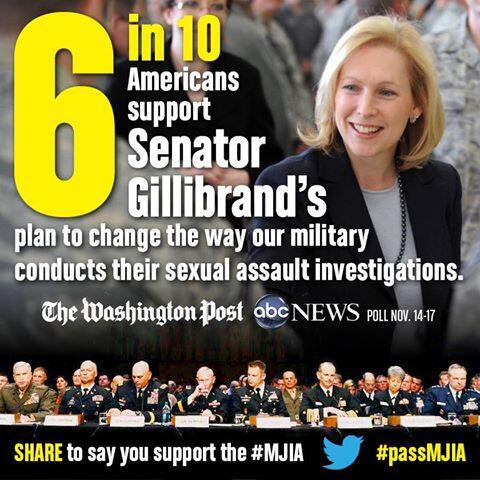
MJIA.jpeg
Military Justice Improvement Act #PassMJIA

S. 967 – Military Justice Improvement Act of 2013 – Voting Record of U.S. Senate

NOTE: INVOKING CLOTURE REQUIRES A 3/5 MAJORITY OF THE SENATE. IT IS NOT A VOTE ON THE PASSAGE OF THE PIECE OF LEGISLATION, BUT LIMITS FURTHER DEBATE TO 30 HOURS. CLOTURE IS TYPICALLY USED TO END A FILIBUSTER. A FAILED CLOTURE VOTE OFTEN PREVENTS THE LEGISLATION FROM EVER COMING TO A VOTE.

NOTE: THIS LEGISLATION NEEDED A THREE-FIFTHS MAJORITY VOTE TO PASS.

Date: March 6, 2014
Issues: Crime, Military Personnel, Women
Bill: Military Justice Improvement Act of 2013
Roll Number: 59
Yea: 55
Nay: 45
Cloture Not Invoked (Senate)

Gillibrand brings victims’ voices to Senate floor in fight for military justice -U.S.Senator Kirsten Gillibrand (March 6, 2014)

Before Senate Vote, Hirono Urges Colleagues To Pass Military Justice Improvement Act -Mazie Hirono (March 6, 2014)

Sen. Paul joined Senate colleagues to urge passage of the Military Justice Improvement Act. This piece of bipartisan legislation will combat sexual assault and other violent crimes in the military by restructuring the way in which they are reported and prosecuted. -Senator Rand Paul (March 6, 2014)

Floor Statement on the Military Justice Improvement Act -Senator Chuck Grassley (March 6, 2014)

U.S. Senator Jeanne Shaheen (D-NH) went to the Senate floor to reiterate her support for the Military Justice Improvement Act of which she is an original co-sponsor and call for its immediate passage. -Senator Jeanne Shaheen (March 6, 2014)

U.S. Senator Susan Collins spoke on the Senate floor today in strong support of legislation coming before the Senate that would address the crisis of sexual assault in the military. -Senator Susan Collins (March 6, 2014)

(Washington, D.C.) — Yesterday on the Senate floor, U.S. Senator Dean Heller (R-NV) spoke in support of Senator Kirsten Gillibrand’s (D-NY) bipartisan Military Justice Improvement Act (S. 1752). -[Former] Senator Dean Heller (March 6, 2014)

The Senate came within five votes of passing a major change to the military’s command structure. An amendment by Sen. Kirsten Gillibrand, D-N.Y., would have stripped commanders of authority over sexual assault cases and put everything in the hands of seasoned military trial lawyers. -CBS Evening News (March 6, 2014)

Senator Ted Cruz speaks out in support of a military sexual assault bill that was blocked in the Senate. -CNN (March 6, 2014)

PBS NewsHour: Hirono Fights For Military Justice Improvement Act -Mazie Hirono (March 7, 2014)

Senator Brian Schatz’s remarks on failure of Military Justice Improvement Act passage -Hawaii247.com (March 7, 2014)

Editors Note: The Senator’s name with a link is a Senator still serving in the U.S. Senate (as of June 24, 2019). You can click on the link and it will take you to their official Senate page. The Senators without a link have been voted out, left, retired, or died. If you click on the Vote link Yea or Nay, it will take you to the Senator’s twitter page. You can thank them for supporting the MJIA or remind those who voted Nay why the MJIA is so important.

State District Name Party Vote
AK Jr Sen.  Mark  Begich Democratic Yea
NH Sr Sen.  Jeanne  Shaheen Democratic Yea
MD Sr Sen.  Barbara  A.  Mikulski Democratic Yea
MN Jr Sen.  Al  Franken Democratic Yea
VT Jr Sen.  Bernard  ‘Bernie’  Sanders Independent Yea
MN Sr Sen.  Amy  Klobuchar Democratic Yea
TX Jr Sen.  Rafael  Edward  ‘Ted’  Cruz  Republican Yea
NM Jr Sen.  Martin  T.  Heinrich Democratic Yea
MA Sr Sen.  Elizabeth  A.  Warren Democratic Yea
HI Sr Sen.  Brian  Emmaneul  Schatz Democratic Yea
NY Jr Sen.  Kirsten  E.  Gillibrand Democratic Yea
CA Sr Sen.  Dianne  Feinstein Democratic Yea
PA Sr Sen.  Robert  P.  ‘Bob’  Casey  Jr. Democratic Yea
IN Sr Sen.  Joe  Donnelly  Sr. Democratic Yea
CT Jr Sen.  Christopher  S.  ‘Chris’  Murphy Democratic Yea
HI Jr Sen.  Mazie  K.  Hirono Democratic Yea
NV Sr Sen.  Dean  Heller Republican Yea
KY Sr Sen.  Mitch  McConnell Republican Yea
CA Jr Sen.  Barbara  Boxer Democratic Yea
VT Sr Sen.  Patrick  J.  Leahy Democratic Yea
DE Jr Sen.  Christopher  A.  ‘Chris’  Coons Democratic Yea
CO Sr Sen.  Michael  Farrand  Bennet Democratic Yea
LA Sr Sen.  David  B.  Vitter Republican Yea
WA Sr Sen.  Patty  Murray Democratic Yea
IA Sr Sen.  Charles  E.  ‘Chuck’  Grassley Republican Yea
ND Jr Sen.  Heidi  Heitkamp Democratic Yea
WV Sr Sen.  John  D.  ‘Jay’  Rockefeller  IV Democratic Yea
NJ Sr Sen.  Robert  ‘Bob’  Menendez Democratic Yea
OR Jr Sen.  Jeffery  A.  ‘Jeff’  Merkley Democratic Yea
LA Sr Sen.  Mary  L.  Landrieu Democratic Yea
CO Sr Sen.  Mark  E.  Udall Democratic Yea
AR Sr Sen.  Mark  Lunsford  Pryor Democratic Yea
ME Sr Sen.  Susan  M.  Collins Republican Yea
IL Sr Sen.  Richard  J.  ‘Dick’  Durbin Democratic Yea
WY Sr Sen.  Michael  B.  ‘Mike’  Enzi Republican Yea
WA Jr Sen.  Maria  Cantwell Democratic Yea
MI Sr Sen.  Debbie  Ann  Stabenow Democratic Yea
NY Sr Sen.  Charles  E.  ‘Chuck’  Schumer Democratic Yea
OR Sr Sen.  Ron  Wyden Democratic Yea
IA Jr Sen.  Thomas  ‘Tom’  Harkin Democratic Yea
OH Sr Sen.  Sherrod  C.  Brown Democratic Yea
NJ Jr Sen.  Cory  A.  Booker Democratic Yea
NE Sr Sen.  Mike  O.  Johanns Republican Yea
NM Sr Sen.  Thomas  S.  ‘Tom’  Udall Democratic Yea
KS Jr Sen.  Jerry  W.  Moran Republican Yea
NV Sr Sen.  Harry  M.  Reid Democratic Yea
MD Sr Sen.  Benjamin  L.  ‘Ben’  Cardin Democratic Yea
KY Jr Sen.  Rand  Paul Republican Yea
SD Sr Sen.  Timothy  Peter  ‘Tim’  Johnson Democratic Yea
MA Jr Sen.  Edward  J.  ‘Ed’  Markey Democratic Yea
MT Jr Sen.  John  E.  Walsh Democratic Yea
NC Jr Sen.  Janet  R.  ‘Kay’  Hagan Democratic Yea
AK Sr Sen.  Lisa  A.  Murkowski Republican Yea
CT Sr Sen.  Richard  ‘Dick’  Blumenthal Democratic Yea
WI Jr Sen.  Tammy  Baldwin Democratic Yea
MT Sr Sen.  Jon  Tester Democratic Nay
IL Jr Sen.  Mark  Steven  Kirk Republican Nay
ID Jr Sen.  James  E.  ‘Jim’  Risch Republican Nay
FL Sr Sen.  Marco  Rubio Republican Nay
ND Sr Sen.  John  H.  Hoeven Republican Nay
RI Jr Sen.  Sheldon  Whitehouse Democratic Nay
WI Sr Sen.  Ron  Johnson Republican Nay
VA Sr Sen.  Mark  R.  Warner Democratic Nay
SC Jr Sen.  Timothy  E.  ‘Tim’  Scott Republican Nay
VA Jr Sen.  Timothy  M.  ‘Tim’  Kaine Democratic Nay
TN Jr Sen.  Robert  ‘Bob’  Corker Republican Nay
DE Sr Sen.  Thomas  Richard  ‘Tom’  Carper Democratic Nay
NE Sr Sen.  Deb  Fischer Republican Nay
AZ Sr Sen.  Jeff  Flake Republican Nay
NH Jr Sen.  Kelly  A.  Ayotte Republican Nay
MS Sr Sen.  Roger  F.  Wicker Republican Nay
ID Sr Sen.  Michael  D.  ‘Mike’  Crapo Republican Nay
UT Sr Sen.  Orrin  G.  Hatch Republican Nay
GA Sr Sen.  Clarence  Saxby  Chambliss Republican Nay
FL Sr Sen.  William  Clarence  ‘Bill’  Nelson  Sr. Democratic Nay
AL Sr Sen.  Richard  C.  Shelby Republican Nay
MO Sr Sen.  Claire  McCaskill Democratic Nay
ME Jr Sen.  Angus  S.  King  Jr. Independent Nay
RI Sr Sen.  John  Francis  ‘Jack’  Reed Democratic Nay
MO Sr Sen.  Roy  Blunt Republican Nay
TN Sr Sen.  Lamar  Alexander Republican Nay
SD Sr Sen.  John  R.  Thune Republican Nay
IN Sr Sen.  Daniel  R.  ‘Dan’  Coats Republican Nay
UT Sr Sen.  Michael  ‘Mike’  Lee Republican Nay
PA Jr Sen.  Patrick  J.  ‘Pat’  Toomey Republican Nay
OH Jr Sen.  Robert  J.  ‘Rob’  Portman Republican Nay
MS Sr Sen.  Thad  Cochran Republican Nay
TX Sr Sen.  John  Cornyn Republican Nay
NC Sr Sen.  Richard  M.  Burr Republican Nay
SC Sr Sen.  Lindsey  O.  Graham Republican Nay
AZ Sr Sen.  John  Sidney  McCain  III Republican Nay
OK Sr Sen.  James  M.  ‘Jim’  Inhofe Republican Nay
MI Sr Sen.  Carl  Levin Democratic Nay
NA None  Jefferson  Beauregard  ‘Jeff’  Sessions  III Republican Nay
KS Sr Sen.  Charles  Patrick  ‘Pat’  Roberts Republican Nay
WY Jr Sen.  John  Barrasso Republican Nay
WV Sr Sen.  Joseph  ‘Joe’  Manchin  III Democratic Nay
GA Sr Sen.  John  H.  ‘Johnny’  Isakson Republican Nay
OK Jr Sen.  Thomas  Allen  ‘Tom’  Coburn Republican Nay
AR Sr Sen.  John  N.  Boozman Republican Nay

Related Links:
S. 967 – Military Justice Improvement Act of 2013
S. 967 – Military Justice Improvement Act of 2013 – Voting Record of U.S. Senate
S. 967 – Military Justice Improvement Act of 2013 – National Key Vote
Comprehensive Resource Center for the Military Justice Improvement Act
Gillibrand brings victims’ voices to Senate floor in fight for military justice
Before Senate Vote, Hirono Urges Colleagues To Pass Military Justice Improvement Act
Sen. Paul Speaks in Support of Military Justice Improvement Act
Floor Statement on the Military Justice Improvement Act
On Senate Floor Senator Shaheen Calls for Passage of Military Justice Improvement Act
Sen. Collins speaks in support of efforts to address military sexual assault
Heller Speaks About Military Sexual Assault Legislation
Senate blocks change to military sexual assault cases
Sen. Cruz: They didn’t sign up to be sexually assaulted
PBS NewsHour: Hirono Fights For Military Justice Improvement Act
Senator Brian Schatz’s remarks on failure of Military Justice Improvement Act passage
The war in Congress over rape in the military, explained
Senate Armed Services Committee Members & House Armed Services Committee Members (June 21, 2019)

The Military Justice Improvement Act Helps Guarantee Constitutional Rights for All (2013)

1907

I support the Military Justice Improvement Act for a number of reasons but first and foremost because it will provide a safe place for survivors to report. And if survivors can report, we can prevent others from becoming victims of these same criminals. The whole premise behind this law is to remove the gatekeepers (Commander and Chain of Command). Not because they all are incapable and incompetent of doing the right thing but because they are trained to be warriors not police, detectives, and prosecutors. Therefore, they can quite potentially hurt a case by meddling in it.

The Commander may know both parties and cannot be impartial in this case. Therefore, we need to treat all cases as if they are worst case scenario so that our response is uniform and consistent. This law is only the first of many steps that need to be taken in order to ensure a fair process for both the victim and the accused. No one wants special rights; no one wants bias in the process.  As a matter of fact, we are making the military’s response to violent crime similar to that of the civilian system. For example, would you report a crime to your boss?  No. You would report a crime to the police, a rape crisis center, etc.

Since not all bases have legal and support services available to them, the next logical step is to turn to the Judge Advocate General, who is more of a legal professional then the Commander. Commanders are not trained to assist traumatized victims, conduct investigations, or study the modus operandi of predators. Most prosecutors are schooled in these techniques automatically just because of their legal training. The ideal scenario would include one place to call or go to assist them with the process. We can’t do this until they report. The SARC or SAPRO can act as a support system but only if they have a supportive Command.  Therefore, we need to guarantee a support system that will review the situation from an objective point of view. The good soldier defense and how long you have served should not determine your credibility.

If you don’t believe the military has a reporting problem, then you don’t know the numbers.  The numbers are staggering and illusive.  The 26,300 troops that the Department of Defense reports are sexual assaulted per year does not include the military service academies, the Coast Guard, or sexual harassment cases.  Unfortunately, the Department of Defense is still referring sexual harassment cases to the Equal Employment Opportunity office, which is a Commander’s program. Therefore once again, if the EEO representative is not supported by the Commander then they cannot help you. Of the 26,300 estimated troops, only 3,374 reported the crimes perpetrated against them.  Sixty-two percent of those that did not report the crime did not report because of fear of retaliation and the impact on their career, and rightly so.

Give Our Troops Constitutional Rights for Veteran’s Day, Pass the Military Justice Improvement Act (MJIA)

MJIA

The Military Justice Improvement Act (MJIA), although not the final answer, is a great first step in our fight for justice for crime victims. Currently, the Department of Defense (DoD) estimates that 26,300 service members are victims of military sexual assault (touching). These numbers do not include other violent crimes, sexual harassment, stalking, bullying, hazing, etc. Of those numbers, the DoD estimates that more then half of them are male victims, which proves that this is not a female issue but instead a repeat offender issue.

The military’s current justice system elevates an individual Commander’s discretion over the rule of law. The MJIA legislation would help us create an impartial system where victims would feel safe to report. They are telling us in their own voices that they do not trust the Chain of Command to handle their cases effectively. Recent DoD studies have shown that 62% of those who reported were in fact retaliated against which reinforces others to remain silent.

The MJIA would not only give them a safe place to report confidentially but would allow a legal professional to determine whether or not a case should be tried in a court of law. The biggest problem with military sexual assault is underreporting. We can’t fix the problem unless the soldiers feel safe enough to report. We can’t rid the military of perpetrators if we do not work together to get a conviction and protect our military and civilians.

Learn more here.

Breaking the chain: Sen. Gillibrand’s mission to change military policy on sexual assault

RetaliationBreaking the chain: Sen. Gillibrand’s mission to change military policy on sexual assault

Sen. Kirsten Gillibrand is on a mission to change how the military prosecutes sexual assaults. She points to one statistic to explain why: 60 percent of those who reported sexual assaults last year were retaliated against by their superiors. “The victims tell us over and over again that they don’t trust the chain of command,” Gillibrand, a New York Democrat, told “The Fine Print.”

Gillibrand is calling for removing sexual assault cases from the chain of command, so decisions on whether to try such cases would be made by military prosecutors, not commanders.

Watch video: http://news.yahoo.com/blogs/power-players-abc-news/breaking-the-chain–sen–gillibrand%E2%80%99s-mission-to-change-military-policy-on-sexual-assault-213205898.html?vp=1

Gillibrand Fact Sheet on Sexual Assaults in the Military

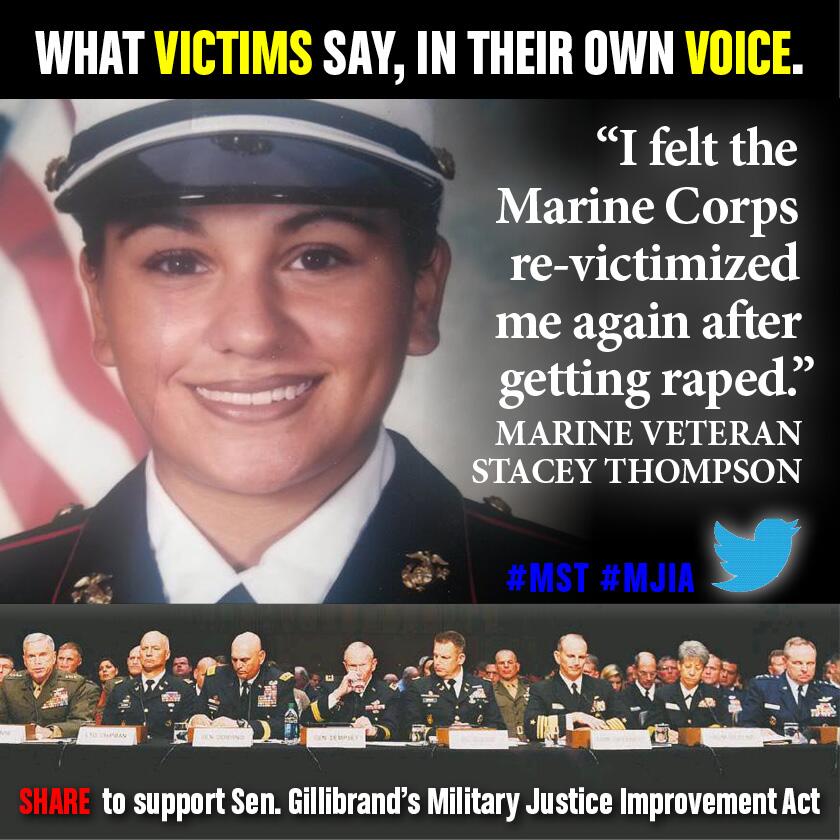
Stacey Thompson MJIA

Gillibrand Fact Sheet on Sexual Assaults in the Military

Washington, D.C. — U.S. Senator Kirsten Gillibrand’s office released the following facts today. Any of the following can be attributed to Senator Gillibrand’s office:

Today we heard more of the same in opposition to the bipartisan coalition sponsoring the Military Justice Improvement Act. This carefully crafted legislation supported by 44 Senators from both sides of the aisle seeks to reverse the systemic fear that numerous victims of military sexual assault have told us they have in deciding whether to report the crimes committed against them due to the clear bias and inherent conflicts of interest posed by the military chain of command’s current sole decision-making power. According to the 2012 SAPRO Report, 25% of women and 27% of men who received unwanted sexual contact indicated the offender was someone in their military chain of command.

According to DOD, 50% of female victims stated they did not report the crime because they believed that nothing would be done with their report. Even the current top military leadership admits the current system “has failed” and victims do not come forward because “they don’t trust the chain of command.” The bill is supported by the International Federation of Professional & Technical Engineers (IFPTE), and all the leading victim’s advocates groups, including but not limited to, Service Women’s Action Network (SWAN), Protect Our Defenders (POD), Iraq and Afghanistan Veterans of America (IAVA), the National Women’s Law Center, Vietnam Veterans of America, The National Alliance to End Sexual Violence (NAESV), plus former Generals, former JAG officers and survivors of sexual assault across the country.

This legislation was drafted in direct response to the testimony heard in the Armed Services Subcommittee on Personnel from victims of sexual assault in the military, and the testimony of the military leadership. Unfortunately, in opposition to the victims, the full SASC committee chose to strike the Military Justice Improvement Act during the mark-up of the NDDA, protecting the current broken system.

The problem of sexual assault in the military is not new, neither are the pledges of “zero tolerance” from the commanders and senior members of the committee, which date all the way back to then-Secretary of Defense Dick Cheney in 1992. Below is a fact sheet correcting some of the misinformation used by opponents of the Military Justice Improvement Act:

Myth: Moving the decision over whether prosecutions move forward from the chain of command to independent military prosecutors will increase retaliation against victims. If an independent prosecutor, and not the commander, moves the case forward others will take it less seriously and retaliation will increase.

Fact: There is absolutely zero statistical or anecdotal evidence that would lend any credibility to this theory. Contrary to that theory, in the current DoD SAPRO survey, of those who responded they have been victims of USC, 62% say they have already been retaliated against which demonstrates the current chain of command structure some are seeking to protect is not working to protect victims. The idea that a commander putting forth the court martial “protects victims from retaliation” is directly rebutted by victims own reports, and ignores anecdotal evidence that commanders are also sometimes the assailant, or have conflicts of interest when a superior officer victimizes a lower ranking servicemember. Additionally, according to a 7 month investigation by the San Antonio Express, a survey of 1,200 service members who sought help since 2003 at the Military Rape Crisis Center found that 90% of victims who reported sexual assault where involuntarily discharged and diagnosed with mental disorders (an extreme form of retaliation).

Myth: We will have more prosecutions from within the chain of command because commanders move forward cases that civilian lawyers would not. Under the Gillibrand bill, if the lawyer doesn’t want to prosecute a case, it ends. Under the Levin bill, the commander can move forward even if the prosecutor doesn’t want to.

Fact: To claim keeping prosecutions inside the chain of command will increase prosecutions is not supported by the statistics. Of the DoD’s 26,000 estimated cases, only 2,558 victims sought justice by filing an unrestricted report and only an abysmal 302 proceeded to trial. A chain of command orientated system that produces only 302 prosecutions of 2,558 actionable reports is simply not holding enough alleged assailants accountable under any metric. The Military Justice Improvement Act will increase victims perception that they can receive an unbiased chance at justice, increasing unrestricted reporting and the number of successful prosecutions, which will put more sexual predators behind bars unable to victimize men and women in uniform again and again.

While the claim that under the Levin bill a commander can proceed against the lawyers recommendation is true, it omits the fact that rarely does a commander currently disagree with his JAG attorney. Additionally, it omits that in the current structure that the NDAA protects, the JAG making the recommendation to the commander is in the commander’s direct chain of command. Under the Military Justice Improvement Act, the JAG making the decision to proceed to trial would be independent of the commander and any possible bias from within the chain of command, such as the current ability for a commander to choose a jury pool.

Lastly, the argument that we should go all the way in the other direction by reducing the civil liberties of the accused does not adhere to the fundamental values of a fair and independent American justice system.

Myth: Critics say this lets the commanders off the hook. How can you hold them accountable when you reduce their power?

Fact: This is a false choice and just plain inaccurate. There is nothing about this proposal that lets commanders off the hook. Commanders will still be held accountable for setting the command climate whether or not they make this one legal decision.  They are still fully responsible for and in control of their troops.  In fact, this proposal leaves many crimes within the chain of command, including 37 serious crimes that are unique to the military, such as going AWOL or insubordination, in addition to all misdemeanor type crimes under Article 15. That’s why a law professor and former Air Force officer wrote in the New York Times, “Everything about the proposal takes military needs into account, except for the fact that military leaders don’t like change.”

Myth: Victims can already report the crimes committed against them outside of the chain of command.

Fact: Of course they can, but under the current system, regardless of whom you report the crime to initially, it ultimately ends up on the desk of the commander who becomes the sole decision maker over whether a case moves forward. The commander holds all the cards regardless of where the crime is reported and it is this bias in the system that keeps victims from coming forward and reporting the crime anywhere because they do not believe they can receive justice.

Myth: This proposal will lead to fewer trials since prosecutors are concerned about their win/loss record and will only recommend cases they can win.

Fact: This reflects a fundamental misunderstanding of how the military justice system works. JAGs move back and forth between defense and prosecution assignments, so they are less concerned about their prosecution numbers. Prosecutors are detailed to the billet for 2-3 years and take whatever cases are given to them by their department head.  The department head takes the cases that are preferred/referred.  Under our new structure the O-6 JAG would have the disposition authority to decide if a case proceeds to trial based on the strengths/weaknesses of the evidence.  In the military, prosecutors are professionally graded on a whole host of matters – not just wins/losses.  In fact, military prosecutors often receive praise from their superiors for being willing to take tough cases to trial.

Important Facts:

  • Of the Active Duty women who indicated experiencing USC and did not report it to a military Authority — 66 percent said they felt uncomfortable making a report.
  • Of the Active Duty women who indicated that they experienced USC and did not report it, 50 percent believed that nothing would be done with their report, and 43 percent heard about negative experiences other victims went through who reported their situation.
  • Of those women who experienced USC and did not report it, 47 percent indicated fear of retaliation or reprisal as the reason for not reporting.
  • Across the services, 74% of Females and 60% of Males perceived one or more barriers to reporting sexual assault.

Original Link: http://www.gillibrand.senate.gov/newsroom/press/release/gillibrand-fact-sheet-on-sexual-assaults-in-the-military

Air Force lawyers draw fire over sexual assault policy

USAF SealAir Force lawyers draw fire over sexual assault policy

Top Air Force lawyers are under fire after urging subordinates to rally  against a Senate proposal that would overhaul the military’s sexual assault  policies.

A letter obtained by POLITICO shows Lt. Gen. Richard Harding,  the Air Force judge advocate general, and Col. Jeffrey Rockwell, urging their  fellow military lawyers to take sides against a Senate amendment expected to  come up for a floor vote before Thanksgiving that removes the command chain from  major criminal prosecutions.

Read more: http://www.politico.com/story/2013/10/air-force-lawyers-sexual-assault-policy-99099.html

Rape Culture and the US Military, Pt. 3: Legislation

Jennifer NorrisRape Culture and the US Military, Pt. 3: Legislation

Part one and part two of this series has outlined the structural nature of rape culture in the US military that is made of and results in severe lack of trust, abuse of power, and a staunch unwillingness to make necessary changes. Those outside the command structure of the military however are more than ready to force them in line. Since February, six pieces of legislation have been introduced in Congress and the Senate that, together, tackle these problems in a comprehensive way.

The Ruth Moore Act, Military Sexual Assault Prevention Act, Service Members Mental Health Review Act, The STOP Act, Combating Military Sexual Assault Act, Military Justice Improvement Act

Read more: http://amplifyyourvoice.org/u/afy_samantha/2013/05/31/rape-culture-and-the-us-military-pt.-3-legislation