ID Go: Apple Valley in California’s Mojave Desert is the perfect place to hide a secret. When the body of an unidentified Jane Doe is discovered there in 1994, it takes almost two decades to bring a twisted tale of love, jealousy, and a horrible crime to light. -A Girl Has No Name, Who Killed Jane Doe? (S2, E2)
Editor’s note: With a cable subscription, you can download the free ID Go app and watch all of the Investigation Discovery programming at your convenience. And for those who do not have cable, you can watch “unlocked” episodes on the ID Go app including the latest premieres. Download the ID Go app and binge away. For those who prefer commercial free programming during your binge session, Prime Video has an ID channel: ‘True Crime Files by Investigation Discovery” available for $2.99 a month. It’s a compilation of older seasons but totally worth the cost if you are a true crime addict.
All Hell Breaks Loose In Club Brawl Leaving A Young Solider Dead -Victim Zero, Homicide Hunter (Preview)
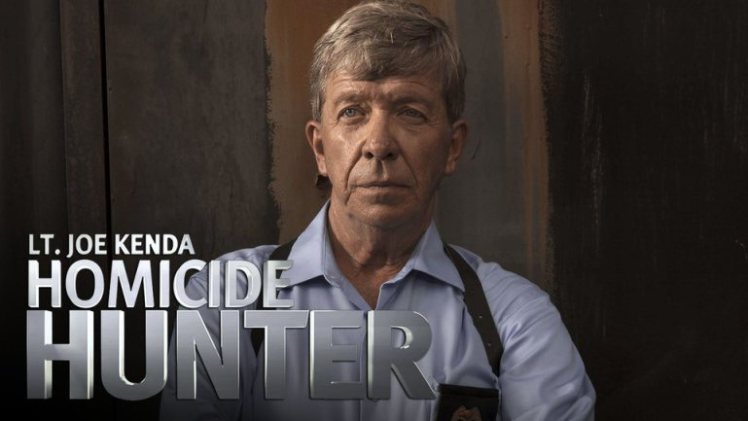
Lt. Joe Kenda of the Homicide Hunter series on Investigation Discovery discussed the murder of Fort Carson Army soldier Christopher Walton, 21, outside a night club in Colorado Springs, Colorado on November 21, 1991. What started out as a good night out on the town turned deadly after two rival units started a brawl at a local bar in Colorado Springs. The fight spilled outside of the bar and that’s when Christopher Walton was shot with a gun in the neck. Christopher Walton was getting ready to get out of the Army and move back to North Carolina. He was a described by his friends as a really good guy who took care of people.
As Kenda investigates the case, which is in his jurisdiction, he learns that a few months earlier a couple of soldiers got in a fight over a girl and that’s when everyone chose sides and the rival began. The rival was between the artillery unit and the maintenance unit at Fort Carson. An informant told Kenda that she thought Chris Smith may have committed the murder. Kenda pays Chris Smith a visit and in deed finds a gun similar to the gun they were looking for in his possession. It was later determined by ballistics that this gun matched the bullet recovered from Christopher Walton’s body.
Chris Smith was arrested for the murder of Christopher Walton. He never admitted to the murder and told Kenda that he had given the gun to someone else that night but would not give up the name. While Smith was in custody, the Army’s Criminal Investigation Division (CID) called Lt Joe Kenda to tell them they had a witness to the event and they thought he might have the wrong guy. The witness, Eric Walker, identified Leroy Davis as the actual shooter. Leroy was a member of the artillery unit at Fort Carson which was the rival unit to Christopher Walton’s maintenance unit.
As it turns out, Chris Smith was telling the truth. He did give the gun to someone that night outside the bar after shooting it in the air because he didn’t want it on his person. Eric Walker told Kenda that Chris Smith gave the gun to Leroy Davis who eventually returned the gun back to Smith. Chris Smith refused to implicate his Army brother, even after he was arrested and jailed. According to Walker, Christopher Walton pushed one of the artillery unit members and Leroy Davis acted on emotional impulse, pulled the gun out of his jacket, and shot Walton in the neck causing his fatal injuries.
For some unknown reason, Leroy Davis faced a court martial as opposed to a being tried by the civilian courts in Colorado Springs. Lt Joe Kenda described military discipline as a whole different game, sharing that they are “draconian and ruthless.” The military has its own internal justice system and has been at the center of a controversial debate in Congress for the past few years over the way it handles violent crimes. In this case, Davis was sentenced to twenty years at Fort Leavenworth where he will be expected to do hard, physical labor the entire time. We learned from one of the soldiers present at the scene that fifteen military members from Fort Carson got discharged as a result of their involvement in this incident.
Investigation Discovery:
A massive brawl erupts at a local bar ends with the shooting death of a young army soldier. To unravel the murder, Lt. Joe Kenda must infiltrate a revered military institution, and expose a dangerous vendetta. -Victim Zero, Homicide Hunter (S5,E9)
Editor’s note: With a cable subscription, you can download the free ID Go app and watch Investigation Discovery programming at your convenience. And for those who do not have cable, you can watch “unlocked” episodes on the ID Go app including the latest premieres. For those who prefer commercial free programming during your binge session, Prime Video has an ID channel: ‘True Crime Files by Investigation Discovery” available for $3.99 a month. It’s a compilation of older seasons but totally worth the cost if you are a true crime addict. Download the ID Go app or purchase ID True Crime Files & binge away.
Soldier and young father Layne Schmidtke is brutally beaten to death by a mob of teenagers. Kenda must reconstruct the chaotic scene through forensic evidence and witness testimonies, which reveals an unlikely suspect as the murderous ringleader. -Slaughterhouse Six, Homicide Hunter (S2, E5)
On September 21, 1991, Layne Schmidtke was found near death on the streets of Colorado Springs, Colorado just before midnight. Layne was transported to the hospital where he later died of blunt force trauma. The death was a result of what was believed to be a street fight gone bad. Lt. Joe Kenda needed to find out why this happened. What were the dynamics that lead to the fight? Investigators wanted to speak with witnesses and found Joseph Reeves at the scene of the crime who admitted he was with Layne when the fight began. Joseph and Layne were great friends and he described Layne as a nice guy and married father of twin daughters. There appeared to be no reason for the brutal attack. Kenda and fellow officers found some individuals with blood on their clothing but until they had more information, it wasn’t enough to arrest them.
Joseph Reeves helped Lt. Joe Kenda understand what happened on the night they were randomly attacked. He said they went out and grabbed some dinner and were on their way home when they were confronted by a group of teens. The trash talk lead to a fight and Layne was punched in the face which resulted in him falling to the ground. Joseph Reeves was able to extricate himself from the fight but in the chaos realized Layne was still under attack. The group of teens were beating and kicking him while he was on the ground. An ambulance arrived on the scene and this ended the fight and the participants scattered. Kenda said it appeared Layne was attacked without any provocation whatsoever. Kenda wanted to know why these kids were motivated to harm Layne? Reeves didn’t know who attacked them during the fight. It all happened so fast.
Kenda learned that Layne Schmidtke and Joseph Reeves were in the Army and served together with the 4th Infantry Division out of Fort Carson, Colorado. Kenda wondered if Layne was attacked because he was a soldier. Kenda found another eye witness at the scene of the crime: Dan Davis. Davis told him that the group of teens who attacked Layne were from the local high school. Kenda learned these were good kids who came from good homes so it was surprising to learn of their involvement in this crime. Davis admitted yelling “COPS!” hoping to break up the fight and the group of teens did indeed scatter. Davis said he didn’t know the names of the individuals in the fight. The police collected evidence from the scene and Kenda went back to the station to speak with the individuals found with blood on their clothing.
The first teen they spoke to didn’t fit the modus operandi of someone who would beat a soldier to death. This teen’s dad was an Army soldier himself and this kid was more likely to join the Army, then beat someone serving in the Army. This teen was not able to identify suspects involved in the fight. But nonetheless, Joe Kenda wanted to test the blood on his clothing to determine who it belonged to. Next Kenda spoke with Anthony Phenix and Kevin Moore. When Kenda questioned Anthony, Anthony admitted the blood on his clothing came from the chaos of the fight. He said he was accidentally dragged into the fight and was hit and hit others but he didn’t know who he was fighting. Kenda needed more information and interviewed Anthony Moore next.
Kevin Moore said he was drunk and passed out in the backseat of a car when someone awoke him to inform him of the fight. Kevin went to the scene and admitted dragging Anthony Phenix from the brawl. So far all the individuals involved in the fight made it appear they were accidentally involved in the fight. Kenda collected the bloody clothing from all three suspects and sent it to the lab to be analyzed. Then Kenda got a call from a witness who claimed she was being threatened if she said anything to the cops. Kenda questioned this high school student to learn more. She said she didn’t see anything but she heard a friend admit that they ‘killed the dude’ while they were on their way home after the fight. She gave Kenda the individual’s name. His name was Dominic Peres.
Kenda had probable cause now because Dominic threatened a witness, a felony crime. They went to Dominic’s home to confront him about the incident. Dominic denied any involvement in the fight. He claimed he was down town but he never saw an assault. Kenda wanted to collect his clothing as evidence but Dominic’s mother admitted she washed the bloody clothing the day before. Before leaving their home, Kenda observed the shoes Dominic was wearing had blood on them. As a result, Dominic was arrested and taken to the County lock-up. Kenda now had to determine who did what that fatal night and had to sift through all the lies. Kenda wasn’t about to let anyone get away with this level of extreme violence. There were now four suspects in custody while they waited for the results from the lab.
Meanwhile, Kenda went to the high school and the principal provided Kenda with a group of female students who witnessed the fight. They were able to provide Kenda with the circumstances that lead to the deadly fight. Apparently these same teens fought with two other Army soldiers in a car, not Layne and Joseph. The GIs were hitting on the girls and the teens were trying to run them off. They drove away. When the teens noticed two other individuals who looked like GIs, they decided to take out their anger on these two unsuspecting individuals. The teens told them to get off their turf and then struck Layne first. They wanted revenge on a pair of soldiers and any two soldiers would do. Kenda finally understood what happened that night; these teens were looking for trouble. But Kenda still needed to find out who was responsible for the attack.
The teen high school students were able to tell Kenda exactly who was involved. A new name was dropped that he hadn’t heard yet. Kenda asked who threw the first punch and it wasn’t Dominic as suspected; it was Anthony Phenix, a star quarterback high school football player. Kevin Moore, Dominic Peres and Shawn Stancil all jumped in the fight and started punching and kicking Layne while he was on the ground. They also identified two more teens involved: Robert Dean and Daniel Davis. Kenda remembered Davis was the helpful teen at the crime scene and at the time they had no idea he was involved in the fight too. Kenda went to Davis’ home and confronted him with the new information. Davis continued to lie to them but cracked and finally offered a confession, claiming he only kicked him once in the feet area. Davis was arrested and in placed in custody.
Kenda searched for the sixth suspect: Robert Dean. Kenda confronted Dean and he denied everything but Kenda observed blood on his shoes as well. Dean was arrested and placed in custody too. The blood analysis from the lab came back and the results were mixed. Nonetheless, all six suspects were charged with murder because of the eye witness testimony. Three were juveniles and three were adults but they were all charged as adults. Daniel Davis and Robert Dean were each sentenced to several years of probation; Robert Dean had violated the terms of his probation and was sentenced to three years. Kevin Moore was sentenced to 12 years of hard time in prison. Shawn Stancil and Dominic Peres receive sixteen years in prison. And Anthony Phenix, the guy who started the fight, was convicted of second degree murder and sentenced to 24 years in prison. The police believe no one intended to kill anyone that night but their collective actions resulted in the untimely death of Army Pfc. Layne Schmidtke.
Editor’s note: With a cable subscription, you can download the free ID Go app and watch Investigation Discovery programming at your convenience. And for those who do not have cable, you can watch “unlocked” episodes on the ID Go app including the latest premieres. For those who prefer commercial free programming during your binge session, Prime Video has an ID channel: ‘True Crime Files by Investigation Discovery” available for $3.99 a month. It’s a compilation of older seasons but totally worth the cost if you are a true crime addict. Download the ID Go app or purchase ID True Crime Files & binge away.
Julie Snodgrass and MSgt Joseph Snodgrass, U.S. Air Force (Photo: Forensic Files)
Military spouse Julie Snodgrass, 33, was found stabbed to death near Clark Air Force Base in the Philippines on February 26, 1991. Julie was discovered in the cab of her pickup truck on an isolated road off base and an autopsy revealed that she was stabbed more than 42 times. The Air Force Office of Special Investigations (AFOSI) had jurisdiction of the case. During the investigation, they found evidence on Air Force Sgt. Joseph Snodgrass’ work computer that linked him to the crime. AFOSI found a letter addressed to his mistress asking for help with the murder of his wife. He also talked about the life insurance policy he had purchased in the event his wife died. The letter disclosed that Snodgrass elicited the help of his housekeeper (and lover), a Philippine native, to hire three hitmen to carry out the crime. The pair could then be together and live off the $400,000 life insurance pay out. During an interview with AFOSI, Sgt. Snodgrass grabbed the floppy disks and cut them to pieces with some shears.
Computer forensic scientists were able to find a way to put the disks back together so the data was readable again. This was the evidence the Air Force needed to make their murder-for-hire case. In the meantime in June 1991, Mount Pinatubo erupted resulting in layers of volcanic ash falling on Clark Air Force Base and Naval Base Subic Bay. Amidst the chaos, Snodgrass attempted a jail break in August 1991 while awaiting trial but lost his bearings in the ashy mess and eventually surrendered. The eruption’s aftermath triggered the decision to withdraw all American Forces from the Philippines. Joseph Snodgrass pleaded guilty to the solicitation of his wife’s murder and was sentenced to life with no parole in a military prison. As a result of the forensic history made by piecing the floppy disk back together making it usable again, the military changed the policies pertaining to the destruction of classified data on floppy disks. The AFOSI’s “catastrophic blunder” was made right and secure communications destruction policy was changed as a result of the lessons learned when forensic scientists made history.
When the wife of a serviceman was brutally murdered in the Philippines, the Air Force Office of Special Investigators swung into action. Clues led to the victim’s husband, but he insisted he was innocent. Investigators would have to do something unprecedented: Reassemble a 5 1/4 inch computer disk which had been cut to pieces with pinking shears. -Shear Luck, Forensic Files (S10,E9)
Editor’s Note: Full episodes of Forensic Files are available on a variety of media platforms. Medical Detectives Channel features full episodes of Forensic Files on YouTube. You can also find full episodes of Forensic Files on both Netflix and Amazon Prime Video. On Netflix, the seasons are grouped as collection 1-9. On Amazon Prime Video, you can find Season 1-10 here; Season 11; Season 12; Season 13; Season 14; Season 15; Season 16; Season 17; Season 18; Season 19; Season 20; and Season 21. Start bingeing and see for yourself why Forensic Files is such a hit!
Update (April 11, 2021:
Today, we were informed that Forensic Files got the narrative wrong and Air Force OSI did not commit a “catastrophic blunder.” MJFA reminded said person that if they weren’t hiding all the crime and death from the public, we’d know more about the case details. We simply are repeating what the crew at Forensic Files said. First this person reminded us, the floppy disk was destroyed in their presence because according to Forensic Files, they were “momentarily distracted.” Then they failed to address the fact an accused killer had a pair of scissors on his person, both a danger to OSI and other Air Force personnel. And finally, Joe Snodgrass worked with AFOSI and knew prior to his interview he was going to be questioned about the floppy disks, so he came prepared to destroy them.
Army Soldier Erin Tynan, 21, was found dead on November 15, 1990 in her off base apartment in Barstow, California. Erin Tynan was an active duty military police officer stationed at the Fort Irwin National Training Center. She had already spent a couple years in Germany and after her enlistment was up, she was going to use her GI Bill to go back to school and get a degree in forensic social work. After she didn’t show up to work, the Army asked the Barstow Police Department to check in on her because they were concerned about a respiratory medical condition she had been diagnosed with in Germany. The Barstow Police Department went to Erin’s home and found her dead at the scene.
Barstow PD detectives determined that Erin had been the victim of a surprise sexual attack and murder. They deduced that whoever killed Erin was someone that she knew and the person was able to gain access inside her apartment and overpower her. The autopsy confirmed that Erin was assaulted, forcibly raped, strangled, and stabbed in the neck post mortem. Investigators believed that the precision stab wound in the back of the neck was the work of someone who served in the military and wanted to make sure she was dead. They first turned to Erin’s last known boyfriend William Jones. He had recently been discharged from the Army and left the day before but there was tension because the six month relationship ended. Jones informed investigators that he had left Erin with a 22 pistol for protection but she was planning on selling the gun to another Army soldier because it jammed. They did not locate the gun in Erin’s apartment and believed the killer stole the gun. Jones was eventually ruled out because his DNA did not match the DNA found at the crime scene and he was in fact physically placed in Illinois at the time of the murder. The next person they turned to was a lead they got from the Army Criminal Investigation Division (CID). CID learned that another soldier by the name of Eugene Knox was in possession of a 22 pistol and had been acting erratically. The Barstow PD spoke with Knox and learned that he had been dating Erin. No one knew the two were seeing one another. Investigators determined that Knox could not have been the killer because he was out in the field on the night of the murder.
A couple years later, evidence from an attempted murder of a young mother in Louisiana was linked to evidence in a murder case in California. The young mother had been shot in the face once with a 22 pistol but her life was spared when the gun jammed the second time the killer pulled the trigger. The murder victim, Curtis Dean, had also been stabbed in the neck in the same precise way that Erin Tynan was stabbed in the neck. The suspect in the murder of Curtis Dean was an Army soldier at Fort Irwin, Christopher Geier. Army CID immediately recognized the similarity in the knife wounds found on both Curtis Dean and Erin Tynan. They contacted the Barstow PD to inform them of what they had learned. Geier admitted to investigators that he was hired to murder Curtis Dean but did not admit to the rape and murder of Erin Tynan when confronted. But it didn’t matter because in the meantime forensic testing revealed the gun used to shoot the young mother in Louisiana who survived matched the 22 pistol missing from Erin’s apartment. And the British Commando knife Geier admitted using on Curtis Dean was consistent with the knife used on Erin Tynan. Hair samples and DNA evidence collected from the rape also matched Geier. The prosecutor determine based on evidence collected at the scene that Geier knew that Erin Tynan would be alone and vulnerable that night. He also knew that her boyfriend Billy Jones was gone. He used the ruse to buy the pistol to gain access into her apartment with one thing in mind: he wanted a sexual encounter with her. After she resisted and rejected him, he raped and strangled her.
On July 21, 1995, Christopher Adam Geier was sentenced to death for the first degree murder of Erin Tyner and Curtis Dean, and the attempted murder of the young mother in Louisiana. Investigators eventually learned that Geier’s Fort Irwin Tank Commander in the Army, Jeffrey Hunter, hired him to kill Curtis Dean. Army soldier Jeffrey Hunter was sentenced to life in prison.
Update: On August 31, 2017, Christopher Geier, 49, collapsed and died in the prison’s recreational yard. The cause of death is unknown, pending the results of an autopsy.
Investigation Discovery:
The discovery of a beautiful military police officer murdered in her own home sends police on a twisted journey for answers. -Blood and Betrayal, On the Case with Paula Zahn (S14,E5)
Editor’s note: With a cable subscription, you can download the free ID Go app and watch Investigation Discovery programming at your convenience. And for those who do not have cable, you can watch “unlocked” episodes on the ID Go app including the latest premieres. For those who prefer commercial free programming during your binge session, Prime Video has an ID channel: ‘True Crime Files by Investigation Discovery” available for $3.99 a month. It’s a compilation of older seasons but totally worth the cost if you are a true crime addict. Download the ID Go app or purchase ID True Crime Files & binge away.
Lt. Joe Kenda, a homicide detective with the Colorado Springs Police Department, was angry when he found out about this murder. Whoever did it gunned down a housewife and mother and he vowed to catch them. On September 12, 1990, a Lupus support meeting was held in a recreational area in Colorado Springs, Colorado. One of the participants was Dianne Hood, who just 18 months earlier after her third child was born, was diagnosed with Lupus. But Dianne was a fighter and was in remission. After the meeting let up, she walked outside with a fellow Lupus support group member, Karen Johnson, and was robbed and shot twice. Karen went flying back into the building and informed the others that Dianne had been shot. Another support group member Sarah was a registered nurse so she ran outside to help. Sarah found Dianne laying in a pool of blood and observed her gasping for breath as she began compressions. EMTs arrived on the scene and took over for Sarah. Dianne had two bullet wounds, one in the shoulder and the other in her chest area. She was pronounced dead at the hospital. This crime sent a shockwave through the community.
After Lt. Kenda arrived on the scene, he found blood on the ground and a couple shocked witnesses. It was assumed initially that this was a robbery gone bad. Kenda interviewed Karen Johnson first because she was the best witness he had. Karen reported that she and Dianne were walking to their cars when they heard footsteps from behind. The person was wearing dark clothes and a ski mask. Dianne gave up her purse to the robber and began to run. The shooter first fired at her shoulder and that put her down and then this person fired a fatal shot at her chest. Everything did in fact look like a robbery gone bad. Unfortunately, Karen didn’t know much about the shooter aside from they were shorter they she was. Kenda and fellow police officers began canvassing the area to see if they could find any additional evidence. Criminals usually have a planned exit so Kenda used a K9 unit to comb the area looking for the scent of the shooter. About about a mile, the dog locked onto a scent. The dog led officers to a garbage can and then sat down. This is dog’s alert system. Inside the garbage can the police found an olive drab field jacket, a pair of gloves, a black ski mask, and some camouflage pants.
The items in the garbage can matched the witnesses description of the shooter at the scene. They also found brown hair in the ski mask and evidence of gun residue on the gloves upon testing at the forensic’s lab. The K-9 dog eventually lost the scent of the shooter because this person most likely got in a car and drove away. The only promising lead just hit a dead end. Kenda didn’t have a suspect, he had a masked maniac so he decided to look into Dianne Elaine Hood’s life; he wanted to know everything about her to find out who in her life wanted her dead. With no other substantial leads, police started canvassing the neighborhood, knocking on every door, to see if anyone saw anything. They encountered a woman who indicated David Burns could have had something to do with it. Kenda learned the locals gave Burns the nickname Homicidal Dave. Kenda wanted to know who this guy was because he wore camouflage similar to that of the shooter. Kenda learned Burns was a veteran of the first Gulf War, spoke loudly and obnoxiously to others, and the community felt he was dangerous. Upon further investigation, David Burns was cleared because he alibi checked out on the night of the murder. With no suspect or person of interest to investigate further, Kenda needed to expand the investigation.
Expanding the investigation meant combing through all the evidence to find new clues. After reading through Karen Johnson’s testimony again, Kenda deduced that someone wanted to make this look like a robbery. Kenda believed Dianne Hood was targeted and that this was an assassination. During the autopsy, two bullets were recovered from Dianne Hood’s body so they were sent to ballistics. Kenda received a call the next day informing him he was looking for very rare and valuable gun, a Colt Peacemaker patent 1872 single action Army revolver, a cowboy gun. This was a huge limiting factor because this rare gun was worth thousands, maybe this person was a gun collector. During a homicide investigation, the police look at everything. Dianne’s life didn’t raise any red flags; she was a devoted mother of three and housewife. Kenda turned to Dianne’s husband Brian Hood and after bringing him to the station, Brian’s life appeared to be just as idyllic as Dianne’s was. Brian Hood was extremely well liked by his neighbors and co-workers. He used to play football and Dianne was a cheerleader; that’s how they met. Brian’s physical stature eliminated him as the shooter.
During the interview, Brian admitted that he was addicted to working out and went to the gym almost every day to keep up his physique. So Kenda went to the gym, spoke with a couple employees, and learned that Brian spends a lot of time with a girl named Jennifer, who worked at a flower shop. Joe went to the flower shop and learned her full name was Jennifer Reali. She was married to Benjamin Reali who was a Captain in the Army and an intelligence officer. The shop owner shared that he liked Ben because they both collected antique guns. This was a solid lead for Kenda. Does Ben own the same antique gun used in the shooting? Did Ben shoot Dianne Hood because of the relationship Brian had with Jennifer at the gym? Did Jennifer shoot Dianne? Ben worked at Fort Carson as a criminal investigator for the US Army so he knew as a soldier, he is an expert in killing and as an investigator, he knew how to get away with it. The clothing recovered in the garbage can was military clothing. Was this his clothing? Ben’s stature did match that described by the shooter. Kenda surprised Ben at work and he immediately went on the defensive. Ben admitted to owning several antique guns and one of them was a Colt 45 Peacemaker (patent 1872).
Kenda wanted the antique gun so it could be analyzed. Ben appeared to be confused and concerned but he handed over the gun. The police couldn’t recover any fingerprints on it. Kenda then invited Ben to go to the police station so they could interview him. The police put Ben on their turf so he wouldn’t be in his normal comfortable setting. Ben was seated and Kenda laid out the clothing they found in the garbage can. Without even looking, Ben said he didn’t recognize the clothing. Kenda said, Ben you need to look at these clothes and examine them. Kenda then threatened to call his military Commander and ruin his career overnight or at a maximum arrest him for murder. Ben admitted the clothing were his and the ballistics office confirmed his gun matched the one they were looking for. Ben claimed he last saw the clothing in his closet at his house but he hadn’t been living there for about 3 weeks; he was staying on post. Ben then told Kenda his wife asked him to hold the gun that morning and a couple weeks ago, she wanted to shoot it so he took her to the gun range to practice. Ben went from a person of interest to a witness. Kenda remembered the witness telling him the shooter put the purse over their shoulder like a woman would do.
Ben Reali was eliminated as a suspect because Kenda knew they were looking for a woman. Forty-eight hours after Dianne was murdered, Kenda was on the hunt for twenty-eight year old Jennifer Reali. He needed to find out more about his prime suspect. He learned she was a college graduate and a mother of two daughters. From outward appearances, she didn’t fit the modus operandi of a killer. Kenda brought Jennifer to the station in the hopes that she would break after he pressed her. While at the station Kenda realized Ben was not a co-conspirator but was struggling with the fact that his wife might be a murderer. The clothing was Ben Reali’s and the bullet casings matched the same gun owned by Ben Reali; as a result Jennifer was arrested for first degree murder and Ben had a hard time with it. After the arrest, Kenda turned all his attention to Jennifer Reali. She denied any knowledge of anything so Kenda presented the evidence to her and backed her into a corner. He could tell she was used to being in control and didn’t like being cornered. Jennifer tried to say the gun must have been stolen but that was ludicrous, as if someone would return the gun after stealing it. Jennifer finally broke and admitted that she did it; Kenda got his confession.
Jennifer Reali admitted to killing Dianne Wood and that she did try to make it look like a robbery. She also shared that someone else was involved in the plot to kill Dianne; she claimed it wasn’t her idea. Jennifer disclosed that she killed Dianne for Brian Hood. She admitted to having an affair with him for the past eight months. She met him at the gym and they became close; this is how the personal and romantic relationship started. Their innocent flirtation eventually turned into a full-blown affair, she says they were in love. She brought Brian to her house when Ben was out of town. Jennifer was very specific about all the details with her affair with Brian. Brian told Jennifer that killing Dianne would help end her suffering with Lupus, a disease he said was going to kill her. He also had an insurance policy on her for $100,000 and if she was murdered, it would double the pay out to $200,000. For a period of months, Brian brainstormed various ways to kill his wife as if he was her mercenary. In the end, Brian decided a staged robbery in a parking lot would do.
Brian told Jennifer they already committed the sin of adultery and the sin of murder was no worse. He claimed that Jennifer was his whole life and he used passages from the Bible to let her know it was okay to kill Dianne as long as she repented. Brian also believed the police were stupid and would assume this was an armed robbery. This was his final plan to convince her they would get away with it. Brian pressured Jennifer for three months to kill his wife and then on September 12th, she went through with it. Jennifer was held in the El Paso County jail for first degree murder but the architect of the plot was still at large. The police hunted down and arrested Brian for conspiracy to commit first degree murder, solicitation to commit first degree murder, and first degree murder. In the meantime, one of Brian’s friends came forward with damning information after reading about his arrest in the paper. He told the witness that he wanted his wife dead. Police learned Brian’s friends were afraid of him because they wondered if he was capable of killing them too. Brian Hood pressured his friends until he found one that would do his bidding; he used his wife’s disease as an excuse to justify murder.
Brian maintained his innoncene throughout the investigation and trial. But the family doctor testified at trial that he told Dianne and Brian that she had the mildest form of Lupus and it could be easily managed; she was not going to die. Brian told his friends he wanted Dianne dead because she was going to die anyways; he knew that wasn’t true. A year after Dianne Hood was shot and killed on December 23, 1991, Brian Hood was found guilty of two counts of criminal solicitation, one count of conspiracy to murder his wife, however on the charge of first degree murder, he was found not guilty. Instead of life in prison, he was sentenced to 37 years. The police felt like he got away with murder. Jennifer Reali plead insanity claiming she had been brainwashed by Brian Hood. The jury didn’t buy it and she was found guilty of first degree murder and conspiracy to commit first degree murder. Jennifer Reali was sentenced to life in prison with the possibility of parole at the Colorado State Penitentiary. The police got justice for Dianne when she couldn’t do it for herself but this murder was devastating to the Hood and Reali families. They couldn’t help but ask: Why would Brian do this? Why not get a divorce? Why kill her? Kenda explained that this was human nature at its worse.
What does a murderer look like? As it turns out they look like the cute mom next door. -Lt Joe Kenda, Retired Homicide Detective
The Colorado Springs woman, who’s been called the “fatal attraction killer,” Jennifer Reali, has a new address. -KRDO Colorado (August 5, 2014)
Gazette city editor Cary Vogrin talks with Eric Singer on Between the Lines about Jennifer Reali’s release to a halfway house from prison after years of serving time for a “fatal attraction” killing. -Colorado Springs Gazette (August 5, 2014)
A rare interview from three years ago sheds new light about the “fatal attraction killer.” -KRDO Colorado (August 6, 2014)
The Department of Corrections says Jennifer Reali has been transferred to a halfway house, despite having her parole denied three years ago. -KRDO Colorado (August 6, 2014)
Audio from the recent parole hearing for Jennifer Reali. The Colorado Springs woman explains why she killed Dianne Hood and why she’s sorry. -Colorado Springs Gazette (November 7, 2014)
Audio from Jennifer Reali’s recent parole board hearing telling officials why she can do more good being free to help others not follow the same path she did. She was convicted of killing her boyfriend’s wife. -Colorado Springs Gazette (November 7, 2014)
No parole for convicted killer, Jennifer Reali (2015) -KRDO Colorado (October 14, 2015)
Reali shot and killed her lover’s wife in 1990. -CBS Denver (April 6, 2018)</p
Investigation Discovery:
Preview: She was broken down by every man who crossed her path, so when Jennifer’s lover told her that his wife had to die – Jennifer made sure she did. -Under His Control, Deadly Women (S4, E10)
Jennifer Reali was having a wild affair with Brian Hood, he made her shoot his wife to death in a parking lot. She did, and now she is serving life in prison. Former FBI profiler Candice DeLong talks face to face with Jennifer to find out the truth -Love Before Life, Facing Evil (S1, E3)
ID Go: Mother of three Dianne Hood is shot to death by a masked gunman on her way home from a Lupus support meeting. Police initially assume it’s a robbery, but Lt. Joe Kenda uncovers a sordid web of lust and greed, revealing a killer no one ever expected. -I Now Pronounce You Dead, Homicide Hunter (S2, E1)
Editor’s note: With a cable subscription, you can download the free ID Go app and watch Investigation Discovery programming at your convenience. And for those who do not have cable, you can watch “unlocked” episodes on the ID Go app including the latest premieres. For those who prefer commercial free programming during your binge session, Prime Video has an ID channel: ‘True Crime Files by Investigation Discovery” available for $3.99 a month. It’s a compilation of older seasons but totally worth the cost if you are a true crime addict. Download the ID Go app or purchase ID True Crime Files & binge away.
In 1986, 26-year-old Ellen Boehm of St. Louis, Missouri was tired of the constraints of family life. She was married to a much older Vietnam veteran and after five years of marriage, they had two children with a third baby on the way. It became quickly apparent, Ellen may not have been ready for the role of mom as she wasn’t your typical stay-at-home mom. Ellen loved professional wrestling and she spent a lot of time watching the matches. Ellen admitted her marriage was in trouble when she confided in friends. When she was eight months pregnant with the third child, her husband Paul told her when he was in Vietnam, he was exposed to Agent Orange and the only way he could be cured is if he went to Texas for treatment. But it was all a lie because Paul was not sick, he left her for another woman he met on-line. As a result, Ellen was broke. She had been abandoned by her husband but it didn’t stop her from indulging in her favorite pastime. But her favorite professional wrestling hobby started interfering with her life. By the time Ellen Boehm was 28-years-old, she was bankrupt. Her children were more of a burden than a joy.
Ellen’s two-year-old son David was fussy and she couldn’t deal with it. On Thanksgiving Day, November 24, 1988, she settled the two older children in bed and she let David stay up. As he was lying on the floor, she took a cushion off the couch and smothered him. When she thinks he was dead, she called for help and said she found little David unconscious. Emergency personnel rushed him to the hospital where David was put on life support. But the doctor said there was nothing they could do; he was brain dead. The doctor asked for permission to take David off life-support and Ellen eventually turned to the doctor and said “Pull it”. She never shed a tear. As a result, Ellen received a life insurance pay-out of $5000. Ironically, only eight months after David’s death, Ellen went shopping for life insurance policies for children. According to investigators, there was a total of $94,000 in life insurance taken out on her children. On September 13, 1989, Ellen’s 8-year-old daughter was taking a bath and Ellen dropped a hairdryer in the tub. She didn’t die so Ellen brought her to the hospital. Ellen’s daughter survived with no permanent injuries and everyone just accepted that it was an unfortunate accident.
Twelve days later, Ellen tried again. Her son Stevie was sleeping on the living room floor when Ellen decided to put a pillow over his face and smother him; he died. Steven’s passing created a sense of unease with Ellen’s friends because they couldn’t understand her reaction. It was as if it was just another day. For long time friend Deanne Bond, a third tragedy was just too much and she called the police. She suspected foul play and police conducted a thorough investigation. Realizing the police were closing in on two murders and one attempted murder, Ellen confessed to everything. She broke down and admitted she did it; she explained how she did it but never explained why. But it didn’t take a rocket scientist to observe that Ellen could not have the life she wanted with children so she chose murder. In 1993, Ellen Boehm pleaded guilty to one count of first degree murder and one count of second degree murder. She received two life sentences with no possibility of parole. Her friend Deanne suspected after she received the first $5,000 life insurance pay-out for her youngest son David, it set the whole thing in motion. Ellen killed her children for money, it was all about the pay-day.
In the 1980s, when Ellen Boehm couldn’t pay her debt, she turned to the quickest payout she knew: life insurance. She murdered her two sons and attempted to kill her daughter. In 1992, Ellen was sentenced to two life terms in prison and is currently incarcerated in Vandalia.
A mother’s role is to love & protect her children, but for some, that doesn’t ring true. When a Missouri mom uses her children for money, it’s clear they lack motherly love. -Deadly Women, Investigation Discovery (S7, E6)
Editor’s note: With a cable subscription, you can download the free ID Go app and watch Investigation Discovery programming at your convenience. And for those who do not have cable, you can watch “unlocked” episodes on the ID Go app including the latest premieres. For those who prefer commercial free programming during your binge session, Prime Video has an ID channel: ‘True Crime Files by Investigation Discovery” available for $3.99 a month. It’s a compilation of older seasons but totally worth the cost if you are a true crime addict. Download the ID Go app or purchase ID True Crime Files & binge away.
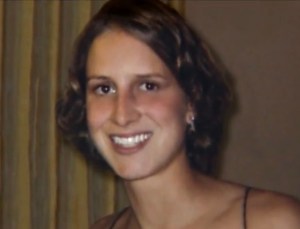
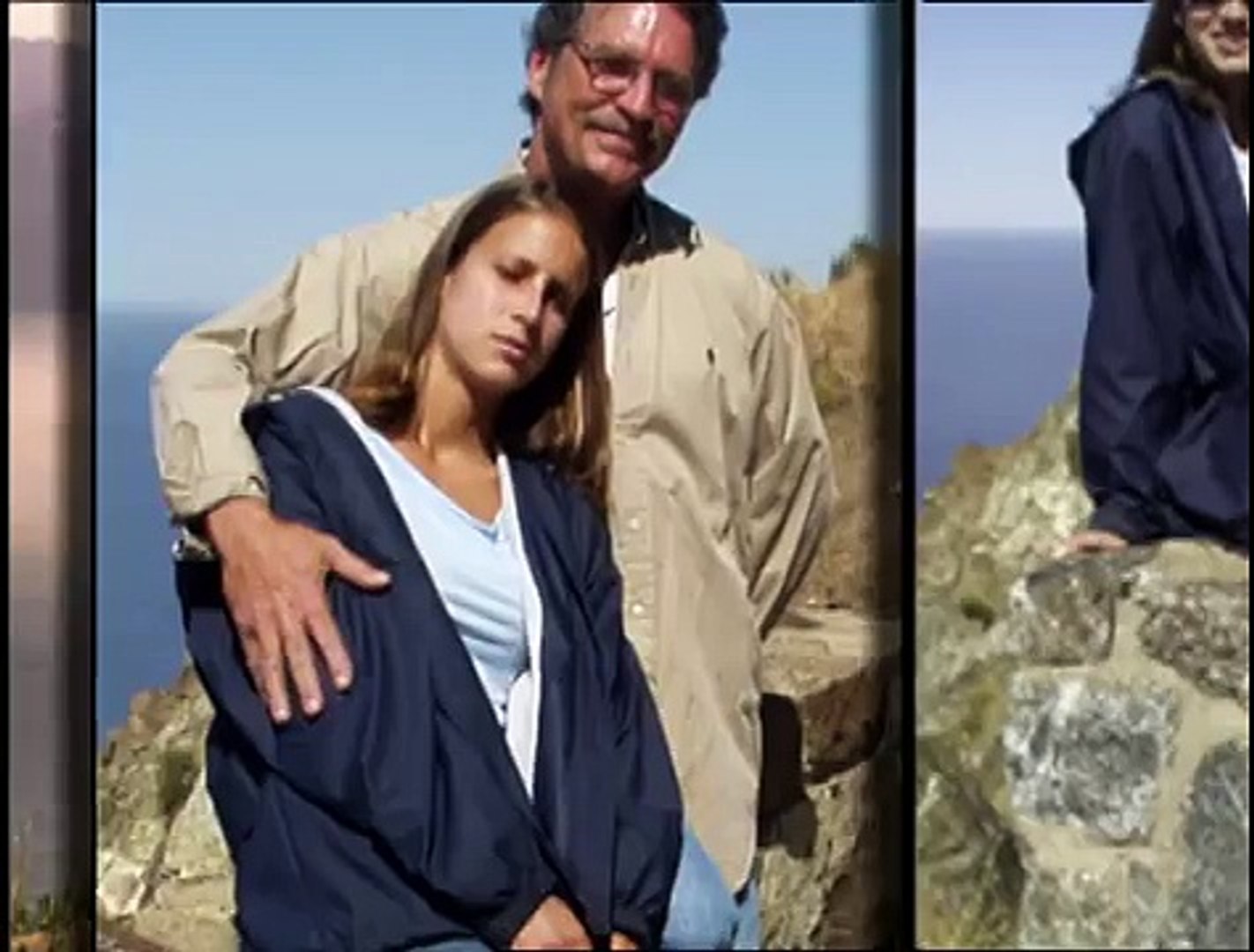
Virginia Reardon, 55, and Billie Joe McGinnis, 52, pushed Navy spouse and roommate Deanna Hubbard Wild, 20, off a 400 foot cliff at Big Sur in California on April 2, 1987. Deanna was living with her husband’s parents while he was at sea with the U.S. Navy. The motive was life insurance and Virginia had a string of insurance claims she cashed in on including Deanna’s death. The couple lured Deanna to the location under the guise of sight seeing, drugged her at lunch, and then it appears Billi Joe pushed her off the cliff. In the meantime, Virginia Reardon is taking pictures the entire time; investigators theorized she wanted a trophy of the homicide. After Deanna’s mother, Bobbie Roberts, found out her daughter was dead, she questioned the accidental ruling. She hired her own private investigator and attorney and they learned that Virginia Reardon had purchased a $35,000 life insurance policy the day before Deanna’s death. Reardon and McGinnis were arrested in 1989 for the murder of Deanna Wild. In 1991, Billi Joe McGinnis was charged with first degree murder but died from complications from pneumonia before his trial started. Virginia was charged and convicted on March 2, 1992 of first degree murder for financial gain. She was sentenced to life in prison, no parole. Virginia Reardon died while serving out her sentence on June 25, 2011.
One of the infamous photos taken before the murder. Investigators believe in this photo Deanna Wild was feeling the effects of the drugs she was given to make her vulnerable.
Forensic Files:
A beautiful, vibrant young woman fell to her death from a cliff overlooking the Pacific Ocean. Initially, investigators thought it was just a terrible accident. But after a closer forensic examination of photographs taken at the scene, police had a very different story of what had happened. -The Financial Downfall, Forensic Files (S9,E12)
Investigation Discovery:
ID Go: Cross these deadly vixens at your own risk. An English beauty spars with her boyfriend, a middle-aged woman sacrifices lives for money, and a couple of game players lure an innocent man into a deadly trap: these women will certainly fight to the death. -Vicious Vixens, Deadly Women (S7, E5)
Editor’s note: With a cable subscription, you can download the free ID Go app and watch Investigation Discovery programming at your convenience. And for those who do not have cable, you can watch “unlocked” episodes on the ID Go app including the latest premieres. For those who prefer commercial free programming during your binge session, Prime Video has an ID channel: ‘True Crime Files by Investigation Discovery” available for $3.99 a month. It’s a compilation of older seasons but totally worth the cost if you are a true crime addict. Download the ID Go app or purchase ID True Crime Files & binge away.
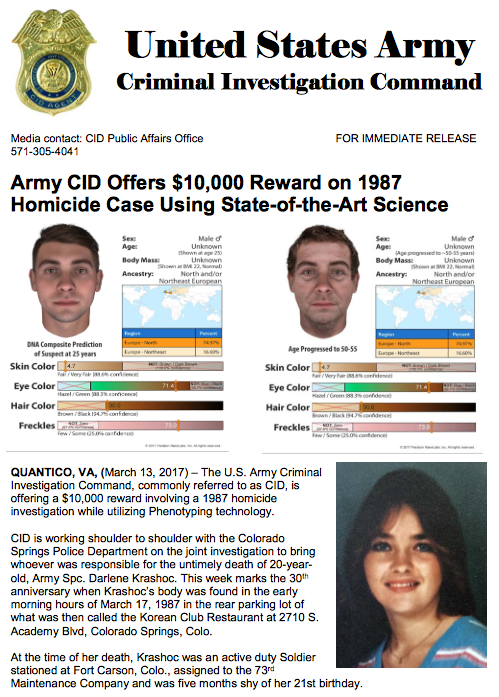
The victim: Darlene Krashoc, 20, a soldier at Fort Carson who worked as a mechanic at the Army post.
The Crime: Two Colorado Springs police officers on routine patrol spotted a partially nude woman laying in the parking lot behind the Korean Restaurant, a nightclub formerly at 2710 S. Academy Blvd., around 5:20 a.m. on March 17, 1987. An autopsy determined that Krashoc had been strangled with a coat hanger and leather thongs after being severely beaten, bitten, sexually assaulted. She may also have been thrown from a moving vehicle.
The investigation: Krashoc’s mother, Betty, last spoke with her daughter a week before her death. Krashoc had changed from a soldier ready to re-enlist to a frightened woman ready to go AWOL to get away from Fort Carson, but wouldn’t tell her mother why.
Colorado Springs Police Department considers a case to be cold if it remains unsolved for more than one year. If you have information that would be of assistance in these investigations, please contact 719-444-7613, by e-mail at CSPDColdCase@springsgov.com or you may remain anonymous and could earn a cash reward by calling Crime Stoppers at 634-STOP (7867). –The Gazette
Thirty years after Krashoc’s body was found, Army Criminal Investigation Command are offering a $10,000 reward to anyone who can lead them to the man they believe killed Darlene Krashoc. If you have any information about the investigation or if the DNA prediction results resemble someone you know or knew at the time, you’re asked to contact your local CID office or CID headquarters in Virginia at (844) Army CID or (571) 305-4375. You can also email army.CID.crime.tips@mail.mil.
When 22 year-old Micki Filmore is found raped and murder in her apartment, detective Kenda focuses his investigation on her activities the previous night. Micki was seen dancing with a man who then paid a late night call to her door. -A Killer Always Rings Twice, Homicide Hunter (S1, E3)
Colorado Springs is the home of five military bases made up of about 40,000 personnel. A lot of them live off-base in local apartment units. On July 19, 1986, as Army Spc. Tracy Spencer was walking by, he noticed his neighbor Micki Filmore was laying lifeless on the floor in her apartment. He was alarmed and ran to his wife Lisa to seek help. She claims she went through the window of the apartment because of her own concern for Micki and discovered that she was in fact dead. They called the police. Lt. Joe Kenda of the Homicide Unit at the Colorado Springs Police Department was assigned to investigate the case. Kenda deduced from the observation of the crime scene that there did not appear to be any struggle, the victim’s wallet and cash were present, and she was naked with her legs open and bruising around her neck. He suspected Micki Filmore was raped and strangled in a quick and brutal attack.
Joe talked about the crimes of rape and murder for a bit. He talked about how rape is unfortunately a very common crime but he also noted that rape and murder is not that common. Lt. Kenda educated the public about the fact that rape and sexual assault is mostly a punishment of women. And in this particular case, the perpetrator surprised Micki Filmore while she was in bed. His only purpose was to rape and kill her. While Joe waited on the results of the autopsy, he tried to figure out the modus operandi of this particular offender because he would strike again. Joe wondered why it was so important for this person to get in and out of the apartment quickly. Was he a local and making sure that nobody saw and recognized him? Neighbors Lisa and Tracy Spencer reported they saw Micki the night before; she was happy, eating pizza, and nothing appeared out of the ordinary.
Joe canvassed the neighbors in the apartment complex and learned that Micki was having troubles: he heard from neighbors that her fiancé left her, she was pregnant, and broke but nobody knew who the father of the child was. One neighbor told Lt. Kenda that he went to a night club with her the night before. He claimed that while they were there, she saw someone she knew. She left the club with her neighbor around 2 a.m. but she did give a piece of paper to the friend she ran into at the club. The neighbor claimed they talked for a little bit and then went their separate ways. After lying down, the neighbor heard knocking on her door. He looked out briefly and saw the same man from the club standing there. Another neighbor said she was awoken by a loud scream and then a thumping noise around 3:45 a.m. She assumed whoever it was they were fighting. Joe still had little evidence to go on but the autopsy helps tell a story.
The autopsy revealed that Micki Filmore’s last moments were met with violence, anger, and rage. And she had engaged in sexual relations within the last twelve hours. Despite what her neighbors said, she was not pregnant and there were no drugs or alcohol in her system. Lt. Kenda learned Micki was twenty-two years old and originally from a rural community in North Carolina. She joined the Army straight out of high school, did a three year tour of duty, traveled the world, and her service ended in December 1985. She was looking forward to leaving to be with her fiancé in a few weeks. Lt. Kenda contacted the fiance and learned that he had not abandoned Micki. The fiance was finalizing a divorce so he could marry Micki and he could verify his whereabouts at the time of the murder. The fiance shared he asked his friend Frank Lynch to look out for Micki while he was gone; but now he had concerns that maybe he was involved. This gave Kenda a new lead and potentially a new suspect.
Kenda met with Frank Lynch who denied any involvement in the murder and could account for himself on the night in question. As a result, Kenda closed out Lynch and in the meantime got a phone call from DiCarlo Dowden. DiCarlo was the man at the club that Micki gave a piece of paper to and the same man suspected of showing up at her apartment the night of the murder. DiCarlo admitted that he ran into Micki at the club, they chatted, they danced, she told him she was not ‘with’ her neighbor (he was an escort), and then gave him her number. She also gave him her address which to him was an invitation so DiCarlo dropped by her apartment but no one answered the door so he left. DiCarlo noticed that a neighbor did see him after looking out their window, which also matched the neighbor’s story. DiCarlo denied any involvement in the crime and there was no probable cause to arrest him, he did volunteer to provide biological evidence for testing.
It takes several weeks for the comparative analysis testing to be completed at the labs. Joe reiterated that DiCarlo was not off the hook yet. On August 12, 1986, another body was discovered in the same apartment complex. Lt. Joe Kenda knew this was not a coincidence. The victim was twenty-four year old Barbara Kramer who was a nurse at Eisenhower Hospital in Colorado Springs. She didn’t show up to work so her sister and a friend went over to her apartment to check in on her. They discovered the newspaper outside her door, signs of a struggle in the apartment, and the friend found Barbara Kramer dead in her bedroom. The family was devastated because they were already worried about her safety after the first murder in that apartment complex but they reported that Barbara was cautious and playing it safe. Kenda was horrified by what he saw at the crime scene because he immediately knew it was the same guy.
The modus operandi of both crimes was exactly the same aside from one woman was black and one woman was white. Both were displayed with their legs open after they were murdered; both were attacked in the middle of the night between the hours of 4 and 7 a.m.; both were single females living alone; both were strangled; and both were living in the same apartment complex. Lt. Kenda was feeling an even more heightened sense of urgency because this guy was a serial killer and was not going to stop; he wanted to prevent a third victim. He also deduced that the killer probably lived in the area and he was carrying on as if nothing mattered. He questioned DiCarlo about his whereabouts and DiCarlo was cleared as a suspect because his girlfriend could alibi him. Kenda knew DiCarlo wasn’t his man because the person he was looking for killed Micki Filmore and Barbara Kramer.
Lt. Kenda knew these murders were similar offenses; they were the same crime, different targets. He wondered how many more had to die before the Colorado Springs Police Department could stop him. Kenda theorized that the perpetrator most likely stalked his victims before the attacks. He did not feel that these crimes were random and he believed that the perpetrator surveilled his victims. This offender simply waited for the right place and right time. Kenda noted that these guys are not as intelligent as one would think but they are cunning. He knew the guy made mistakes and he had to be the one to find them. After interviewing more neighbors about the night before, Kenda learned that one neighbor was awakened to screams around 6 a.m. and another neighbor saw Tracy Spencer banging on Barbara’s door with a piece of paper in his hand around 6:25 a.m. She saw the door open, Spencer enter the apartment, and then the door slam.
This new information intrigued Lt. Kenda because now Tracy Spencer not only found Micki Filmore’s body but a witness saw him knocking on Barbara Kramer’s door around the time that she died. Kenda looked into his criminal history and found only minor offenses, nothing to indicate a propensity for violence. But Kenda was going to apply for a warrant regardless and arrest Tracy Spencer based on the evidence he had. But first he wanted to talk to Tracy’s wife. Lisa was still claiming that Tracy was with her the night of the murders so Kenda told her that a witness saw him and she began to cry. Kenda did not understand why she would protect him and told her she could be arrested next. She told him she did lie and that Tracy was not with her all night. As a matter of a fact, she admitted that he left the apartment in the middle of the night often and went for walks. She claimed Tracy told her he kept finding Barbara’s mail on the ground and wanted to return it to her, despite locked mailboxes at the apartment complex.
Lisa Spencer also admitted to finding an empty envelope with Barbara’s name on it so she threw it away. She observed Tracy get angry when he couldn’t find it but she never told him she threw it away. She also confessed that she did not go through the Micki’s apartment window like she originally shared with the police; she went into the apartment to help Tracy cover up the crime. When Kenda asked her why, her response was that she loved him. Kenda learned that Tracy was on the move so he made a decision to arrest and take him to the station before he hurt someone else. Kenda got a search warrant for his apartment and found the letter he couldn’t find right in the trash where his wife said she put it. And it did in deed have Barbara Kramer’s name on it. Kenda questioned Tracy at the station and even after he was told there were witnesses, Spencer stuck to his story. Eventually he folded some and admitted to taking mail to Barbara but said he didn’t go inside her apartment.
Kenda realized Tracy Spencer was a prolific liar. He denied everything. Kenda confronted him with the semen he said matched him (which was a lie) and then Tracy admitted that he was lying to him because he was having an affair with Micki and did have consensual sex with her that night. He had an explanation for everything. The bottom line was that he was going to commit the crimes regardless of the consequences and then lie about it. That’s what they do. The lab results came back and showed that both Tracy’s blood and hair samples matched those at the crime scenes. Tracy Spencer was arrested for the first degree murders of Micki Filmore and Barbara Kramer. On December 31, 1986, Tracy Spencer was found guilty and sentenced to life in prison plus twenty-four years. He is eligible for parole in 2032. Lt. Kenda ended the show with the fact that Spencer overpowered, raped, and killed two girls he didn’t even know for no real reason. Two women paid the price for his crimes and there could have been more, and that scared him.
Editor’s note: With a cable subscription, you can download the free ID Go app and watch Investigation Discovery programming at your convenience. And for those who do not have cable, you can watch “unlocked” episodes on the ID Go app including the latest premieres. For those who prefer commercial free programming during your binge session, Prime Video has an ID channel: ‘True Crime Files by Investigation Discovery” available for $3.99 a month. It’s a compilation of older seasons but totally worth the cost if you are a true crime addict. Download the ID Go app or purchase ID True Crime Files & binge away.







 MILITARY JUSTICE FOR ALL