Reporting abuse was risking my life – US veteran & rape victim
Correction: Jennifer Norris is not an advocate for MRCC. She left the organization in March 2014.
We hear a lot about #weinstein and the latest, but Jennifer Norris, who served in the US Air Force, has been talking about sexual assault for years. And in the military, reporting rape means endangering yourself. Watch this brave woman speak here https://t.co/1ipeI3SWP6 pic.twitter.com/TAjiVjmdDS — SophieCo (@SophieCo_RT) January 12, 2018
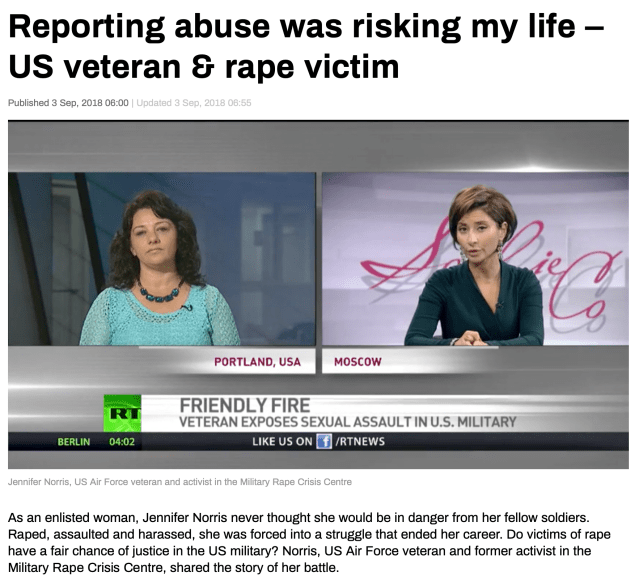
As an enlisted woman, Jennifer Norris never thought she would be in danger from her fellow soldiers. Raped, assaulted and harassed, she was forced into a struggle that ended her career. Do victims of rape have a fair chance of justice in the US military? Norris, US Air Force veteran and former activist in the Military Rape Crisis Centre, shared the story of her battle.
Sophie Shevardnadze: Jennifer Norris, retired U.S. Air Force veteran, former activist in the Military Rape Crisis Centre, who herself had firsthand experience of sexual assault in the military, thank you for joining us on this programme. I want to start right away, the first time this happened, you were drugged by your recruiter – did he trick you into having sex with him? Do you have any recollections of how the incident happened?
Jennifer Norris: When I look back on this incident I realise that I was actually tricked by this man into going to the party to begin with. He had told me that there was a new recruit party for other recruits. I was excited to go and meet them because they would understand exactly how I felt. So he had ill intentions from the gitgo. When I got there there were no new recruits, I was the only one.
SS: How many times were you subjected to sexual assault or abuse? Was it just one case?
JN: It started with that one case and I thought that maybe it would be over after that, that I was just unlucky at the wrong place at the wrong time, so I pushed forward. But, unfortunately, as I entered the military service it happened again and again, and again within the first two years of service.
SS: Tell me this – why didn’t you report it straight away, after that first time?
JN: I didn’t report the first time because I hadn’t even gone to basic training yet and I didn’t really know what to say. I didn’t even know where to go: if I was supposed to go to a commander in the military, if I was supposed to go to the police department. I was completely clueless as to what sexual assault, rape and harassment were at that time. So I just tried to soldier on, move on with the career that I was looking for doing for at least twenty years.
SS: So what happened after you were assaulted? What did you feel? Was it guilt? Was it shame, uncertainty?
JN: It used to be shame because I used to feel like an idiot for going to this person’s party. But after years of counseling and working with rape victims’ advocates I learnt that predators operate in much the same way: they are very manipulative and they will set you up for an attack or they will take advantage of an opportunity. So now I realise it was a calculated crime but it took me years to realise that.
SS: So for those who haven’t faced this kind of ordeal, but danger is always there, tell us how these manipulators actually trick their victims into it? How do they lure you in?
JN: I think, they do what you would call ‘grooming’, they make you believe that they are trustworthy and that they are going to take care of you, and it almost seems that it is too good to be true. When you are naive, you don’t necessarily realise that not everybody is speaking at face value. So as an 18-year-old or even a 24-year-old it’s easy to fall prey to the niceties because you don’t know that there’s evil lurking behind it. And I think that’s the real danger of this kind of people and how they operate is that they are able to get to us based on the trust that’s been established. In the military we are depending on each other in every way, especially in trust.
SS: So how old were you when that happened? Like, eighteen?
JN: No, I was actually 24. I had already graduated from college, as a social worker I worked in the field for a couple of years. As a case manager I worked on a suicide crisis hotline, then I decided I wanted to go and get my master’s degree and the military offered the GI Bill that could help me accomplish those goals. So that’s the No.1 reason why I joined aside from being patriotic and wanting to give back and being involved in something that was bigger than myself. I was completely clueless as to what was in store.
SS: Ok. One woman who went through a similar ordeal – Air Force Sergeant Marti Ribeiro said, “The military has a way of making females believe they brought this upon themselves.” Did you feel that as well?
JN: Yes.
SS: Did you blame yourself for what happened?
JN: I did for the longest time especially with the recruiters incident. If I knew as soon as I walked through that door that there was danger but it was too late to turn back… That particular incident taught me a lot of how to take care of myself in the future. Unfortunately, if you are working for someone who’s assaulting you you can’t escape them. So now I don’t have shame or blame or any of that stuff any more as far as what I did. All I did is go to work in uniform and these people took advantage of their power and opportunity. That’s what we’re trying to change, it’s taking more seriously if someone does in fact abuse their power in that kind of setting.
SS: I’m trying to figure out the psychological aspect of it – how did the military structure make you feel guilty about what had happened and not the other way round?
JN: I understand. So, given the way that you report currently in the military is not that you go to a police office to report a crime. You are supposed to report it to your commander. In my particular case and in a lot of soldiers’ cases the commander also has a relationship with the perpetrator and he may have known the perpetrator way longer than he knows you. So what it does it creates an atmosphere of intimidation that when you see your commander hanging out with the guy who assaulted you, then you feel like “Oh, wow, he’s not going to take me seriously, it looks like they both are really good friends”. And then when you do go ahead and do a report the first thing the defense attorney start looking into is whether or not you did this, you did that, how did you conduct yourself. They immediately go into that you shouldn’t have been in this place, if you hadn’t that wouldn’t have happened. They could have done that to me too. But it’s not our fault that we thought we were attending what we were supposed to be.
SS: Jennifer, I’m thinking, there are also other women in the military, they are compassionate creatures, you could have shared your story with them, they certainly would have understand what you went through, especially if this happens all the time. Maybe there were other women alongside you who were actually subjected to sexual assaults – did you share your story with any of your female peers?
JN: What I’ve learnt is that, first of all, I was one of very few women in my squadron. There may have been, if we were lucky, three of them and one of them is administration personnel, and maybe there was another one in another shop. But I was the only female working for satellite communications in combat communications. So, no, I didn’t have other females that I could turn to and say “hey, this has happened to me”. As the matter of fact, I didn’t want anyone to know that this had happened to me because I didn’t want to be judged. Unfortunately, it appears that once people learn that you’ve reported a sexual assault or may have been involved in an incident they become scared of you instead of being scared of the perpetrator. They think that you are going to be hypersensitive too if they swear or if they say something, you know, offensive when in fact it’s not going to be that way at all. So there’s a culture of fear built up in the military. And I think that’s why they want to automatically blame it on a woman because if she goes away the problem goes away and they can get back to work as normal.
SS: Human Rights Watch reports a very dire picture of what happens to the victims of sexual assault. They say that these people are being “spat on, deprived of food, assailed with obscenities, threatened with ‘friendly fire’ during deployment…discharged for misconduct”. Is it true? Is it really that dangerous to come forward?
JN: It is. In some cases it just depends on your situation. If you are isolated you are in a way more danger than, say, other people would be on some big base that has security forces in a JAG office. But if you are in some place like the Azores or some other random location across the world all you have is the people that are with you. Then yes, you could be in grave danger if in fact someone harms you and threatens you and says that if you say anything they will kill you. It happens, I’ve researched this. We have had non-combats deaths occur overseas that include homicide and unsolved cases that nobody is talking about. That’s what we are trying to tell people is…
SS: Did you get any threats? Were you threatened?
JN: Yes, not only was I threatened, but I was physically beaten after I reported by one of the perpetrators’ friends. The entire squadron turned on me. I was automatically the liar. Even though they didn’t know the circumstances and even though we did have proof and we were able to move forward with two of the four cases the other people in the squadron didn’t know what happened and they believed the perpetrator who was able to tell them the story while I was at some other squadron waiting for the case to go through.
Reporting abuse was risking my life – US veteran & rape victim
SS: But see, for me it’s just mind-bogglingthat you were standing there harassed, assaulted in the open with other people standing by and not interfering. How come no one interfered? Why didn’t troops come forward for a fellow soldier?
JN: Well, I did have a couple of people that had my back along the way. But it felt more like it was a culture of fear, like, nobody dared to stand up to those who were higher-ranking if they were the ones that were doing the harm because they were afraid it would have backlash on their career. Now I don’t have respect for those people who didn’t stand by and take a stand and support the ones who were actually being harmed. But along the way there were some silent people that came up to me and said that this person had done this to them, that that person had done that to them etc. So people would open up along the way but they wouldn’t take it as far as I did and actually report. Although I must say it was because of the senior master sergeant that I finally confided in. He’s the one that finally convinced me to report the four individuals to the commander.
SS: Iraq veteran Chantelle Henneberry says she was less scared of enemy fire than the men she served with. She recalls she would drink less water to avoid going to the bathroom in the night, she was so terrified of being harassed – why do women even join the army despite hearing all these horrific stories?
JN: I think that it boils down to that people don’t think it would happen to them. And that’s just typical of society, you don’t think that bad things are going to happen to you. I had the same mentality before I joined too. So they want to follow their dreams and they want to do what they want to do and some of us dream of being in the military, retire, do great things and move women forward. So I think that’s normal, that’s ok.
SS: The United Nations is speaking out about the problem of sexual assault in the U.S military, saying it needs to ‘ensure effective prosecution of offenders’. Is this going to make any difference?
JN: Absolutely. Right now, the prosecution rate for sexual assault is less than 10% compared to the civilian world which is at least 40%. That’s what we are trying to say – if people are raped or assaulted and then report we would like these cases to be taken seriously. Right now, like I spoke to you earlier, you have to report the crime to your commander. They are not legal professionals, they are no Special Victims Unit. They do not understand how these things work. And what we want is to be able to report to a police department or a law enforcement professional, someone who understands how these people are working and cannot be manipulated by them.
SS: For years, activists and lawmakers in the United States have tried to change this protocol – but leaders in the military are against bringing civilians into bases to investigate alleged assaults – why are they against it? And why are they winning this debate?
JN: Because they are able to protect their institutions if they are able to keep everything in house, and that’s exactly what they do. They want to stamp it out before it gets out to the public whereas we want this out in the public so that people know who these offenders are and can be on alert. They don’t just offend people in the military, they offend people in our communities as well – their wives, their children… So it’s not just a military issue, it’s a societal issue and I think, it would be way more effective if everyone reported to a police department where all the crime data was kept in one place.
SS: Do you think completely removing sexual assault cases from the military chain of command would actually solve the problem?
JN: I think standardizing the justice process in general to have it synced with the civilian society, meaning data basis connected, whether it’s the civilians that try the perpetrator or it’s the military that tries the perpetrator… Everyone should be talking so that we can connect the dots on who’s doing what where because it makes it a little bit more complicated with the military personnel who can transfer all over the country and to different parts of the world. We need all the data collection to be put into a system so we can actually track what these people have done through the course of time and be able to move forward with cases that may win as opposed to he-said, she-said incident.
SS: So, Jennifer, I’m thinking, maybe there should be more women in the U.S. military? If there were more women in high-ranking positions being able to kick butt especially to the men who are potential assaulters? What do you think? Should there be more women in the U.S. military?
JN: That would be ideal. Although we have to take into account that over a half of victims in the military, actually 53% of them are males. So this is not a female issue necessarily. We are at higher risk because we’re seen as a weaker sex. But predators do not discriminate: they are harming both men and women in the military. A lot of media have been trying to cover the issue but we have just not been able to get the footing with it, but people need to know that over half of the victims are men in the military.
SS: There are crazy numbers: according to HRW, only 5 percent of sexual assault cases in the U.S. military lead to convictions of the perpetrators. What happened to the man who assaulted you? Was he punished?
JN: Yes. The recruiter skipped town after I threatened to report him to the commander, unfortunately. So we couldn’t do anything with that case. The technical instructor that assaulted me in Keesler, Mississippi – we had no jurisdiction over because he was active-duty and I was considered National Guard. And the other two were both National Guard members who worked with me, and we were able to move forward with cases. But by the time it went up the chain of command it got minimized from sexual assault to sexual harassment they both retired with full benefits after 20 years of service.
SS: The Pentagon keeps saying that programs are implemented, changes are being made, and the problem is being solved – is it all a lie?
JN: I don’t think it’s all a lie, but I definitely think they sway the media to see things in a certain way. For example, although the numbers may have gone down from 26 thousand to roughly 19 thousand in the last couple of years and they’re bragging about a 30% increase in the reporting it means nothing. And what the civilian world doesn’t understand is that in the military you can report a crime under two different guises: either restricted or unrestricted. If it’s restricted that means that nobody is supposed to know about it including your commander so you can go forward and get some help. If it’s unrestricted then it turns into a full-blown investigation if, in fact, your commander agrees to move forward with the case which is another sticking point. So people need to realise that although the reporting has gone up it’s been restricted reporting which is not helping us catch these criminals. They are still not being reported. You might get some help but they are still moving along in their careers assaulting other people while the latest victim is just getting help.
SS: You now work with those who went through the same as you did – are you seeing more cases of women speaking out, has the situation gotten better?
JN: I think awareness has definitely gotten better around the issue. There’s way more talk within the military and outside in the veteran community to address getting help after someone has been traumatized by an incident like this. So that has definitely improved. I actually benefited greatly from programmes that have come up as a result of our advocacy with military sexual assaults. So for that I’m thankful. As far as the military justice system and policy goes it’s the same thing it has always been – nothing has changed whatsoever. As far as the court issue we’ve been trying to address which is taking the commander out of the decision-making process as far as you can move forward with the case. We just want law enforcement professionals, detectives and investigators to deal with these cases, not a commander who’s great at war but has absolutely no idea how the legal process works and what sexual assault is. I shouldn’t have reported it to my boss.
SS: What do you do for the victims, how are you helping them?
JN: What I do is I empower them. When I did worked as an advocate I actually would help them deal with their cases as they were moving along in the process and I noticed the same patterns over and over. What I do now (and it was actually hard to do it before we could change things) is focus on helping them to heal despite not being able to get justice, trying to find a place of faith and comfort in yourself to know that you didn’t do anything wrong. It’s just the system that isn’t working well and it needs to be changed, and there’s nothing we can do about it right now except to take care of ourselves and hope for the best in the future.
SS: You mentioned earlier that it’s not just men-women problem and that 51% percent of those assaulted being men. I’ve read a recent survey by the American Psychological Association that says the number of men facing sexual assault in the military is 15 times higher than reported by the Pentagon. That would mean up to 210 thousand men are assaulted in one year. Is that number correct? Is it a right calculation? And do you help men as well?
JN: Yes, whoever needs help and comes to me – I will assist them as best as I can. That actual study from the American Psychological Association was retracted. They used not a very good way to determine those numbers. It wasn’t correct so it was retracted. It’s not actually that high. But it doesn’t really matter. It’s still high enough that it should be a concern. The actual number that I shared with you is that roughly 53% of victims of military sexual assault are males. It’s not a female soldier issue, it’s a predator issue and that’s what we’re trying to tell people.
SS: Jennifer, thank you so much for sharing this story with us. Thank you so much for empowering women who want to do the same thing that you did. Thank you so much for being so brave and outspoken. And I hope that you’ll win over Pentagon.
JN: Thank you.
Related Links: