Joanna Rogers and Rosendo Rodriguez, US Marine Corps Reservist
On September 13, 2005, Summer Baldwin, 29, was found in a suitcase in a landfill in Lubbock, Texas. After an extensive investigation, authorities zeroed in on US Marine Corps Reservist Rosendo Rodriguez. In the course of the investigation, Rodriguez also admitted to murdering Joanna Rogers, 16, on May 4, 2004 in Lubbock Texas. But there was not enough forensic evidence to connect Rodriguez to Joanna’s murder. Joanna’s badly decomposed body was also found in a suitcase in the the landfill. Rodriguez was found guilty of two capital murders: Summer Baldwin and her unborn baby. Rosendo Rodriguez was sentenced to death in the State of Texas. Rodriguez appealed his death penalty conviction but a federal court denied the request in May 2017.
The body of a young mother was found in a suitcase in a Texas landfill. The suitcase leads investigators to Rosendo Rodriguez, who had an overwhelming amount of forensic evidence against him. But upon an extensive search of the same landfill, Rogers’ decomposing body was also found in a suitcase. -Forensic Files
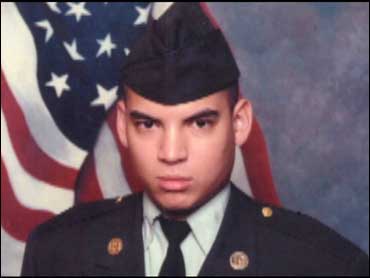
Spc. Richard T. Davis, U.S. Army (photo: CBS News)
“On July 15, 2003, less than two days after returning from deployment to Iraq, Davis was murdered outside Fort Benning, Georgia by a fellow soldier from Baker Company, Alberto Martinez. Three other soldiers were also present and involved in the events that led up to the killing and followed the killing. Initially, the Army concluded that Davis deserted and despite pleas from Davis’ father, would not initiate an investigation into his son’s disappearance for nearly two months. Davis’ remains were not found until November 2003. He had been stabbed in the head, neck, and chest at least thirty-three times. His body was later dismembered, doused in lighter fluid, and burned. Unnamed sources have suggested that Davis was killed because he had planned to make a complaint about a rape of an Iraqi woman by US troops.”
Read more about Richard T. Davis (Wikipedia) here.
Based on a True Story:
“In the Valley of Elah” tells the story of a war veteran (Tommy Lee Jones), his wife (Susan Sarandon) and the search for their son, a soldier who recently returned from Iraq but has mysteriously gone missing, and the police detective (Charlize Theron) who helps in the investigation. -In the Valley of Elah, Warner Bros.
Disabled Army veteran Jack Irwin, 71, went missing from Upland, California on September 13, 1999. About nine months earlier, Jack sold his cabin at Mt. Baldy to Judy Gellert and Marcia Johnson who also befriended him. Apparently he let them make payments on the mortgage at the cabin because they were low on cash and he wanted to move to a warmer climate. At one point he had confided in some close family friends that the couple were no longer making payments and the whole situation was making him feel uncomfortable. Then Marcia reported Jack missing. She told police he went on a trip to Seattle, Washington to visit the Space Needle.
Jack’s other friends informed police they suspected Judy and Marcia because of their large purchases since moving to Mt. Baldy, including a corvette. At the time of Jack’s disappearance in 1999, he had about $230,000 in the bank. By January 2000, his bank account was down to $14. Police learned the couple sold Jack’s home in Upland and bought a luxury home in San Diego. And the cabin at Mt. Baldy burned to the ground in August 2000 resulting in an insurance pay out of $170,000. The pair had access to half a million dollars and spent almost all of it. Detectives also discovered Marcia sued a therapist for emotional distress and was awarded a $30,000 settlement.
Marcia became involved in a sexual relationship with another therapist after claiming she broke up with her girlfriend. Her partner Judy found out about the affair and convinced Marcia to file yet another lawsuit against a therapist. In the course of the depositions for the lawsuit the therapist claimed Marcia was delusional because she admitted to killing her brother and sister and an old man who lived on Mt. Baldy. As a result of this information, detectives put a wire tap on Marcia and Judy’s phones and started turning up the heat. As a result, Judy Gellert was arrested for accessory to murder because she admitted to knowing about what happened.
Marcia Johnson was arrested for murder after acknowledging she murdered Jack Irwin. Marcia told detectives Jack Irwin showed up to the Mt. Baldy cabin, mostly likely to confront Marcia about the money she owed him. Marcia admitted that she got angry and just wanted him to shut up. So she went into the house, grabbed a gun, and shot him in the back of his head. She then grabbed a chainsaw and cut off his head, hands, and feet. Afterwards, Marcia sealed the body parts in plastic bags and dumped them in a remote location on Mt. Baldy. On November 2, 2004, Marcia Johnson was found guilty on twenty-six counts including first degree murder, arson, grand theft, elder abuse, and insurance fraud.
On December 15, 2004, Marcia Johnson was sentenced to life without the possibility of parole. Judy Gellert accepted a plea bargain in exchange for her testimony against Marcia Johnson and was sentenced to 180 days in jail, five years probation, and ordered to pay $150,000 in restitution. The detectives considered this one of the most cold blooded crimes they had ever heard of. Marcia Johnson was a con. She was greedy and didn’t care about anyone but herself. She is the type who does not accept responsibility for their actions and everything is always someone else’s fault. Jack Irwin was an unsuspecting victim who didn’t realize that he had been targeted for his disability benefits, bank account, and assets from the get go.
Four years after a 71 year-old Korean War hero goes missing near Upland, California, a DA’s investigator picks up a trail of clues that seem to lead to the victim’s closest friends. -Come Back Jack, Murder Book (S2, E13)
Editor’s note: With a cable subscription, you can download the free ID Go app and watch all of the Investigation Discovery programming at your convenience. And for those who do not have cable, you can watch “unlocked” episodes on the ID Go app including the latest premieres. Download the ID Go app and binge away. For those who prefer commercial free programming during your binge session, Prime Video has an ID channel: ‘True Crime Files by Investigation Discovery” available for $2.99 a month. It’s a compilation of older seasons but totally worth the cost if you are a true crime addict.
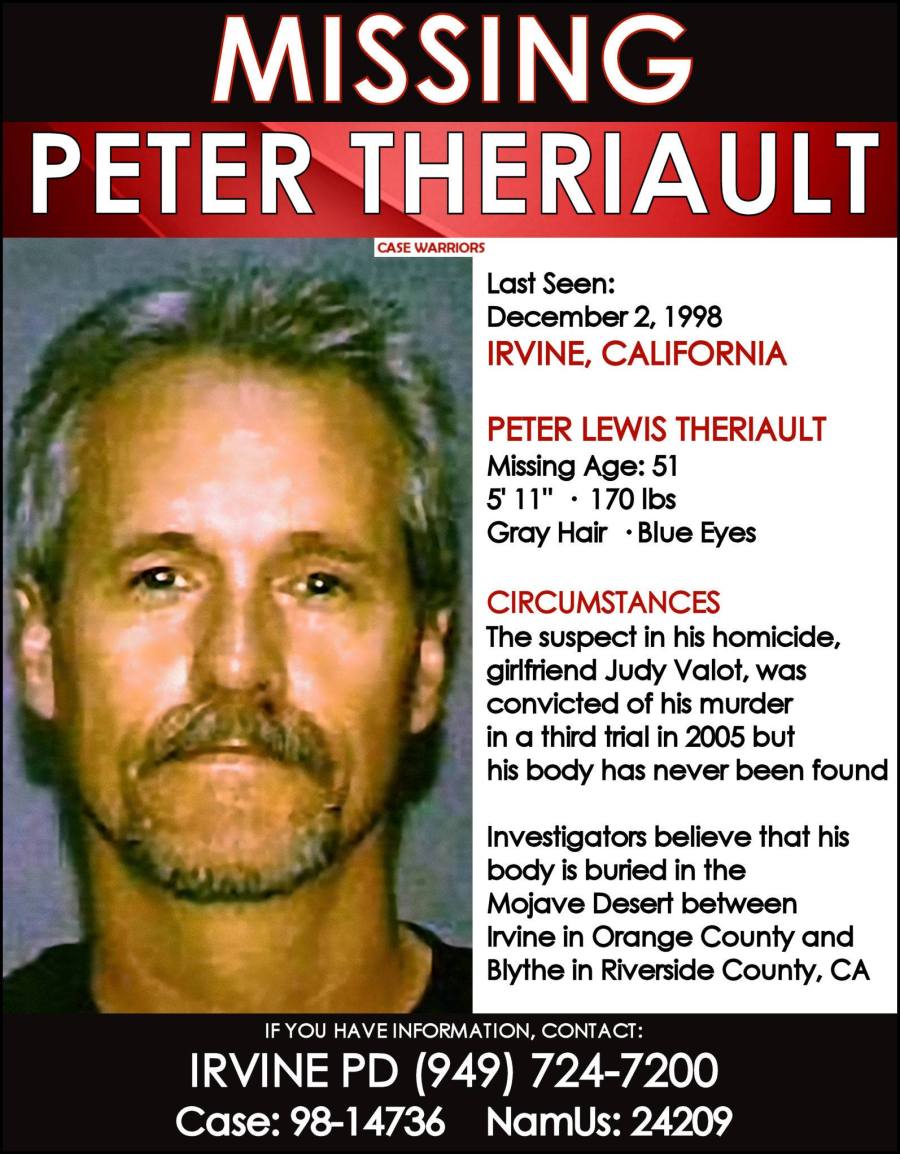
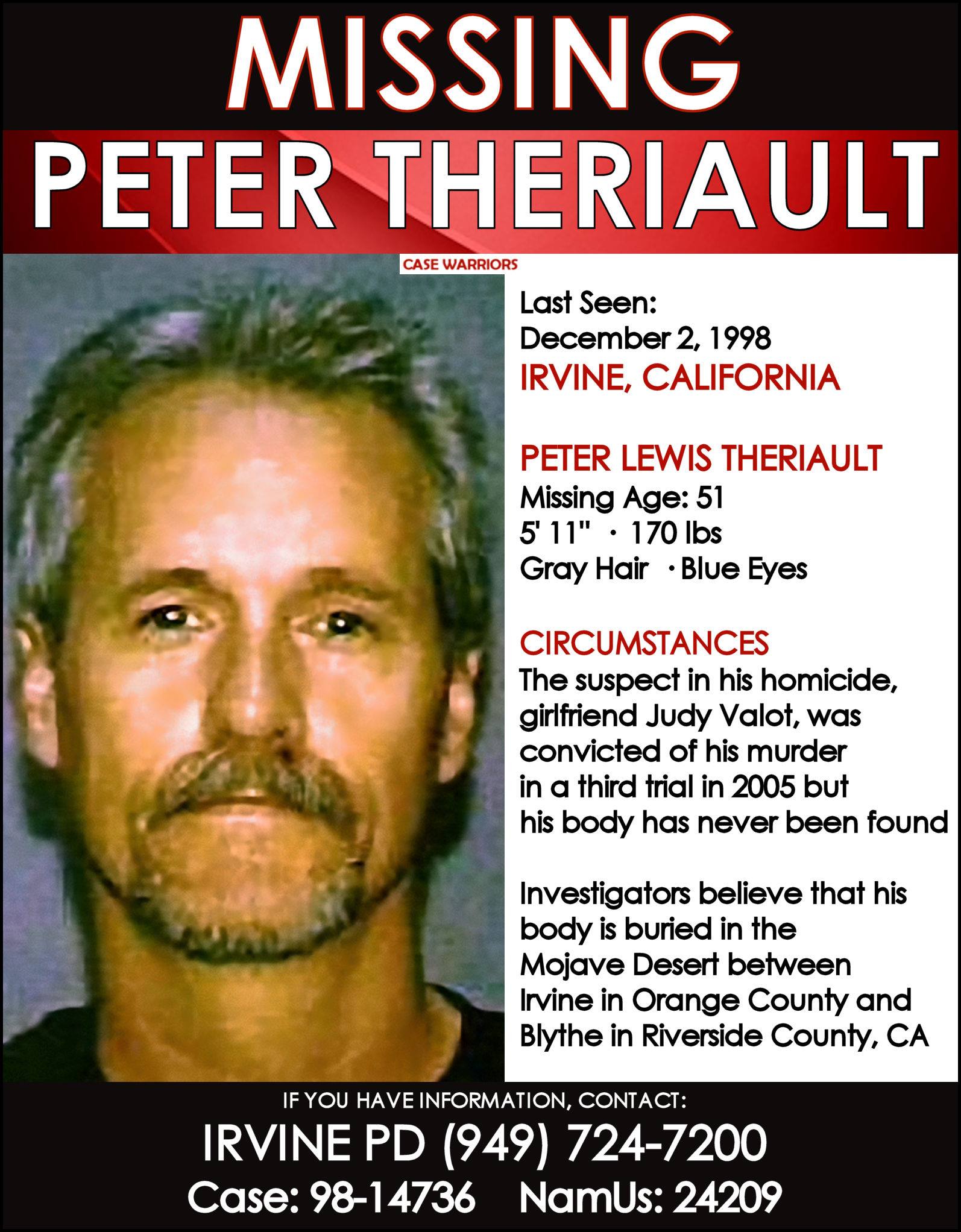
Army veteran Peter Theriault went missing on December 2, 1998 from Irvine, California. Live-in girlfriend Judy Valot, 54, was charged and convicted of second degree murder in January 2000 despite a body, weapon, or any physical evidence. She was found guilty of murdering Peter Theriault and disposing of his body in a California desert because she was convinced he was cheating on her. There was no evidence that Peter was in fact cheating on her. Valot appealed her conviction and was granted a new trial. And again in 2005, Judy Valot was found guilty of second degree murder. She was sentenced to fifteen years to life in prison. Judy Valot was denied parole in February 2013 as she maintains her innocence and refuses to reveal the location of Peter’s body who is still missing to this day.
Investigation Discovery:
In December 1998, Peter Theriault, 51, fails to arrive for his shift at a car plant in Commerce City, California. Pete hasn’t missed a day of work in almost three decades. Friends and family immediately suspect something is very wrong. -The Green Eyed Monster, The Perfect Murder (S5,E7)
Editor’s note: With a cable subscription, you can download the free ID Go app and watch Investigation Discovery programming at your convenience. And for those who do not have cable, you can watch “unlocked” episodes on the ID Go app including the latest premieres. For those who prefer commercial free programming during your binge session, Prime Video has an ID channel: ‘True Crime Files by Investigation Discovery” available for $3.99 a month. It’s a compilation of older seasons but totally worth the cost if you are a true crime addict. Download the ID Go app or purchase ID True Crime Files & binge away.
Army Officer Training School (OTS) candidate Lisa Gaudenzi, 31, disappeared from her Caroline County residence in Ruther Glen, Virginia on January 26, 1995. Lisa was a married, mother of two children, and was supposed to report for duty in Fort Lee, Virginia but never showed up. Her husband Lawrence Gaudenzi said the last time he saw Lisa was when he dropped her off at the bus station. The military police looked into the absence but after no solid leads, deemed Lisa absent without leave (AWOL); she was eventually dishonorably discharged. After an extensive investigation, spanned over 15 years, Lawrence Gaudenzi was charged with Lisa’s murder on May 16, 2008, despite Lisa’s body never being found.
For no apparent reason, during the middle of his trial, Lawrence Gaudenzi pleaded guilty to second degree in May 2009 and was sentenced to 25 years in prison. Prosecutor’s theorized that Lawrence overheard Lisa tell a friend that she was getting a divorce from Lawrence after OTS. Lisa was tiring of Lawrence’s violence and control issues; she was ready to move on. After about a year in prison, Lawrence Gaudenzi finally led investigators to where he hid Lisa’s body in Spotsylvania County 15 years prior. Virginia State Police found the last of Lisa’s remains on June 9, 2010 and delivered them to her family. Lisa’s AWOL and Army discharge status were upgraded and she was buried with full military honors.
A mother of two vanishes the day before she reports for Officer Training School. Her husband claims she ran off with another lover, but her family suspects something much worse. It takes 14 years for the truth to emerge…from the least likely of sources. -The Perfect Suspect
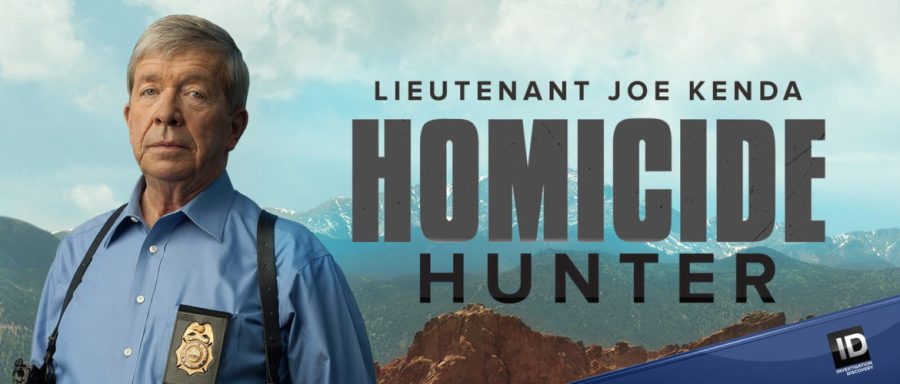
When the severed head of a wife and mother is found, Lt. Joe Kenda uses forensics and interrogation to find both her body and her killer. Then… a young man’s murder looks like a robbery gone wrong until Kenda learns the odd reason he’s living there. -The Line Goes Dead, Homicide Hunter (S6,E13)
On October 16, 1993, a mother was home with her son cooking supper. She went outside to call her dog Shadow to return home. When the dog returned, he had something large in his mouth. Danielle and her son realized that the dog had a human skull in it’s mouth. Lt. Joe Kenda of the Colorado Spring Police Department was grocery shopping when he got the call. He left his grocery shopping cart as is and headed to the scene. When Kenda arrived on the scene, the medical examiner was observing the skull. The medical examiner observed another animal got to the skull before the dog did and the time of death was within the last couple of weeks. The skull appeared to be a female with no obvious signs of bullet wounds or trauma. But they didn’t have the rest of the body to determine the official cause of death. Lt. Joe Kenda decided to start with the missing persons reports first.
Kenda also wanted to find the rest of the remains. Unfortunately, it was dark outside so they decided to resume the search the next day in during the daylight hours. The police used cadaver dogs to find the rest of the body. Cadaver dogs are trained to notify their handler when they make a hit. Kenda knew this would be a daunting task because El Paso County is the size of Rhode Island. An hour into the search, the K9 officer got a hit. They found a few more human bones; some still had flesh attached and some had teeth marks on them. Kenda theorized maybe she was a hiker out for a walk one day and got attacked by a bear. Now Joe Kenda needed to identify the dead female. They used dental records to determine if the dead woman’s teeth matched any dental records on file. On the third missing woman’s dental records, they finally found a match. Diane Pelkey, 36, was reported missing one week prior by her husband Michael Pelkey.
Michael Pelkey paid for a full page ad in the newspaper looking for Diane Pelkey. Police learned Michael was a 16 year veteran in the US Army and lived off post in Colorado Springs with his wife. Kenda now had the unfortunate task of informing Michael Pelkey of his wife’s death. He told him positive identification was made through dental records. Michael Pelkey was overcome with grief. They had been together for over 15 years. They had a son and she was four months pregnant. Michael claims the last time he saw Diane they were out at dinner and then got in an argument. He said she walked away from him and he had not seen her since. Kenda deduced she would have had to walk ten miles to get home. Kenda decided she was not killed by a bear, she was killed by a human. They didn’t know if maybe someone picked her up hitchhiking and killed her. Michael Pelkey claimed he didn’t look for his wife because he had to go home and take care of their five year old son.
As Kenda was reviewing the missing persons report for Diane Pelkey, he noticed one of the officers put JDLR (Just Doesn’t Look Right) on the bottom of the report. This is usually done when an officer feels something isn’t right or the person making the report was suspicious. Kenda spoke with the officer who took the report. They both decided the missing persons report was suspicious because Michael didn’t say anything about their child, Diane’s pregnancy, or that they got in an argument that same night. Kenda explained that usually if someone thinks something happen to a loved one, they won’t leave him alone. Kenda ran Michael Pelkey’s name through the data base and found there was a history of domestic violence, restraining orders in the past, and the couple had filed for a divorce. Kenda believed Michael Pelkey may have killed his wife but he wasn’t sure he had the authority to pursue the case.
Diane Pelkey’s remains were found in El Paso County, Colorado so the case may be out of Kenda’s jurisdiction. He pressed the sheriff’s office to put the squeeze on Michael Pelkey. They brought him into the sheriff’s department and started questioning him. They presented all the evidence they had to Pelkey and he became overwhelmed. Michael broke during the interrogation and admitted to killing his wife on October 8, 1993. He claimed they were in the car and he wanted to do some fishing. They started arguing; he accused her of being unfaithful, she accused him of being unfaithful. He said she wanted out of the vehicle to get some space from him and that didn’t sit well with him. Michael claims he snapped and started strangling Diane. Michael tried to claim that it was an accident. Kenda thought this was not an accident because it takes two to three minutes to strangle someone to death.
Michael Pelkey then told detectives he panicked after strangling Diane and decided to drive to a rural area in the Rocky Mountain foothills to dispose of her body. He put a seatbelt on her and drove as if she was simply a passenger in his car. He drove to a ravine near the highway and left her in an area where he didn’t think anyone would find her. Afterwards, he filed a missing persons report and took out an ad in the local paper to deflect suspicion from himself. Michael Pelkey probably thought he would get away with murdering her wife. But his plan unraveled and he was arrested for murder. The District Attorney allowed the Fort Carson Army leadership to court martial him despite the fact that the crime occurred in El Paso County. Michael Pelkey was convicted of second degree murder and sentenced to life. He is serving his sentence at Fort Leavenworth, a military penitentiary in Kansas.
You are held to a higher standard in the United States military. You will not behave in this way and if you do, you will be one sorry son of a bitch. Sgt. Pelkey found that out the hard way. -Lt. Joe Kenda
Editor’s note: With a cable subscription, you can download the free ID Go app and watch Investigation Discovery programming at your convenience. And for those who do not have cable, you can watch “unlocked” episodes on the ID Go app including the latest premieres. For those who prefer commercial free programming during your binge session, Prime Video has an ID channel: ‘True Crime Files by Investigation Discovery” available for $3.99 a month. It’s a compilation of older seasons but totally worth the cost if you are a true crime addict. Download the ID Go app or purchase ID True Crime Files & binge away.
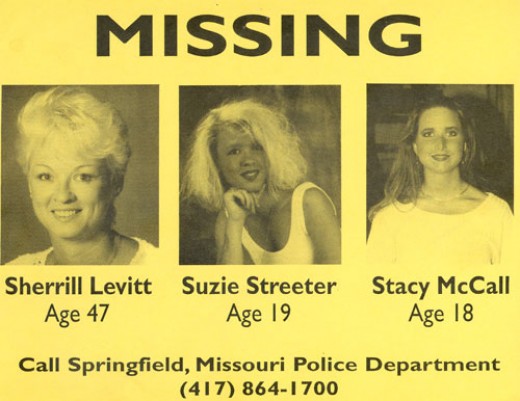
Sherrill Levitt, Suzie Streeter, & Stacy McCall (The Springfield Three) went missing from Springfield, Missouri on June 6, 1992.
Sherrill Levitt, Stacy McCall, and Suzanne Streeter disappeared from Sherrill’s Springfield, Missouri home on June 6, 1992. ‘The Springfield Three’ were spending the night together and when the home was inspected there didn’t appear to be a struggle of any kind. It’s as if the three women just vanished, which still gives the families hope, despite the harsh reality they were probably the victims of foul play. Army veteran Robert Cox was named a person of interest in their disappearance. In California, Cox pleaded guilty to kidnapping and assault with a deadly weapon and was sentenced to nine years in prison and dishonorably discharged from the Army. After his release, Cox was convicted and sentenced to death in 1988 for the 1978 murder of Sharon Zellars in Orlando, Florida. But in a rare ruling that conviction and death sentence was overturned in 1989 due to lack of evidence. After released, Robert Cox moved to Springfield, Missouri where he coincidentally worked with Stacy McCall’s father. But there was no evidence linking him directly to ‘The Springfield Three’ disappearance, therefore he was never charged with any crime. In the meantime, Cox was arrested in Texas for aggravated robbery and it was while he was in custody that he declared he believed ‘The Springfield Three’ were dead and whoever did it was someone who knew what they were doing. To this day, the three women are still missing and no one has been charged with any crimes. If you have any information that could help solve this mystery, please contact the Springfield Missouri Police Department.
In the News:
June 6, 1992 – Stacy McCall, 18, graduates from Kickapoo High School in Springfield. She meets her friend Suzie Streeter, 19. The two plan to travel to stay in Branson overnight. McCall phones her mother to say she and Suzie will be staying at a friend’s house in Battlefield. They left the home and decided to spend the night at Suzie’s home at 1717 E. Delmar St. -KY3 News (June 3, 2010)
Three Missing Women 1992 Springfield, MO 2 -KY3 News (June 3, 2010)
Three Missing Women 1992 Springfield, MO 3 -KY3 News (June 3, 2010)
Three Missing Women 1992 Springfield, MO 4 -KY3 News (June 4, 2010)
Looking back 21 years of The Springfield Missing Three -Ozarks Sentinel
True Crime Daily:
What happened to Stacy McCall, Suzanne “Suzie” Streeter, and Sherrill Levitt? These three women vanished in Springfield, Missouri in 1992, after Susie and Stacy attended a graduation party. Crime Watch Daily’s Kim Goldman is determined to find out what happened to them. -True Crime Daily (Part 1)
What happened to Stacy McCall, Suzanne “Suzie” Streeter, and Sherrill Levitt? -True Crime Daily (Part 2)
What happened to Stacy McCall, Suzanne “Suzie” Streeter, and Sherrill Levitt? -True Crime Daily (Part 3)
YouTube, Podcasts & Documentaries:
BrainScratch: The Springfield Three -LordanArts
The Springfield Three -True Crime Garage
June 6th, 1992 was an important day for the seniors at Kickapoo high school, Missouri. After years of hard work, it was finally graduation, a time of excitement and uncertainty, the future full of promise. But for Suzie Streeter and Stacy McCall the night would end in mystery, when they and Suzie’s mother Sherrill seemingly vanished into thin air. This is the story of the Springfield Three. -Case Remains
The Springfield 3 I Missing Presumed Dead #9 -Deadbug Says
Twisted 2’s #12: Springfield 3 & Eyeball Killer -Scary Mysteries
The Following Is A True Crime Documentary Based Off The Unfortunate Disappearances Of Three Women In Springfield Missouri. -Skinned Locus
Where are the Springfield Three? -Vanished Without a Trace -Shauna Rae
The Tragic Case of Gina Clark & The Springfield 3 – Without a Trace -Creepypasta.com
Investigation Discovery:
Preview: June 6, 1992, hours after their graduation, Stacy McCall, Suzie Streeter and her mother Sherrill Levitt go missing without a trace. They are later dubbed, “The Springfield Three”. -Disappeared, Investigation Discovery
Preview: More than 15 years after the disappearance of “The Springfield Three”, clues to their location may lie beneath a parking garage at Cox Hospital. Will investigators find the answers they need to bring the missing women home? -Disappeared, Investigation Discovery
“Milwaukee, Wisconsin, police officers spot Tracy Edwards running down the street in handcuffs, and upon investigation, they find one of the grisliest scenes in modern history: Jeffrey Dahmer’s apartment.
A forensic examination of the apartment turned up 11 victims–the first of whom disappeared in March 1989, just two months before Dahmer successfully escaped a prison sentence for child molestation by telling the judge that he was desperately seeking to change his conduct. Dahmer later confessed to 17 murders in all, dating back to his first victim in 1978.”
Investigators Probing Whether Accused Killer Had German Victims With AM-Body Parts, Bjt (AP, July 26, 1991):
“BONN, Germany (AP) – Police across Germany on Friday reopened files of unsolved murders and disappearances, seeking possible links to an accused mass killer in Milwaukee who served with the U.S. Army here. Dahmer was stationed from July 1979 to March 1981 with the 68th Armored Regiment in Baumholder in central Germany’s Rhineland-Palatinate state, where officials say five unsolved murder cases were being re-examined to seek any connection to Dahmer.
But four of the five murder victims were women, and no links to Dahmer have been made, said Christiana Kleinschmidt, a federal police spokeswoman in Wiesbaden. In addition, federal authorities said they were reviewing all cases of unidentified male murder victims or missing men during the time Dahmer was in Germany. Dahmer joined the Army in 1978 after dropping out of Ohio State University. He was discharged from service early because of alcohol problems.” Read more from AP here.
Little-Known Fact #5 about Dahmer from The Lineup:
#5 He served as a combat medic in the U.S. Army
“In January 1979, Dahmer enlisted in the U.S. Army. He trained as a medical specialist in San Antonio, Texas, and was deployed to Baumholder, West Germany. From 1979 to 1981, Dahmer served as a combat medic, during which time he reportedly raped two soldiers; the first victim claimed Dahmer raped him once after drugging him. The second, who was Dahmer’ roommate, stated that he was raped repeatedly while they shared a living space. Dahmer’s alcoholism followed him to West Germany as well. In 1981, after being declared unsuitable for military service, Dahmer was honorably discharged and sent back to the United States.” Read more from The Lineup here.
Six weeks after the murder of Steven Hicks, Dahmer enrolled at Ohio State University with hopes of majoring in business. However, his alcoholism meant that he only achieved low grades and he dropped out after just three months. In 1979, his father then encouraged him to join the U.S. Army where he trained as a medical specialist.
During his time in the army, two soldiers came forward with claims they had been drugged and raped by Dahmer. In 1981, he was deemed unfit for military service and received an honourable discharge.
Preston Davis, who was in the military service at the same time as Dahmer, recalled, “Jeffrey had killed his first victim a year before joining the military, and he would get drunk in the barracks and say, ‘I killed the guy in Ohio,’ and we’d say, ‘You didn’t kill nobody!’ He became a monster once he started drinking. Alcohol is what turned him into a monster.”[5] Read more from Listverse here.
Robert Hansen was a mild-mannered family man with a passion for hunting. A master at his trade, Hansen sought a more challenging prey – his fellow human. Hansen kidnapped women, set them loose in the Alaskan wilderness, and hunted them down for sport. -Hunting Humans, Ice Cold Killers (S1, E1)
Serial killer and Army Reserves veteran Robert C. Hansen confessed to the murder of 17 women and the kidnapping and rape of another 30 women in Alaska. But the authorities believe there are many more victims and their cases are still open. Hansen was officially charged with the abduction and rape of Cindy Paulson and the murders of Joanna Messina, Sherry Morrow, Paula Goulding, and the unidentified body known as “Eklutna Annie.” On February 28, 1984, Robert Hansen was sentenced to 461 years plus life in prison with no parole. Hansen led the police to 17 grave sites he marked on a map but only 12 of his victims bodies were recovered. Robert Hansen’s health was declining for over a year when he died of natural causes on August 21, 2014 at the age of 75.
In 1982, two off-duty police officers were hunting for wild game. As darkness fell and they headed home, they made a gruesome discovery. They knew enough to back away and dispatched the Alaska State Troopers to the scene. The crime scene investigators unearthed the partial bones of a woman buried in a shallow grave. They also found bones scattered around the surrounding area. In Alaska, wild game won’t hesitate to drag off the evidence. They also found a 223 caliber bullet casing. The victim was bound and blind folded at the time of death, and she was shot three times. She was identified as Sherry Morrow; Sherry was drawn to Alaska for the easy money. She worked as an exotic dancer in a seedy area of Anchorage known as ‘Fourth Avenue’. Police looked to see if anyone else in that community had disappeared under similar circumstances. Before the discovery of Sherry’s body, none of the missing persons reports were linked or suggestive of murder. Morrow’s case inspired police to take a look at the cold case files.
Two years before Morrow’s body was found, construction workers found the partial remains of a woman buried in a shallow grave; her body was desecrated by wild life and her bones were scattered. Police couldn’t make an identification and dubbed their Jane Doe “Eklutna Annie”. Nobody ever came forward with information about Annie. Police were concerned they were dealing with a brutal killer so they started canvassing the area where the dancers spent their time. Sherry’s co-workers feared the worst because a number of women had gone missing and they were never heard from again. Over the next several years, five more dancers went missing. Police suspected Sherry and Annie’s cases were connected. They were all victims from the beginning because everyone preyed on these girls, including the bar owners and pimps. Several dancers reported seeing the same man and provided police with a physical description. Police learned of a third body found in a gravel pit near where Eklutna Annie’s body was found.
The victim was identified as Joanna Messina. She was a canary worker who was last seen leaving the dock with her dog and a red haired man her co-workers couldn’t identify. Messina was shot and killed with a 22, not a 223. Two more women vanished and were never seen or heard from again. The blindfolds at the crime scenes told the police a lot about the killer. He was a sexual sadist who wanted complete control. He derived pleasure from his victim’s fear and pain and disposed of their bodies in isolated areas in Alaska. Nine months later, a truck driver found a frantic hand-cuffed woman running in the road; someone with a gun ducked out of site. The trucker took her to a nearby hotel where she was safe and called the Anchorage police. The police found a 17-year-old woman still in handcuffs and in shock. She told the officers she was a topless dancer down on 4th Avenue; she said she was propositioned by a red haired man in his 40s the night before. She confessed that she accepted the stranger’s offer.
Once inside the man’s car, she said the man pulled a gun on her. He kidnapped her, handcuffed her, and told her if she cooperated and did what he wanted, she wouldn’t be harmed. He took her to a middle class house in Muldoon. He held her hostage in a basement filled with mounted heads of animals. He brutalized her for hours. He chained her to beam in the basement and repeatedly sexually assaulted her. She told the police he was going to fly her to his cabin in the woods, promising to release her if she cooperated. Once at the airport, the kidnapper shoved her in a small plane and began loading supplies. The second he turned his back, she made her escape. Hoping to corroborate her account, investigators took her to the airfield to find the plane. She identified a plane owned by Robert Hansen; he was a 50 year-old avid hunter and local business man. Hansen owned a well established bakery, had lot of friends, and went to church. By all accounts, he was an upstanding member of the community.
When questioned by police, Hansen was outraged and insisted the dancer was lying to extort money from him. He also questioned whether it was even possible to rape a prostitute. He claimed he had an alibi and told investigators his wife and children were in Europe and he spent the night playing poker with friends. When questioned, the two men substantiated his story. Hansen allowed authorities to search his home but they didn’t find evidence of what the victim described. She also refused to take a polygraph and this made the police wonder if she fabricated the story. It was a “he said, she said” case because they had no evidence. Citing a lack of evidence, the prosecutor dropped the case. Three months later, Alaska State Troopers discovered the partially decomposed remains of another woman in a shallow grave. She was identified as a missing dancer from the Fourth Avenue district. Investigators found a blindfold buried among the remains. An autopsy revealed Paula Goulding had also been shot by a 223 caliber bullet.
Initially, the police didn’t link the cases but the use of the 223 caliber bullet helped them realize they were dealing with a serial killer who was targeting exotic dancers in Anchorage. Troopers contacted the Federal Bureau of Investigation for assistance; agents created a behavioral profile of the serial killer. The killer believed he was invincible because he picked the perfect victims. He chose the dancers on Fourth Ave because he thought no one would care if they were missing. They started looking into Robert Hansen’s past. They learned he was abused as a child and had very low self-esteem. He was always considered small and had few friends; he was often ridiculed by his peers. After graduating from high school, Hansen enlisted in the Army Reserve and went to basic training at Fort Dix. He later received advanced training as a military police officer at Fort Knox. While enlisted in the Army, he was known to frequent prostitutes. He told fellow soldiers, he found them dissatisfying and yearned to take control of the situation.
Despite his strict up bringing and disciplined military structure, the profilers learned Hansen had a number of run-ins with the law. He served time for arson and theft but he appeared to have long since left that life behind. In 1967, he married and moved to Alaska. He was a functioning member of society. They believe his low self-esteem would drive him to live in a place like Alaska. His former neighbor told investigators he loved the thrill of the hunt; and he was always looking for the bigger hunt. He was an avid trophy hunter. Hansen’s weak point was women because he was unsuccessful with them. He hunted where most of the victims were found. “Perhaps Hansen tired of game and turned to more interesting prey like humans.” Humans create a much greater challenge to the hunter. Police deduced he most likely had trophies from his hunts for humans. The killer was a sexual sadist, proficient, and more successful over time. Authorities threatened the two men who alibied him with jail time if they didn’t come clean about the night the dancer was abducted.
Both friends quickly broke down and said they were covering for him because they thought he was a legitimate guy. They believed him when he said he thought the dancers were trying to extort him. The police asked Hansen to come down to the station and executed a search warrant. An officer searched the attic and in the rafters he found a bag of jewelry. And nestled with his bag of trophies, they found IDs belonging to the victims and newspaper clippings. Authorities also found a trophy map with locations of where he killed his victims. Hansen tracked his kills. The most critical find was a 223 caliber mini 14 rifle. The rifle was sent to the crime lab for further analysis. The 223 matched perfectly with the round they found in Eklutna. Robert Hansen was charged with assault and kidnapping. Despite his pleas of innocence, the evidence was mounting against him. The District Attorney agreed to charge Hansen with four murders: Sherry Morrow, Eklutna Annie, Joanna Messina, and Paula Goulding. Hansen accepted a plea deal. Police believe he chose prostitutes because they represent the evil in humans.
Robert Hansen chose prostitutes because they will go anywhere for anything and when they disappear, no one cares. He admitted he controlled the game from the point of abduction. He was the predator and they were they prey. He killed Eklutna Annie first. Then he abducted Sherry Morrow. He took most of his victims to his remote cabin and brutalized them for hours before he stripped them naked, blindfolded them and then released them in the woods. He turned them loose, gave them a head start, and hunted them down. He was a trophy hunter. He then collected things off the girls so he could re-live the events. Robert Hansen’s killing spree lasted twelve years in Alaska. Hansen confessed to 17 killings but it is believed he had many more victims. He eventually lead police to 15 gravesites unknown to investigators. Unfortunately, investigators only recovered 7 bodies likely due to the veracious animal activity in the Alaskan wilderness. Robert Hansen was sentenced to 461 years plus life in prison with no chance of parole.
A Killer Among Us: Inside the Hunt for an Alaska Serial Killer (June 11, 2017, KTUU-Channel 2, Anchorage, Alaska)
The Frozen Ground Movie (2012)
THE FROZEN GROUND Official Trailer (2013)
The Frozen Ground – Clip 3 | Lionsgate
The Frozen Ground (2012) – Chained Scene (1/10) | Movieclips
The Frozen Ground (2012) – The Lucky One Scene (2/10) | Movieclips
The Frozen Ground (2012) – Pole Dancing Scene (3/10) | Movieclips
The Frozen Ground (2012) – Hunting Her Scene (4/10) | Movieclips
The Frozen Ground (2012) – On the Run Scene (5/10) | Movieclips
The Frozen Ground (2012) – Shock at the Strip Club Scene (6/10) | Movieclips
The Frozen Ground (2012) – The Interrogation Scene (7/10) | Movieclips
The Frozen Ground (2012) – From Bad to Worse Scene (8/10) | Movieclips
The Frozen Ground (2012) – He’s Coming Scene (9/10) | Movieclips
The Frozen Ground (2012) – Truth Comes Out Scene (10/10) | Movieclips
Based on a true story. An Alaskan State Trooper (Nicholas Cage) must partner with a near victim and the only witness to escape the clutches of the serial killer in order to bring the murderer to justice. -The Frozen Ground
Frozen Ground – Examining the Frozen Ground
Editor’s note: With a cable subscription, you can download the free ID Go app and watch all of the Investigation Discovery programming at your convenience. And for those who do not have cable, you can watch “unlocked” episodes on the ID Go app including the latest premieres. Download the ID Go app and binge away. For those who prefer commercial free programming during your binge session, Prime Video has an ID channel: ‘True Crime Files by Investigation Discovery” available for $2.99 a month. It’s a compilation of older seasons but totally worth the cost if you are a true crime addict.
Sherrill Levitt, Stacy McCall, and Suzie Streeter vanished from Sherrill Levitt’s Springfield, Missouri home on June 7, 1992. Dishonorably discharged Army veteran Robert Craig Cox was named a person of interest in their disappearance. Cox not only had a history of violence and run ins with the law but he was living in the Springfield, Missouri area at the time of ‘The Springfield Three’ disappearance and coincidentally worked with Stacy McCall’s father. While serving in the Army, Cox pleaded guilty to kidnapping and assault with a deadly weapon in California. He was sentenced to nine years in prison and dishonorably discharged from the Army, ironically after being named ‘Soldier of the Year’ in 1979. Cox was also a suspect in the death of 19 year old Sharon Zellers who disappeared after leaving work at Walt Disney World on December 30, 1978. Zellar’s badly beaten body was found several days later near Orlando, Florida in an orange grove. Cox was in central Florida visiting his parents and as a result became a suspect because he was staying in a motel close to the grove. Hospital staff also reported Robert Cox to authorities because part of his tongue had been bitten off by someone else, despite his claims that he bit his own tongue off. A case against Cox was never pursued by Florida authorities due to lack of evidence, therefore the case went unsolved for a decade. But after Cox was released from prison in California in 1986, Florida authorities charged Cox with Sharon Zeller’s murder and he was convicted and sentenced to death in 1988. Although in a rare ruling, the Florida Supreme Court overturned the murder conviction and death sentence arguing that prosecutors only had circumstantial evidence which was not enough to convict in a criminal case. Robert Cox was released in 1989 and then moved to Springfield, Missouri where he worked with Stacy McCall’s father. Although questioned in the disappearance of the three women, Cox has not admitted to any wrongdoing and authorities have found no evidence linking him to their disappearance. To this day, ‘The Springfield Three’ have not been found and no one has been charged with any crimes.
Stacy McCall, Sherrill Levitt, and Suzie Streeter went missing from Springfield, Missouri on June 7, 1992.
More than 15 years after the disappearance of “The Springfield Three”, clues to their location may lie beneath a parking garage at Cox Hospital. Will investigators find the answers they need to bring the missing women home? -Investigation Discovery










 MILITARY JUSTICE FOR ALL