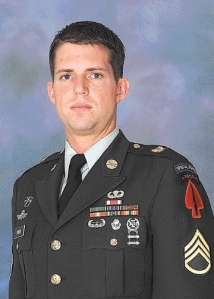
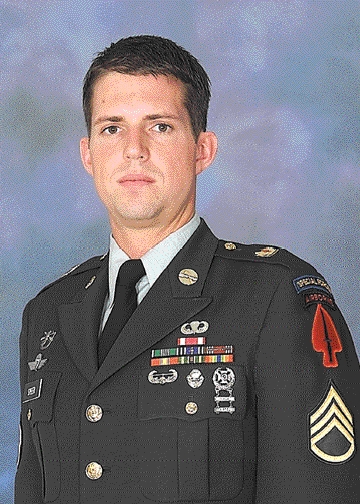
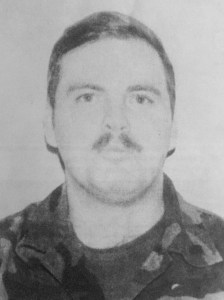
Army Sgt. 1st Class Christopher Speer, 28, died on August 7, 2002 as the result of wounds received in action on July 27, 2002 in Afghanistan. SFC Speer was one of five soldiers wounded in the same incident and was evacuated to Germany for medical care. SFC Speer was assigned to Headquarters U.S. Army Special Operations Command at Fort Bragg, North Carolina.
In March 2005, Fort Bragg Army Sergeant Cedric Ramon Griffin, 28, pleaded guilty to murdering his wife Marilyn Griffin and setting her home on fire on July 9, 2002 in Fayetteville, North Carolina. Sgt. Griffin was charged by the Cumberland County Superior Court with the first-degree murder of his estranged wife Marilyn Griffin, first-degree arson, and the attempted murder of Marilyn’s two daughters. Marilyn died as a result of approximately 50 stab wounds to the chest, neck, back and abdomen; the preliminary autopsy results indicated Marilyn died prior to the fire. Marilyn’s daughters, ages 6 and 2, woke up during the fire, escaped, and went to a neighbor’s house for help. According to law enforcement officials, the motive appeared to be “domestic related” and Sgt. Griffin turned violent after Marilyn threatened to reveal his infidelity to his commander. The couple were married for eight years and Marilyn was murdered two months after she left Sgt. Griffin. She moved into her new home only a week before she died. Sgt. Cedric Griffin faced the death sentence in North Carolina if he was convicted of stabbing his wife to death but according to the Army Wives book, former Army Sgt. Cedric Griffin pleaded guilty to murdering Marilyn Griffin and is serving a life sentence in the Central Prison in Raleigh, North Carolina.
This domestic violence related homicide was one of five murders that occurred in a six week period at Fort Bragg in 2002. Rigoberto Nieves fatally shot his wife Teresa after an argument on June 11, 2002; William Wright admitted to strangling his wife Jennifer on June 29, 2002; Brandon Floyd fatally shot his wife Andrea on July 19, 2002; and military spouse Joan Shannon manipulated her daughter Elizabeth to shoot her step-father Major David Shannon on July 23, 2002 while he slept.
Army Pfc. Gary S. Kalinofski, 21, died of a gunshot wound at Camp Magrath near Pristina, Kosovo on March 4, 2002. The military casualty announcement confirmed the gunshot wound was not a result of engagement with hostile forces. Pfc. Kalinofski’s home of record was listed as Fayetteville, North Carolina. Pfc. Kalinofski served in Kosovo since November 2001 in a peacekeeping mission role on behalf of A Company, Task Force 1-32nd Infantry Regiment at Fort Drum, New York. According to the book Army Wives by Tanya Biank, the Army Criminal Investigation Division (CID) ruled that Pfc. Gary Kalinofski died as a result of a self-inflicted gunshot wound. Gary was survived by his parents; his dad also served in the Army and was in Kosovo at the time Gary took his own life. The Army Wives author shared that Gary’s parents were interviewed by Army CID but they didn’t have any insight or knowledge to help Army CID understand why Gary chose to die by suicide.
Editor’s Note: There was no Department of Defense press release for the announcement of the death of Army casualty Pfc. Gary S. Kalinofski in Kosovo.
When some brides vowed to love and honor their husbands, they lied. These Deadly Women made a mockery of marital commitment. They only promised “To Have and To Kill”. -To Have and To Kill, Deadly Women (S8, E14)
Tyshee Prokop and her childhood friends from Killeen, Texas murdered Gary Prokop, an Army soldier stationed at Fort Hood in 1998. Tyshee married Gary shortly after meeting him and they had a child together. But Tyshee wasn’t ready for family life. About a year and a half after they were married, they filed for divorce. Gary was going to get out of the Army and move back home. Tyshee conspired with her friends to have Gary murdered before he got out of the Army so she could collect medical benefits and the $100,000 dollar life insurance policy. He was murdered on June 25th with a single gunshot wound to the head while he was sleeping. One of the co-conspirators, Rodney Barfield, felt remorse about his involvement with the crime. He confessed his full involvement in the murder and detailed everyone’s roles. In 2002, Tyshee Prokop and her friends were arrested and charged with the murder of Gary Prokop. They were sentenced as follows:
Tyshee Manik Prokop – pled guilty, sentenced to life in prison
Charles Edward Turnbull III – convicted, sentenced to life in prison
Rodney Barfield – pled guilty, sentenced to 25 years
Reuben James Salgado – pled guilty (tampering with evidence charge)
Jacob Luther Harris – pled guilty (to a conspiracy charge)
Editor’s note: With a cable subscription, you can download the free ID Go app and watch Investigation Discovery programming at your convenience. And for those who do not have cable, you can watch “unlocked” episodes on the ID Go app including the latest premieres. For those who prefer commercial free programming during your binge session, Prime Video has an ID channel: ‘True Crime Files by Investigation Discovery” available for $3.99 a month. It’s a compilation of older seasons but totally worth the cost if you are a true crime addict. Download the ID Go app or purchase ID True Crime Files & binge away.
Judy Buenoano was executed by the State of Florida on March 30, 1998.
Air Force Sergeant James Goodyear, 37, died on September 16, 1971 in Orlando, Florida. Sergeant Goodyear died just three months after completing a year long tour of duty in Vietnam. He left behind his wife Judy Buenoano Goodyear and her son Michael Buenoano. Judy received $28,000 in military life insurance benefits and military death benefits to help support the family. When her son Michael turned eighteen, he joined the US Army. On his way to his post in Georgia, he stopped in to visit his mother Judy, she fed him, and afterwards he became ill. The illness led to a crippling condition that left him paralyzed in his lower extremities and he was subsequently discharged from the Army as a Private. Michael was disabled and Judy was taking care of him. On May 13, 1980 Judy took Michael for a canoe ride. Judy reported to local authorities that her canoe capsized and her son Michael had drowned. She collected $125,000 in military life insurance benefits for her son’s death.
In June 1983, Judy was suspected in the car bombing of her fiancé John Gentry of Pensacola, Florida. She stood to gain $500,000 in life insurance money for this death. Judy Buenoano was first convicted of the attempted murder of John Gentry. As a result of her involvement in the attempted murder of John, investigators looked into the ‘accidental deaths’ of her husband James Goodyear and her son Michael. They exhumed John’s body a decade later and an autopsy revealed he had been poisoned with arsenic. Testimony revealed long-term arsenic poisoning had actually caused her son Michael’s disability. And when Judy drowned him, he was wearing an extra 15 pounds of weighted braces. Judy reportedly admitted to being involved in the 1978 death of her boyfriend Bobby Joe Morris as well. She received $50,000 in life insurance benefits for his death. Judy Buenoano was found guilty of first degree murder and sentenced to death. She was executed by the electric chair in Florida on March 30, 1998. Judy Buenoano was motivated by money, profit, and greed.
Army SSG Kevin Spann married Gina Lynn Pierce in 1989 and became a step-father to her son. They met in Gina’s hometown in Illinois and moved to Fort Worth, Texas in 1990. About a year after they were married, Kevin was deployed to Kuwait in support of Operation Desert Storm. Gina couldn’t handle being alone so she went back to her hometown in Illinois. After Kevin returned home from Kuwait, he went to Illinois to see if Gina would go to Fort Gordon, Georgia with him. Gina agreed and things were going well until Kevin had to start working long hours. Kevin suggested she get a job to help occupy her time. It would be at this job where Gina would meet three teenagers who quickly became her friends despite the age difference.
Gina became popular with the teenagers when they learned that she could buy them alcohol. They all started partying together at hotels after work and eventually Gina started sleeping with one of them. After awhile Gina just moved the parties to her marital home. Kevin would come home from work and find drunk, passed out kids all over his house. Gina also did not hide the fact that she was sleeping with one of the teens, Larry Kelley. She did not care how Kevin Spann felt about the arrangement. One day, Larry’s step father kicked him out of the house. Because Larry didn’t know where else to turn, he turned to Gina who agreed to let him move in with them. Not only did he move into the house but he moved into the marital bedroom with Gina and Kevin moved out. Kevin slept in another room in the same house.
In the spring of 1997, Kevin had finally had enough and asked Gina for a divorce. But Gina begged Kevin to make the marriage work and she promised him she would change. She knew that if Kevin divorced her she would end up with nothing. Kevin loved her and wanted to make the marriage work so he agreed to try again but he insisted that Larry get out of his house in one week. It would be days later that Gina found her front door open and Kevin lying on the floor in a pool of blood. SSG Kevin Spann was shot twice and killed at his doorstep on Mother’s Day, May 11, 1997. He was shot once in the head and once in the chest, torso area. When the killers left, he was still alive. Kevin bled to death.
Gina and Larry Kelley provided each other with alibis when investigators questioned their whereabouts. Although Larry also told police that he was Gina’s live in boyfriend which peaked investigators interest and made the couple prime suspects. They hauled both Gina and Kevin down to the station. Gina adamantly denied any involvement in the shooting. Larry on the other hand told investigators everything. He told them that Gina asked him to find someone to shoot her husband so he did. He found Matthew Piazzi and Gerald Horne to do the job. Investigators would learn that Gina devised a plan and told the teenagers what to do. After Gina and Larry left the residence, Matthew and Gerald were to knock on the door, wait for Kevin to answer, shoot him, and then get rid of the gun. Matthew was the gunman.
Investigators searched Gina’s car and found a $300,000 life insurance policy for Kevin Spann which gave them the evidence they needed to charge Gina with murder. Gina Spann and Larry Kelley conspired to murder Kevin and were both sentenced to life without parole. Gina finally admitted her role in the murder after learning that Larry Kelley was facing the death sentence. She agreed to tell investigators what her role was in the murder if they took the death penalty off the table for both of them. Gina Spann plead guilty to first degree murder and Larry Kelley was convicted of first degree murder. Matthew Piazzi and Gerald Horne both plead guilty to first degree murder and were sentenced to life in prison. Christopher Bargeron pled guilty to conspiracy and was sentenced to 5 years in prison.
Kevin and Gina Spann know that life in the military is anything but easy. But when Kevin goes away, Gina plays. -Special Delivery, Deadly Affairs (S2, E9)
Some women can’t resist boy toys. But fur flies when these Deadly Women reveal they’re “Killer Cougars.” -Deadly Women (S10, E1)
Editor’s note: With a cable subscription, you can download the free ID Go app and watch Investigation Discovery programming at your convenience. And for those who do not have cable, you can watch “unlocked” episodes on the ID Go app including the latest premieres. For those who prefer commercial free programming during your binge session, Prime Video has an ID channel: ‘True Crime Files by Investigation Discovery” available for $3.99 a month. It’s a compilation of older seasons but totally worth the cost if you are a true crime addict. Download the ID Go app or purchase ID True Crime Files & binge away.
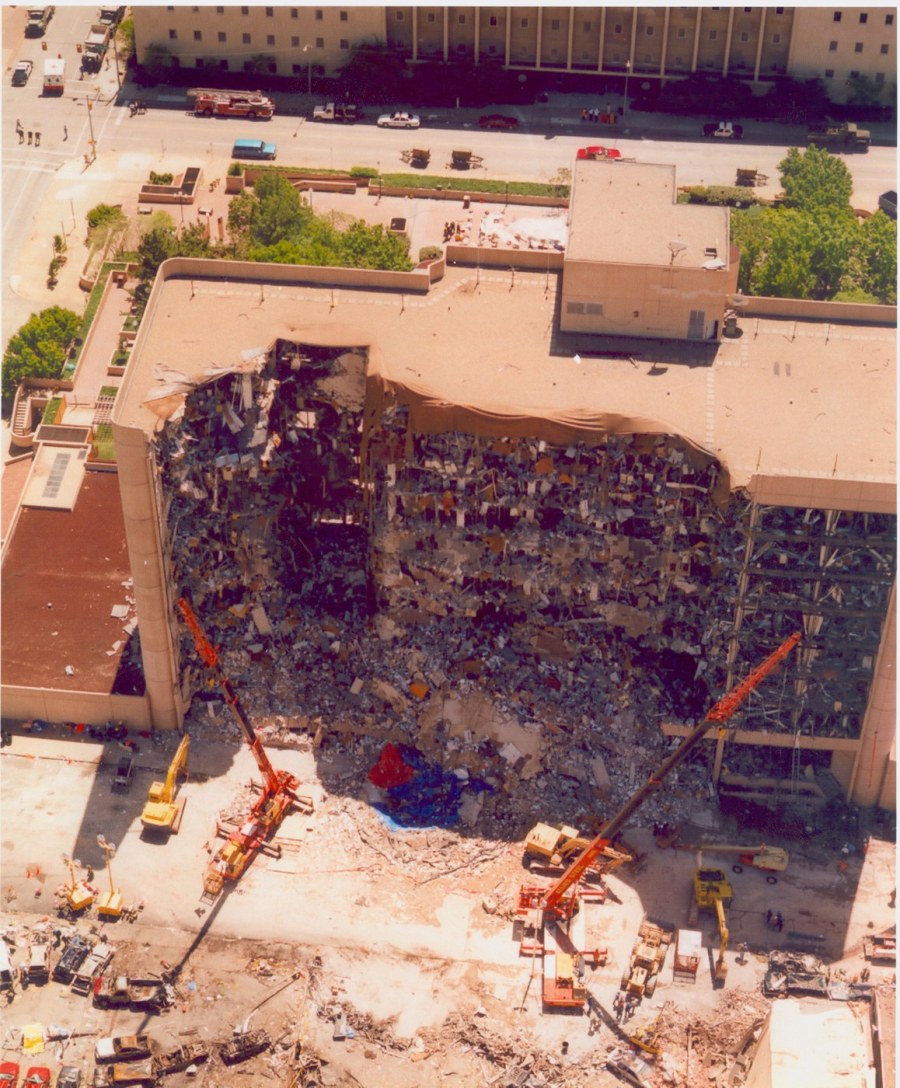
Alfred P. Murrah Federal Building, Oklahoma City, Oklahoma (Photo: FBI.gov)
“On the morning of April 19, 1995, an ex-Army soldier and security guard named Timothy McVeigh parked a rented Ryder truck in front of the Alfred P. Murrah Federal Building in downtown Oklahoma City. He was about to commit mass murder.
Inside the vehicle was a powerful bomb made out of a deadly cocktail of agricultural fertilizer, diesel fuel, and other chemicals. McVeigh got out, locked the door, and headed towards his getaway car. He ignited one timed fuse, then another.
“The events of April 19, 1995, dramatically changed Oklahoma City and all of us who remember that spring morning. But the stories of the 168 people killed live in our hearts as well as in the Oklahoma City National Memorial & Museum. Learn more about the victims here.” -Oklahoma City National Memorial
Learn what motivated domestic terrorists Timothy McVeigh and Terry Nichols to commit the Oklahoma City Bombing, which killed 168 people on April 19, 1995. Discover the federal and local clean up efforts and the fate of McVeigh and Nichols. -History
USA: Oklahoma City Bombing Rescue – 1995 | Today in History | 19 Apr 16 -AP Archive
In the News:
The FBI has released long-secret security tapes showing the chaos immediately after the 1995 bombing of the Oklahoma City federal building. The soundless recordings show people rushing from nearby buildings after the fertilizer bomb went off. (Sept. 27) -Associated Press
Don Lemon talks with the child survivors of the Oklahoma City bombing 15 years after the attack. -CNN
20 years after the terror attack, survivors and families of victims look back on the devastating terror attack. -CBS News
20 years ago tomorrow, domestic terrorist Timothy McVeigh and his co-conspirators set off an enormous truck bomb in downtown Oklahoma City. The blast killed 168 people, including 19 children. Anna Werner reports on that awful day after visiting the site. -CBS This Morning
Americans remember the bombing that killed 168 people and injured hundreds more. -ABC News
Remembering the April 19, 1995 tragedy in Oklahoma when a truck bomb exploded outside of the Alfred P. Murrah Federal Building injuring hundreds and leaving 168 people dead. -NBC News
Today marks the 23rd anniversary of the Oklahoma City bombing, a time to remember the 168 lives lost in an act of domestic terrorism that rocked the nation. -CBS News
On the morning of Wednesday, April 19, 1995, a former Army soldier parked a rented Ryder truck in front of the Alfred P. Murrah Federal Building in Oklahoma City, Oklahoma.He got out, locked it and ignited two fuses. At 9:02 a.m., the explosion ripped through the building where 500 people worked and children attended America’s Kids day care. The blast killed 168 people including 19 children under the age of 6. -PennLive.com
USA: Oklahoma City: Remains of Bombed Building to be Demolished. -AP Archive
Oklahoma City National Memorial & Museum:
At the 20th anniversary remembrance for the Oklahoma City bombing, the former president says it’s important for all Americans to remember how much they owe Oklahomans. -CBS News
Video of The Oklahoma City National Memorial and Museum. -CNN
American Experience PBS:
Premiering at the 2017 Sundance Film Festival. Coming to American Experience PBS on February 7, 2017 at 9/8c. -American Experience, PBS
After the Oklahoma City Bombing, Clinton’s ability to reach Americans on a personal level did much to help the nation’s grief. “It’s kind of a throwaway line now, I feel your pain, but he literally could,” says Robert McNeely. “I mean he could take people and just hug them and connect to them in a way and really listen to them.” -American Experience, PBS
Oklahoma City explores how a series of deadly encounters between American citizens and federal law enforcement—including the standoffs at Ruby Ridge and Waco—led to the bombing of the Murrah Building in Oklahoma City in April 1995, the worst act of domestic terrorism in American history. -American Experience, PBS
At the time of the Oklahoma City bombing in 1995, the Alfred P. Murrah Federal Building was home to several government agencies — and a daycare. -American Experience, PBS
During the stand-off between federal agents and the Branch Davidians in Waco, Texas in 1993, people gathered on a hill roughly three miles away to see what was happening at the compound. One of those drawn to Waco was a 24-year-old Army veteran named Timothy McVeigh. -American Experience, PBS
Filmmaker Barak Goodman and editor Don Kleszy discuss their newest documentary, “Oklahoma City” and how it led to the creation of another one-hour film about Ruby Ridge. -American Experience, PBS
The 1995 Oklahoma City Bombing was the largest act of domestic terrorism in U.S. history. A new documentary on the PBS series American Experience takes a fresh look at the events and motivations that led to the attack by Timothy McVeigh, and finds resonance for today. -PBS NewsHour
At the 20th anniversary, we look back at the Oklahoma City bombing. Public television station OETA shares reflections from survivors and victims’ families, and Judy Woodruff talks to former Deputy Attorney General Jamie Gorelick, former Director of Homeland Security of Oklahoma Kerry Pettingill and Barry Grissom, U.S. attorney for the district of Kansas, for lessons learned from the attack. -PBS NewsHour
On April 19, 1995, Timothy McVeigh, a former soldier deeply influenced by the literature and ideas of the radical right, parked a Ryder truck with a five-ton fertilizer bomb in front of the Alfred P. Murrah Federal building in Oklahoma City. Moments later, 168 people were killed and 675 were injured in the blast. OKLAHOMA CITY traces the events — including the deadly encounters between American citizens and law enforcement at Ruby Ridge and Waco — that led McVeigh to commit the worst act of domestic terrorism in American history. With a virulent strain of anti-government anger still with us, the film is both a cautionary tale and an extremely timely warning. -YouTube Movies
Lt. Joe Kenda, a homicide detective with the Colorado Springs Police Department, was angry when he found out about this murder. Whoever did it gunned down a housewife and mother and he vowed to catch them. On September 12, 1990, a Lupus support meeting was held in a recreational area in Colorado Springs, Colorado. One of the participants was Dianne Hood, who just 18 months earlier after her third child was born, was diagnosed with Lupus. But Dianne was a fighter and was in remission. After the meeting let up, she walked outside with a fellow Lupus support group member, Karen Johnson, and was robbed and shot twice. Karen went flying back into the building and informed the others that Dianne had been shot. Another support group member Sarah was a registered nurse so she ran outside to help. Sarah found Dianne laying in a pool of blood and observed her gasping for breath as she began compressions. EMTs arrived on the scene and took over for Sarah. Dianne had two bullet wounds, one in the shoulder and the other in her chest area. She was pronounced dead at the hospital. This crime sent a shockwave through the community.
After Lt. Kenda arrived on the scene, he found blood on the ground and a couple shocked witnesses. It was assumed initially that this was a robbery gone bad. Kenda interviewed Karen Johnson first because she was the best witness he had. Karen reported that she and Dianne were walking to their cars when they heard footsteps from behind. The person was wearing dark clothes and a ski mask. Dianne gave up her purse to the robber and began to run. The shooter first fired at her shoulder and that put her down and then this person fired a fatal shot at her chest. Everything did in fact look like a robbery gone bad. Unfortunately, Karen didn’t know much about the shooter aside from they were shorter they she was. Kenda and fellow police officers began canvassing the area to see if they could find any additional evidence. Criminals usually have a planned exit so Kenda used a K9 unit to comb the area looking for the scent of the shooter. About about a mile, the dog locked onto a scent. The dog led officers to a garbage can and then sat down. This is dog’s alert system. Inside the garbage can the police found an olive drab field jacket, a pair of gloves, a black ski mask, and some camouflage pants.
The items in the garbage can matched the witnesses description of the shooter at the scene. They also found brown hair in the ski mask and evidence of gun residue on the gloves upon testing at the forensic’s lab. The K-9 dog eventually lost the scent of the shooter because this person most likely got in a car and drove away. The only promising lead just hit a dead end. Kenda didn’t have a suspect, he had a masked maniac so he decided to look into Dianne Elaine Hood’s life; he wanted to know everything about her to find out who in her life wanted her dead. With no other substantial leads, police started canvassing the neighborhood, knocking on every door, to see if anyone saw anything. They encountered a woman who indicated David Burns could have had something to do with it. Kenda learned the locals gave Burns the nickname Homicidal Dave. Kenda wanted to know who this guy was because he wore camouflage similar to that of the shooter. Kenda learned Burns was a veteran of the first Gulf War, spoke loudly and obnoxiously to others, and the community felt he was dangerous. Upon further investigation, David Burns was cleared because he alibi checked out on the night of the murder. With no suspect or person of interest to investigate further, Kenda needed to expand the investigation.
Expanding the investigation meant combing through all the evidence to find new clues. After reading through Karen Johnson’s testimony again, Kenda deduced that someone wanted to make this look like a robbery. Kenda believed Dianne Hood was targeted and that this was an assassination. During the autopsy, two bullets were recovered from Dianne Hood’s body so they were sent to ballistics. Kenda received a call the next day informing him he was looking for very rare and valuable gun, a Colt Peacemaker patent 1872 single action Army revolver, a cowboy gun. This was a huge limiting factor because this rare gun was worth thousands, maybe this person was a gun collector. During a homicide investigation, the police look at everything. Dianne’s life didn’t raise any red flags; she was a devoted mother of three and housewife. Kenda turned to Dianne’s husband Brian Hood and after bringing him to the station, Brian’s life appeared to be just as idyllic as Dianne’s was. Brian Hood was extremely well liked by his neighbors and co-workers. He used to play football and Dianne was a cheerleader; that’s how they met. Brian’s physical stature eliminated him as the shooter.
During the interview, Brian admitted that he was addicted to working out and went to the gym almost every day to keep up his physique. So Kenda went to the gym, spoke with a couple employees, and learned that Brian spends a lot of time with a girl named Jennifer, who worked at a flower shop. Joe went to the flower shop and learned her full name was Jennifer Reali. She was married to Benjamin Reali who was a Captain in the Army and an intelligence officer. The shop owner shared that he liked Ben because they both collected antique guns. This was a solid lead for Kenda. Does Ben own the same antique gun used in the shooting? Did Ben shoot Dianne Hood because of the relationship Brian had with Jennifer at the gym? Did Jennifer shoot Dianne? Ben worked at Fort Carson as a criminal investigator for the US Army so he knew as a soldier, he is an expert in killing and as an investigator, he knew how to get away with it. The clothing recovered in the garbage can was military clothing. Was this his clothing? Ben’s stature did match that described by the shooter. Kenda surprised Ben at work and he immediately went on the defensive. Ben admitted to owning several antique guns and one of them was a Colt 45 Peacemaker (patent 1872).
Kenda wanted the antique gun so it could be analyzed. Ben appeared to be confused and concerned but he handed over the gun. The police couldn’t recover any fingerprints on it. Kenda then invited Ben to go to the police station so they could interview him. The police put Ben on their turf so he wouldn’t be in his normal comfortable setting. Ben was seated and Kenda laid out the clothing they found in the garbage can. Without even looking, Ben said he didn’t recognize the clothing. Kenda said, Ben you need to look at these clothes and examine them. Kenda then threatened to call his military Commander and ruin his career overnight or at a maximum arrest him for murder. Ben admitted the clothing were his and the ballistics office confirmed his gun matched the one they were looking for. Ben claimed he last saw the clothing in his closet at his house but he hadn’t been living there for about 3 weeks; he was staying on post. Ben then told Kenda his wife asked him to hold the gun that morning and a couple weeks ago, she wanted to shoot it so he took her to the gun range to practice. Ben went from a person of interest to a witness. Kenda remembered the witness telling him the shooter put the purse over their shoulder like a woman would do.
Ben Reali was eliminated as a suspect because Kenda knew they were looking for a woman. Forty-eight hours after Dianne was murdered, Kenda was on the hunt for twenty-eight year old Jennifer Reali. He needed to find out more about his prime suspect. He learned she was a college graduate and a mother of two daughters. From outward appearances, she didn’t fit the modus operandi of a killer. Kenda brought Jennifer to the station in the hopes that she would break after he pressed her. While at the station Kenda realized Ben was not a co-conspirator but was struggling with the fact that his wife might be a murderer. The clothing was Ben Reali’s and the bullet casings matched the same gun owned by Ben Reali; as a result Jennifer was arrested for first degree murder and Ben had a hard time with it. After the arrest, Kenda turned all his attention to Jennifer Reali. She denied any knowledge of anything so Kenda presented the evidence to her and backed her into a corner. He could tell she was used to being in control and didn’t like being cornered. Jennifer tried to say the gun must have been stolen but that was ludicrous, as if someone would return the gun after stealing it. Jennifer finally broke and admitted that she did it; Kenda got his confession.
Jennifer Reali admitted to killing Dianne Wood and that she did try to make it look like a robbery. She also shared that someone else was involved in the plot to kill Dianne; she claimed it wasn’t her idea. Jennifer disclosed that she killed Dianne for Brian Hood. She admitted to having an affair with him for the past eight months. She met him at the gym and they became close; this is how the personal and romantic relationship started. Their innocent flirtation eventually turned into a full-blown affair, she says they were in love. She brought Brian to her house when Ben was out of town. Jennifer was very specific about all the details with her affair with Brian. Brian told Jennifer that killing Dianne would help end her suffering with Lupus, a disease he said was going to kill her. He also had an insurance policy on her for $100,000 and if she was murdered, it would double the pay out to $200,000. For a period of months, Brian brainstormed various ways to kill his wife as if he was her mercenary. In the end, Brian decided a staged robbery in a parking lot would do.
Brian told Jennifer they already committed the sin of adultery and the sin of murder was no worse. He claimed that Jennifer was his whole life and he used passages from the Bible to let her know it was okay to kill Dianne as long as she repented. Brian also believed the police were stupid and would assume this was an armed robbery. This was his final plan to convince her they would get away with it. Brian pressured Jennifer for three months to kill his wife and then on September 12th, she went through with it. Jennifer was held in the El Paso County jail for first degree murder but the architect of the plot was still at large. The police hunted down and arrested Brian for conspiracy to commit first degree murder, solicitation to commit first degree murder, and first degree murder. In the meantime, one of Brian’s friends came forward with damning information after reading about his arrest in the paper. He told the witness that he wanted his wife dead. Police learned Brian’s friends were afraid of him because they wondered if he was capable of killing them too. Brian Hood pressured his friends until he found one that would do his bidding; he used his wife’s disease as an excuse to justify murder.
Brian maintained his innoncene throughout the investigation and trial. But the family doctor testified at trial that he told Dianne and Brian that she had the mildest form of Lupus and it could be easily managed; she was not going to die. Brian told his friends he wanted Dianne dead because she was going to die anyways; he knew that wasn’t true. A year after Dianne Hood was shot and killed on December 23, 1991, Brian Hood was found guilty of two counts of criminal solicitation, one count of conspiracy to murder his wife, however on the charge of first degree murder, he was found not guilty. Instead of life in prison, he was sentenced to 37 years. The police felt like he got away with murder. Jennifer Reali plead insanity claiming she had been brainwashed by Brian Hood. The jury didn’t buy it and she was found guilty of first degree murder and conspiracy to commit first degree murder. Jennifer Reali was sentenced to life in prison with the possibility of parole at the Colorado State Penitentiary. The police got justice for Dianne when she couldn’t do it for herself but this murder was devastating to the Hood and Reali families. They couldn’t help but ask: Why would Brian do this? Why not get a divorce? Why kill her? Kenda explained that this was human nature at its worse.
What does a murderer look like? As it turns out they look like the cute mom next door. -Lt Joe Kenda, Retired Homicide Detective
The Colorado Springs woman, who’s been called the “fatal attraction killer,” Jennifer Reali, has a new address. -KRDO Colorado (August 5, 2014)
Gazette city editor Cary Vogrin talks with Eric Singer on Between the Lines about Jennifer Reali’s release to a halfway house from prison after years of serving time for a “fatal attraction” killing. -Colorado Springs Gazette (August 5, 2014)
A rare interview from three years ago sheds new light about the “fatal attraction killer.” -KRDO Colorado (August 6, 2014)
The Department of Corrections says Jennifer Reali has been transferred to a halfway house, despite having her parole denied three years ago. -KRDO Colorado (August 6, 2014)
Audio from the recent parole hearing for Jennifer Reali. The Colorado Springs woman explains why she killed Dianne Hood and why she’s sorry. -Colorado Springs Gazette (November 7, 2014)
Audio from Jennifer Reali’s recent parole board hearing telling officials why she can do more good being free to help others not follow the same path she did. She was convicted of killing her boyfriend’s wife. -Colorado Springs Gazette (November 7, 2014)
No parole for convicted killer, Jennifer Reali (2015) -KRDO Colorado (October 14, 2015)
Reali shot and killed her lover’s wife in 1990. -CBS Denver (April 6, 2018)</p
Investigation Discovery:
Preview: She was broken down by every man who crossed her path, so when Jennifer’s lover told her that his wife had to die – Jennifer made sure she did. -Under His Control, Deadly Women (S4, E10)
Jennifer Reali was having a wild affair with Brian Hood, he made her shoot his wife to death in a parking lot. She did, and now she is serving life in prison. Former FBI profiler Candice DeLong talks face to face with Jennifer to find out the truth -Love Before Life, Facing Evil (S1, E3)
ID Go: Mother of three Dianne Hood is shot to death by a masked gunman on her way home from a Lupus support meeting. Police initially assume it’s a robbery, but Lt. Joe Kenda uncovers a sordid web of lust and greed, revealing a killer no one ever expected. -I Now Pronounce You Dead, Homicide Hunter (S2, E1)
Editor’s note: With a cable subscription, you can download the free ID Go app and watch Investigation Discovery programming at your convenience. And for those who do not have cable, you can watch “unlocked” episodes on the ID Go app including the latest premieres. For those who prefer commercial free programming during your binge session, Prime Video has an ID channel: ‘True Crime Files by Investigation Discovery” available for $3.99 a month. It’s a compilation of older seasons but totally worth the cost if you are a true crime addict. Download the ID Go app or purchase ID True Crime Files & binge away.
Air Force Sergeant James Goodyear, 37, died on September 16, 1971 in Orlando, Florida. Sergeant Goodyear died just three months after completing a year long tour of duty in Vietnam. He left behind his wife Judy Buenoano Goodyear and her son Michael Buenoano. Judy received $28,000 in military life insurance benefits and military death benefits to help support the family. When her son Michael turned eighteen, he joined the US Army. On his way to his post in Georgia, he stopped in to visit his mother Judy, she fed him, and afterwards he became ill. The illness led to a crippling condition that left him paralyzed in his lower extremities and he was subsequently discharged from the Army as a Private. Michael was disabled and Judy was taking care of him. On May 13, 1980 Judy took Michael for a canoe ride. Judy reported to local authorities that her canoe capsized and her son Michael had drowned. She collected $125,000 in military life insurance benefits for her son’s death.
Judy Buenoano was executed in the State of Florida on March 30, 1998.
In June 1983, Judy was suspected in the car bombing of her fiancé John Gentry of Pensacola, Florida. She stood to gain $500,000 in life insurance money for this death. Judy Buenoano was first convicted of the attempted murder of John Gentry. As a result of her involvement in the attempted murder of John, investigators looked into the ‘accidental deaths’ of her husband James Goodyear and her son Michael. They exhumed John’s body a decade later and an autopsy revealed he had been poisoned with arsenic. Testimony revealed long-term arsenic poisoning had actually caused her son Michael’s disability. And when Judy drowned him, he was wearing an extra 15 pounds of weighted braces. Judy reportedly admitted to being involved in the 1978 death of her boyfriend Bobby Joe Morris as well. She received $50,000 in life insurance benefits for his death. Judy Buenoano was found guilty of first degree murder and sentenced to death. She was executed by the electric chair in Florida on March 30, 1998. Judy Buenoano was motivated by money, profit, and greed.