When some brides vowed to love and honor their husbands, they lied. These Deadly Women made a mockery of marital commitment. They only promised “To Have and To Kill”. -To Have and To Kill, Deadly Women (S8, E14)
Tyshee Prokop and her childhood friends from Killeen, Texas murdered Gary Prokop, an Army soldier stationed at Fort Hood in 1998. Tyshee married Gary shortly after meeting him and they had a child together. But Tyshee wasn’t ready for family life. About a year and a half after they were married, they filed for divorce. Gary was going to get out of the Army and move back home. Tyshee conspired with her friends to have Gary murdered before he got out of the Army so she could collect medical benefits and the $100,000 dollar life insurance policy. He was murdered on June 25th with a single gunshot wound to the head while he was sleeping. One of the co-conspirators, Rodney Barfield, felt remorse about his involvement with the crime. He confessed his full involvement in the murder and detailed everyone’s roles. In 2002, Tyshee Prokop and her friends were arrested and charged with the murder of Gary Prokop. They were sentenced as follows:
Tyshee Manik Prokop – pled guilty, sentenced to life in prison
Charles Edward Turnbull III – convicted, sentenced to life in prison
Rodney Barfield – pled guilty, sentenced to 25 years
Reuben James Salgado – pled guilty (tampering with evidence charge)
Jacob Luther Harris – pled guilty (to a conspiracy charge)
Editor’s note: With a cable subscription, you can download the free ID Go app and watch Investigation Discovery programming at your convenience. And for those who do not have cable, you can watch “unlocked” episodes on the ID Go app including the latest premieres. For those who prefer commercial free programming during your binge session, Prime Video has an ID channel: ‘True Crime Files by Investigation Discovery” available for $3.99 a month. It’s a compilation of older seasons but totally worth the cost if you are a true crime addict. Download the ID Go app or purchase ID True Crime Files & binge away.
Offender: Troy Graves, 29, US Air Force service member Victims: Shannon Schieber, 23, University of Pennsylvania student (rape/homicide), multiple rape victims in Pennsylvania & Colorado
Circumstances: Shannon Schieber was enrolled as a Phd. student at the Wharton School of Business, on May 7, 1998, Shannon was studying for exams when a neighbor heard what sounded like cries for help, he called 911 to report that his neighbor was asking for help, the police arrived but no one answered the door and the neighbor backed off his statement, they searched the property and the neighbor said it could have been outside so they left, Shannon’s brother showed up the next day and Shannon didn’t answer the door, the neighbor told her brother what he heard the night before, they broke into the apartment and found Shannon naked on her bed, Shannon was strangled to death and it appeared she tried to fight off her attacker, police found DNA at the scene, DNA ruled out those close to Shannon, Shannon’s parents were outraged that the man who killed their daughter was in the apartment when the police knocked on her door, but the police did their job right and by the book, a few days before the murder, Shannon reported being followed home one night, she was scared, so police started investigating the stranger angle, perhaps this is a serial rapist, they look into sex crimes in the area, they want to match the DNA to other sex crimes in the area.
In February 1999, they got a DNA match, 2 other sexual assaults had occurred but they were coded as misdemeanors, the assaults occurred just a few blocks from Shannon’s apartment, in June and July 1997, two more sexual assaults were connected to the offender bringing the total to 5, the PPD coded these sexual assaults as misdemeanors as well, they downgraded the offenses because it lessoned the load for the police, and made the arrest rate look better than it was, Shannon’s case helped enact change in Philadelphia, if they had investigated these cases, everyone would have known there was a serial rapist, Shannon would not be dead if she knew what was going on, the DNA still didn’t have a match to the offender, in 1997, a sketch was drawn from the recollections of the first victim, they got a new composite, this offender would enter the home, hold the victim down on the bed, rape them or make them perform oral sex, it was about control and domination for this guy and he was also somewhat of a romantic, once they acquiesced, he would treat them like a date, he would get comfortable with the victims, they determined he was a light skinned black male based on information he shared with one victim about his life growing up with bi-racial parents.
He was dubbed the Center City rapist, in August 1999, no other cases were reported since Shannon’s murder, the case went cold, the police got a bulletin in 2001 from Fort Collins, Colorado, the offenders modus operandi sounded familiar to the Philadelphia PD, on June 13, 2001, one victim was home when she was attacked from behind and raped, after she acquiesced, the rapist became gentle as if he was a boyfriend, after he left, she called 911, she was his third victim in Fort Collins, they were all blitz attacked, FC police were investigating a serial rapist, a fourth & fifth rapes were reported, he made a mistake and left behind a ball cap at the fifth victims home, Fort Collins DNA was matched to the rapes in Philadelphia, PPD gave FCPD the composite drawing, police received a letter in the mail from the suspect, he was taunting them, in the fall of 2001, the attacks in Fort Collins stopped, meanwhile the PPD started focusing on cross referencing names of suspects with the two geographic locations, they got a match for Air Force service member Troy Graves, he was in Philadelphia, Fort Collins, and now at Warren AFB in Cheyenne, Wyoming, in 2002, the police had the new suspect in their sites.
The police learned that Troy was also investigated by the Office of Special Investigations, it was over charges of harassing a female colleague, the charges were dropped but there was still something suspicious there, Graves has a clean criminal record and no finger prints on file, the case was circumstantial, they reached out to Graves to come to the police department and do an interview, Troy Graves and his wife showed up to the Fort Collins PD, the police immediately separated the couple, his wife admitted that he had insomnia and went for walks and drives at night and that honestly she thought he was having an affair, meanwhile Troy denied knowing anything about the crimes, the police confronted him about the rapes in Fort Collins, he denied being arrested for any sex crimes, he denied being investigated by the Air Force, he did not want to provide his fingerprints but a warrant was issued to compel him, the fingerprints were a match, Troy Graves was arrested and booked into custody on April 23, 2002, this case changed the PPD policies on sexual assault to include how evidence is handled and how the victims are treated and interviewed.
Disposition: Troy Graves feared a trial would not go in his favor in Fort Collins, Colorado, he pleaded guilty in exchange for a life sentence without the possibility of parole; Pennsylvania wanted to seek the death penalty but Shannon’s family did not want that because Shannon wouldn’t have wanted that, Graves entered into a plea agreement and got life in prison plus sixty years
Notable Quotes: “We have to change the system but not put people to death.” -Vicki Schieber (Shannon’s mom)
In 1998, a gifted Philadelphia graduate student is found murdered in her bed. The hunt for her killer forces police to reevaluate a series of unsolved crimes, turning the city upside down. Will her killer be caught or will he strike again? -Terror in Philadelphia, People Magazine Investigates (S3,E2)
Editor’s note: With a cable subscription, you can download the free ID Go app and watch Investigation Discovery programming at your convenience. And for those who do not have cable, you can watch “unlocked” episodes on the ID Go app including the latest premieres. For those who prefer commercial free programming during your binge session, Prime Video has an ID channel: ‘True Crime Files by Investigation Discovery” available for $3.99 a month. It’s a compilation of older seasons but totally worth the cost if you are a true crime addict. Download the ID Go app or purchase ID True Crime Files & binge away.
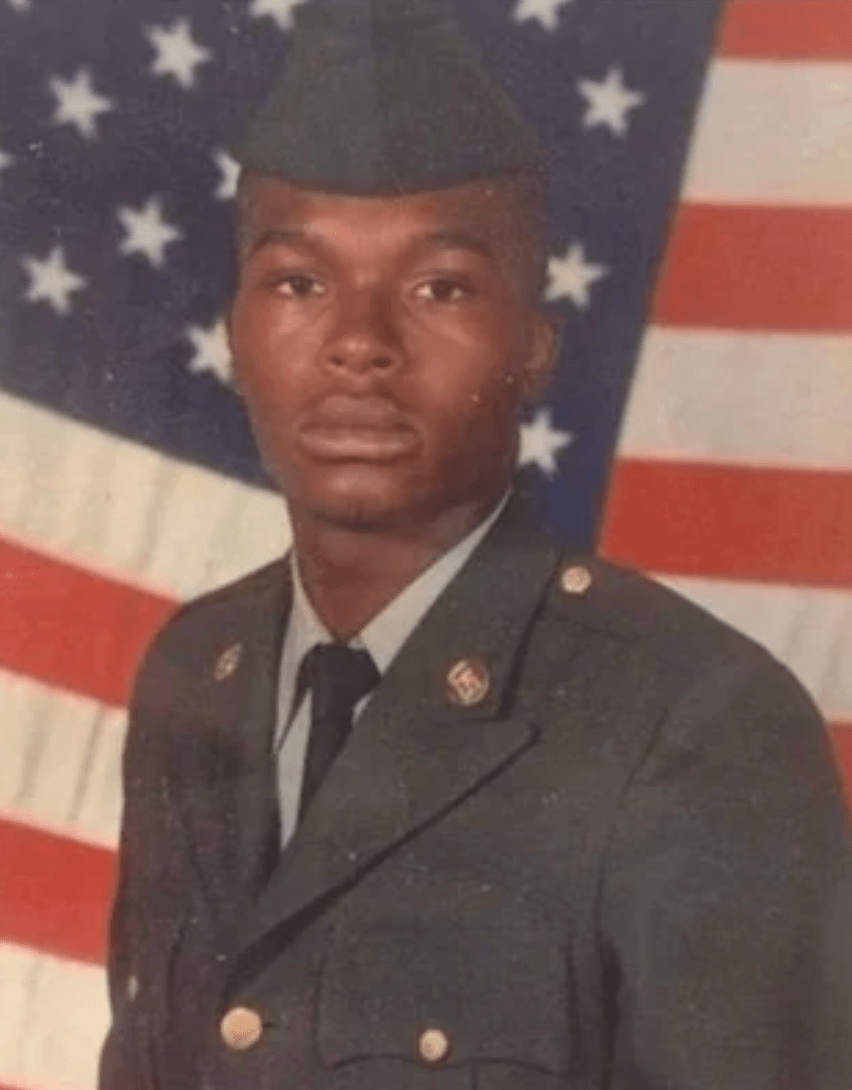
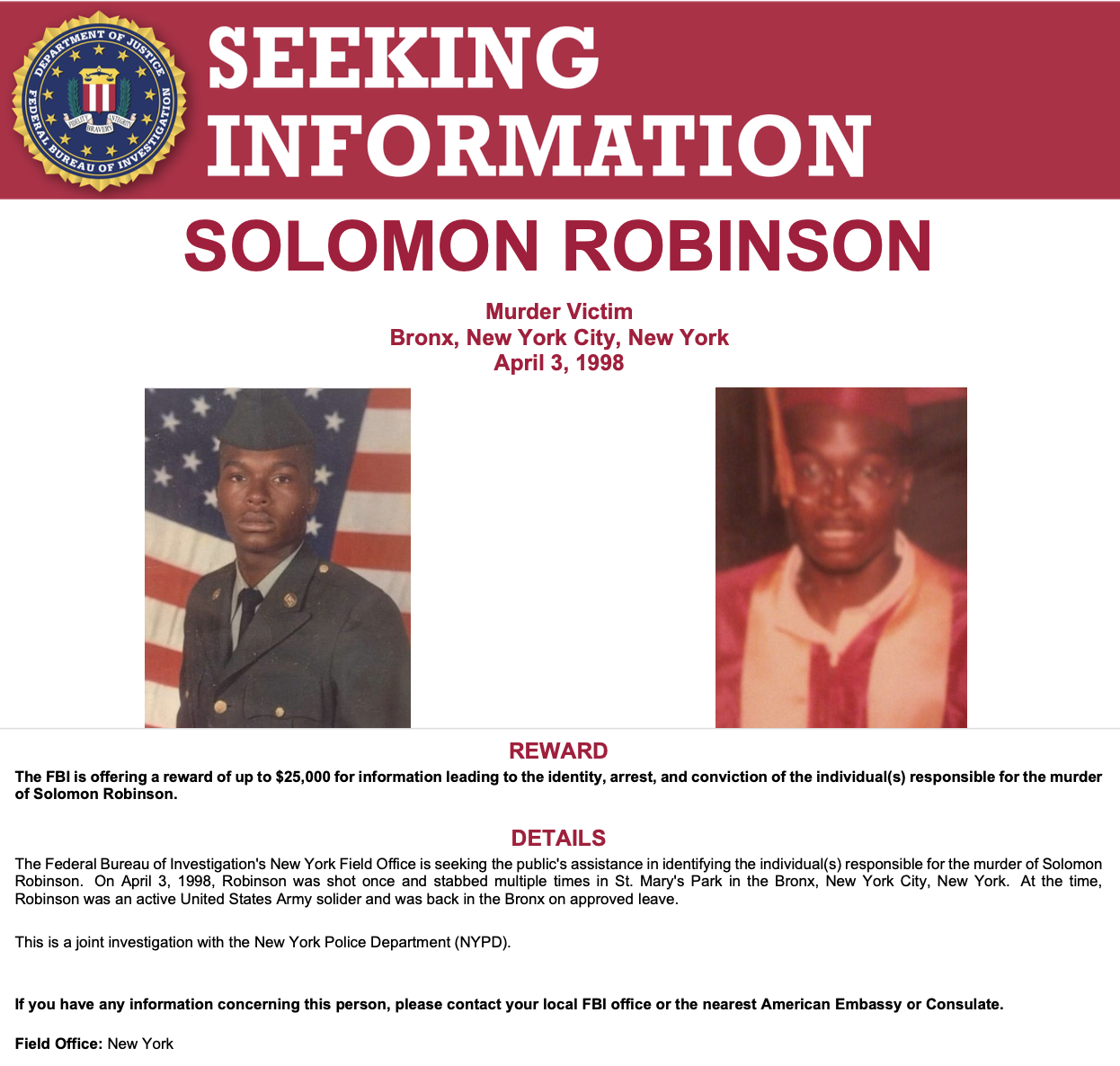
Murder Victim Bronx, New York City, New York April 3, 1998
Reward:
The FBI is offering a reward of up to $25,000 for information leading to the identity, arrest, and conviction of the individual(s) responsible for the murder of Solomon Robinson.
Details:
The Federal Bureau of Investigation’s New York Field Office is seeking the public’s assistance in identifying the individual(s) responsible for the murder of Solomon Robinson.
On April 3, 1998, Robinson was shot once and stabbed multiple times in St. Mary’s Park in the Bronx, New York City, New York. At the time, Robinson was an active United States Army soldier and was back in the Bronx on approved leave.
This is a joint investigation with the New York Police Department (NYPD).
New development brings hope for relatives of 1998 Bronx murder victim | A teenager from the Bronx who was committed to serving in the Army was attacked and killed in a local park 26 years ago. The murder of Solomon Robinson still hasn’t been solved. But now, detectives say they’ve learned new information that has led to a new development in the cold case. | NBC New York
Judy Buenoano was executed by the State of Florida on March 30, 1998.
Air Force Sergeant James Goodyear, 37, died on September 16, 1971 in Orlando, Florida. Sergeant Goodyear died just three months after completing a year long tour of duty in Vietnam. He left behind his wife Judy Buenoano Goodyear and her son Michael Buenoano. Judy received $28,000 in military life insurance benefits and military death benefits to help support the family. When her son Michael turned eighteen, he joined the US Army. On his way to his post in Georgia, he stopped in to visit his mother Judy, she fed him, and afterwards he became ill. The illness led to a crippling condition that left him paralyzed in his lower extremities and he was subsequently discharged from the Army as a Private. Michael was disabled and Judy was taking care of him. On May 13, 1980 Judy took Michael for a canoe ride. Judy reported to local authorities that her canoe capsized and her son Michael had drowned. She collected $125,000 in military life insurance benefits for her son’s death.
In June 1983, Judy was suspected in the car bombing of her fiancé John Gentry of Pensacola, Florida. She stood to gain $500,000 in life insurance money for this death. Judy Buenoano was first convicted of the attempted murder of John Gentry. As a result of her involvement in the attempted murder of John, investigators looked into the ‘accidental deaths’ of her husband James Goodyear and her son Michael. They exhumed John’s body a decade later and an autopsy revealed he had been poisoned with arsenic. Testimony revealed long-term arsenic poisoning had actually caused her son Michael’s disability. And when Judy drowned him, he was wearing an extra 15 pounds of weighted braces. Judy reportedly admitted to being involved in the 1978 death of her boyfriend Bobby Joe Morris as well. She received $50,000 in life insurance benefits for his death. Judy Buenoano was found guilty of first degree murder and sentenced to death. She was executed by the electric chair in Florida on March 30, 1998. Judy Buenoano was motivated by money, profit, and greed.
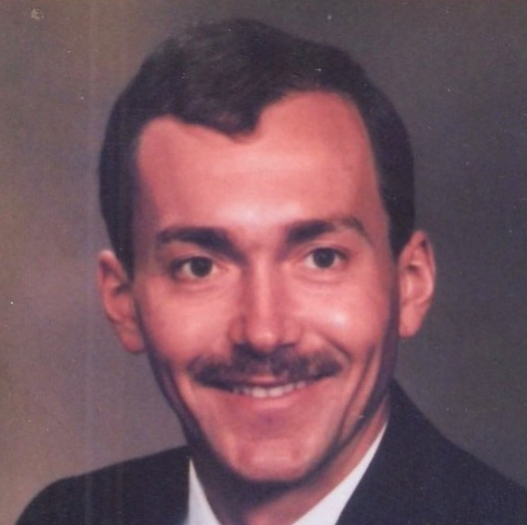
Army Captain Gordon Hess was found dead in a creek bed at Fort Knox, Kentucky on March 4, 1998 while there on temporary duty with the New York Army National Guard. Army investigators ruled the cause of death was ‘suicide’ but the family and an outside forensic pathologist dispute those findings given the autopsy revealed that Captain Hess had twenty-six stab wounds to the neck and chest area.
Doreen Hess shared with the LA Times: “Even as we attempted to bury his mutilated body, the Army stabbed him again with a suicide ruling.” The Army claims that it fully investigates all undetermined deaths as a homicide initially but after a thorough investigation of this case, including hundreds of interviews, they determined that Captain Hess died by suicide.
The family vehemently disagrees with the Army investigator’s findings based on the forensic evidence and a history of the Army ruling a soldier’s death a suicide when in fact it was most likely a homicide. An important fact to remember is that if an Army investigation determines the cause of death is suicide, they never have to investigate it again despite the impact on the families left behind.
“Absolutely no way did this man commit suicide. This gentleman was murdered.” -Charles DeAngelo, Esq.
“In time the historic aspects or victimology relating to Hess began to unveil itself to the investigators. That, coupled with the Psychological Autopsy, provided much needed data. Gordon Hess was dedicated and devoted to his family, friends and community. He loved his family and children and was a dedicated father and husband. Hess had been described by many as a ‘Perfectionist.’ He consistently strived to be the best and to do things better. “He was competitive and struggled to be number one while he begrudgingly tolerated second best.” According to the report his career path was erratic and frustrating. For a competitive and dedicated man he struggled early in his career after leaving the Army, working at several jobs.”
“Although he was personally successful, this all led to financial strain due to the failures of several employers. He always wanted to be on a winning team which finally seemed to have happened when he became a fireman. Hess appeared at this time to excel at all his endeavors and likely expected nothing less from himself. It was indicated that earlier in his life Hess loved the Army and initially did not want to get out but family issues and concerns made it happen. Therefore, his affiliation and participation with the National Guard was probably one of the most cherished endeavors in his life. He enjoyed status and achievement in a structured environment that was team oriented and was a respected leader.”
“It also reflected that becoming a company commander was viewed by him as a significant achievement. The Army and this status was a big part of his identity; one that he did not just turn off after a training cycle because he continued to be involved by being at the Armory frequently well beyond the expectations of his supervisors and his stated responsibilities. The Army was a part of him. Yet he was not depressive and did not appear to suffer from any psychiatric disorder or medical problem. While he had conquered much adversity in the past, Hess was a man who struggled with feelings of inferiority that ‘fueled his drive to prove to others and to himself that he was competent and worthy of his achievements.’ He strongly identified with his roles as a fireman and an Army Captain. However, he had difficulty tolerating self perceived failure in the audience of those he sought and received affirmation.”
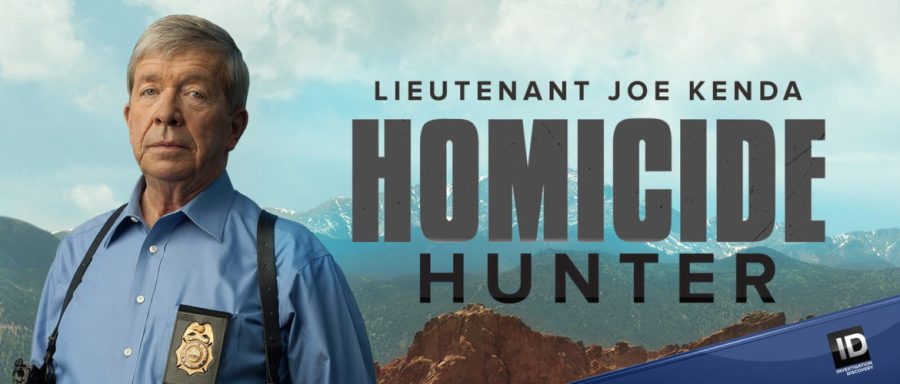
A four-week-old girl is kidnapped, leaving her mother in anguish and police scrambling to find her. As days go by with no sign of the baby or demands for ransom, sergeants Joe Kenda and Robert Sapp fear she’s been sold on the black market or worse. -Bring My Baby Home, Homicide Hunter (S7,E20)
On February 19, 1988, 5 week old Rachel Ann White was abducted from her grandmother’s Colorado Springs, Colorado home. Detective Joe Kenda met Robert Sapp of the Colorado Springs PD Juvenile Crimes Unit at Evelyn Reed’s house. Evelyn explained that she was taking care of Rachel for her daughter Cora Abbott and was interviewing potential baby sitter candidates. One of the potential candidates was a hispanic woman by the name of Sharon Sanchez. Evelyn was interviewing Sharon when the phone rang and Evelyn asked ‘Sharon’ to hold Rachel while she went into the other room to answer it. When Evelyn returned, Sharon and Rachel were gone and when she ran outdoors to see if she could stop her, Sharon was driving away in a light colored vehicle with Texas plates.
Investigators were not sure where to go with the investigation because Sharon Sanchez was an alias but they worked on the case around the clock and used the media to reach out to the public. Then they got a phone call from an Air Force Major. The Major informed Kenda that he had an Air Force officer, Captain Paul Rentz, working for him who said his wife had a baby and this was suspicious because Paul never said anything about his wife being pregnant. The Major and his wife stopped by Captain Rentz’s home to give the baby a proper Air Force welcome and to congratulate them. But his wife Maritza made excuses and was reluctant to let them in the house to see the baby; she eventually relented. After visiting the baby and leaving their home, the Major’s wife said it was not a newborn baby and she definitely wasn’t 3 days old. Then they saw the news that a baby was kidnapped and called the police right away. Kenda and Sapp didn’t hesitate to investigate this promising tip.
Kenda and Sapp went straight to the Rentz’s home. When they arrived at the home, the first thing they spotted was a small silver car with Texas plates that matched the description of the vehicle they were looking for. Kenda and Sapp questioned Maritza Rentz and asked her where she had the baby, who was the doctor, and where was the birth certificate. When Maritza produced a birth certificate, the birth certificate lead one to believe the baby was two days old. Kenda and Sapp knew this wasn’t a real birth certificate because they both had children. They demanded to see the baby. Maritza retrieved the child and she was a perfect match to the composite drawing. They also observed this was not a newborn and they knew immediately it was Rachel White. Captain Rentz appeared to be dumbfounded that the baby wasn’t his. Kenda and Sapp notified Cora Abbott that they found her baby.
Kenda said that when Cora was reunited with her daughter, the daughter she never thought she would see again, it was a very touching moment. Maritza Rentz was charged with kidnapping and Paul Rentz was questioned. He told investigators that Maritza didn’t have sex with him throughout the ‘pregnancy’ because she said it was harmful to the child. She also wouldn’t let him see her body. He admitted that things were rocky. Paul Rentz’ culpability was definitely in question because investigators couldn’t imagine that he didn’t know. But Maritza confirmed Paul didn’t know. She told investigators that she was pregnant but lost her baby and didn’t have the heart to tell Paul. She said she put pillows under her clothes so it appeared she was pregnant. She said she couldn’t see any other way and hoped the baby would help the relationship. When it was time for the baby to be born, Maritza said she was faced with a choice: come clean to her husband or find a baby.
Maritza read the newspaper ads and the difficulty she ran into was that most of the kids were too old. And then she found Cora Abbott’s ad looking for someone to watch her infant while she was at work. Maritza created a false identity, responded to the ad, and visited Evelyn Reed’s home for the interview. She admitted she almost didn’t follow through with the abduction but when the phone rang, the opportunity presented itself and she took it. When she returned home, she called Paul and told him she just got back from the hospital where she had the baby. Paul didn’t question any of it. Kenda reminded the viewer that being stupid isn’t against the law and believing your wife is not a criminal act. He admitted it was difficult to prosecute Paul Rentz because they didn’t have enough evidence to prove anything against him. As a result, he was found not guilty. Maritza pleaded guilty to second degree kidnapping but the judge didn’t give her any jail time. Instead, she claimed mental insanity and was confined to an institution for one year. The happy ending is that Rachel was found against all odds and she is thriving as a young woman.
Editor’s note: With a cable subscription, you can download the free ID Go app and watch Investigation Discovery programming at your convenience. And for those who do not have cable, you can watch “unlocked” episodes on the ID Go app including the latest premieres. For those who prefer commercial free programming during your binge session, Prime Video has an ID channel: ‘True Crime Files by Investigation Discovery” available for $3.99 a month. It’s a compilation of older seasons but totally worth the cost if you are a true crime addict. Download the ID Go app or purchase ID True Crime Files & binge away.
In 1999, the television program 60 Minutes reported on the hidden War at Home in the U.S. military. They reported that at the time of airing, Pentagon records showed that 58,000 military spouses were victims of domestic violence and that rate was three times higher than the civilian population rate. The overall concerns were that the military justice system was a system that routinely failed to punish even the most violent and abusive servicemen. As a result, it often left an abused spouse alone without protection to fight a secret war. 60 Minutes highlighted the cases of three Fort Campbell soldiers who were charged with killing their wives or girlfriends (Bill Coffin, Dane Zafari, Tracy Leonard) and one Navy spouse who was a victim of domestic violence.
One of the cases singled out was that of Fort Campbell Sergeant Bill Coffin who murdered his ex-fiance Ronnie Spence after a civilian judge granted her an emergency protection order. In December 1997, Sgt. Coffin murdered Ronnie in front of their baby daughter in a shared home near Fort Campbell, Kentucky. Sgt. Coffin shot her twice through the trailer, entered the home and then shot her in the face and through the heart. While Ronnie was lying dead on the floor, Sgt. Coffin emptied the gun into her. Several weeks before the shooting, court records showed that Sgt. Coffin had repeatedly threatened to kill Ronnie and his superior officers at Fort Campbell knew about the threats.
I think they should have confined him to that army base. They should have gotten him some help. They should have stopped him, they should have intervened. They did nothing. -Kathy Spence (mother)
60 Minutes interviewed Kentucky Judge Peter MacDonald who stated that domestic violence cases involving Fort Campbell soldiers routinely showed up in his courtroom. He said that Army commanders regularly ignored court orders issued to protect the abused spouses. Judge MacDonald issued the emergency protective order requiring Sgt. Bill Coffin to stay away from Ronnie Spence. Sgt. Coffin instead shot and killed her. According to 60 Minutes, Sgt. Coffin pleaded guilty to domestic violence and other charges, and was sentenced. Judge MacDonald felt the readiness of the troops was more important than the protection of the battered and abused spouses.
In an in depth investigation, 60 Minutes learned that the Army’s domestic violence guide for commanders listed a number of things that could have been done in Sgt. Bill Coffin’s case but were not. The guide included restricting an abuser to the barracks or assigning them to the quarters of a superior. They also learned that the military spends millions yearly on a Family Advocacy program designed to treat and prevent domestic violence. But Sherry Arnold, a licensed clinical social worker, who helped run the program for the Marines in Camp Pendleton in California, said the Commanders have preconceived notions. She often witnessed victim blaming, minimization, a hands off approach, an ‘it’s a family matter’ attitude, and indifference to the seriousness of the situation and escalating violence.
Robert Clark, the commanding general of Fort Campbell, Ky., where several particularly violent incidents have occurred, said the military does a good job handling domestic violence cases. But Peter MacDonald, chief district court judge in Kentucky with jurisdiction over Fort Campbell, said the Army routinely ignores his court orders designed to protect abused spouses. “They have no conception of what’s going on in domestic violence.” –Deseret News
After the public learned of the scandalous way the U.S. military handles felony crimes like domestic violence, rape, and stalking, the Pentagon was ordered by Congress to investigate domestic violence in the armed forces. Congress recommended stronger protections for battered spouses and stiffer penalties for the servicemen who abuse them. In 2000, Major Joanne P.T. Eldridge suggested a proposal to add anti-stalking provisions to Article 134 in the Uniform Code of Military Justice. Since 1999 and long before this, domestic violence has continued to be an on-going serious invisible issue in the military. Both military spouses and service members are victims of domestic abuse. The year 60 Minutes aired the ‘The War at Home’ programming, Fort Campbell soldier Barry Winchell was murdered because a couple soldiers suspected he might be gay. Barry’s murder prompted the lift of the controversial Don’t Ask Don’t Tell policy.
The year after 60 minutes aired, civilian spouse Michelle Theer conspired with her lover, Army Ranger John Diamond, to kill her husband Air Force Captain Frank Theer for the life insurance money. In 2002, four wives were slain in six weeks at Fort Bragg in North Carolina. They were Teresa Nieves, Jennifer Wright, Andrea Floyd, and Marilyn Griffin. In 2008, Army Lt. Holley Wimunc was abused, stalked, and murdered by her Marine husband. In 2011, Holley’s father advocated for H.R. 1517 sponsored by Representative Bruce Braley. This law was aimed at protecting both domestic violence and sexual assault victims. This law would have required the removal of Commanders from the investigation and prosecution of felony crimes. The Holley Lynn James Act and any subsequent legislation, like the Military Justice Improvement Act, suggesting the removal of the Commander from the processing of felony crimes have been unsuccessful.
Rep. Bruce Braley introduces the Holley Lynn James Act — a bill to help victims of sexual assault and domestic violence in the military get justice. The bill is named after Holley Lynn James, a constituent of Rep. Braley who was killed by her husband while both were in the service.
Offender: Michael Dean Overstreet Occupation: US Navy veteran (discharged for psychological problems after one month), construction, frequently unemployed Pathology: Stranger abduction, rape, and murder by strangulation, shot victim in forehead Dates: September 27, 1997 Location: Franklin, Indiana, moved body to Atterbury Wildlife Preserve (Brown County) Motive: Hunted prey, lured victim, stranger abduction, rape & murder Victim: Kelly Eckart (18), Franklin College student M.O.: Stalked at work, followed home after work shift, bumped her car while both driving on road, abducted after she pulled over Conviction: Sentenced to death (July 31, 2000), Indiana court ruled not competent to be executed in 2014, still on death row Status: Incarcerated, death row Appearance: Blanket of Evidence (Forensic Files); All-American Sweethearts (Murder Comes to Town); Death Row (Real Stories); First Love, Forever Evil (Evil Lives Here) Red Flags: Deprived and abusive childhood, Schizotypal Personality Disorder, mother failed to seek mental health for him, got in fights, bully in high school, went to jail for having a gun at school, isolated & controlled significant other, stalking, threatening, long history of domestic abuse, obsession with weaponry especially knives, always carried a knife, owned firearms, threatened wife with knife, grabbed wife by throat & pointed gun at her head (shot it next to her head), threatened wife with rifle, unexplained absences, secret life/two lives, hallucinations, volatile temper, unpredictable, paranoid, admitted to wife he killed people (delusional thoughts), psychological deterioration, liked killing animals, spent a lot of time alone in the woods, obsessed with media after crimes committed, wife afraid to call the police with suspicions, one misdemeanor in criminal history, loves his family & two children, model prisoner
In the News:
A northern Indiana judge is nearing a decision on whether a man convicted of abducting and killing a Franklin College student in 1997 should be put to death. -RTV6 The Indy Channel (November 13, 2014)
Overstreet ruled not competent to face death penalty. -WTHR (November 20, 2014)
Full Episode: Housing 1900 inmates, 12 of whom are on death row, Trevor spends two weeks in the dark and forbidding world of Indiana State Maximum Security Prison. He hears from men who know what it is like to live under the shadow of the death penalty and even the date and time they will die. -Indiana Death Row, Part 1, Real Stories (August 28, 2017)
Full Episode: Indiana Death Row | Part 2 | Real Stories (August 30, 2017)
Forensic Files:
Full Episode: A young woman disappeared after working the late shift in a department store. Days later, her body was found in an isolated ravine. Tiny clues told police a great deal about the killer. He would own olive-colored carpeting, a white blanket, and distinctive bullets made from wax, not lead. -Blanket of Evidence, Forensic Files (S11, E38)
Investigation Discovery:
Eighteen-year-old Kelly Eckart disappears one night after finishing up her shift at a local hardware store. Hours later her car is discovered abandoned by the side of the road, still running, but Kelly is nowhere to be found. -All-American Sweethearts, Murder Comes to Town (S1, E3)
Melissa Holland was certain that her high school boyfriend, Michael Overstreet, was the man she’d always dreamed of. But only after they were married did she begin to realize that her determination to live happily ever after had put her in mortal danger. -First Love, Forever Evil, Evil Lives Here (S3, E6)
Editor’s note: With a cable subscription, you can download the free ID Go app and watch Investigation Discovery programming at your convenience. And for those who do not have cable, you can watch “unlocked” episodes on the ID Go app including the latest premieres. For those who prefer commercial free programming during your binge session, Prime Video has an ID channel: ‘True Crime Files by Investigation Discovery” available for $3.99 a month. It’s a compilation of older seasons but totally worth the cost if you are a true crime addict. Download the ID Go app or purchase ID True Crime Files & binge away.
“Timothy McVeigh, a former U.S. Army soldier, is convicted on 15 counts of murder and conspiracy for his role in the 1995 terrorist bombing of the Alfred P. Murrah Federal Building in Oklahoma City. On April 19, 1995, just after 9 a.m., a massive truck bomb exploded outside the Alfred P. Murrah Federal Building. The blast collapsed the north face of the nine-story building, instantly killing more than 100 people and trapping dozens more in the rubble. Emergency crews raced to Oklahoma City from across the country, and when the rescue effort finally ended two weeks later, the death toll stood at 168 people, including 19 young children who were in the building’s day-care center at the time of the blast.” Read more from This Day in Historyhere.










 MILITARY JUSTICE FOR ALL