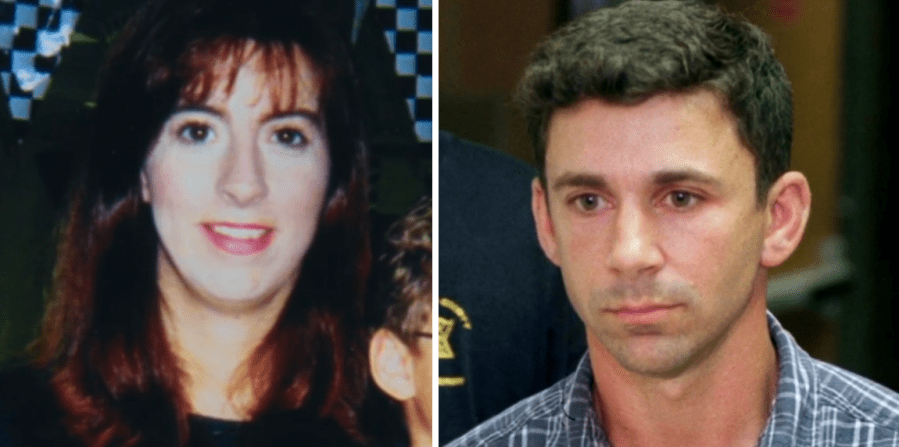
On August 29, 1989, Navy veteran Richard Uffelman and his two sons opened fire from their living room window and shot and killed their neighbors Michael and Florence Phillips in Machiasport, Maine. The Phillips family moved back to Maine so they could be closer to their family and the ocean, and they wanted to escape crime in Indiana. Shortly before they moved to Maine, a murder occurred outside their home and this was it for them; they wanted to raise their son Michael in a safe environment. Richard and Anita Uffelman and their two sons were the new neighbors of the Phillips in Maine. Richard was described as an authoritarian and a believer in good order and discipline. He worked at the local post office and taught his two children to shoot guns. Initially the neighbors were good friends and their boys played together. At some point, family came to visit the Phillips for a week. The happy family reunited outside on the front lawn while they barbecued, drank some beers, and enjoyed one another’s company. Apparently Richard found a broken bottle on his lawn during the event and automatically assumed the Phillips threw the bottle on his lawn. Richard called the police to complain about the incident but there was no proof since the Phillips denied doing it. This was it for Richard; the Phillips home interfered with his view of the ocean and he was going to exact his revenge. Read here.
On April 10, 2008, Navy sailor Chris Shortt discovered his step-daughter Meghan Landowski stabbed to death in their Portsmouth, Virginia home. Meghan was 16 years old and from the looks of the crime scene, there was a struggle; Meghan fought back. Investigators learned the killer used a knife from the family’s kitchen. They found it in a gutter down the street. The police didn’t know who committed the murder but they believed it was personal and Meghan knew her attacker. Chris and Angie Shortt believed Robert Hickey killed Meghan and they called NCIS at Naval Station Norfolk to let them know what happened. NCIS questioned Hickey. Robert Hickey was a military officer who was on his way to the rank of Captain when he was accused of sexual assault by Meghan. Robert was a close friend of the family and NCIS believe he groomed Meghan for a sexual relationship. Meghan said Rob began touching her when she was 14 and by age 15, Meghan was having a sexual relationship with a 30-year-old man. The family supported Meghan as she pressed charges against Robert but they learned from civilian investigators that Hickey’s crimes amounted to a misdemeanor in Virginia; he would spend 12 months maximum in prison. But Robert Hickey was a Navy sailor and subject to the Uniform Code of Military Justice. The Navy was investigating and planning to prosecute the case. Read here.
ID Go: A Filipino woman falls for a married US Navy Officer who will do anything to keep his mistress and his money. -An Officer, Not a Gentleman, Forbidden: Dying for Love (S1,E4)
ID Go: When high school senior Michelle Miller joins the Future Soldiers program, she sees it as the first step to realizing her dream of enlisting in the Army. But a forbidden affair with her recruiter risks her career in the Army, and her future itself. -The Sergeant and the Schoolgirl, Forbidden: Dying for Love (S2,E1)
ID Go: A young mom falls for a married military man after a chance meeting at his naval base. -The Girl with the Gold Earring, Forbidden: Dying for Love (S2,E8)
ID Go: A young Army recruit enlists with dreams of serving her country. What she doesn’t expect is to find love with a commanding officer in her platoon. The two battle to keep their forbidden affair secret but can they defeat the enemy within? -Love is a Battlefield, Forbidden: Dying for Love (S3, E1)
ID Go: While her husband serves in the army, a lonely married mother of three finds comfort in the arms of her church’s charismatic new minister. But danger looms in the form of a jealous love-rival that will stop at nothing to scare her away. -Onward, Christian Soldier, Forbidden: Dying for Love (S4,E4)
ID Go: A decorated marine faces war at home when he falls for a married woman. Suspicion and jealousy plague their affair as they battle to keep their secret from their spouses but with the stakes so high it’s a truth they’ll stop at nothing to hide. -Love is War, Forbidden: Dying for Love (S4,E8)
Editor’s note: With a cable subscription, you can download the free ID Go app and watch Investigation Discovery programming at your convenience. And for those who do not have cable, you can watch “unlocked” episodes on the ID Go app including the latest premieres. For those who prefer commercial free programming during your binge session, Prime Video has an ID channel: ‘True Crime Files by Investigation Discovery” available for $3.99 a month. It’s a compilation of older seasons but totally worth the cost if you are a true crime addict. Download the ID Go app or purchase ID True Crime Files & binge away.
ID Go: While her husband serves in the army, a lonely married mother of three finds comfort in the arms of her church’s charismatic new minister. But danger looms in the form of a jealous love-rival that will stop at nothing to scare her away. -Onward, Christian Soldier, Forbidden: Dying for Love (S4,E4)
Forbidden: Dying for Love featured the Jennifer and William Wright 2002 homicide-suicide case on Investigation Discovery. ‘Onward, Christian Soldier’ highlighted the circumstances that lead to the murder of Jennifer Wright and the pain it inflicted on those who were left behind including their three sons. According to the show, William Wright was a Master Sergeant in the U.S. Army and was stationed at Fort Bragg in North Carolina with his wife and three children. MSgt Wright was routinely deployed after 9/11/2001 and as a result he was never home. Bill’s absence was hard on Jennifer and the marriage. She wanted Bill to leave the Army but the Army was his life; it’s what he was meant to do. While Bill was deployed in Afghanistan, he learned that Jennifer was telling people back home that he divorced her.
Bill was stunned to learn the news and was granted leave to go back stateside and deal with his family crisis. Bill learned Jennifer was having an affair with the pastor at church and she wanted a divorce. Instead of salvaging his marriage, Bill murdered Jennifer in the family home on June 29, 2002 and covered it up. When investigators questioned Bill about Jennifer’s murder, he broke down and told them everything. Bill admitted he hit his wife with a baseball bat and then strangled her to death. He then put her body in a garbage bag and buried her in some woods near Fort Bragg. In 2003, William Wright was in prison awaiting trial when he died by suicide in his jail cell. Jennifer and William’s sons expressed concern that the Army’s anti-malaria drugs negatively impacted their father’s health and was most likely the reason this tragedy occurred.
This domestic violence related homicide was one of five murders that occurred in a six week period at Fort Bragg in 2002. Rigoberto Nieves fatally shot his wife Teresa on June 11, 2002; Cedric Griffin fatally stabbed his wife Marilyn on July 9, 2002; Brandon Floyd fatally shot his wife Andrea on July 19, 2002; and military spouse Joan Shannon manipulated her daughter Elizabeth to shoot her step-father Major David Shannon on July 23, 2002 while he slept.
Editor’s note: With a cable subscription, you can download the free ID Go app and watch all of the Investigation Discovery programming at your convenience. And for those who do not have cable, you can watch “unlocked” episodes on the ID Go app including the latest premieres. Download the ID Go app and binge away. For those who prefer commercial free programming during your binge session, Prime Video has an ID channel: ‘True Crime Files by Investigation Discovery” available for $2.99 a month. It’s a compilation of older seasons but totally worth the cost if you are a true crime addict.
Under the Sabers: The Unwritten Code of Army Wives or Army Wives by Tanya Biank was an excellent read. I first heard about the book when I was researching the 2002 Fort Bragg murders of Teresa Nieves, Jennifer Wright, Marilyn Griffin, Andrea Floyd and Major David Shannon. I ordered it from Amazon and threw it in a pile with all my other military crime books until I saw a Forbidden: Dying for Loveepisode about the murder of Army spouse Jennifer Wright. The show didn’t mention it but I knew Jennifer’s murder was one of five homicides at Fort Bragg that occurred within a two month period in 2002. I learned more about Jennifer Wright from Investigation Discovery than what’s available on-line. And at the time, the national media was quick to speculate whether war & violence, frequent deployments or anti-malaria drugs were to blame. But after the Army investigated itself, it determined that the high operational tempo after September 11, 2001 placed a great strain on already troubled marriages.
In other words, some form of domestic abuse, financial issues, and adultery in some cases were to blame for stained marriages. I researched the five murders and the motives were similar in four of the cases. Arguments were a pre-cursor to the murders and three out of four of the spouses wanted to leave the relationship. Was rejection the trigger? Domestic violence experts agree leaving the relationship is the most dangerous time. In Major Shannon’s case, it appears that the motive was greed, pure and simple, as greed is one of the most common motives for female killers. Major Shannon’s wife Joan stood to gain a large amount of money from his Serviceman’s Group Life Insurance (SGLI) if he died. This time the Army was most likely correct but unfortunately things haven’t changed to this day. There have been many more victims of domestic violence in the military since 2002 and this book inspired me to honor each and every one of them.
The author Tanya Biank grew up in a military family and covered military issues at Fort Bragg as a reporter for the Fayetteville Observer. Tanya was able to give us a realistic perspective of what was going on at Fort Bragg during the time period right before and after September 11, 2001. Tanya was the one writing about the rash of homicides for the local newspaper during the summer of 2002. As a result of Tanya’s reporting, the main stream media picked up the story and it went national and international. Fort Bragg was forced to answer to a frenzied pack of media outlets and in typical fashion, the Army investigated itself and found themselves not responsible. Although Tanya reported in the book that Congress authorized $5 million for domestic violence programs in the military that year. And on December 2, 2002, President Bush signed into law an act that makes domestic violence protective orders enforceable on military installations.
Tanya was the perfect person to write about Fort Bragg. She had a great understanding of the various perspectives and this was revealed in the book. She talked about how September 11th changed things for both the service member and the families. I found myself feeling thankful for the education about Fort Bragg’s missions and how they fit into the big picture. They train hard for a reason. They are some of the first on the front lines and some of the families have no idea where they are going or how long they will be gone. Unexpectedly, I experienced a myriad of emotions as I read along. Emotions about 9/11, emotions about what was happening at my own squadron, and emotions around the notifications of death. My Commander and a Chaplain informed me of my father’s unexpected death. And my colleagues helped me get home safely. I realized this was standard protocol while reading this book.
I couldn’t put the book down once I started, despite the emotions and memories it triggered. Tanya Biank did a great job of enticing the reader to learn more about the individual and the family, and just when you least expected, the unexpected would happen. It reminded me of my own life and how hard it was to put mission before self year after year when all one was doing was stuffing down the pain. But like those in the book, we don’t seek counseling because it’s considered a career ender. We don’t trust the system so most of us just keep our troubles to ourselves. And for those who want to maintain a security clearance, we know they are going to ask the question about mental health treatment. I understand why the question has to be asked because it’s important to identify someone with suicidal tendencies or anger problems but it prevents the rest of us from asking for the help we need, until it’s too late.
Tanya talked about the unusually high crime rates in Fayetteville and she said its civilians who commit most of the crime. She admitted Fort Bragg was under the shadow of the the murders of Colette, Kimberley & Kristen MacDonald in 1970 because former Captain Jeffrey MacDonald, despite being found guilty, swears he’s innocent. As recently as December 2018, MacDonald was denied a new trial by a federal appeals court and he continues to be the subject of both media and true crime programming. Tanya also talked about the racially motivated murders of Michael James & Jackie Burden in 1995. Army privates James Burmeister and Malcolm Wright were found guilty of the crime. This too made national news and the Army was forced to weed out any perceived Neo-Nazis, white supremacists, and skinheads. The media speculated the Army was full of them; turns out this random attack by Fort Bragg soldiers was an isolated incident.
After researching the five Fort Bragg murders in 2002 on-line, I realized that Tanya’s book was the most comprehensive discussion of the incidents. The book gave us an inside look at the people involved and the way it unfolded real-time. Tanya shared that the military likes to keep their problems under wrap because of the way the media speculates. I can see why they would be annoyed with how scandals are reported. Once the information is out there, it’s hard to fight off the perception. But the bottom line is the acts of a few don’t represent the whole. Unfortunately, I could write book after book about clusters of domestic violence related homicides in the military since 2002. This book made me realize how long the military has known about the problems and that throwing money at the problem doesn’t fix it. We need real solutions that save lives.
Editor’s Note: Tanya Biank’s book Under the Sabers inspired the creation of Army Wives on Lifetime television. After reading the book, I can understand why the series was created in 2007. I included links to the show below if you are interested in watching the series. It was cancelled after seven seasons.
“On July 19 the perfect picture shattered. After a loud argument that was overheard by neighbors, Brandon Floyd shot his wife Andrea, then turned his gun on himself. The double slaying was the fourth domestic tragedy at Fort Bragg in recent weeks. On June 11 Sgt. First Class Rigoberto Nieves, 32, shot himself and his wife, Teresa, 28, two days after returning from Afghanistan. Over the next six weeks Master Sgt. William Wright, 36, allegedly strangled his wife, Jennifer, 32; Sgt. Cedric Griffin, 28, allegedly stabbed his estranged wife, Marilyn, 32, and set fire to her home; and Maj. David Shannon, 40, was shot while sleeping in his home, a killing in which police have said that the wife remains a suspect.” Read more from Peoplehere.
In March 2005, Fort Bragg Army Sergeant Cedric Ramon Griffin, 28, pleaded guilty to murdering his wife Marilyn Griffin and setting her home on fire on July 9, 2002 in Fayetteville, North Carolina. Sgt. Griffin was charged by the Cumberland County Superior Court with the first-degree murder of his estranged wife Marilyn Griffin, first-degree arson, and the attempted murder of Marilyn’s two daughters. Marilyn died as a result of approximately 50 stab wounds to the chest, neck, back and abdomen; the preliminary autopsy results indicated Marilyn died prior to the fire. Marilyn’s daughters, ages 6 and 2, woke up during the fire, escaped, and went to a neighbor’s house for help. According to law enforcement officials, the motive appeared to be “domestic related” and Sgt. Griffin turned violent after Marilyn threatened to reveal his infidelity to his commander. The couple were married for eight years and Marilyn was murdered two months after she left Sgt. Griffin. She moved into her new home only a week before she died. Sgt. Cedric Griffin faced the death sentence in North Carolina if he was convicted of stabbing his wife to death but according to the Army Wives book, former Army Sgt. Cedric Griffin pleaded guilty to murdering Marilyn Griffin and is serving a life sentence in the Central Prison in Raleigh, North Carolina.
This domestic violence related homicide was one of five murders that occurred in a six week period at Fort Bragg in 2002. Rigoberto Nieves fatally shot his wife Teresa after an argument on June 11, 2002; William Wright admitted to strangling his wife Jennifer on June 29, 2002; Brandon Floyd fatally shot his wife Andrea on July 19, 2002; and military spouse Joan Shannon manipulated her daughter Elizabeth to shoot her step-father Major David Shannon on July 23, 2002 while he slept.
Forbidden: Dying for Love featured the Jennifer and William Wright 2002 homicide-suicide case on Investigation Discovery. ‘Onward, Christian Soldier’ highlighted the circumstances that lead to the murder of Jennifer Wright and the pain it inflicted on those who were left behind including their three sons. According to the show, William Wright was a Master Sergeant in the U.S. Army and was stationed at Fort Bragg in North Carolina with his wife and three children. MSgt Wright was routinely deployed after 9/11/2001 and as a result he was never home. Bill’s absence was hard on Jennifer and the marriage. She wanted Bill to leave the Army but the Army was his life; it’s what he was meant to do. While Bill was deployed in Afghanistan, he learned that Jennifer was telling people back home that he divorced her.
Bill was stunned to learn the news and was granted leave to go back stateside and deal with his family crisis. Bill learned Jennifer was having an affair with the pastor at church and she wanted a divorce. Instead of salvaging his marriage, Bill murdered Jennifer in the family home on June 29, 2002 and covered it up. When investigators questioned Bill about Jennifer’s murder, he broke down and told them everything. Bill admitted he hit his wife with a baseball bat and then strangled her to death. He then put her body in a garbage bag and buried her in some woods near Fort Bragg. In 2003, William Wright was in prison awaiting trial when he died by suicide in his jail cell. Jennifer and William’s sons expressed concern that the Army’s anti-malaria drugs negatively impacted their father’s health and was most likely the reason this tragedy occurred.
This domestic violence related homicide was one of five murders that occurred in a six week period at Fort Bragg in 2002. Rigoberto Nieves fatally shot his wife Teresa on June 11, 2002; Cedric Griffin fatally stabbed his wife Marilyn on July 9, 2002; Brandon Floyd fatally shot his wife Andrea on July 19, 2002; and military spouse Joan Shannon manipulated her daughter Elizabeth to shoot her step-father Major David Shannon on July 23, 2002 while he slept.
ID Go: While her husband serves in the army, a lonely married mother of three finds comfort in the arms of her church’s charismatic new minister. But danger looms in the form of a jealous love-rival that will stop at nothing to scare her away. -Onward, Christian Soldier, Forbidden: Dying for Love (S4,E4)
Editor’s note: With a cable subscription, you can download the free ID Go app and watch all of the Investigation Discovery programming at your convenience. And for those who do not have cable, you can watch “unlocked” episodes on the ID Go app including the latest premieres. Download the ID Go app and binge away. For those who prefer commercial free programming during your binge session, Prime Video has an ID channel: ‘True Crime Files by Investigation Discovery” available for $2.99 a month. It’s a compilation of older seasons but totally worth the cost if you are a true crime addict.
Two days after returning home from Afghanistan, Fort Bragg Army SFC Rigoberto Nieves shot and killed his wife Teresa Nieves after an argument on June 11, 2002 in their Fayetteville, North Carolina home; SFC Nieves then turned his .40-caliber service revolver on himself. This domestic violence related homicide was one of five murders that occurred in a six week period at Fort Bragg in 2002. William Wright admitted to murdering his wife Jennifer on June 29, 2002; Cedric Griffin murdered his wife Marilyn on July 9, 2002; Brandon Floyd murdered his wife Andrea on July 19, 2002; and military spouse Joan Shannon manipulated her daughter Elizabeth to shoot her step-father Major David Shannon on July 23, 2002 while he slept.
In 1999, the television program 60 Minutes reported on the hidden War at Home in the U.S. military. They reported that at the time of airing, Pentagon records showed that 58,000 military spouses were victims of domestic violence and that rate was three times higher than the civilian population rate. The overall concerns were that the military justice system was a system that routinely failed to punish even the most violent and abusive servicemen. As a result, it often left an abused spouse alone without protection to fight a secret war. 60 Minutes highlighted the cases of three Fort Campbell soldiers who were charged with killing their wives or girlfriends (Bill Coffin, Dane Zafari, Tracy Leonard) and one Navy spouse who was a victim of domestic violence.
One of the cases singled out was that of Fort Campbell Sergeant Bill Coffin who murdered his ex-fiance Ronnie Spence after a civilian judge granted her an emergency protection order. In December 1997, Sgt. Coffin murdered Ronnie in front of their baby daughter in a shared home near Fort Campbell, Kentucky. Sgt. Coffin shot her twice through the trailer, entered the home and then shot her in the face and through the heart. While Ronnie was lying dead on the floor, Sgt. Coffin emptied the gun into her. Several weeks before the shooting, court records showed that Sgt. Coffin had repeatedly threatened to kill Ronnie and his superior officers at Fort Campbell knew about the threats.
I think they should have confined him to that army base. They should have gotten him some help. They should have stopped him, they should have intervened. They did nothing. -Kathy Spence (mother)
60 Minutes interviewed Kentucky Judge Peter MacDonald who stated that domestic violence cases involving Fort Campbell soldiers routinely showed up in his courtroom. He said that Army commanders regularly ignored court orders issued to protect the abused spouses. Judge MacDonald issued the emergency protective order requiring Sgt. Bill Coffin to stay away from Ronnie Spence. Sgt. Coffin instead shot and killed her. According to 60 Minutes, Sgt. Coffin pleaded guilty to domestic violence and other charges, and was sentenced. Judge MacDonald felt the readiness of the troops was more important than the protection of the battered and abused spouses.
In an in depth investigation, 60 Minutes learned that the Army’s domestic violence guide for commanders listed a number of things that could have been done in Sgt. Bill Coffin’s case but were not. The guide included restricting an abuser to the barracks or assigning them to the quarters of a superior. They also learned that the military spends millions yearly on a Family Advocacy program designed to treat and prevent domestic violence. But Sherry Arnold, a licensed clinical social worker, who helped run the program for the Marines in Camp Pendleton in California, said the Commanders have preconceived notions. She often witnessed victim blaming, minimization, a hands off approach, an ‘it’s a family matter’ attitude, and indifference to the seriousness of the situation and escalating violence.
Robert Clark, the commanding general of Fort Campbell, Ky., where several particularly violent incidents have occurred, said the military does a good job handling domestic violence cases. But Peter MacDonald, chief district court judge in Kentucky with jurisdiction over Fort Campbell, said the Army routinely ignores his court orders designed to protect abused spouses. “They have no conception of what’s going on in domestic violence.” –Deseret News
After the public learned of the scandalous way the U.S. military handles felony crimes like domestic violence, rape, and stalking, the Pentagon was ordered by Congress to investigate domestic violence in the armed forces. Congress recommended stronger protections for battered spouses and stiffer penalties for the servicemen who abuse them. In 2000, Major Joanne P.T. Eldridge suggested a proposal to add anti-stalking provisions to Article 134 in the Uniform Code of Military Justice. Since 1999 and long before this, domestic violence has continued to be an on-going serious invisible issue in the military. Both military spouses and service members are victims of domestic abuse. The year 60 Minutes aired the ‘The War at Home’ programming, Fort Campbell soldier Barry Winchell was murdered because a couple soldiers suspected he might be gay. Barry’s murder prompted the lift of the controversial Don’t Ask Don’t Tell policy.
The year after 60 minutes aired, civilian spouse Michelle Theer conspired with her lover, Army Ranger John Diamond, to kill her husband Air Force Captain Frank Theer for the life insurance money. In 2002, four wives were slain in six weeks at Fort Bragg in North Carolina. They were Teresa Nieves, Jennifer Wright, Andrea Floyd, and Marilyn Griffin. In 2008, Army Lt. Holley Wimunc was abused, stalked, and murdered by her Marine husband. In 2011, Holley’s father advocated for H.R. 1517 sponsored by Representative Bruce Braley. This law was aimed at protecting both domestic violence and sexual assault victims. This law would have required the removal of Commanders from the investigation and prosecution of felony crimes. The Holley Lynn James Act and any subsequent legislation, like the Military Justice Improvement Act, suggesting the removal of the Commander from the processing of felony crimes have been unsuccessful.
Rep. Bruce Braley introduces the Holley Lynn James Act — a bill to help victims of sexual assault and domestic violence in the military get justice. The bill is named after Holley Lynn James, a constituent of Rep. Braley who was killed by her husband while both were in the service.