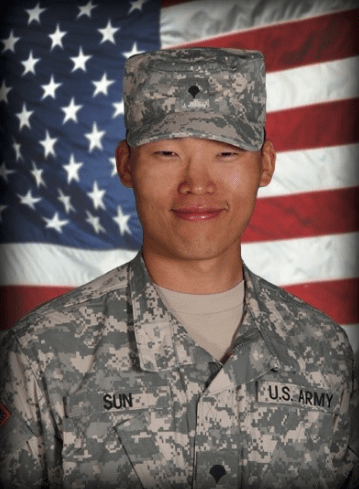
Spc. Yingming Sun, 25, of Monterey Park, California, joined the Army in October 2013. He was a motor transport operator and had been assigned to 3rd Battalion, 16th Field Artillery Regiment, 2nd Armored Brigade Combat Team, 1st Cavalry Division at Fort Hood since August 2014. His awards and decorations include National Defense Service Medal, Global War on Terrorism Medal, Korea Defense Service Medal, Army Service Ribbon, and Overseas Service Ribbon.
Learn more from III Corps and Fort Hood Facebook page here.
Mr. Speaker, Texas has been hammered by historic torrential rain and flooding. As the Texas floodwaters rose, 12 soldiers from Fort Hood, Texas, were crossing Owl Creek in a 21⁄2-ton Light Medium Tactical Vehicle when it became stuck in the Owl Creek low water crossing.
Suddenly, the vehicle was swept over and sent downstream by fast-moving water. Nine American soldiers drowned in the massive flood waters. Today, we remember them, and here they are: Staff Sergeant Miguel Colon Vazquez, 38, from New York.
The soldiers were members of the 3rd Battalion, 16th Field Artillery Regiment, 2nd Armored Brigade Combat Team of the 1st Cavalry Division. These American soldiers were volunteers who swore to protect the United States.
They were a cut above the rest and were ready to defend freedom at home and abroad. Their lives were ripped from this world and their families all too soon. We are grateful for them and their families for their service and their sacrifices.
These soldiers are the best of America. Our thoughts and prayers are with the soldiers and their families, who have been devastated by the floods of Texas this spring.
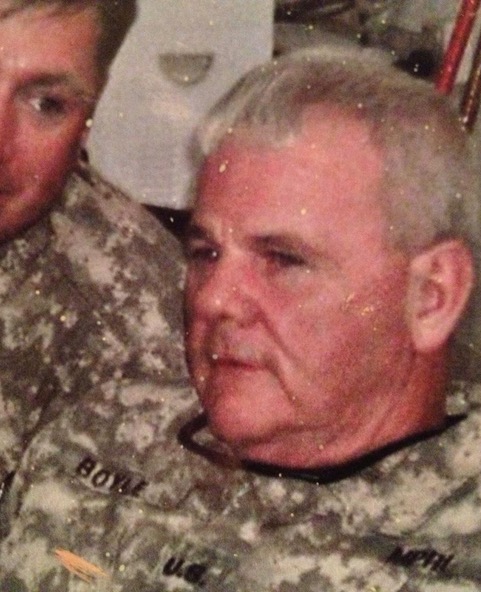
Thomas J. Boyle, Jr. died in Kandahar Province, Afghanistan on June 19, 2012.
“Obviously, suspicions are not proof of wrong doing, but Pauline Boyle has discovered enough evidence to warrant an all-out independent investigation. The problem is that asking the Army to investigate itself is asking the Fox to guard the hen house. The result will always be questionable. The Boyle family does have hard facts that clearly indicates there was an overt attempt to cover-up the circumstances of Thomas J. Boyle’s death.
Was there a military drug cartel that no one wanted to talk about, or was it a conspiracy of some of the soldiers on base to stop the change of command and keep the lieutenant colonel in command for as long as possible.”
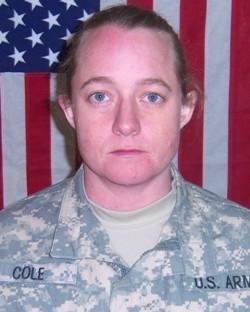
Army Pfc. Jennifer Cole died of a non combat related incident in Bayji, Iraq on August 2, 2008. Pfc. Cole was supporting Operation Iraqi Freedom on behalf of the 426th Support Battalion, 1st Brigade Combat Team, 101st Airborne Division (Air Assault) at Fort Campbell, Kentucky. An investigation revealed that Jennifer died of a gunshot wound to the abdomen. According to the family, she was accidentally shot by a fellow Army soldier while they were cleaning their weapons. They learned that the weapon had not been cleared prior to the cleaning and no one is sure how it got into the place where Jennifer was shot. The soldier (Thurston) responsible for the accidental shooting was charged with negligent homicide. He spent 30 days in military jail and was given a general discharge from the Army. Jennifer’s mom, Candy Gholson, shared with Napa Valley, California newspapers that the Army wouldn’t give her information, provide her with paperwork, or tell her exactly what happened to her daughter.
Candy Gholson shared that she heard three different versions and wanted to know exactly what happened. She also shared that she learned from Jennifer’s roommate in the Army that no one ever questioned her and they both thought that odd considering most investigations start with those closest to the victim. Both Jennifer’s parents shared the frustration that it is not easy getting answers from a military organization or is it easy dealing with the bureaucracy of the Army and their typical federal government run-around. The parents were told to go through the Freedom of Information Act for the investigation report but the Army warned them it could take up to a year to get the trial transcript they were requesting. Jennifer’s step father, a US Marine Corps veteran, reiterated that he too wanted to know the details of what happened and that he didn’t have hard feelings towards the soldier who killed his step-daughter. But he does feel that Thurston’s superiors should have been court-martialed for ineffective supervision and oversight of the weapons.
“I understand they had a trial for the guy (Thurston) who shot my daughter. I was told he spent 30 days in a military jail and was discharged from the Army. He didn’t get a dishonorable discharge, but the one just above that. But I have never received any paperwork to that effect,” Gholson said. “I just want answers. And it’s not easy trying to get them from a military government institution. “I’ve heard three different stories from the Army about what happened the day Jennifer died,” Gholson said. “I want to know what exactly happened that day. There were witnesses. Why can’t the Army get the story straight?” ~Napa Valley Register (December 11, 2008)
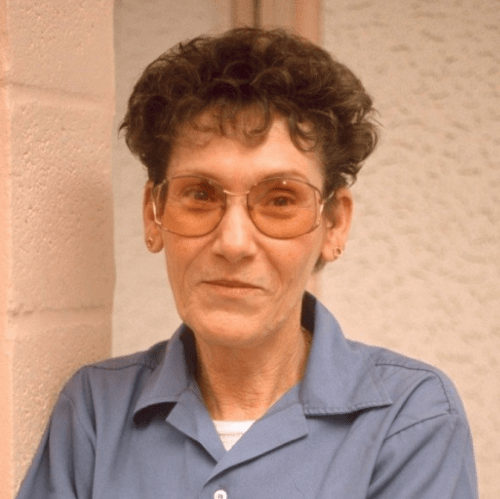
Judy Buenoano was executed by the State of Florida on March 30, 1998.
Air Force Sergeant James Goodyear, 37, died on September 16, 1971 in Orlando, Florida. Sergeant Goodyear died just three months after completing a year long tour of duty in Vietnam. He left behind his wife Judy Buenoano Goodyear and her son Michael Buenoano. Judy received $28,000 in military life insurance benefits and military death benefits to help support the family. When her son Michael turned eighteen, he joined the US Army. On his way to his post in Georgia, he stopped in to visit his mother Judy, she fed him, and afterwards he became ill. The illness led to a crippling condition that left him paralyzed in his lower extremities and he was subsequently discharged from the Army as a Private. Michael was disabled and Judy was taking care of him. On May 13, 1980 Judy took Michael for a canoe ride. Judy reported to local authorities that her canoe capsized and her son Michael had drowned. She collected $125,000 in military life insurance benefits for her son’s death.
In June 1983, Judy was suspected in the car bombing of her fiancé John Gentry of Pensacola, Florida. She stood to gain $500,000 in life insurance money for this death. Judy Buenoano was first convicted of the attempted murder of John Gentry. As a result of her involvement in the attempted murder of John, investigators looked into the ‘accidental deaths’ of her husband James Goodyear and her son Michael. They exhumed John’s body a decade later and an autopsy revealed he had been poisoned with arsenic. Testimony revealed long-term arsenic poisoning had actually caused her son Michael’s disability. And when Judy drowned him, he was wearing an extra 15 pounds of weighted braces. Judy reportedly admitted to being involved in the 1978 death of her boyfriend Bobby Joe Morris as well. She received $50,000 in life insurance benefits for his death. Judy Buenoano was found guilty of first degree murder and sentenced to death. She was executed by the electric chair in Florida on March 30, 1998. Judy Buenoano was motivated by money, profit, and greed.
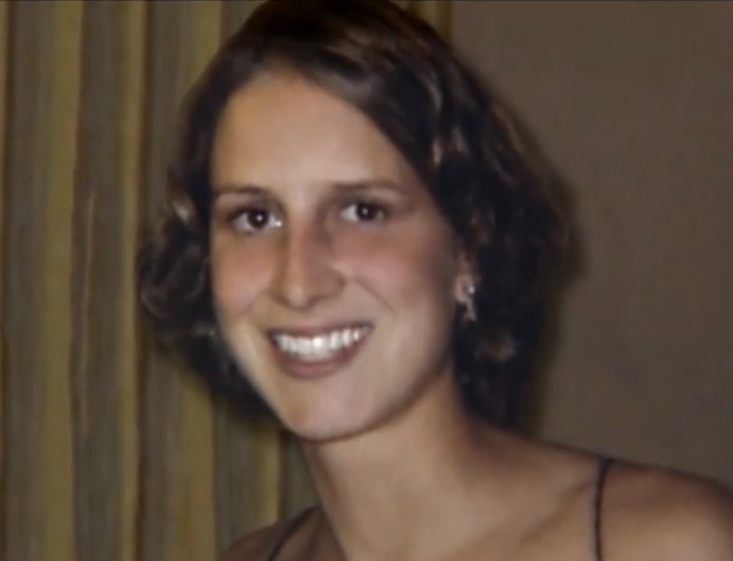
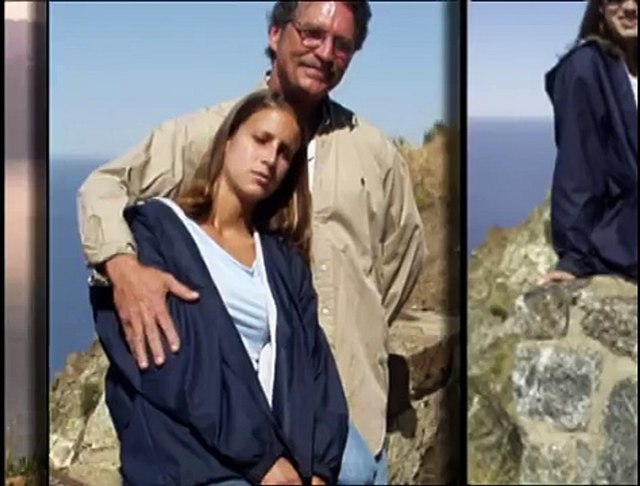
Virginia Reardon, 55, and Billie Joe McGinnis, 52, pushed Navy spouse and roommate Deanna Hubbard Wild, 20, off a 400 foot cliff at Big Sur in California on April 2, 1987. Deanna was living with her husband’s parents while he was at sea with the U.S. Navy. The motive was life insurance and Virginia had a string of insurance claims she cashed in on including Deanna’s death. The couple lured Deanna to the location under the guise of sight seeing, drugged her at lunch, and then it appears Billi Joe pushed her off the cliff. In the meantime, Virginia Reardon is taking pictures the entire time; investigators theorized she wanted a trophy of the homicide. After Deanna’s mother, Bobbie Roberts, found out her daughter was dead, she questioned the accidental ruling. She hired her own private investigator and attorney and they learned that Virginia Reardon had purchased a $35,000 life insurance policy the day before Deanna’s death. Reardon and McGinnis were arrested in 1989 for the murder of Deanna Wild. In 1991, Billi Joe McGinnis was charged with first degree murder but died from complications from pneumonia before his trial started. Virginia was charged and convicted on March 2, 1992 of first degree murder for financial gain. She was sentenced to life in prison, no parole. Virginia Reardon died while serving out her sentence on June 25, 2011.
One of the infamous photos taken before the murder. Investigators believe in this photo Deanna Wild was feeling the effects of the drugs she was given to make her vulnerable.
Forensic Files:
A beautiful, vibrant young woman fell to her death from a cliff overlooking the Pacific Ocean. Initially, investigators thought it was just a terrible accident. But after a closer forensic examination of photographs taken at the scene, police had a very different story of what had happened. -The Financial Downfall, Forensic Files (S9,E12)
Investigation Discovery:
ID Go: Cross these deadly vixens at your own risk. An English beauty spars with her boyfriend, a middle-aged woman sacrifices lives for money, and a couple of game players lure an innocent man into a deadly trap: these women will certainly fight to the death. -Vicious Vixens, Deadly Women (S7, E5)
Editor’s note: With a cable subscription, you can download the free ID Go app and watch Investigation Discovery programming at your convenience. And for those who do not have cable, you can watch “unlocked” episodes on the ID Go app including the latest premieres. For those who prefer commercial free programming during your binge session, Prime Video has an ID channel: ‘True Crime Files by Investigation Discovery” available for $3.99 a month. It’s a compilation of older seasons but totally worth the cost if you are a true crime addict. Download the ID Go app or purchase ID True Crime Files & binge away.
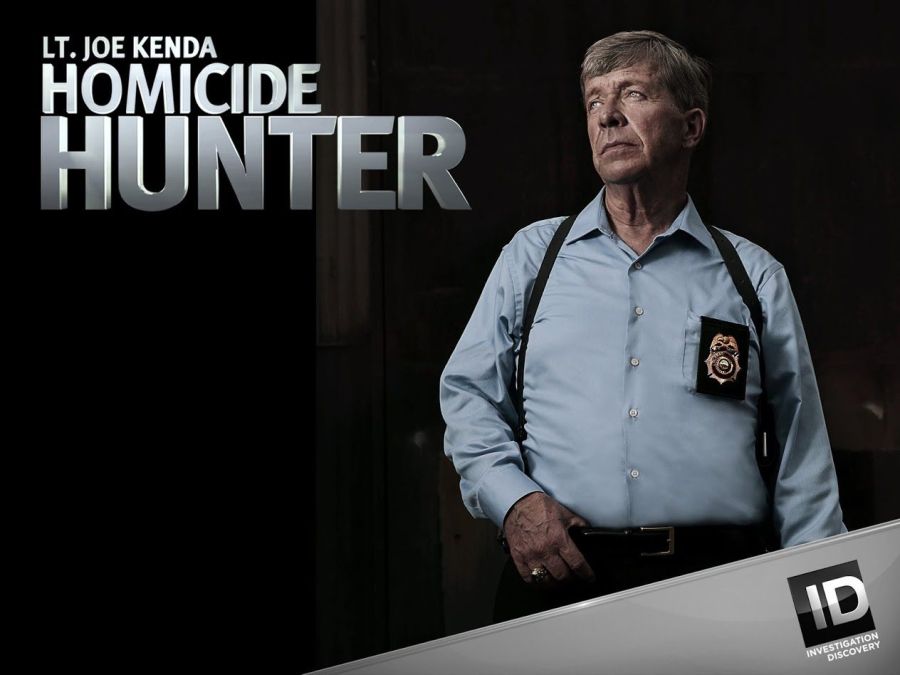
When a mysterious explosion rocks a sleepy suburb, it’s up to Kenda to ID a pile of charred remains and find the killer who triggered the blast. Then…a young mother’s murder leads the CSPD on a harrowing car chase that ends in a violent showdown. -Point of No Return, Homicide Hunter (S5,E13)
Homicide Hunter is an Investigation Discovery show featuring retired police Detective Lt. Joe Kenda (1973-1996). Lt. Kenda worked for the Colorado Springs Police Department for years and investigated and solved hundreds of cases during his employment. Now in his retirement, he outlines the cases that he encountered on the job and explains how he eventually solved the case. Colorado Springs is home of Fort Carson, an Army base with about 30,000 soldiers. This show is especially interesting given the fact that Lt. Kenda worked in a city with a close proximity to a large base. We have learned over time just how intertwined his job was with a military base known for an active role in fighting wars overseas over the years.
Exercises and deployments continually hone the skills of the Fort Carson Soldiers. When not deployed, Soldiers train annually at Pinon Canyon Maneuver Site and the National Training Center in California. Additionally, units participate in joint exercises around the world, including Central and South Africa, Europe, and Southwest Asia. In 2003, most Fort Carson units were deployed in support of Operations Enduring Freedom and Iraqi Freedom. ~Fort Carson History
Last night, Lt Joe Kenda discussed an explosives case that had been assigned to him. A powerful explosion occurred in a suburban neighborhood of Colorado Springs on November 12, 1978. He was actually working on paperwork on a Sunday when he received a call from police on the scene. They think they found human remains in the remnants of a detached garage near a single dwelling home. Joe was asked to investigate because this could be an intentional act of murder. Joe shared that the scenes he has investigated over the years have been horrific and quite shocking to include this one. As a result, he admitted that he has a hard time eating and sleeping, which are both signs of Post Traumatic Stress of which he admitted he has. This is a normal response for anyone who witnesses these acts of horror, especially over a long period of time.
After Joe arrived on the scene, he deduced that the damage looked like shrapnel damage. But his immediate thought was that it was most likely a gas explosion. He notices in the garage what looks like a large pile of human remains. Based on the remains, he assumed that it was most likely an adult male who was killed. If it’s not a gas explosion, what is it? A couple theories began to emerge including maybe the man lit a cigarette in an area with gas cans and exposed fuel or the victim was booby trapped with hidden wire. This could have been a murder.
Based on his fears of more explosives on scene, he decided to call the Colorado Springs Police Department (CSPD) Bomb Squad to investigate further to determine whether there were any more active munitions. He explained how explosive technicians truly understand explosives and other various devices. As soon as the Bomb Squad arrived at the scene, they immediately recognized the explosive had the smell of a military explosive. Fort Carson had this kind of ammunition on their base since before World War II. The Bomb Squad theorized that somebody from the base most likely smuggled it from Fort Carson and brought it to the current location. A CSPD detective explained how now we have robots to investigate bomb scares but back then we didn’t have that. Explosive technicians put their lives on the line everyday but more so before the advent of robots and other technologies to help minimize the danger of their jobs.
The CSPD Bomb Squad found another hand grenade in the garage that appeared to be live. An ordinance specialist entered the garage and not only found another grenade but he also found evidence of the dead man who was blown up by the first grenade. The second grenade appeared to be untampered with and there were no other explosives found at that location. Police suspected that the victim could have been in the building when someone threw the grenade in. They needed to learn more about the victim to determine if he had any enemies that would do something like this. They learned that the house is a rental and the current tenants only moved in a couple of months ago. The neighbor shared that a man named Estevan had recently retired and moved into this location. While on scene, a police officer found a human index finger quite a distance from the remnants of the garage. This discovery changed the whole direction of the case because the finger was found with a wire around it and this was the pin ring from the hand grenade. The victim may have pulled the pin and detonated the explosive. This could have been an accident.
Joe needed to identify the victim so he started with taking the victim’s finger to the lab so they could attempt to identify him by finger print. The lab technicians told him that without a name, it could take months before they get a match. In the meantime, Estevan’s wife showed up at the police station after learning what happened at her residence. Joe had to tell her that her husband was dead. She shared that his name was Estevan Maestas and he was a custodian at the school with finger prints on file. Estevan was simply going to clean out the garage because the people who lived their before left a bunch of junk in there. She left the house after he went out to the garage. Because his past did not indicate that this could have been a suicide attempt, it was theorized that this was in fact a tragic accident. Estevan most likely found the grenade, had no idea that it was live and maybe he thought it was a toy. He pulled the pin and he never felt a thing, he never knew what hit him.
The CSPD speculated that the grenades had been stolen from Fort Carson and brought into this rental home by a soldier. They assumed that most likely this guy didn’t want to deal with having to dispose of the grenades so he just left them there to become the next person’s problem. This was a hard pill to swallow given a man lost his life over this reckless act. Why was it not followed up on? Given how the military has strict regulations and is supposed to have strict chain of custody records to help them track all explosives, it should be easy to determine whether or not this grenade came from this base. It could have been brought home as a souvenir from World War II, Vietnam, or the Gulf War era. Were they able to cross reference the rental records at the location of the explosion with Fort Carson soldiers? This case revealed more mystery then resolve. If a soldier did smuggle the grenades from the base, why was there no investigation for theft, and now maybe even manslaughter? It is assumed that this person intentionally left them behind because they didn’t want to properly dispose of them.
In theory, no soldier should have been able to get these grenades on a plane or off the base without a search or a documentation trail given how the military usually conducts business. Much like communications security equipment (COMSEC), ammunition is inventoried and kept under lock and key in an effort to prevent compromises with dangerous repercussions. In most circumstances, if Fort Carson recognized that ammunition was missing, they would shut down the base until they found it. If someone dropped the ball at Fort Carson, a man lost his life because of careless documentation and security practices. And the Colorado bomb squad and Lt. Joe Kenda risked their lives in an effort to prevent anyone else from getting hurt or killed. Hopefully, soldiers learn a valuable lesson from this circumstance given it could have been a harmless act that went terribly wrong. Whoever left the grenades behind may not have intended for Estevan Maestas to die but he did. If a military member was responsible, it would be nice to know that the military has implemented safety and security procedures that can help prevent this kind of a tragedy from ever happening in our communities again.
Editor’s note: With a cable subscription, you can download the free ID Go app and watch Investigation Discovery programming at your convenience. And for those who do not have cable, you can watch “unlocked” episodes on the ID Go app including the latest premieres. For those who prefer commercial free programming during your binge session, Prime Video has an ID channel: ‘True Crime Files by Investigation Discovery” available for $3.99 a month. It’s a compilation of older seasons but totally worth the cost if you are a true crime addict. Download the ID Go app or purchase ID True Crime Files & binge away.


 MILITARY JUSTICE FOR ALL