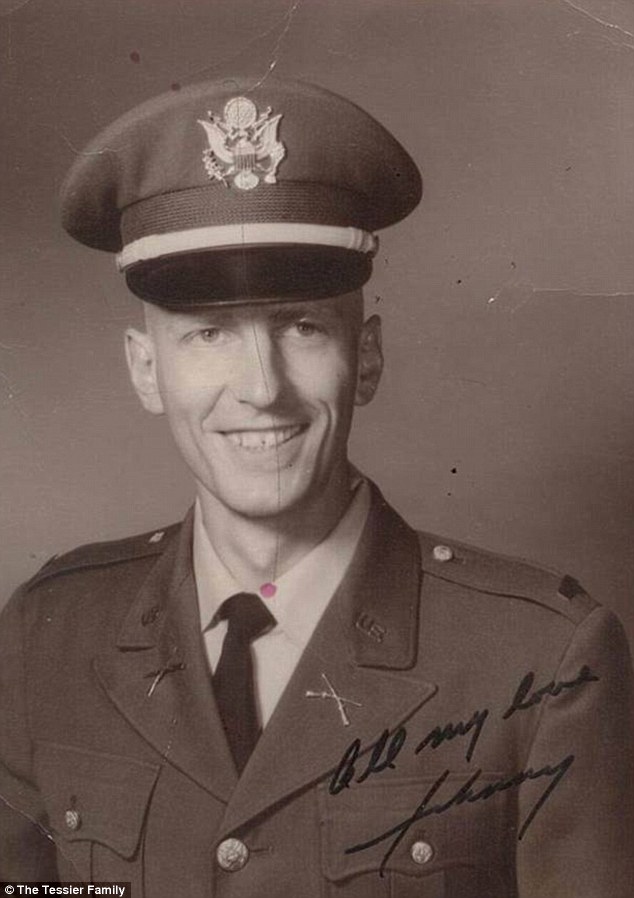
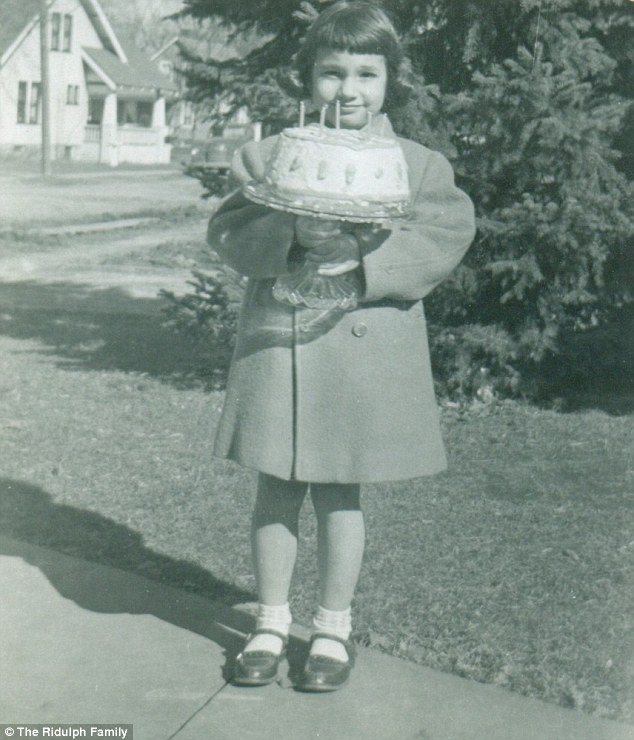
Maria Ridulph, 7, disappeared on December 3, 1957 in Sycamore, Illinois. She was found stabbed to death a few months later. Air Force veteran John Tessier (aka Jack McCullough) of Seattle, Washington, 17 at the time, was convicted in 2012 of the kidnapping and murder of Maria and sentenced to life in prison. It was the oldest cold case in the country to be solved but soon that victory would be lost and conviction overturned on appeal. A prosecutor found evidence that supported McCullough’s long-held alibi that he had been 40 miles away at the time of the disappearance. As a matter of fact, the former Captain was enlisting in the Air Force and left for active duty service a few days later. A certificate of innocence was issued and Jack McCullough was set free on April 15, 2016. Despite the past sexual abuse of minors allegations, which McCullough doesn’t deny, he wants to clear his name of the homicide. McCullough is suing the State of Illinois for wrongful conviction. The case remains unsolved to this day.
Retired police officer Jack McCullough was convicted of murder in Illinois more than half a century after the crime. But he was released Friday after a prosecutor found he could not have done it. McCullough says he will sue the state for the suffering five years of imprisonment. “48 Hours” correspondent Erin Moriarty reports.
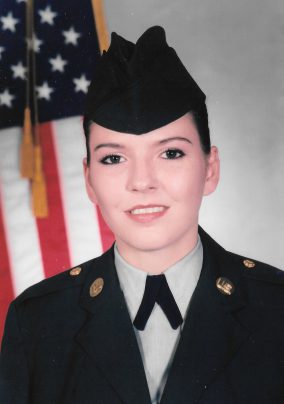
US Army veteran Felicia Reeves, 40, was found hanging August 19, 2015 in a bathroom in a room at the Royal Motel in Elizabeth, New Jersey. Initially the police ruled her death a suicide but the family questioned the investigator’s decision. One year later, Union County prosecutor’s reopened the probe into the investigation of Felicia to determine if in fact this was a homicide. According to her family, Felicia Reeves was a disabled veteran and had ties to organized criminal elements who might have wanted to silence her. The family also shared that she was sexually assaulted while stationed in Korea and her back was hurt during the attack which is what caused her permanent disability. She suffered from Post Traumatic Stress Disorder as well. Felicia escaped a couple abusive relationships and in the past couple years became associated with people who appeared to be taking advantage of her and manipulating her. Felicia’s painkiller prescription from the Department of Veterans Affairs was a frequent target for her new found friends. Felicia was in the process of trying to get custody of her two sons and had recently become concerned that she may be in danger. In February 2017, a homicide task force looking into the death of Felicia Reeves told the family that their investigation upholds the suicide ruling and the case was closed. Reeves’ sister Suzan Bayorgeon said “nothing about the New Jersey decision surprises her. Nor does it change her belief that Reeves was murdered, with her death made to look like a suicide.”
“Reeves had been in several bad relationships before her death and didn’t trust other people. Reeves’ sister, Suzan Bayorgeon, told the news outlet that Reeves had repeatedly commented that if she were discovered dead, it would be a murder.” -NJ.com
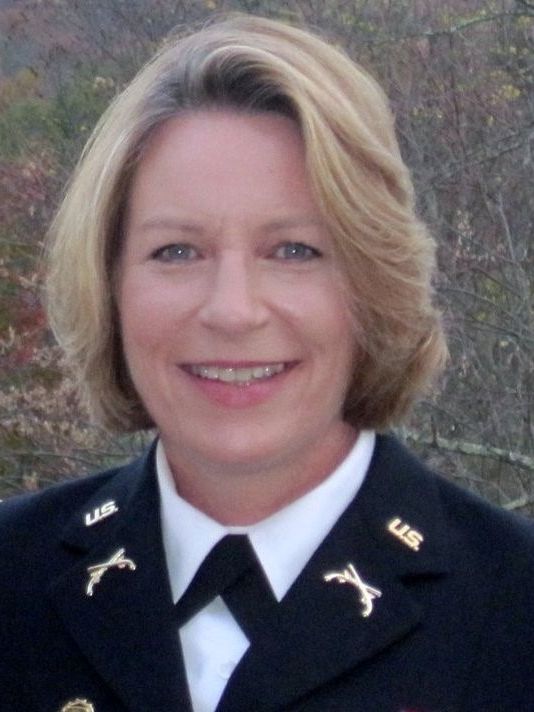
Lt Col Teresa James had a stellar career in the Army National Guard for over 30 years until she reported being sexually assaulted by a senior officer. Shortly after reporting the crime, she took convalescent leave for 30 days to seek medical treatment and eventually was medically retired because “she refused to come into work” according to leadership in the West Virginia Army National Guard. Lt Col James states that she asked for an extension to her convalescent leave (while continuing to seek medical treatment) or to work at an alternate location away from those who were retaliating against her. She did not want to retire and fought the forced medical retirement process but lost those appeals. She is now speaking up about the sexual assault and retaliation she experienced after reporting the assault. This case is a good example of the complications associated with the expedited transfer policy and how it is applies to the National Guard when both the accused and the victim are permanently stationed at the same location.
In May 2016, news broke that the Department of Defense Inspector General found that a brigadier general in the West Virginia Army National Guard did in fact retaliate against Lt Col James after she reported that she had been sexually assaulted by another officer. This is the first time that the DoD IG has confirmed a report of retaliation in the military. This case highlights the need for coordinated reform on the part of the Chief, the National Guard Bureau, and all of the state National Guard headquarters. The federal government does not have jurisdiction over the States therefore only the Governor and State Congressional members have authority to enact new laws for the National Guard. The National Guard must enact it’s own policies. The DoD IG has no jurisdiction over the West Virginia Army National Guard therefore cannot court martial or admonish the individuals involved. Lt Col James is focusing on ensuring that all State’s enact legislation to protect their National Guard members.
“My whole reason for speaking out is to educate other survivors,” she said,“ ‘That you are not alone. There are people out there that will help you, and that the best thing to do if you are assaulted is report it.’” (via Charleston Gazette-Mail)
Family of Katherine Morris wants Dept. of Justice to investigate death. -WMAR-2 News (August 10, 2015)
Army Spouse Katherine Morris Found Dead in Car Near Mall; Cause of Death Initially Ruled Suicide But Further Investigation Suggests Homicide Motivated by Insurance Fraud (May 6, 2012): https://wp.me/p3XTUi-5ve
Robert Hansen was a mild-mannered family man with a passion for hunting. A master at his trade, Hansen sought a more challenging prey – his fellow human. Hansen kidnapped women, set them loose in the Alaskan wilderness, and hunted them down for sport. -Hunting Humans, Ice Cold Killers (S1, E1)
Serial killer and Army Reserves veteran Robert C. Hansen confessed to the murder of 17 women and the kidnapping and rape of another 30 women in Alaska. But the authorities believe there are many more victims and their cases are still open. Hansen was officially charged with the abduction and rape of Cindy Paulson and the murders of Joanna Messina, Sherry Morrow, Paula Goulding, and the unidentified body known as “Eklutna Annie.” On February 28, 1984, Robert Hansen was sentenced to 461 years plus life in prison with no parole. Hansen led the police to 17 grave sites he marked on a map but only 12 of his victims bodies were recovered. Robert Hansen’s health was declining for over a year when he died of natural causes on August 21, 2014 at the age of 75.
In 1982, two off-duty police officers were hunting for wild game. As darkness fell and they headed home, they made a gruesome discovery. They knew enough to back away and dispatched the Alaska State Troopers to the scene. The crime scene investigators unearthed the partial bones of a woman buried in a shallow grave. They also found bones scattered around the surrounding area. In Alaska, wild game won’t hesitate to drag off the evidence. They also found a 223 caliber bullet casing. The victim was bound and blind folded at the time of death, and she was shot three times. She was identified as Sherry Morrow; Sherry was drawn to Alaska for the easy money. She worked as an exotic dancer in a seedy area of Anchorage known as ‘Fourth Avenue’. Police looked to see if anyone else in that community had disappeared under similar circumstances. Before the discovery of Sherry’s body, none of the missing persons reports were linked or suggestive of murder. Morrow’s case inspired police to take a look at the cold case files.
Two years before Morrow’s body was found, construction workers found the partial remains of a woman buried in a shallow grave; her body was desecrated by wild life and her bones were scattered. Police couldn’t make an identification and dubbed their Jane Doe “Eklutna Annie”. Nobody ever came forward with information about Annie. Police were concerned they were dealing with a brutal killer so they started canvassing the area where the dancers spent their time. Sherry’s co-workers feared the worst because a number of women had gone missing and they were never heard from again. Over the next several years, five more dancers went missing. Police suspected Sherry and Annie’s cases were connected. They were all victims from the beginning because everyone preyed on these girls, including the bar owners and pimps. Several dancers reported seeing the same man and provided police with a physical description. Police learned of a third body found in a gravel pit near where Eklutna Annie’s body was found.
The victim was identified as Joanna Messina. She was a canary worker who was last seen leaving the dock with her dog and a red haired man her co-workers couldn’t identify. Messina was shot and killed with a 22, not a 223. Two more women vanished and were never seen or heard from again. The blindfolds at the crime scenes told the police a lot about the killer. He was a sexual sadist who wanted complete control. He derived pleasure from his victim’s fear and pain and disposed of their bodies in isolated areas in Alaska. Nine months later, a truck driver found a frantic hand-cuffed woman running in the road; someone with a gun ducked out of site. The trucker took her to a nearby hotel where she was safe and called the Anchorage police. The police found a 17-year-old woman still in handcuffs and in shock. She told the officers she was a topless dancer down on 4th Avenue; she said she was propositioned by a red haired man in his 40s the night before. She confessed that she accepted the stranger’s offer.
Once inside the man’s car, she said the man pulled a gun on her. He kidnapped her, handcuffed her, and told her if she cooperated and did what he wanted, she wouldn’t be harmed. He took her to a middle class house in Muldoon. He held her hostage in a basement filled with mounted heads of animals. He brutalized her for hours. He chained her to beam in the basement and repeatedly sexually assaulted her. She told the police he was going to fly her to his cabin in the woods, promising to release her if she cooperated. Once at the airport, the kidnapper shoved her in a small plane and began loading supplies. The second he turned his back, she made her escape. Hoping to corroborate her account, investigators took her to the airfield to find the plane. She identified a plane owned by Robert Hansen; he was a 50 year-old avid hunter and local business man. Hansen owned a well established bakery, had lot of friends, and went to church. By all accounts, he was an upstanding member of the community.
When questioned by police, Hansen was outraged and insisted the dancer was lying to extort money from him. He also questioned whether it was even possible to rape a prostitute. He claimed he had an alibi and told investigators his wife and children were in Europe and he spent the night playing poker with friends. When questioned, the two men substantiated his story. Hansen allowed authorities to search his home but they didn’t find evidence of what the victim described. She also refused to take a polygraph and this made the police wonder if she fabricated the story. It was a “he said, she said” case because they had no evidence. Citing a lack of evidence, the prosecutor dropped the case. Three months later, Alaska State Troopers discovered the partially decomposed remains of another woman in a shallow grave. She was identified as a missing dancer from the Fourth Avenue district. Investigators found a blindfold buried among the remains. An autopsy revealed Paula Goulding had also been shot by a 223 caliber bullet.
Initially, the police didn’t link the cases but the use of the 223 caliber bullet helped them realize they were dealing with a serial killer who was targeting exotic dancers in Anchorage. Troopers contacted the Federal Bureau of Investigation for assistance; agents created a behavioral profile of the serial killer. The killer believed he was invincible because he picked the perfect victims. He chose the dancers on Fourth Ave because he thought no one would care if they were missing. They started looking into Robert Hansen’s past. They learned he was abused as a child and had very low self-esteem. He was always considered small and had few friends; he was often ridiculed by his peers. After graduating from high school, Hansen enlisted in the Army Reserve and went to basic training at Fort Dix. He later received advanced training as a military police officer at Fort Knox. While enlisted in the Army, he was known to frequent prostitutes. He told fellow soldiers, he found them dissatisfying and yearned to take control of the situation.
Despite his strict up bringing and disciplined military structure, the profilers learned Hansen had a number of run-ins with the law. He served time for arson and theft but he appeared to have long since left that life behind. In 1967, he married and moved to Alaska. He was a functioning member of society. They believe his low self-esteem would drive him to live in a place like Alaska. His former neighbor told investigators he loved the thrill of the hunt; and he was always looking for the bigger hunt. He was an avid trophy hunter. Hansen’s weak point was women because he was unsuccessful with them. He hunted where most of the victims were found. “Perhaps Hansen tired of game and turned to more interesting prey like humans.” Humans create a much greater challenge to the hunter. Police deduced he most likely had trophies from his hunts for humans. The killer was a sexual sadist, proficient, and more successful over time. Authorities threatened the two men who alibied him with jail time if they didn’t come clean about the night the dancer was abducted.
Both friends quickly broke down and said they were covering for him because they thought he was a legitimate guy. They believed him when he said he thought the dancers were trying to extort him. The police asked Hansen to come down to the station and executed a search warrant. An officer searched the attic and in the rafters he found a bag of jewelry. And nestled with his bag of trophies, they found IDs belonging to the victims and newspaper clippings. Authorities also found a trophy map with locations of where he killed his victims. Hansen tracked his kills. The most critical find was a 223 caliber mini 14 rifle. The rifle was sent to the crime lab for further analysis. The 223 matched perfectly with the round they found in Eklutna. Robert Hansen was charged with assault and kidnapping. Despite his pleas of innocence, the evidence was mounting against him. The District Attorney agreed to charge Hansen with four murders: Sherry Morrow, Eklutna Annie, Joanna Messina, and Paula Goulding. Hansen accepted a plea deal. Police believe he chose prostitutes because they represent the evil in humans.
Robert Hansen chose prostitutes because they will go anywhere for anything and when they disappear, no one cares. He admitted he controlled the game from the point of abduction. He was the predator and they were they prey. He killed Eklutna Annie first. Then he abducted Sherry Morrow. He took most of his victims to his remote cabin and brutalized them for hours before he stripped them naked, blindfolded them and then released them in the woods. He turned them loose, gave them a head start, and hunted them down. He was a trophy hunter. He then collected things off the girls so he could re-live the events. Robert Hansen’s killing spree lasted twelve years in Alaska. Hansen confessed to 17 killings but it is believed he had many more victims. He eventually lead police to 15 gravesites unknown to investigators. Unfortunately, investigators only recovered 7 bodies likely due to the veracious animal activity in the Alaskan wilderness. Robert Hansen was sentenced to 461 years plus life in prison with no chance of parole.
A Killer Among Us: Inside the Hunt for an Alaska Serial Killer (June 11, 2017, KTUU-Channel 2, Anchorage, Alaska)
The Frozen Ground Movie (2012)
THE FROZEN GROUND Official Trailer (2013)
The Frozen Ground – Clip 3 | Lionsgate
The Frozen Ground (2012) – Chained Scene (1/10) | Movieclips
The Frozen Ground (2012) – The Lucky One Scene (2/10) | Movieclips
The Frozen Ground (2012) – Pole Dancing Scene (3/10) | Movieclips
The Frozen Ground (2012) – Hunting Her Scene (4/10) | Movieclips
The Frozen Ground (2012) – On the Run Scene (5/10) | Movieclips
The Frozen Ground (2012) – Shock at the Strip Club Scene (6/10) | Movieclips
The Frozen Ground (2012) – The Interrogation Scene (7/10) | Movieclips
The Frozen Ground (2012) – From Bad to Worse Scene (8/10) | Movieclips
The Frozen Ground (2012) – He’s Coming Scene (9/10) | Movieclips
The Frozen Ground (2012) – Truth Comes Out Scene (10/10) | Movieclips
Based on a true story. An Alaskan State Trooper (Nicholas Cage) must partner with a near victim and the only witness to escape the clutches of the serial killer in order to bring the murderer to justice. -The Frozen Ground
Frozen Ground – Examining the Frozen Ground
Editor’s note: With a cable subscription, you can download the free ID Go app and watch all of the Investigation Discovery programming at your convenience. And for those who do not have cable, you can watch “unlocked” episodes on the ID Go app including the latest premieres. Download the ID Go app and binge away. For those who prefer commercial free programming during your binge session, Prime Video has an ID channel: ‘True Crime Files by Investigation Discovery” available for $2.99 a month. It’s a compilation of older seasons but totally worth the cost if you are a true crime addict.
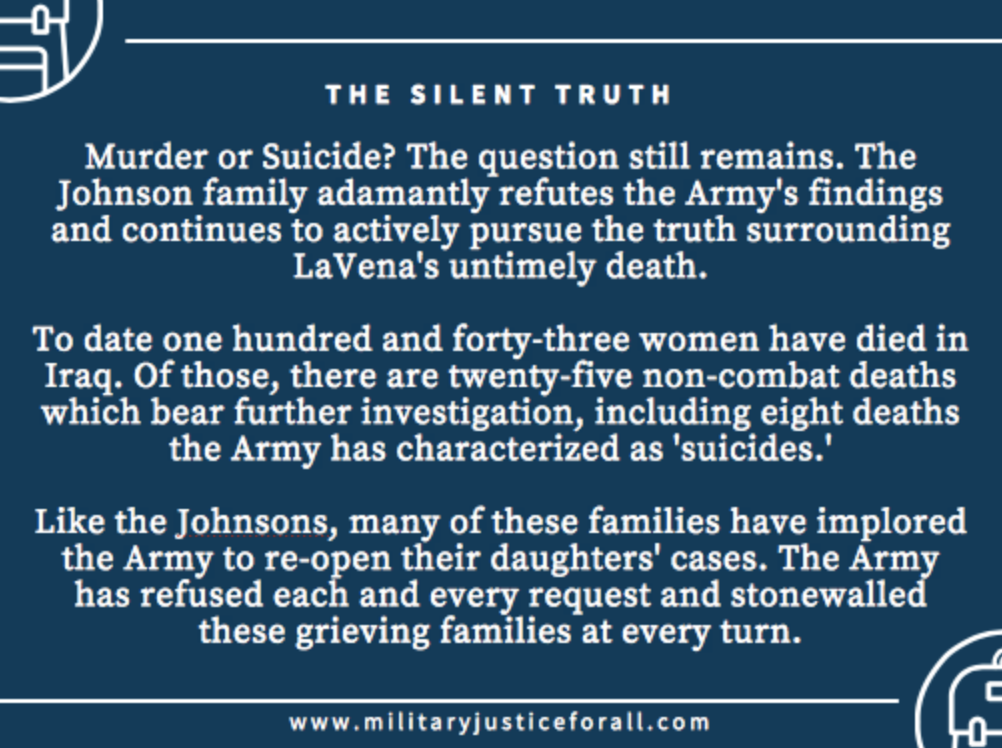
The American Army Has a Huge Hidden Rape Problem (June 23, 2016)
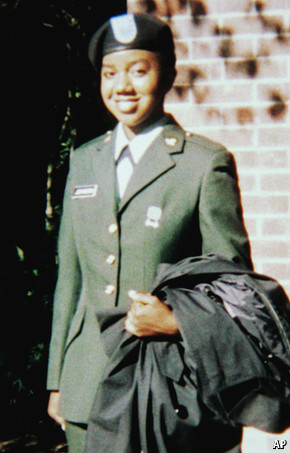
“What happened to LaVena Lynn Johnson and so many others speaks to a Pentagon culture which more closely resembles a rogue government–than a legitimate branch serving under civilian control. It is highly telling that this family, along with the Tillman family each had to have a documentary film made JUST TO ALERT THE PUBLIC TO THE TRUTH OF PENTAGON COVER-UPS. I urge everyone to view this important documentary–before the local military recruiter mandated under No Child Left Behind–‘friends’ their child at school. God forbid, they could wind up coming home in a body bag–like LaVena.” Read more from Truthouthere.
In the News:
Pfc. LaVena Johnson died in Iraq on July 19th, 2005 and her family needs your help. -Unsolved Mysteries (September 26, 2014)
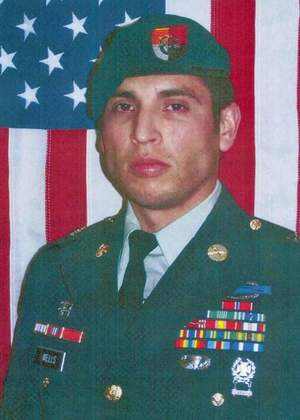
Army Special Forces soldier Sean Wayne Wells was shot and killed in his home near Fort Bragg, North Carolina on October 7, 2013. According to the Fayetteville Observer, Sean was shot by two masked men who entered his home through an unlocked door. They forced Sean’s wife and child into another room. They left driving a white 2012 Toyota Camry. Investigators believe this murder was premeditated and not random. This homicide is under investigation by the Fayetteville Police Department. The family pleads for your help to find the two men who murdered Sean in cold blood. They believe this case is solvable. Got a tip? Crime Stoppers
Navy CPO John Keith Bemis, 30, was found fatally shot in his Spring Valley, California residence on August 7, 2012. Keith enlisted in the U.S. Navy in 2000 and was an air conditioning and refrigeration mechanic assigned to the U.S.S. Independence docked in San Diego, California. Although the exact time of death is unknown, Keith was found dead on Tuesday morning, August 7th, by Navy co-workers and the Sheriff’s Department. Keith was found in his bedroom lying on his back in full uniform wearing a motorcycle helmet with a single intraoral gunshot wound. Keith’s death was quickly ruled a suicide but Keith’s parents, Tony and Sue Bemis, who never believed Keith died by suicide, want Keith’s death to be reopened and investigated as a homicide. They have conducted their own investigation and have determined the evidence simply doesn’t add up. Keith was a happy and healthy young man with a stellar military career; he was a suicide prevention advocate for the Navy; there were no medical or mental health issues or stressors noted in Keith’s naval medical records; and he did not leave a note. The San Diego County Sheriff’s Department (Lemon Grove) were tasked with investigating and documenting the incident and the San Diego County Medical Examiner’s office conducted an autopsy. Photos were taken at the scene and at autopsy.
Tony and Sue Bemis elicited the help of the Armed Forces Medical Examiner (AFME) because they wanted a second autopsy conducted. Now both the San Diego County Medical Examiner and the AFME had ruled the cause of death suicide. After the family received a copy of the autopsy reports and photos, they began to notice upon closer examination that there were words like “gay” and “fag” written on Keith’s body. They found other oddities like numbers and words written on Keith’s body and on items in the bedroom where he was found. They found markings consistent with writing on the back of Keith’s neck. They observed two bullet holes in the ceiling; only one bullet was recovered. And were surprised by the damage caused to the motorcycle helmet where the bullet that killed their son apparently exited. They learned Keith was last seen on August 6 around 9 p.m. and suspect Keith was met with foul play shortly after returning home. Neighbors told the family he parked his truck in handicap parking (which he normally would not do) upon returning home. Neighbors also reported hearing a loud thud. After the family examined the evidence known to them (and to police), they found enough compelling evidence to warrant concern. Keith didn’t have any of the associated risk factors with suicide. But Keith did have a recent break up with a woman he had dated off and on for three years.
Keith met his ex-girlfriend in Tijuana and the relationship dynamics and reasons why they broke up are unknown. Those who interacted with Keith prior to his death did not observe any depression associated with the break-up. In the days following the break-up Keith celebrated an upcoming promotion on Sunday August 5, 2012; he spoke with family during a party at his condominium. He had recently purchased some new t-shirts and none of his electronic communications prior to the incident indicated any kind of unusual behavior. Unfortunately, Keith’s computer was of no use; the hard drive was wiped. Some mystery could have been alleviated with gun shot residue (GSR) testing of Keith’s hands but this testing was not conducted by either the San Diego County or Armed Forces medical examiners. The family tested Keith’s three guns for forensic evidence (including the gun allegedly used to take his own life) and no blood, blowback, or remains were found on any of Keith’s guns. The family wants homicide investigators to explore the various motives and theories because they know Keith didn’t die by his own hand. They can’t have peace until there is justice for their son. And none of us are safe if we turn the other way and ignore what quite possibly could be a homicide. Keith was concerned about a missing key to his place. Was a known offender able to gain access with the missing key? Nothing appeared to be stolen from Keith’s residence. Was it a personal crime?
If Keith’s death was a homicide, then a killer roams free. And because of this, we need to make death and missing persons investigations a priority. Every death investigation should be a homicide investigation initially until evidence proves otherwise. And we should always use gun shot residue testing to confirm suicide by gun. We should conduct a victimology, interview family and friends, and look at the totality of the evidence before making premature determinations that control the future of an investigation. The interviews, electronic records, and necessary forensic testing speak for the victim. We should take a look at all the possible theories. Some theories in this case include but are not limited to: ex-girlfriend angry Keith broke off with her, feels rejected, wants revenge; mistaken identity, intruder meant to target roommate; the missing house key was used to enter residence, intruder known; roommate was in Navy, maybe Keith suspected illegal activity and co-workers wanted him to remain silent; was this a national security incident or an act of terrorism? Tony and Sue Bemis created a website in Keith’s name. They are determined to find out what happened to their son because the evidence collected doesn’t support a suicide ruling. Take a look at the evidence for yourself and make your own determination. The more eyes on the case, the better. Please sign the petition, follow Death of Navy CPO John Keith Bemis on Facebook, and for tips, please contact Tony and Sue by e-mail.
CPO John “Keith” Bemis’ death was declared a suicide in August 2012, but the evidence doesn’t add up and his parents need your help. -Unsolved Mysteries (February 27, 2015)
San Diego County Sheriff’s Department Report (August 7, 2012):
San Diego County Sheriff’s Department Report (Download PDF)
Armed Forces Medical Examiner’s Report (August 17, 2012):
Armed Forces Medical Examiner’s Report (Download PDF)
San Diego County Medical Examiner’s Report (September 28, 2012):
San Diego County Medical Examiner’s Report (Download PDF)
Able Legal Investigations Summary Report (January 12, 2014):
Able Legal Investigations Summary Report (Download PDF)
Ryan Forensic DNA Consulting Report (September 2, 2014):
Ryan Forensic DNA Consulting Report (Download PDF)
DNA Diagnostics Center Forensic Report (October 27, 2017):
DNA Diagnostics Center Forensic Report (Download PDF)
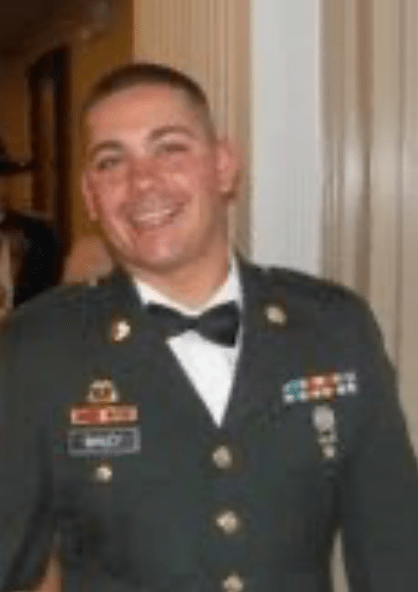
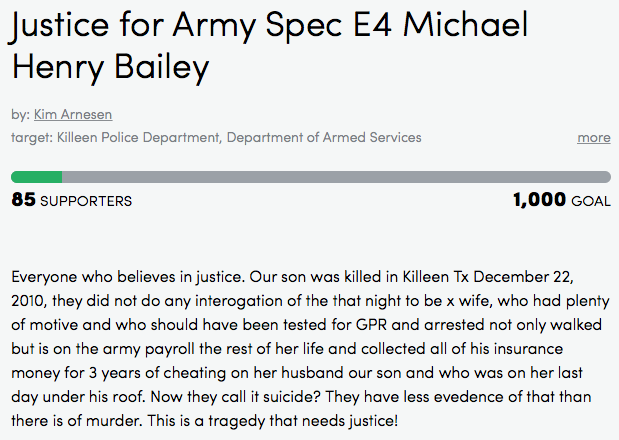
Army Spc. Michael Henry Bailey II, 26, died on December 29, 2011 from injuries sustained from a gunshot wound on December 23, 2011. He was assigned to 4th Squadron, 9th Cavalry Regiment, 2nd Brigade Combat Team, 1st Cavalry Division, in Fort Hood, Texas. Spc. Bailey deployed in support of Operation Iraqi Freedom from May 2011 to November 2011. At the time of the Army press release, the incident was under investigation. According to a family petition, they believe that there was more evidence supporting murder then suicide. They asked the Army and the Killeen Police Department to investigate the circumstances further as they believe that someone close to Spc. Bailey’s life had motive (life insurance) and this person was allegedly present at the location on the day of the shooting.
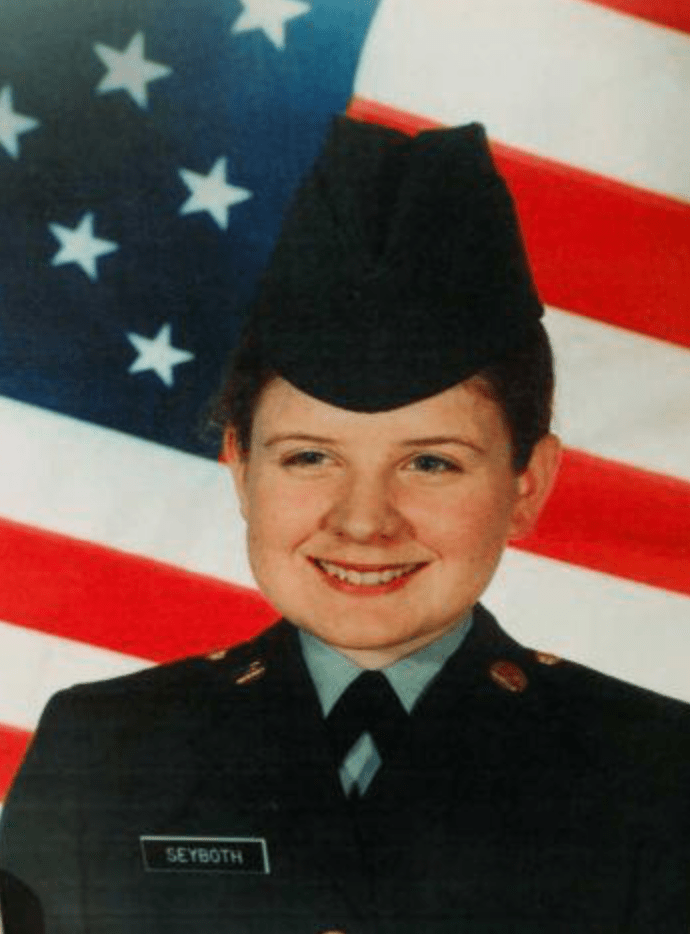
Army Staff Sgt. Amy (Seyboth) Tirador died of injuries sustained from a non-combat related incident in Kirkush, Iraq on November 4, 2009. Staff Sgt. Tirador was supporting Operation Iraqi Freedom on behalf of the 209th Military Intelligence Company, 1st Squadron, 14th Cavalry Regiment, 3rd Stryker Brigade Combat Team, 2nd Infantry Division in Fort Lewis, Washington. This was Amy’s third tour of duty in support of Operation Iraqi Freedom. The Department of Defense announced the circumstances surrounding the incident were under investigation at the time of the press release. Media reports declared that Amy was found by a maintenance worker in the base’s small generator room with a single gunshot wound to the back of the head. The Army pathologist ruled the cause of death as a ‘self inflicted gunshot wound’ but Amy’s mother Colleen Murphy disagreed and vowed to launch a private investigation. The family expressed concerns publicly that this was an execution style murder on a secure base and that she was killed in the generator room to muffle the sounds of the gunshot. Amy’s DNA evidence was found on the 9mm and that of another person. The family shared that the investigation report attempted to lead one to believe that Amy was considered high risk for suicide because of pressures at work as an Arabic translator and a strained marriage. Amy’s husband Michael Tirador was living at the same deployed location in Iraq as Amy at the time of her death. Amy’s mother denied any history of depression or substance abuse and does not believe her daughter died by suicide.
A year after Amy’s death the Army Criminal Investigation Division indicated in media reports that the investigation was not completed and no final rulings had been made. Yet Colleen Murphy shared that she was told the case was officially closed and expressed frustration with the miscommunication she typically experienced with Army bureaucracy. Amy’s mother also indicated that a lot of women in the military who have died have had their deaths falsely ruled as suicides. Colleen learned from other families who have lost their loved ones that they have even exhumed their daughters’ bodies and found that, without a shadow of a doubt, they did not kill themselves. Colleen indicated that she was going to get a second autopsy in light of the Army pathologist’s determination of cause of death. Michael Tirador expressed in interviews that he did not believe that his wife committed suicide and ordered that her body be exhumed for a second autopsy. Michael was of course a person of interest but his DNA did not match the second DNA profile on the gun. Colleen Murphy indicated that despite Michael’s claims that they had a good marriage, Amy wanted to divorce him. Amy’s father Greg Seyboth expressed concern that her work as a interrogator made her a high-profile target. Retired Army Colonel Ann Wright validated Amy’s family when she published an article stating that several female soldier’s deaths have been grossly mislabled by the military yet when faced with further evidence, they refused to change their findings. Colleen Murphy stated that she will never accept that her daughter committed suicide and that the Army is covering up the real reason that she was killed.
Tirador’s “greatness” has been shrouded in military “secrecy”. Her military legacy clouded by the military’s label of a “non-combat” death. An execution-style death in a “secure area” on an American military base in a war zone. –Family of Amy Tirador
Amy Seyboth-Tirador should have been coming home from her tour of duty overseas very soon. Instead, family and friends are planning a big memorial event in her honor. It’s a ride to remember the Army staff sergeant whose death still remains a mystery to loved ones. -WNYT NewsChannel 13 (August 6, 2010)
Interview with Amy Seyboth Tirador’s mother, 2 of 4 -810 WGY News (February 4, 2010)
Interview with Amy Seyboth Tirador’s mother, 4 of 4 -810 WGY News (February 4, 2010)







 MILITARY JUSTICE FOR ALL