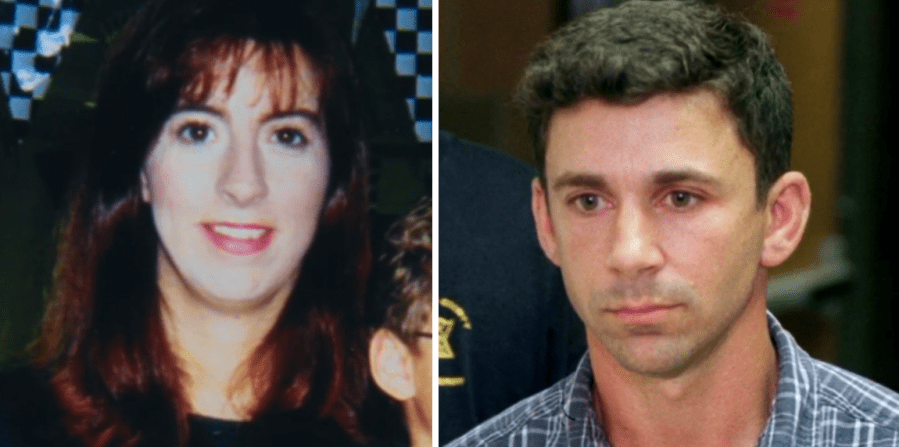
Forbidden: Dying for Love featured the Jennifer and William Wright 2002 homicide-suicide case on Investigation Discovery. ‘Onward, Christian Soldier’ highlighted the circumstances that lead to the murder of Jennifer Wright and the pain it inflicted on those who were left behind including their three sons. According to the show, William Wright was a Master Sergeant in the U.S. Army and was stationed at Fort Bragg in North Carolina with his wife and three children. MSgt Wright was routinely deployed after 9/11/2001 and as a result he was never home. Bill’s absence was hard on Jennifer and the marriage. She wanted Bill to leave the Army but the Army was his life; it’s what he was meant to do. While Bill was deployed in Afghanistan, he learned that Jennifer was telling people back home that he divorced her.
Bill was stunned to learn the news and was granted leave to go back stateside and deal with his family crisis. Bill learned Jennifer was having an affair with the pastor at church and she wanted a divorce. Instead of salvaging his marriage, Bill murdered Jennifer in the family home on June 29, 2002 and covered it up. When investigators questioned Bill about Jennifer’s murder, he broke down and told them everything. Bill admitted he hit his wife with a baseball bat and then strangled her to death. He then put her body in a garbage bag and buried her in some woods near Fort Bragg. In 2003, William Wright was in prison awaiting trial when he died by suicide in his jail cell. Jennifer and William’s sons expressed concern that the Army’s anti-malaria drugs negatively impacted their father’s health and was most likely the reason this tragedy occurred.
This domestic violence related homicide was one of five murders that occurred in a six week period at Fort Bragg in 2002. Rigoberto Nieves fatally shot his wife Teresa on June 11, 2002; Cedric Griffin fatally stabbed his wife Marilyn on July 9, 2002; Brandon Floyd fatally shot his wife Andrea on July 19, 2002; and military spouse Joan Shannon manipulated her daughter Elizabeth to shoot her step-father Major David Shannon on July 23, 2002 while he slept.
ID Go: While her husband serves in the army, a lonely married mother of three finds comfort in the arms of her church’s charismatic new minister. But danger looms in the form of a jealous love-rival that will stop at nothing to scare her away. -Onward, Christian Soldier, Forbidden: Dying for Love (S4,E4)
Editor’s note: With a cable subscription, you can download the free ID Go app and watch all of the Investigation Discovery programming at your convenience. And for those who do not have cable, you can watch “unlocked” episodes on the ID Go app including the latest premieres. Download the ID Go app and binge away. For those who prefer commercial free programming during your binge session, Prime Video has an ID channel: ‘True Crime Files by Investigation Discovery” available for $2.99 a month. It’s a compilation of older seasons but totally worth the cost if you are a true crime addict.
Army Pfc. Gary S. Kalinofski, 21, died of a gunshot wound at Camp Magrath near Pristina, Kosovo on March 4, 2002. The military casualty announcement confirmed the gunshot wound was not a result of engagement with hostile forces. Pfc. Kalinofski’s home of record was listed as Fayetteville, North Carolina. Pfc. Kalinofski served in Kosovo since November 2001 in a peacekeeping mission role on behalf of A Company, Task Force 1-32nd Infantry Regiment at Fort Drum, New York. According to the book Army Wives by Tanya Biank, the Army Criminal Investigation Division (CID) ruled that Pfc. Gary Kalinofski died as a result of a self-inflicted gunshot wound. Gary was survived by his parents; his dad also served in the Army and was in Kosovo at the time Gary took his own life. The Army Wives author shared that Gary’s parents were interviewed by Army CID but they didn’t have any insight or knowledge to help Army CID understand why Gary chose to die by suicide.
Editor’s Note: There was no Department of Defense press release for the announcement of the death of Army casualty Pfc. Gary S. Kalinofski in Kosovo.
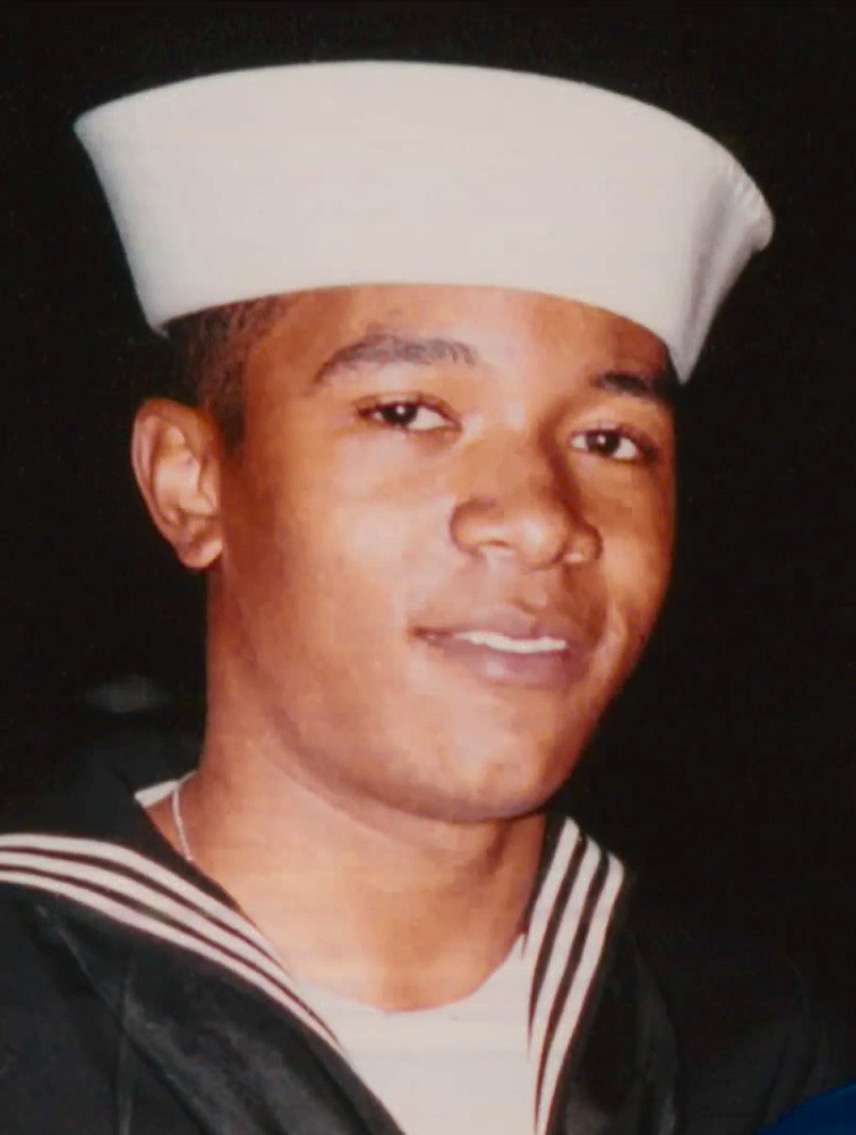
ID Go: An abandoned car belonging to missing sailor Nicholas Cox turns up in a parking lot. Inside, Demery uncovers a grisly cache of blood evidence, but no Cox. In order to find justice for his fallen brother-in-arms, Demery must first locate his body. -Friendly Fire, Murder Chose Me (S1, E3)
Editor’s note: With a cable subscription, you can download the free ID Go app and watch all of the Investigation Discovery programming at your convenience. And for those who do not have cable, you can watch “unlocked” episodes on the ID Go app including the latest premieres. Download the ID Go app and binge away. For those who prefer commercial free programming during your binge session, Prime Video has an ID channel: ‘True Crime Files by Investigation Discovery” available for $2.99 a month. It’s a compilation of older seasons but totally worth the cost if you are a true crime addict.
Secretary of Defense Donald H. Rumsfeld today released the following statement (April 7, 2001):
“Americans are saddened by today’s tragic loss of life of both U.S. and Vietnamese service personnel in the Socialist Republic of Vietnam. Those of us in the Department of Defense, and the families of our missing, are keenly aware of the dedication of both the American and Vietnamese team members who were, on this very day, searching for servicemen who have been missing in action since the end of the war.”
7 Americans, 9 Vietnamese Die in Viet Helo Crash (April 10, 2001):
“The Americans killed in the crash were identified as Army Lt. Col. Rennie M. Cory Jr., commander, Detachment 2, Joint Task Force-Full Accounting; Army Lt. Col. George D. Martin III, incoming commander; Air Force Maj. Charles E. Lewis, deputy commander; Army Sgt. 1st Class Tommy J. Murphy, mortuary affairs team sergeant, Central Identification Laboratory-Hawaii; Navy Chief Petty Officer Pedro J. Gonzales, corpsman; and Air Force Master Sgt. Steven L. Moser and Tech. Sgt. Robert M. Flynn, linguists. U.S. Pacific Command officials in Hawaii released the names April 9 at 7 p.m. The Vietnamese dead include the three-member crew and four aircraft technicians. Also killed were two members of the Vietnamese agency that assists U.S. Pacific Command’s Joint Task Force-Full Accounting in its investigation and recovery efforts.”
“A Pacific Command investigation into an April 7 helicopter crash that killed seven U.S. servicemen in Vietnam found that deteriorating weather conditions, poor visibility and the Vietnamese pilot’s failure to “properly react” to those conditions were predominant factors in the accident.” –Honolulu Advertiser (October 17, 2001)
Pvt. John Bennett is the Only U.S. Soldier Executed for Rape in Peacetime. He Was Mentally Troubled and Black. Six White Murderers Were Also on Military Death Row. They Were Spared.
Richard A. Serrano is a Staff Writer in The Times’ Washington, bureau. He last wrote for the magazine about the bombing of the Oklahoma, City federal building, which was also the subject of his book, “One of, Ours,” published in 1998 by W.W. Norton
“Rain always frightened him, and on the night he was hanged in a military prison in Kansas, a rolling prairie thunderstorm was kicking up outside. That was four decades ago. Pvt. John Bennett had just turned 26. He went to his death perhaps more terrified of the thunder and lightning than of the gaunt hangman waiting upon the gallows.
News of the hanging scarcely made the papers. Executions then, like today, were commonplace, so much so that his story has never been told. But he is the last member of the U.S. Armed Forces to be executed. And he is the only serviceman hanged for rape during peacetime.
America is once again examining the death penalty, spurred by the most damning evidence in history that innocents have been sentenced to die. Advances in DNA testing and other revelations have overturned scores of death sentences in recent years, raising fresh doubts about American criminal justice, especially for minorities, who make up the majority of death row prisoners.
As a result, the death penalty issue looms larger in presidential politics than it has for a generation. Both major party candidates favor death sentencing, and Republican nominee George W. Bush has given it special emphasis. He expresses confidence in his state’s handling of capital cases and says that not one innocent man has been executed on his watch as governor of Texas.
The issue also has landed in the Oval Office, where President Clinton delayed by four months the federal government’s first scheduled execution since 1963. Juan Raul Garza will now have until Dec. 12–a date notably after the presidential election–to seek clemency. Garza’s attorneys say they will argue that the criminal justice system discriminates against minorities.
Amid the chatter, national opinion polls have found that while most Americans still favor death sentencing, the support is diminishing. Even its proponents question the role that race, mental illness, poverty, politics and the quality of legal representation play in death penalty cases. All those factors were present on that stormy night in April 1961 inside the U.S. Disciplinary Barracks at Ft. Leavenworth. Was the system broken back then? Has it been fixed since?“
Read more from Richard A. Serrano (LA Times) here or here and check out Serrano’s book ‘Summoned at Midnight: A Story of Race and the Last Military Executions at Fort Leavenworth’here.
Vanity Fair Confidential featured an episode called Don’t Ask Don’t Kill on Investigation Discovery highlighting the case of Army Pfc. Barry Winchell at Fort Campbell, Kentucky in 1999. Winchell was bludgeoned to death by a fellow soldier while he lay asleep in his cot on July 5 in the barracks. Winchell was described by his friends as someone who would give the shirt off his back for you. He was a model soldier and had dreams of becoming a Warrant Officer. He was a member of the elite Screaming Eagles, 101st Airborne and was considered a perfect fit for the military. He was described by fellow soldiers as a 50 caliber expert.
After Barry Winchell died, the military immediately began downplaying what had occurred on base at Fort Campbell. They initially claimed it was a fight that had gone too far. They told the family that Barry Winchell had been kicked in the head with a boot but his injuries did not match that theory. As a result, the family and media outlets were convinced the military was hiding the real story and believed they were trying to cover up the crime. Why? The military concluded that this was a rare soldier on soldier attack in their barracks but the claim that he was kicked in the head did not match the crime scene either. Although the military was tasked with the investigation of the murder, they declined to speculate on a motive.
The Army was not cooperating with anyone. ~Vanity Fair Confidential
When Barry’s girlfriend Calpernia Addams learned about what happened to Barry, he was on life support and considered brain dead. He died twelve hours after the attack and she didn’t get an opportunity to see him. Calpernia learned that he had been murdered on base and believed that there was more to this story then what the Army was sharing. As a result, she set out to make sure both Barry’s parents and the media knew what she knew and suspected had happened. Calpernia was born a boy. She served in the US Navy as a transsexual and then once she got out of the military, she began her transition from man to woman. When Calpernia and Barry met, they hit it off immediately and started dating. When she met Barry, she was halfway to becoming a woman. She lovingly shared that Barry accepted her for who she was and supported her in her transition from man to woman.
Calpernia strongly believed that people were blurring the lines between whether Barry was gay or straight. She wanted people to know that he was straight and he liked women. Calpernia believed that Barry’s troubles began with an anonymous accusation that Barry was gay. She claimed that a fellow soldier said he saw Barry giving oral sex to a man in a Nashville gay bar. But no one believed it and his military comrades didn’t think he was gay. Calpernia believed that it was Barry’s roommate, Justin Fisher, who started spreading the rumors in an effort to cause harm to Barry. In 1999 the Don’t Ask Don’t Tell policy was in effect and a soldier could in fact lose their career if they were found out. Justin Fisher didn’t have the best reputation. He was described as someone who thought he was a gangster even though he was from Nebraska. And some believed that Justin never should have been allowed to join the military.
According to Calpernia, Justin Fisher and Barry Winchell had a love/hate relationship. Fisher tormented him, joked about his sexuality, about him being a homosexual, and kept calling him a faggot. He told others that he didn’t trust him and eventually openly spread rumors that Barry was gay. Fisher also blackmailed Barry with his alleged homosexuality. He told their Non Commissioned Officers (NCOs) about him being gay knowing that Barry could lose his career under the Don’t Ask Don’t Tell (DADT) policy. Back in those days, once accused of being gay, you were dead in the water in a military setting. Some believe this case reveals that if gone unchecked the military can become an incubator for hate. At the time of DADT, it was virtually impossible to report anti-gay harassment and Barry’s family and friends were not quite sure how he dealt with the regular doses of harassment. As evidenced in this case and many others, he had nowhere to turn without fear of losing his cherished career.
At the time of DADT, it was virtually impossible to report anti-gay harassment without fear of losing your career. ~Vanity Fair Confidential
The military was in charge of the investigation because the crime occurred on a federal base. As with many cases, family, friends, and the media forced the Army to be accountable for what happened on their base on their watch. So as the investigation into Barry’s Winchell’s death continued, we learned what actually happened. Calvin Glover, an eighteen year old new recruit, was ultimately charged with the murder of Barry Winchell. Observers felt that he did it because of a combination of too many men, too much alcohol, and too little to do. The day before the murder, Calvin and Winchell got into a fight. Apparently Winchell dealt him one punch in the face and he went down. Calvin who was highly intoxicated swore he would get him back but Winchell apologized to him the next day and it appeared that everything was fine. Unfortunately, Justin Fisher (Winchell’s roommate) was provoking Calvin all day long asking him if he was going to take Winchell’s abuse.
That same night after Calvin Glover had consumed seventeen beers, he decided he was going to bed. Fisher went to his room and told him that Barry was telling everyone that he beat him up and they were all laughing about it. Fisher handed Calvin a wooden bat, suggested he hit Barry with it, and Calvin said he felt compelled to use it. In a drunken, peer pressured stupor, Calvin hit Barry Winchell multiple times in the head with the wooden bat. Barry Winchell was asleep and couldn’t defend himself. After Calvin was done hitting Barry, Fisher was laughing, jumping up and down, and told Calvin that they would keep it in the family. Then Calvin immediately began to destroy evidence. Fisher acted like he stumbled upon Winchell on the cot and was trying to help him. The soldiers tried calling 911 but they were not able to get through to emergency services on a base phone. Barry was taken to the hospital and twelve hours later, he was dead. Everyone in the barracks was wondering who would come in the barracks and kill them.
The soldiers tried calling 911 but they were not able to get through to emergency services on a base phone. ~Vanity Fair Confidential
In the course of the investigation, Justin Fisher eventually identified Calvin Glover as the culprit. As a result of Calpernia Addams and others that stepped forward, we learned that there was more to the story underneath the surface. We learned that Justin Fisher had a much larger role in the crime then he was willing to admit. Justin Fisher introduced Calpernia Addams to Barry Winchell. Apparently Justin Fisher was interested in Calpernia Addams and after she chose Barry, he asked her if she would hook him up with one of her drag queen friends. Justin ended up hooking up with Kimmie Mayfield, who was a man. Everyone suspected that Justin was interested in guys because of his relationship with Kimmie. They hooked up several times in the course of a few months. We also learned this wasn’t Justin’s first walk on the wild side. He had a history of experimentation. Barry shared with Calpernia that one time he woke up to Justin playing with his feet. Calpernia deduced that Justin may have been jealous of Calpernia being with Barry or vice versa. It was noted that people tend to hate those who remind them of something they don’t want to face.
In the end about 90% of the soldiers who served with Barry Winchell, Calvin Glover, and Justin Fisher didn’t think this was a hate crime but instead a crime of passion. They did not witness any anti-gay rage; but they did witness too much alcohol. One of the soldiers believed that Justin Fisher also hit Barry Winchell with the bat because of the blood spatter evidence left at the crime scene. It matched someone who was left handed and Fisher was left handed. One of the soldiers mentioned this to Fisher and Fisher told him he was in the wrong career and should be a detective instead. The soldiers who served with them believed that Justin Fisher was the murderer and Calvin Glover was the murder weapon. Calvin felt pressured by Justin Fisher to hit Winchell while he was intoxicated. It is suspected that Fisher hit Winchell with the bat as well and may have been the one that dealt the fatal blows. Calvin participated in the Vanity Fair programming by phone from prison and did in fact express remorse for his role in Barry Winchell’s death.
Both Calvin Glover and Justin Fisher were court martialed. In the end, Calvin Glover was convicted of pre-meditated murder and was sentenced to life in prison with an opportunity for parole. Justin Fisher was charged as an accessory and restricted to his barracks while he was going through trial. Observers felt that it was ridiculous that Fisher was restricted to his barracks when in fact he was the mastermind of the murder. He too was convicted and sentenced to twelve and half years but was released early in 2006 after only serving seven years. Observers felt that Justin Fisher’s sentence was a miscarriage of justice considering it never would have happened if it wasn’t for him pushing Calvin Glover to hit Barry Winchell with the baseball bat that night. Justin Fisher now lives in the Mid-West and declined to comment on this Vanity Fair episode. He walks as a free man. In retrospect, Calvin Glover shared that he feels like this was a love triangle gone wrong and he wishes that he could take it all back.
At the end of the programming, Pat and Wally Kutteles (Barry’s parents) shared that they sent their son off to serve in the military, they did not send him off to be beaten to death with a bat while he was sleeping. Dixon Osborn from the Servicemen’s Legal Defense Network (SLDN) believed that the military simply wanted to sweep it under the rug with no connection to the gay reference. The military hoped the general public, the media, and Barry’s parents would just accept that it was a drunken brawl. All those involved felt like the military investigation was a joke. Calpernia Addams, Barry’s parents and friends, and the SLDN wanted to honor Barry’s memory by exposing the truth about Barry’s untimely death. They used Barry Winchell’s case as a catalyst to lift the dangerous Don’t Ask Don’t Tell policy. According to those involved, President Bill Clinton’s DADT policy was the biggest mistake ever for the military because it taught people to lie. At the peak of DADT, there were 3-4 soldiers discharged per day for their sexual orientation. DADT was a failure of the Clinton administration.
All those involved felt like the military investigation was a joke. ~Vanity Fair Confidential
In an interesting twist, the Commander who was in charge at the time of the death of Barry Winchell sparked protest in Washington DC in 2000 when he was reassigned to the Joint Chiefs of Staff at the Pentagon. In response, Eric Shinseki, the Army’s Chief of Staff, stated that General Clark’s command at Fort Campbell had been “distinguished by great competence and compassionate leadership. The Army has placed its trust and confidence in Major General Clark and I am confident he will continue to excel in service to our nation.” The military concluded in a public statement that this was the first gay bashing murder in over ten years and that soldier on soldier violence was rare. In October 1999, President Clinton signed an executive order increasing penalties for hate crimes in the military justice code and allowed a sentencing authority to hear evidence that a violent crime was based on race, color or sexual orientation. However, the order only applied to crimes committed after Nov. 30, 1999.
Barry Winchell’s parents lobbied with the SLDN to help change the DADT policy after losing their son. Even though their son was not gay, he was accused of being gay which eventually led to his death. Roughly ten years later in 2010, President Barack Obama signed a historic bill ending the DADT policy, a policy that compelled gay and lesbian service members to hide their sexual orientation. The ending of the policy made it official for gays and lesbians to serve openly in the Armed Forces. President Obama said he “hopes all those who left the service because of the policy will seek to re-enlist. And he encouraged all gays to consider service.” Although, gays and lesbians were cautioned to keep their identity to themselves until the law was official in 2011. This comes as one of the first major actions by Secretary Defense Leon Panetta, who had been on the job for three weeks. SecDef Panetta also lifted the ban on women in combat in 2013. Our military is now officially equal in all respects.
Offender: Troy Graves, 29, US Air Force service member Victims: Shannon Schieber, 23, University of Pennsylvania student (rape/homicide), multiple rape victims in Pennsylvania & Colorado
Circumstances: Shannon Schieber was enrolled as a Phd. student at the Wharton School of Business, on May 7, 1998, Shannon was studying for exams when a neighbor heard what sounded like cries for help, he called 911 to report that his neighbor was asking for help, the police arrived but no one answered the door and the neighbor backed off his statement, they searched the property and the neighbor said it could have been outside so they left, Shannon’s brother showed up the next day and Shannon didn’t answer the door, the neighbor told her brother what he heard the night before, they broke into the apartment and found Shannon naked on her bed, Shannon was strangled to death and it appeared she tried to fight off her attacker, police found DNA at the scene, DNA ruled out those close to Shannon, Shannon’s parents were outraged that the man who killed their daughter was in the apartment when the police knocked on her door, but the police did their job right and by the book, a few days before the murder, Shannon reported being followed home one night, she was scared, so police started investigating the stranger angle, perhaps this is a serial rapist, they look into sex crimes in the area, they want to match the DNA to other sex crimes in the area.
In February 1999, they got a DNA match, 2 other sexual assaults had occurred but they were coded as misdemeanors, the assaults occurred just a few blocks from Shannon’s apartment, in June and July 1997, two more sexual assaults were connected to the offender bringing the total to 5, the PPD coded these sexual assaults as misdemeanors as well, they downgraded the offenses because it lessoned the load for the police, and made the arrest rate look better than it was, Shannon’s case helped enact change in Philadelphia, if they had investigated these cases, everyone would have known there was a serial rapist, Shannon would not be dead if she knew what was going on, the DNA still didn’t have a match to the offender, in 1997, a sketch was drawn from the recollections of the first victim, they got a new composite, this offender would enter the home, hold the victim down on the bed, rape them or make them perform oral sex, it was about control and domination for this guy and he was also somewhat of a romantic, once they acquiesced, he would treat them like a date, he would get comfortable with the victims, they determined he was a light skinned black male based on information he shared with one victim about his life growing up with bi-racial parents.
He was dubbed the Center City rapist, in August 1999, no other cases were reported since Shannon’s murder, the case went cold, the police got a bulletin in 2001 from Fort Collins, Colorado, the offenders modus operandi sounded familiar to the Philadelphia PD, on June 13, 2001, one victim was home when she was attacked from behind and raped, after she acquiesced, the rapist became gentle as if he was a boyfriend, after he left, she called 911, she was his third victim in Fort Collins, they were all blitz attacked, FC police were investigating a serial rapist, a fourth & fifth rapes were reported, he made a mistake and left behind a ball cap at the fifth victims home, Fort Collins DNA was matched to the rapes in Philadelphia, PPD gave FCPD the composite drawing, police received a letter in the mail from the suspect, he was taunting them, in the fall of 2001, the attacks in Fort Collins stopped, meanwhile the PPD started focusing on cross referencing names of suspects with the two geographic locations, they got a match for Air Force service member Troy Graves, he was in Philadelphia, Fort Collins, and now at Warren AFB in Cheyenne, Wyoming, in 2002, the police had the new suspect in their sites.
The police learned that Troy was also investigated by the Office of Special Investigations, it was over charges of harassing a female colleague, the charges were dropped but there was still something suspicious there, Graves has a clean criminal record and no finger prints on file, the case was circumstantial, they reached out to Graves to come to the police department and do an interview, Troy Graves and his wife showed up to the Fort Collins PD, the police immediately separated the couple, his wife admitted that he had insomnia and went for walks and drives at night and that honestly she thought he was having an affair, meanwhile Troy denied knowing anything about the crimes, the police confronted him about the rapes in Fort Collins, he denied being arrested for any sex crimes, he denied being investigated by the Air Force, he did not want to provide his fingerprints but a warrant was issued to compel him, the fingerprints were a match, Troy Graves was arrested and booked into custody on April 23, 2002, this case changed the PPD policies on sexual assault to include how evidence is handled and how the victims are treated and interviewed.
Disposition: Troy Graves feared a trial would not go in his favor in Fort Collins, Colorado, he pleaded guilty in exchange for a life sentence without the possibility of parole; Pennsylvania wanted to seek the death penalty but Shannon’s family did not want that because Shannon wouldn’t have wanted that, Graves entered into a plea agreement and got life in prison plus sixty years
Notable Quotes: “We have to change the system but not put people to death.” -Vicki Schieber (Shannon’s mom)
In 1998, a gifted Philadelphia graduate student is found murdered in her bed. The hunt for her killer forces police to reevaluate a series of unsolved crimes, turning the city upside down. Will her killer be caught or will he strike again? -Terror in Philadelphia, People Magazine Investigates (S3,E2)
Editor’s note: With a cable subscription, you can download the free ID Go app and watch Investigation Discovery programming at your convenience. And for those who do not have cable, you can watch “unlocked” episodes on the ID Go app including the latest premieres. For those who prefer commercial free programming during your binge session, Prime Video has an ID channel: ‘True Crime Files by Investigation Discovery” available for $3.99 a month. It’s a compilation of older seasons but totally worth the cost if you are a true crime addict. Download the ID Go app or purchase ID True Crime Files & binge away.
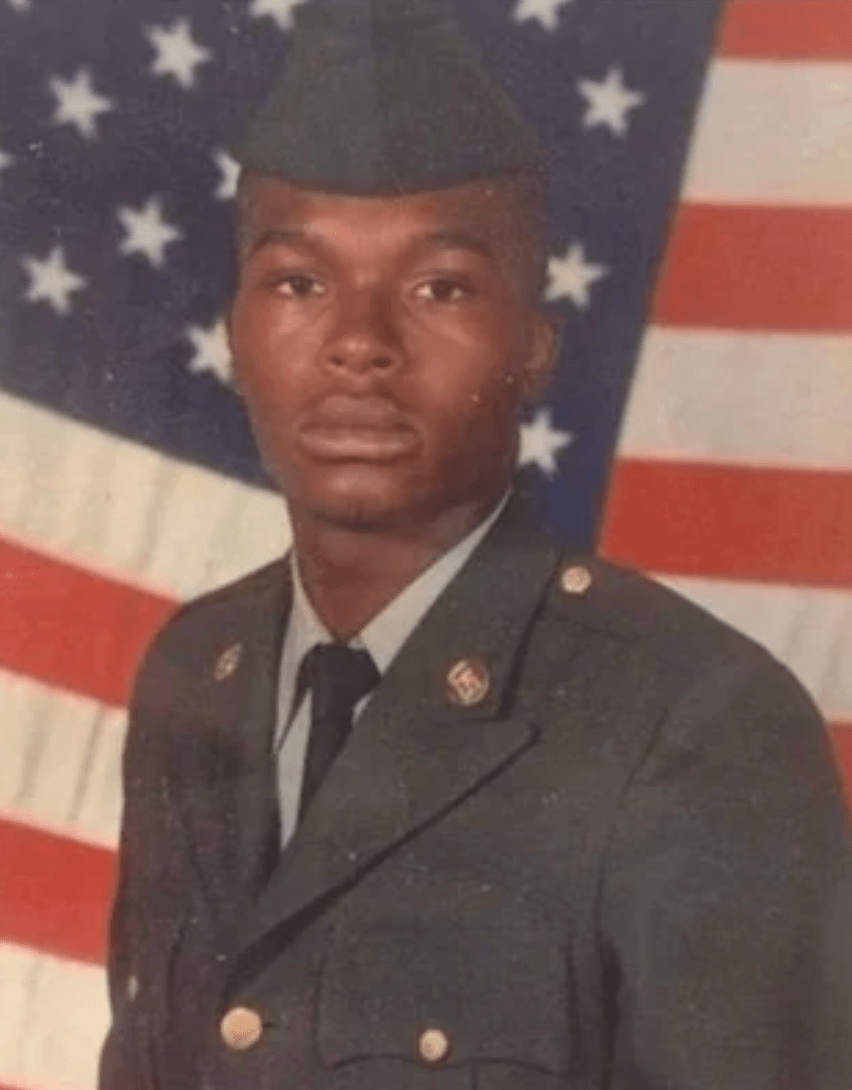
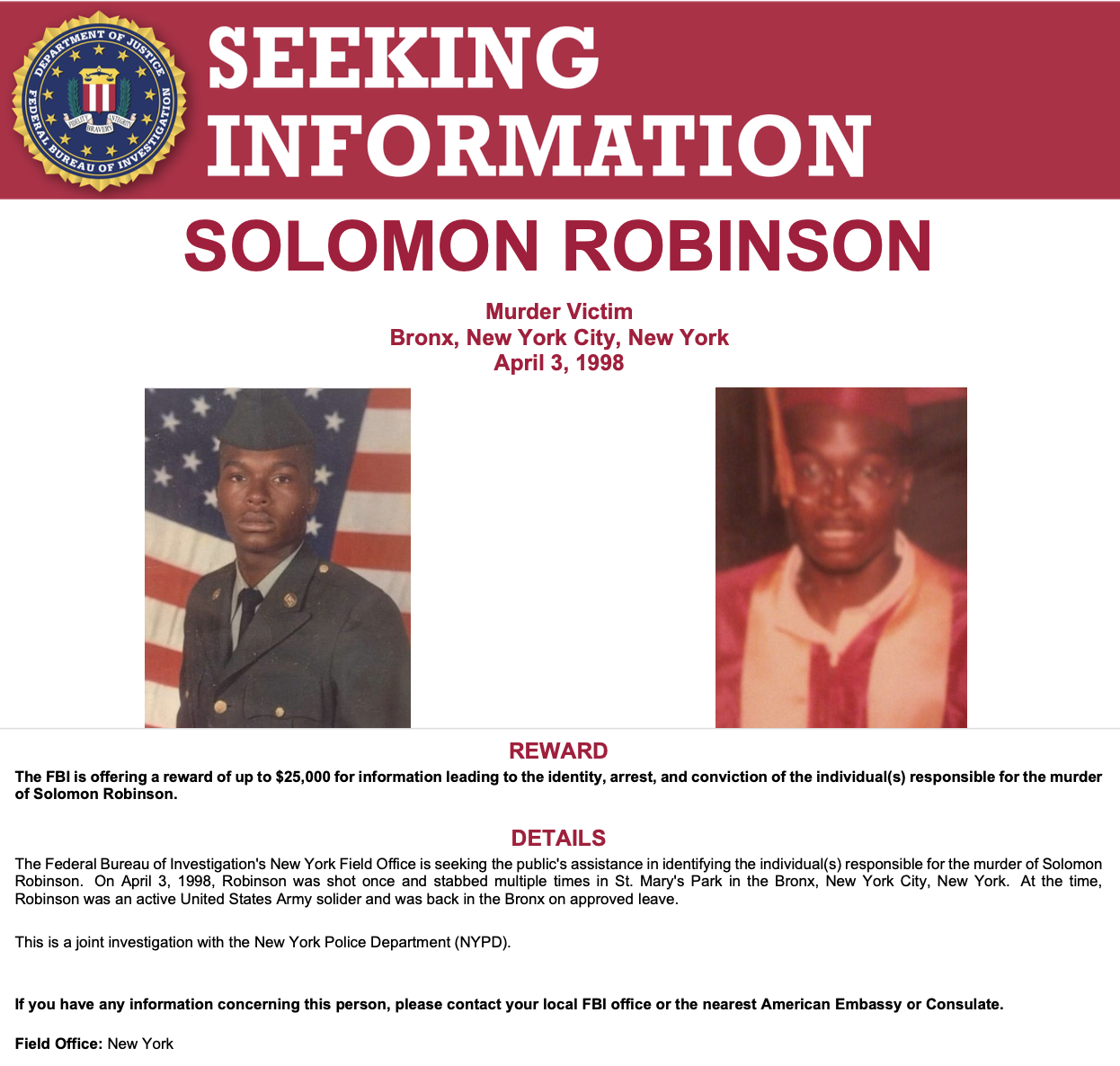
Murder Victim Bronx, New York City, New York April 3, 1998
Reward:
The FBI is offering a reward of up to $25,000 for information leading to the identity, arrest, and conviction of the individual(s) responsible for the murder of Solomon Robinson.
Details:
The Federal Bureau of Investigation’s New York Field Office is seeking the public’s assistance in identifying the individual(s) responsible for the murder of Solomon Robinson.
On April 3, 1998, Robinson was shot once and stabbed multiple times in St. Mary’s Park in the Bronx, New York City, New York. At the time, Robinson was an active United States Army soldier and was back in the Bronx on approved leave.
This is a joint investigation with the New York Police Department (NYPD).
New development brings hope for relatives of 1998 Bronx murder victim | A teenager from the Bronx who was committed to serving in the Army was attacked and killed in a local park 26 years ago. The murder of Solomon Robinson still hasn’t been solved. But now, detectives say they’ve learned new information that has led to a new development in the cold case. | NBC New York
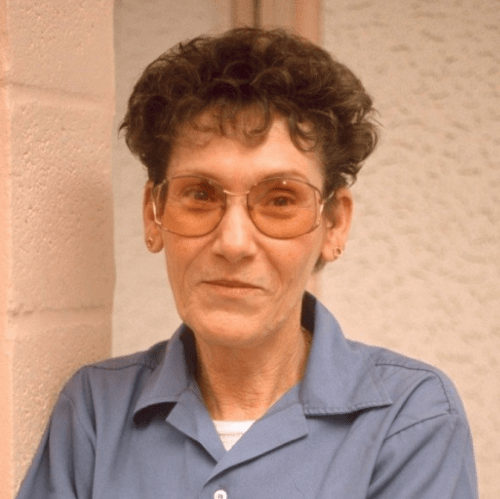
Judy Buenoano was executed by the State of Florida on March 30, 1998.
Air Force Sergeant James Goodyear, 37, died on September 16, 1971 in Orlando, Florida. Sergeant Goodyear died just three months after completing a year long tour of duty in Vietnam. He left behind his wife Judy Buenoano Goodyear and her son Michael Buenoano. Judy received $28,000 in military life insurance benefits and military death benefits to help support the family. When her son Michael turned eighteen, he joined the US Army. On his way to his post in Georgia, he stopped in to visit his mother Judy, she fed him, and afterwards he became ill. The illness led to a crippling condition that left him paralyzed in his lower extremities and he was subsequently discharged from the Army as a Private. Michael was disabled and Judy was taking care of him. On May 13, 1980 Judy took Michael for a canoe ride. Judy reported to local authorities that her canoe capsized and her son Michael had drowned. She collected $125,000 in military life insurance benefits for her son’s death.
In June 1983, Judy was suspected in the car bombing of her fiancé John Gentry of Pensacola, Florida. She stood to gain $500,000 in life insurance money for this death. Judy Buenoano was first convicted of the attempted murder of John Gentry. As a result of her involvement in the attempted murder of John, investigators looked into the ‘accidental deaths’ of her husband James Goodyear and her son Michael. They exhumed John’s body a decade later and an autopsy revealed he had been poisoned with arsenic. Testimony revealed long-term arsenic poisoning had actually caused her son Michael’s disability. And when Judy drowned him, he was wearing an extra 15 pounds of weighted braces. Judy reportedly admitted to being involved in the 1978 death of her boyfriend Bobby Joe Morris as well. She received $50,000 in life insurance benefits for his death. Judy Buenoano was found guilty of first degree murder and sentenced to death. She was executed by the electric chair in Florida on March 30, 1998. Judy Buenoano was motivated by money, profit, and greed.











 MILITARY JUSTICE FOR ALL